Thursday 6th June 2019
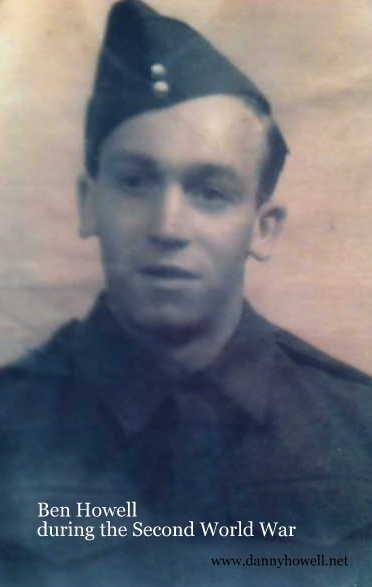
Today is the 75th anniversary of the D-Day landing. My late father, Ben Howell, was one of the many who took part and like many men of his generation he never spoke about the Second World War. Modesty prevented them from mentioning the part they played, and the things they obviously saw they thought better left unsaid. But there was one, and only one occasion, when dad opened up and told me everything about his life, including his army days as a private in the South Lancashire Regiment. I tape-recorded his candid memories, at his home in The Dene, Warminster, on 29th December 1995. In the recording he recalled how after being posted to various parts of England and then to Scotland, he (then aged 21) and his comrades took part in “the invasion”. What follows, is an extract from that tape-recording, recalling how he took part in the D-Day landings:
Ben Howell said ~
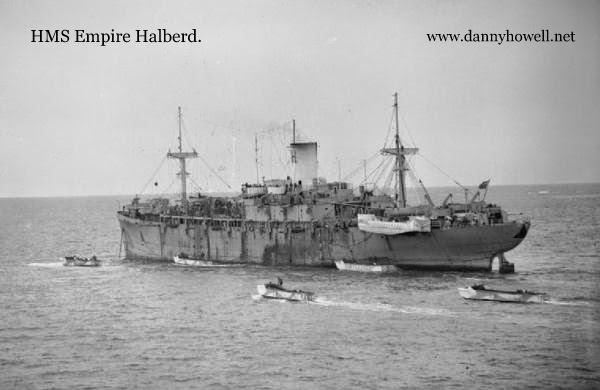
“We went up to Scotland, for like commando training, well, invasion training, for the second front. We went to Carronbridge, a little village, and from there we went up to Inveraray. There’s all the big lochs up there. On the lochs they had big boats. Troop ships. How those ships got there, where they come from, I don’t know but they must have come up through the lochs, Loch Shiel or Loch Fyne. We had to board the ships and sail about on them. We had to come down over the side of the ship on nets into landing craft and then go to the shore. We had to do all that business. That was preparing us for what we had to do in the invasion. The ships were called the Empire Halberd and the Empire Battleaxe. That was two of the ships, the two I trained on.”
“Then we went up to Forres, which is on the other side of Scotland, up Inverness way. And we went to Aviemore. There was nothing there in those days. It was dead as a door nail. Today it’s a busy ski centre. The one thing I remember about Aviemore was that it was cold.”
“We came back down to Cowplain, outside Portsmouth. Cowplain is near Waterlooville. This would have been in April/May time of 1944. Of course this was getting near invasion time. We were in a little wood, in bell tents, packed solid. The whole area around Portsmouth was packed solid with soldiers. Portsmouth used to get bombed but the war had adopted a different pattern. There wasn’t quite so much of the bombing going on. It had been the early 1940s when London, Bristol and Coventry got bombed. I know that when we were allowed out from where our tents were, we used to go across to Waterlooville, about two miles down the road. We would walk down to Waterlooville and get in the pubs there. The pubs opened at six o’clock in the evening but by eight o’clock they had sold all the beer because there were that many troops there. All you could get after eight o’clock was lemonade. We chaps didn’t think that was very clever.”
With regards D-Day, we knew something was going to happen. One of the first things we knew was in camp one morning when the Sergeant-Major came out of his bell tent and he had had all his hair cut off in a crewcut. We chaps started grinning and saying things like “silly bugger” behind his back. “Alright!,” he said, “Yours will be like this soon!” And it was. Off came our hair, all the lot. Then we got told, vaguely, what was going to happen. So then we knew the invasion was imminent.”
“We knew we were going to go on boats across the Channel. We got on the boat one day but the weather delayed things for 24 hours, so we had to get back off the boat. We went the next night. It was dark and I’ve no idea what the name of the boat was that I was on. Hundreds of boats went. It was solid, jam-packed, but we weren’t aware at the time what was going on all around us. We did see pictures, later, after the War. It was dark going across. It was a fairly quiet crossing, considering what we were doing.”
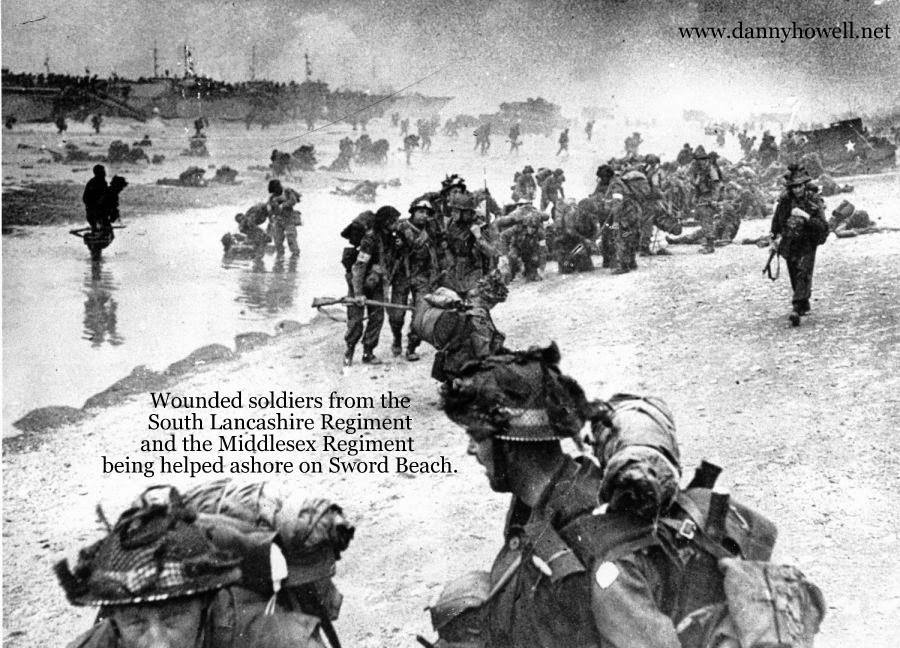
“It was daylight when we got to Sword Beach. We landed at 7 o’clock at Sword Beach. You could see buildings the other side of the beach. We got out of the boat on to a landing craft and headed for the beach. There were blokes in the water everywhere.* We made it to near the shore and came out of the landing craft. The plan was to get in land as soon as possible, take the beach, and make a bridgehead. We had to establish that. We had been briefed to do that. I’ve no idea what we were supposed to do after that. Of course we were only a small cog in the whole thing.”
“The chaps I was with had a fairly clear run on the beach.** There were snipers, German soldiers, in the houses beyond the beach. We discovered a couple of German snipers in one of the slip trenches on the beach. Someone near me slung a couple of grenades into the trench and that was the end of them. A couple of Jerry planes flew over but that was all we saw. The planes just flew over. They never dropped anything where I was. The war had taken a different pattern then. Jerry was more or less on the run.”
“We got up the beach and regrouped. We had a few casualties but luckily I wasn’t touched. One of our chaps was missing. We never saw him again. He came from Shirebrook, near Mansfield. He was a nice chap called Alf Flint. We never saw him again and we never found out what had happened to him.”
“We made our way inland, as best we could. We did get lost but we sorted ourselves out and joined together with the other boys. We moved in, dug slip trenches and occupied our positions. They were all around us, we weren’t just on our own. Where the Canadians and the English had landed at the end of the beach it was all a standstill. We were holding there while the Americans landed at Cherbourg and went round the back. We didn’t move very far but our objective was Caen. I never got as far as that because I was only in France about a month before I was sent back home. A shell had exploded near me and I was suffering from shell shock.”
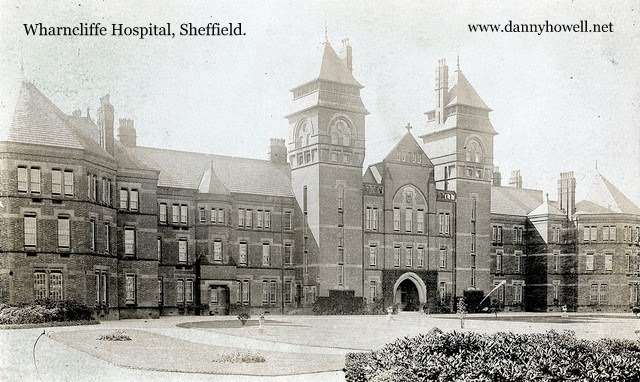
“I returned to England, to Pinderfields Hospital, in Wakefield. Pinderfields Hospital is still going today. From there I went to Wharncliffe Hospital, Sheffield. From there I got moved to a rehabilitation centre in Bedford. I spent several months in hospitals before rejoining my regiment at various postings around England, prior to late 1945, early 1946, when I came to Warminster.”
“Was I scared on D-Day? I don’t mind telling you I was. Of course I was. We were all scared. Anyone who says they wasn’t scared, well, let’s just say, they were!”
Footnotes:
* “The blokes in the water everywhere” were injured and there were also dead men who had been hit by machine-gun fire.
** “A fairly clear run up up the beach.” A typical under-statement from my dad, playing down the seriousness of the situation, the noise and smell of battle.