Blog

New Book: Exit To Boot Hill Locked

Wednesday 4th November 2026

NEW BOOK!

An exciting time at dannyhowell.net

I’m pleased to announce that the fourth title in my Mortal Visible series of books featuring photographs of Warminster taken by myself is now published and available on a first come/first served basis.

The title is Exit To Boot Hill Locked. Published by Bedeguar Books. ISBN 978-1-872818-63-4. The book is hardback, measures 218mm x 218mm approx., and has 100 pages plus illustrated endpapers. It features 124 colour photographs of people, places and things in Warminster, taken between 2012 and 2026. Photographs have succinct captions and there is an index.

Supplied brand new and shrink-wrapped. The price is £20 per book. Free delivery locally (Warminster and surrounding villages). If you live further away I can post (postage and packing will be extra). There are no plans for the book to be available in shops. I will be adding the book to my online shop on this website.

Limited edition. Only available while stocks last. If you would like to purchase a copy or copies, please let me know – DM me or email me: dannyhowellnet@gmail.com If you are new to buying books direct from me then remember to include your address.

And dare I say it, these books make unique Christmas presents for anyone interested in Warminster!

The Medieval Warhorse

Thursday 20th August 2026

Warminster Library & Museum

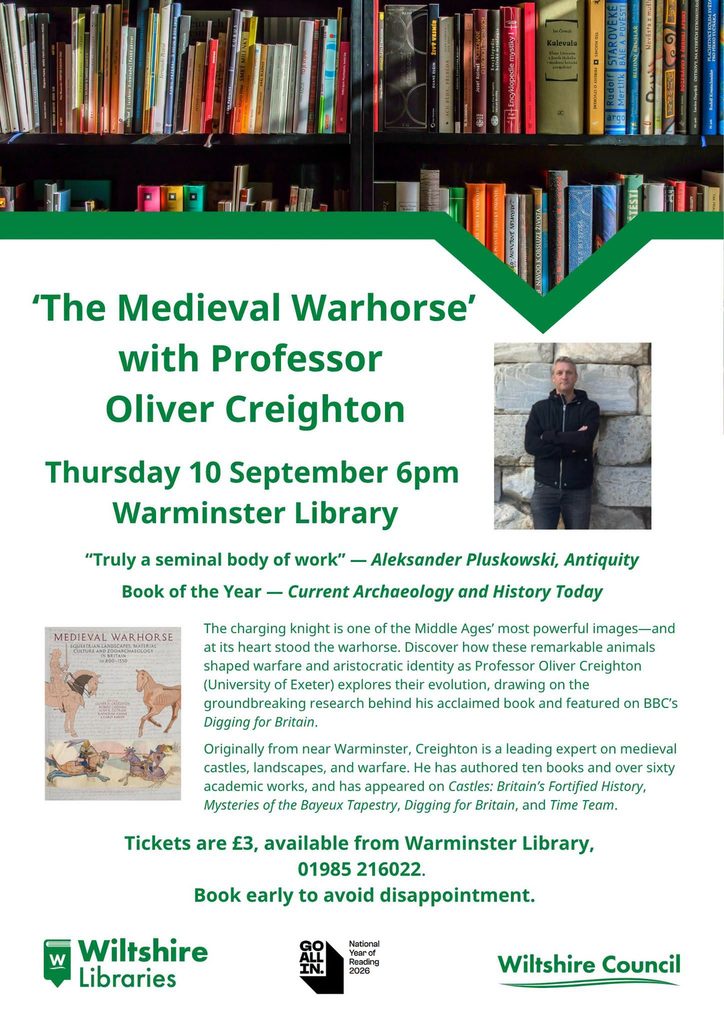
Meet the author: Professor Oliver Creighton

Warminster Library, Thursday 10 September, 6pm

The charging knight is one of the Middle Ages’ most powerful images—and at its heart stood the warhorse. Discover how these remarkable animals shaped warfare and aristocratic identity as Professor Oliver Creighton (University of Exeter) explores their evolution, drawing on the ground-breaking research behind his acclaimed book and featured on BBC’s Digging for Britain.

“Truly a seminal body of work” — Aleksander Pluskowski, Antiquity

Book of the Year — Current Archaeology and History Today

Originally from near Warminster, Creighton is a leading expert on medieval castles, landscapes, and warfare. He has authored ten books and over sixty academic works, and has appeared on Castles: Britain’s Fortified History, Mysteries of the Bayeux Tapestry, Digging for Britain, and Time Team.

Tickets are £3 and available from Warminster Library 01985 216022, book early to avoid disappointment.

To discover more information about this and other National Year of Reading events taking place across Wiltshire Libraries, please visit https://orlo.uk/sxoHA

To go all in and learn more about National Year of Reading 2026, please visit https://orlo.uk/Fc2dD

World Photography Day

Wednesday 19th August 2026

Today, Wednesday 19th August, is World Photography Day. It’s an annual event, and the date remembers the 1839 announcement of the Daguerreotype process. The day highlights how photography captures history, human emotion, and daily life.

With celebrating photography in mind, here’s a press report of something I was doing nearly 37 years ago:

The guest speaker at the December 1989 meeting of Warminster Camera Club was local historian Danny Howell, who presented a two-hour slide show about Warminster’s early photographers.

Using examples of their work, photographers’ marks and advertising, he brought to life many details about the careers of the town’s first photographers.

Thomas Greenslade Targett, based in Warminster from 1855, was the first man in Wiltshire to go into photography as a business. He also sold china and earthenware from his glasshouse studio – the Warminster Photographic Rooms – in front of St. Laurence’s Chapel. In June 1861 he crossed the street to rooms above what is now Gibson’s, chemists, and in 1863 he sold his business to James Grant.

Grant transferred the business to Silver Street and re-named it the Obelisk Photographic Rooms, using a depiction of an Obelisk as his trademark on the back of his photographs. A native of Warminster, he was also in business as a tiler and plasterer and, between 1872 and 1878, was the landlord of the New Inn – premises now used by Obelisk Antiques – in Silver Street.

After passing through the hands of Charles John Witcomb and son, a Salisbury firm which ran the Warminster shop as a sub-branch, the Silver Street business was bought in the 1890s by William S. Keddie who renamed it the Royal Studio.

There were by then two other photographers in Warminster. Frederick Futcher was operating from 36 High Street and John Smith was based at 96 Pound Street. Between 1867 and 1885, Smith had been based at 27 East Street. Among Smith’s surviving work is a set of seven views, all taken in 1875, of the Market Place, East Street, Weymouth Street, Christ Church, Lower Marsh, Bishopstrow and Shearwater.

Sam Burgess had a small shop at 4 Brook Street, from before the turn of the century to about 1922. As well as selling sweets, groceries, cigarettes and paraffin, he was a photographer, with a studio in a shed at the top of his garden. Rumour had it that, after a row, he didn’t speak to his wife for a month. She resolved the situation by lighting a candle and following him about in broad daylight. After a while he asked her what she was doing. She replied “It’s alright, I’ve found it now. I thought you had lost your tongue!”

Herbert Frank Joyce ran the Premier Studio at Silver Street from the late 1890s. Although he called himself “the children’s photographer’ he also photographed many local events. Soon after the First World War he moved to Eversfield House at 52 Market Place, now Gateway Supermarket, calling his new premises Eversfield Studio, and continuing as a photographer until the early 1940s.

Targett’s old studio, above what is now Gibson’s, was taken over by Henry Ernest Till, who had already opened a successful business at Westbury. Born at Warwick in 1877, he had been educated in London before becoming apprenticed to a Chippenham photographer, John Singer, then setting up business in Colchester and Brightlingsea. One of Mr. Till’s regular commissions was to photograph the cast of the Warminster Operatic Society productions during the 1920s and 1930s.

Mr. Howell concluded his slide-show by saying how much the work of the early photographers had helped him with his researches into local history. He noted, however, that a lot of photographs were undated and without details, which was a pity. He hoped the members of Warminster Camera Club would continue to take photographs of Warminster scenes, events and people, which would be of use to historians in future years.

_________

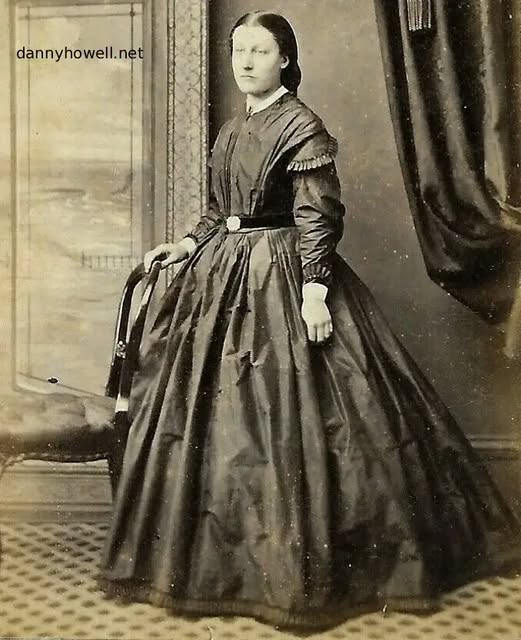
Attached is a CDV photo from my Warminster collection. It shows a lady, whose name has long since been forgotten, photographed by James Grant in his studio at Silver Street, Warminster, during the late 1860s. Note the painted backdrop of an open window with a view of the sea.
The Origin Of The Name Copheap

Sunday 21st June 2026

For everyone who loves Copheap.

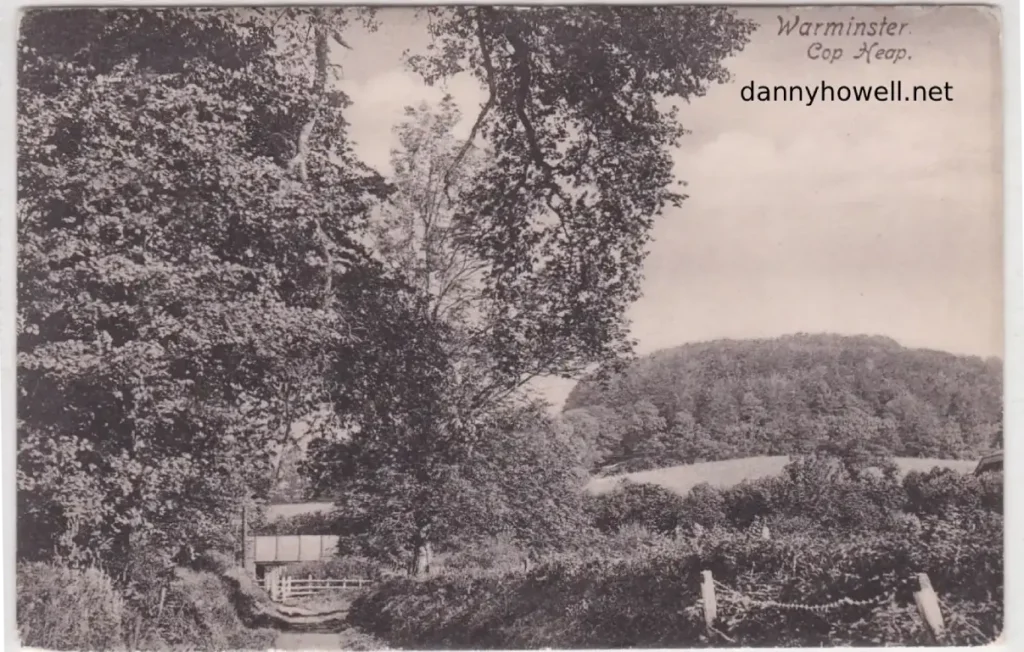
A view north from The Avenue, Warminster, up the little lane towards the railway bridge immediately west of Warminster Railway Station. Copheap in the background on the right. As depicted on a postcard by Lucas Bros, circa 1915.

Although the little lane survives, the areas each side of it have certainly changed since the photo was taken. The Avenue School now occupies the area off of the left of the pic. The railway bridge is still there, of course, giving road access under the bridge to what is now the Railway Station Car Park. But the view to Copheap, in the distance on the right, is now obscured by the apartment blocks of Homeminster House.

But this is not really a post about changes in Warminster. This morning a lady contacted me wanting to know the origin of the name Copheap. I have replied to her. But as it was such a good question, I thought I would share my answer with followers of https://dannyhowell.net/

Copheap has also been shown as Cop Head and Cop Head Hill on old maps.

The word ‘cop’ (sometimes spelt copp in days long gone by) is an Old English word for a hill, peak, crest, head, mound or summit.

So cop is simply a noun from hundreds of years ago meaning “hill”.

Head is also another old way of referring to a hill.

But ‘heap’ is often an old reference to a cairn. As you will know, a cairn is a pile of stones placed by people as a boundary marker or some other marker or where there is an ancient burial.

Of course, Copheap has a Bronze Age burial mound at its summit.

Not sure how often the word ‘cop’ appears in English place names but there is a village on the Cheshire/Staffordshire border called Mow Cop which is on top of a very steep hill with far reaching views for miles around. So again, cop meaning a hill. You may like to know that the word “mow” as in that village name comes from the Old English word ‘muga’ which is an old word for “a heap”.

Hopefully you can decipher something out of what I’ve just typed. Maybe we can conclude “A hill with a cairn” for Copheap.

error: Content is protected !!