Wednesday 19th August 2026
Today, Wednesday 19th August, is World Photography Day. It’s an annual event, and the date remembers the 1839 announcement of the Daguerreotype process. The day highlights how photography captures history, human emotion, and daily life.
With celebrating photography in mind, here’s a press report of something I was doing nearly 37 years ago:
The guest speaker at the December 1989 meeting of Warminster Camera Club was local historian Danny Howell, who presented a two-hour slide show about Warminster’s early photographers.
Using examples of their work, photographers’ marks and advertising, he brought to life many details about the careers of the town’s first photographers.
Thomas Greenslade Targett, based in Warminster from 1855, was the first man in Wiltshire to go into photography as a business. He also sold china and earthenware from his glasshouse studio – the Warminster Photographic Rooms – in front of St. Laurence’s Chapel. In June 1861 he crossed the street to rooms above what is now Gibson’s, chemists, and in 1863 he sold his business to James Grant.
Grant transferred the business to Silver Street and re-named it the Obelisk Photographic Rooms, using a depiction of an Obelisk as his trademark on the back of his photographs. A native of Warminster, he was also in business as a tiler and plasterer and, between 1872 and 1878, was the landlord of the New Inn – premises now used by Obelisk Antiques – in Silver Street.
After passing through the hands of Charles John Witcomb and son, a Salisbury firm which ran the Warminster shop as a sub-branch, the Silver Street business was bought in the 1890s by William S. Keddie who renamed it the Royal Studio.
There were by then two other photographers in Warminster. Frederick Futcher was operating from 36 High Street and John Smith was based at 96 Pound Street. Between 1867 and 1885, Smith had been based at 27 East Street. Among Smith’s surviving work is a set of seven views, all taken in 1875, of the Market Place, East Street, Weymouth Street, Christ Church, Lower Marsh, Bishopstrow and Shearwater.
Sam Burgess had a small shop at 4 Brook Street, from before the turn of the century to about 1922. As well as selling sweets, groceries, cigarettes and paraffin, he was a photographer, with a studio in a shed at the top of his garden. Rumour had it that, after a row, he didn’t speak to his wife for a month. She resolved the situation by lighting a candle and following him about in broad daylight. After a while he asked her what she was doing. She replied “It’s alright, I’ve found it now. I thought you had lost your tongue!”
Herbert Frank Joyce ran the Premier Studio at Silver Street from the late 1890s. Although he called himself “the children’s photographer’ he also photographed many local events. Soon after the First World War he moved to Eversfield House at 52 Market Place, now Gateway Supermarket, calling his new premises Eversfield Studio, and continuing as a photographer until the early 1940s.
Targett’s old studio, above what is now Gibson’s, was taken over by Henry Ernest Till, who had already opened a successful business at Westbury. Born at Warwick in 1877, he had been educated in London before becoming apprenticed to a Chippenham photographer, John Singer, then setting up business in Colchester and Brightlingsea. One of Mr. Till’s regular commissions was to photograph the cast of the Warminster Operatic Society productions during the 1920s and 1930s.
Mr. Howell concluded his slide-show by saying how much the work of the early photographers had helped him with his researches into local history. He noted, however, that a lot of photographs were undated and without details, which was a pity. He hoped the members of Warminster Camera Club would continue to take photographs of Warminster scenes, events and people, which would be of use to historians in future years.
_________
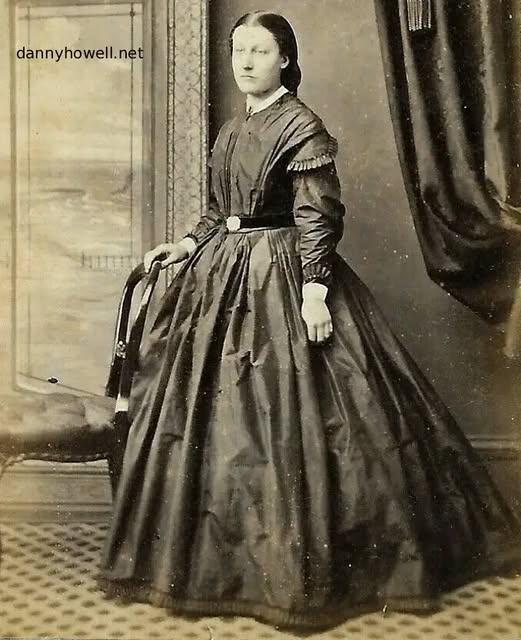
Attached is a CDV photo from my Warminster collection. It shows a lady, whose name has long since been forgotten, photographed by James Grant in his studio at Silver Street, Warminster, during the late 1860s. Note the painted backdrop of an open window with a view of the sea.