Chalk And Cheese

Tuesday 24th February 2026

I paid £3 for a book that is at least 125 years old, at the British Red Cross charity shop, Three Horseshoes Walk, Warminster, this morning.

Titled Our Own Country, Descriptive, Historical, Pictorial, it is one of a six-volume set of books published by Cassell, Petter, Galpin & Co., during the 1880s and 1890s. The writers of the illustrated articles in these books are not credited.

The volume I have acquired begins with an article about Salisbury Plain and Stonehenge. The first sentence of this article reads: “It is not unfitting that a book in which it is proposed to describe the most interesting and important sites of Great Britain should, in its opening pages, deal with Salisbury Plain.”

Here is an extract from the article, referring to the landscape of Salisbury Plain:

A century ago there was little touch of cultivation about Salisbury Plain. Sheep in the summer, and flock of bustards in the winter, were, in Drayton’s words, the “burgesses of the heath;” and a journey across it, even in fine weather, was not undertaken without some risk of losing the way.*

This condition of things has entirely changed. Good and broadly-marked roads traverse the plain in all directions, whilst corn-fields and tilled land have greatly encroached on it, stealing upwards from the surrounding valleys. But the general outline of Salisbury Plain is still sufficiently marked. It is the southern division of the two great divisions of the chalk in Wiltshire.

The northern division forms what is known as the Marlborough Downs, and its escarpments are far bolder than those of Salisbury Plain, from which it is divided by the Vale of Pewsey, which extends across the centre of the county, and is scooped out of the upper-greensand.

The southern chalk district extends from Salisbury in a line bearing north-east, by Amesbury and Sidbury to Easton Hill, where there is a wide view of the Pewsey valley, with the opposite heights of Marlborough, scarred by the Wansdyke. Thence the chalk ranges westward, with a little inclination to the south, as far as Westbury and Warminster; and so returns, in a line bearing south-east, by Heytesbury to Salisbury. All along this border the bolder heights are marked by intrenchments – Battlesbury, Scratchbury, Chisenbury – which overlook the richer country, and served as watch-towers for the ancient people of the plain.

In shape, this plain is an irregular triangle, whilst the length of each side may be roughly estimated at about twenty miles. Of its general character we shall better judge in passing over it toward Stonehenge. The chalk mass of the plain is pierced by the Bourne brook, by the Wily [Wylye], the Nadder, and the southern Avon, all of which meet in the neighbourhood of Salisbury. These river-valleys, in their quiet beauty, their hamlets nestled among trees, their venerable mansions, their broad meadows, through which the stream flows onward between tufts of purple loose-strife and great masses of sword-flag, contrast pleasantly with the open heights of the downs.

It is held, however, that the influence of the chalk is felt throughout Southern Wiltshire, and that the sharp division of the county is between the chalk district generally and that north of the Marlborough Downs, where the land for the most part lies on Oxford clay. Wiltshire is thus divided between “chalk” and “cheese” – for the northern district is a great dairy ground.

*Thus Mr. Pepys and his party, journeying from Salisbury toward Somersetshire, lost their way on the plain, and were obliged to spend the night in a strange town [Chitterne].
Codford St. Mary Mentioned In Upstairs Downstairs

Friday 20th February 2026

They’ve been repeating the television series Upstairs Downstairs on television. The series was made in the 1970s and portrays the lives of the Bellamy family and their servants.

One of the episodes I saw recently was The Beastly Hun (Series 4, Episode 3). Written by Jeremy Paul, it is set in May 1915, and in London there is much anti-German feeling and talk of spies.

Edward Barnes, the footman, has enlisted and is away serving in the army.

In one scene, his wife Daisy (played by Jacqueline Tong) goes to a local bakery to buy bread from Albert Schoenfeld (played by Gertan Klauber).

As Daisy goes to leave the shop, Mr. Schoenfeld asks her: “How is Edward getting on?” Daisy, having reached the door of the shop, replies: “Oh, alright. I get nice cheerful letters.” Mr. Schoenfield says: “From the Front, eh?” Daisy answers: “No, Codford St. Mary, his camp on Salisbury Plain.” Mr. Schoenfeld remarks: “Tell him to stay there.” Daisy responds: “I will. Bye!”

Cryptic Crosswords And Philosophical Writing

Saturday 10th January 2026

I chatted with a lady, in her eighties, at the bus shelter on the northern side of the Market Place, Warminster, this morning. She told me she lives on her own. I asked how she kept herself busy. She said she didn’t watch much television, especially in the evenings, as it was “a load of tripe.” She said she kept her mind active by doing crosswords, cryptic ones, although she said she doesn’t always complete them. She said she also writes philosophical things but not for anyone else to read. She said she writes them as a release and then later she burns them.

Love Lapwings In Flight

Friday 2nd January 2026

I saw a big flock (or should that be a deceit) of lapwings at Bishopstrow Farm late afternoon today. I loved watching them in their erratic bouts of flight over Bridge Park, Dairy Field and the Gully Field, turning and tumbling, their white parts glinting in the winter sunshine. A wonderful sight.

An Egret, Two Herons And Two Swans

Tuesday 26th November 2025

As I walked from Bishopstrow to Boreham during the early part of this afternoon I saw a white egret flying over the course of the River Wylye at Hounds Mead.

Later that afternoon when I called in at Bishopstrow Mill to see Paul and Julia Gibson, Julia told me how that morning she had been for coffee with Hannah Anderson at Waterways, Watery Lane, Bishopstrow, and on the water by Waterways were an egret (probably the same one), two herons and two swans.

Commit Random Acts Of Kindness

Tuesday 28th October 2025

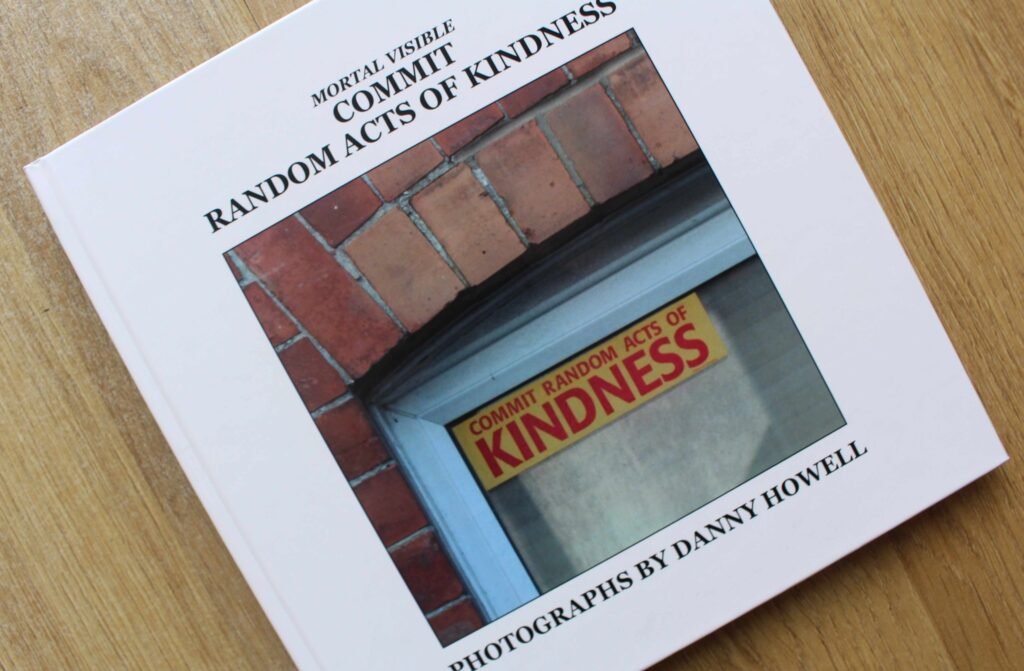
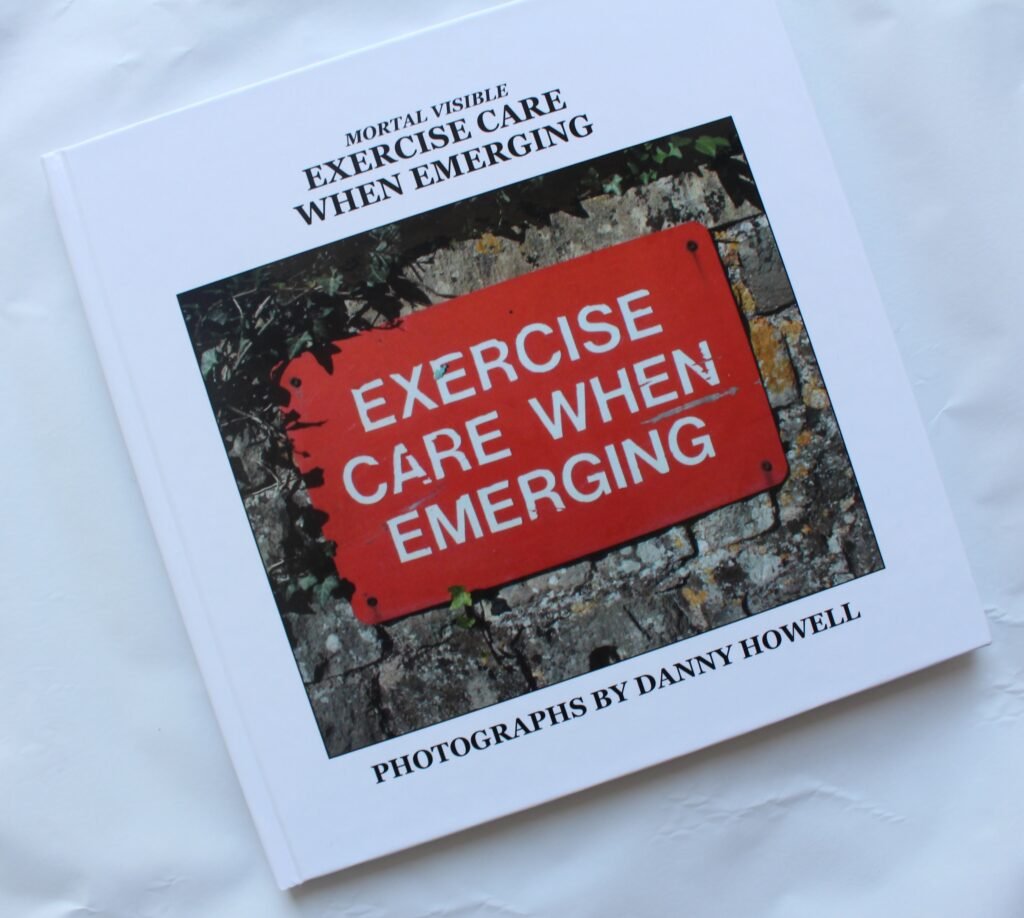
New book. I’m pleased to say that the second book in my Mortal Visible series of books featuring photographs of Warminster taken by myself is now available. The title is Commit Random Acts Of Kindness. Published by Bedeguar Books. ISBN 978-1-872818-61-0. The book is hardback, measures 218mm x 218mm approx., and has 100 pages plus illustrated endpapers. It features 112 colour photographs of people, places and things in Warminster, taken between 2009 and 2025. Photographs have succinct captions and there is an index. Supplied brand new and shrink-wrapped.

The price is £20 per book. Free delivery locally (Warminster and surrounding villages). If you live further away I can post (postage and packing will be extra). The book will not be available in shops. Limited edition. (The first book in the series is nearly sold out and is already a collector’s item). Only available while stocks last – first come, first served. If you would like to purchase a copy, please let me know – DM me on my Facebook page or email me: dannyhowellnet@gmail.com If you are new to buying books direct from me then remember to include your address. And dare I say it, these books make unique Christmas presents for anyone interested in Warminster!

Have The Box Bushes In Battlesbury Wood Succumbed To Blight?

Monday 6th October 2025

When I was a small boy in the early 1960s a favourite place to go playing was the wood on the south-facing front of Battlesbury Hill. Back then, it was mainly a deciduous woodland as I remember with beeches, chestnuts, and sycamores, and the odd yew tree – until it was cleared by the War Department, about 1965, and replanted as the more evergreen wood we know it as today.

My friends and I, who all lived at The Dene, would “go up the lane” and over Morgan’s Drove railway bridge and spend practically all day during the school holidays exploring and running about on Battlesbury Hill and messing about in Battlesbury Wood. We would take a bottle of homemade lemonade (made from lemonade crystals soaked in tap water). And mother would let us take some bread and jam with us. We kept track of the time by counting the trains that passed by below, listening out for the REME hooter, and keeping our eye on how low the sun was going down over Cley Hill way,

Battlesbury Wood was an idyllic place to our young minds. I remember at the western end of the wood was a little shed. Sometimes there was a man at the shed – he must have been a keeper or something for Tom Bazley who farmed Boreham Farm. The fields of Boreham Farm stretched as far as Battlesbury and beyond to Sack Hill where there was a thatched field-barn. The man seemed old to us children (mind you, a lot of adults looked old in those days even though they were middle-aged) but he was kind and friendly. Sometimes he would take us boys through the wood, showing us butterflies and fungi and anything else from the world of nature, telling us interesting things about what we saw. It was all very pleasant and part of our fun, but I guess today someone doing something like that would be mistakenly labelled a paedophile risk. How attitudes have changed?

Of course, there are still a lot of beech trees in Battlesbury Wood and box bushes too – the box bushes vividly remind me of my childhood. Back in the early 1960s us boys would look in the box bushes for linnets’ nests. From about the last fortnight of April onwards just about every box bush in the lower part of Battlesbury Wood would have a linnet’s nest. I can “see” those nests now – the archetypal cup shape nest of little birds like finches, built with tiny twigs and the leaves of plants, lined with feathers. Each nest would have four or five eggs. Those eggs were light blue with purple or reddish-brown dots. Of course, being so pretty, they were very desirable to boys who collected birds’ eggs. Those boys would make a little hole in each end of the egg and blow the contents out so they could add it to their collection. I was never one for that. I could never take a bird’s egg. I have loved nature and animals and birds all my life. And, I can hear my mother now telling me (one of the many old wives’ tales she and her contemporaries would often say) that if we took a bird’s egg we would get a crooked finger and everyone would then know what a horrible thing we had done.

Sadly, I don’t think I could find a linnet’s nest in a box bush in Battlesbury Wood now. Probably more difficult to see a linnet, at all, these days. I think I’m right in saying that linnets are on the red list of UK conservation groups now, their numbers having fallen dramatically.

Yesterday afternoon I went into Battlesbury Wood (it’s the time of year for looking for fungi) and I immediately noticed a difference. The lower parts of every box bush have turned grey and brown, the leaves are brittle and there are bare patches. They shouldn’t be like that; they are evergreens. They have obviously succumbed to box blight – a fungal disease that thrives in dry and warm conditions.

I can’t imagine Battlesbury Wood without its box bushes. I reckon they might have been planted by the Temple family, the Lords of the Manor of Boreham, whose land included Battlesbury. Back in the day, box was much admired as an addition to managed woodland and also in gardens where the fact it can be trimmed without adverse consequences made it ideal for little hedges in garden features.

I attach a photo I took yesterday (Sunday 5th October 2025) showing the change in the greenery in Battlesbury Wood. I wonder if anyone (Ministry Of Defence, DIO, Ecologists, Conservation Officers) will do anything to try and remedy the problem?

I posted my notes and photo on my Facebook page and gained 116 likes and 13 comments including:

Liz Duggan
It might not be box blight as this tends to affect plants that have been regularly pruned and are very dense – those plants look like they have plenty of air flow around them. However, it could be the box tree moth caterpillar.

Nick P B Dombkowski
Battlesbury Wood was always my go-to place. I still occasionally go and risk the rope swing. Mind you both box in our front garden are virtually dead. I put it down to the extremely dry spell that we had over the summer months.

Julian Stafford-Wood
Lovely to read, thank you. A lot of boxes have been damaged this year from the box tree moth, essentially an invasive species

Carol Colderick
This brings back so many happy memories . I used to live in Queensway, and just like you spent so many hours playing here with friends. I remember all the violets and primroses in the woods and cowslips on the hills.

Norma Braine
Although I was brought up in Devon so much of this post resonates with me. My playground was the cliff paths and headlands around Torbay.

Bob Davis
I used to spend a lot of time up there and in the woods by Boreham Farm. Remember sliding down the slope on the western end during the winter of 1966.

Jim Finnigan
Watched some awesome firepower demonstrations on top of that hill. A-10’s baaaaaarp!!!

Gordon Davies
You had the best of that woodland, Danny, with the old trees, shame on the WD.

Jezzie Moon
It’s so sad that children don’t learn about the countryside so much anymore x love your stories. Thank you.

Monica Farey
Great memories, the box may well grow back, mine have.

Laurie Anne Collins
I love reading your memories, thank you x.

Fascinating Piece Of Local History!

Saturday 4th October 2025

If you are walking up the Boot Hill part of Deverill Road, Warminster, soon after you pass the Fox & Hounds public house, you may notice what appears to be the bricked-up arch of a doorway in the wall alongside the pavement. I took the attached photo only a couple of days ago, on Thursday 2nd October 2025.

This doorway once gave access to a beer cellar used by the landlords of the Fox & Hounds in days long gone by. And at one period Frank Moody, who had various businesses at Fore Street during the 1920s, including a bicycle shop, a furniture store, and also a pig-slaughtering house and a bacon factory there; he used this cellar at Boot Hill as a curing place and as additional storage for cured bacon. Frank Moody died in 1930.

This cellar also had military use during the Second World War, not with the regular army but with the town’s Home Guard. The land above it provided vegetable garden ground for the residents of Christ Church Terrace.

What I’m going to repeat next is going to sound very “Dad’s Army”.

On 19th March 1986 I tape-recorded the memories of Percy Vincent, and published them in my book Remember Warminster Volume Three. Among his wealth of recollections, Percy recalled:

“During the War I was in the Home Guard . . . We were in different sections. My section was operating by Christ Church. We took a piece of the churchyard wall at Christ Church out, opposite the Fox And Hounds pub. We took the top off the wall and dug in a bit, a hole, so that we could get in. That was our strong point against anybody coming up Boot Hill. They had to come round the corner and our fire-point lay there.”

“Opposite that was a couple of old-fashioned doors laid in the wall, where Moody’s bacon factory had some cellars, where they put the bacon. That was cold storage before fridges came about. We had a flame-thrower in there. It was just before you get to the Fox And Hounds pub, on the right. There was a wall and halfway down that wall were two wooden doors and that was the cellar belonging to Moody’s, the bacon factory people. We commanded that cellar and we put our flame-thrower in there. That was our point at Christ Church.”

Fortunately we have more written recollections concerning the cellar at Boot Hill.

Wilfred Middlebrook, who lived at Christ Church Terrace, during the war years, wrote a newspaper serialisation in 1971 which he called The Changing Face Of Warminster. In it he wrote the following notes about the cellar. He noted:

“An underground cave. The Fox And Hounds still retains its private malthouse at the rear, unused for many years. An adjacent ‘cave’ under the gardens, was once used for curing bacon; the smoke emerging from a small chimney protruding from one of the Christ Church Terrace gardens above. This cellar was used by the Home Guard during the last War as a magazine for their ammunition and explosives, complete with a sandbagged defence post in the gardens that roofed the cellar, and a matching strongpoint in the Christ Church cemetery across the road.”

“In August 1941 the newly-formed Home Guard staged an anti-invasion exercise in Deverill Road, manning the defence posts they had dug and sandbagged at the bottom of my garden in Christ Church Terrace, and the cemetery post across the road. Thunder-flashes were lobbed about the place, blowing the tops off my carrots, but the ‘enemy’ happened to win this particular round. An ‘enemy’ agent, dressed as a nun, gained entrance into my house at the point of a gun concealed within his/her flowing robes. After hiding in the front bedroom and biding his time, he finally threw open the window and bombed the lot! A few days after the Home Guard had stocked their magazine – the old Fox And Hounds beer cellar under my front garden – with explosives. My neighbour was discussing our crops. ‘Are your potatoes coming up yet?’ he asked. ‘Not yet,’ I replied, ‘but they soon will be if anything goes wrong down below!'”

I posted the photo and my notes above on my dannyhowellnet Warminster and District Facebook page and it gained 228 likes, 19 shares and 39 comments including:

Tina Randall
This is really interesting, I’ve seen the arches often and the flat area on Christ Church Terrace but it’s good to know the history.

Angie Howarth
Oh wow – so when can we open it up and start curing bacon again? Amazing history, thank you.

Vicki Towers
I always wondered what the bricked up doorways were.

Sarah Muir
Even as I child walking up to attend Sambourne School in the late 70’s I wondered what those arches were for.

Kenny Biffo Byfield
There was also a gun emplacement opposite cut out of the church wall which was manned to observe any enemy movements coming up from the Deverill Road.

Robert Lewis
Is the same Percy Vincent that had a milk round in later years? . . . . so much information that I didn’t know . . . . thank you so much Danny.

Kenny Biffo Byfield
Robert Lewis no that’s a different Vincent, Robert.

Robert Lewis
Thank you Kenny.

George Dwight
How did they NOT suspect a nun during an anti-invasion exercise! ?

Ian Gruncell
I’ve often wondered about that.

Norma Braine
A great read. I don’t know Warminster well but live in Wiltshire. I can imagine the ‘Dad’s Army’ scenario . . . . what a laugh that episode would have been! Thanks for sharing a bit of localish history and a good laugh!

Linda Stafford
We always thought it was a tunnel to somewhere, don’t think we ‘knew’ where!

Dibbley Wood
Should open them up . . . Go exploring . . . And teach the kids of today.

Gordon Davies
Dad’s Army, I think, was good for morale, made men who could not join up to do real fighting, something to do and might be useful if the Germans did invade. Just goes to show what is hidden around an old town.

Eileen Goring-Smith
I walk past here regularly so will take better notice in future.

Sheila Oaten
Fascinating piece of local history!

Tom Biss
Interesting.

Beverley McSparron
Very interesting thank you for sharing.

Sandra Major
Lovely part of history and knew Percy Vincent very well.

Joyce Snelling

Sandra Major
Is that the same Percy Vincent who was manager at Dents glove factory?

Nikki Spreadbury-Clews
Very interesting, thank you.

Bob Payne
Thank you for the history, that was wonderful.

Kenny Biffo Byfield
Bob Payne I can remember going inside that room as a lad when I lived in Upper Marsh Road, Bob. 

Bob Payne
Kenny Biffo Byfield I was too afraid to go in there, Ken.

Jezzie Moon
Thank you for all your historical information Danny.

Clare Blandford
Amazing look back in time ! Thanks for sharing.

Margaret Aiken
Thank you for sharing this information! So interesting.

Christopher Knight
Great piece of Warminster history.

Clive Moulder
Frank moody was I believe my ex-wifes grandfather.

Kenny Biffo Byfield
Leonard Crouton I knew all this from my dad and other men who were in the Home Guard during the war.

A Song Or Two . . . A Year Or Two

Friday 3rd October 2025

Here at dannyhowell.net we not only research and write and take photos about Warminster and the surrounding area, as well as collecting images and ephemera, we are also musos and enjoy gathering items with local music connections.

Among the audio archive we have a promo CD by Richard and Tim Steer called A Song Or Two . . . A Year Or Two. It was released by 4Real Records (www.realrecords.com), catalogue number syn2001CDS. Published by Joustwise Ltd/Peer Music, there are 13 tracks, all written by Richard Steer, who also did the cover illustration.

Richard and Tim provided the vocals and guitars; Ben Steer played accordion, and Peter Lamb was on electric bass. The violin was played by Mike Evans. Clare Lindley played violin on the song Imber Range.

I’m sure there are others who like me find that a lot of albums contain one or two great tracks you want to play over and over again, and the rest are skipped through. But, for me, this is not the case with A Song Or Two . . . A Year Or Two. All the tracks are very listenable and the skip button is not required.

I do have a favourite track though – it’s called Cannimore Sand. It has a haunting tune and lyrics about a singing thrush, firs and tree tops, and treading the sandy soil into the floorboards and the carpet when you get home.

“Cannimore’s not just a wood, It’s a living animal, There’s mud up to your knees when the stream’s in full flow; She’ll weave a spell around you with the frost on the wet strands . . . “

If you love walking in Cannimore Woods, enjoying the nature and breathing in the pine-filled air, then I guess you will relate to Richard’s heart-felt lyrics

I would imagine most of you will have seen the talented Steer family performing locally. I usually catch them at Bishopstrow Fete. They were there again last year and I got the opportunity to personally tell them how much I enjoy A Song Or Two . . . A Year Or Two.

Mystery Photograph

Saturday 20th September 2025

Mystery photograph.

As well as taking photographs myself of Warminster and the surrounding area, I also purchase old photos from a variety of sources including online and flea markets. I’m fortunate too that many kind people give me old photographs and documents. Identifying scenes and people in old photographs isn’t always easy but sometimes there are clues.

The photograph shared here is 142 years old. It is an original photograph, measures six inches by four inches and is mounted on card. It came in a frame but the frame is more modern. It shows a house with two men standing outside. The man on the left is wearing what looks like a bowler hat; he is wearing a waistcoat under his jacket, and his watch chain is visible. The other man is also wearing a hat, is dressed in shirt and tie, and has a dog with him. On the back was handwritten: “Holly Lodge, Warminster. 18.8.83. Dog Toby. George, he was the horseman.” The 83 date refers to 1883.

The question is: where is this house? We know there is a Holly Lodge at Boreham Road, Warminster, but that’s an old toll house with a distinctive style. The Holly Lodge in this photograph is somewhere else. Behind the house can be seen a large field stretching away to a distant hedgerow. Of course, Warminster, in 1883 wasn’t very built up, there were plenty of fields around the town centre. The reference to a horseman suggests that George’s employer was maybe a gentleman with a horse and carriage. The address Holly Lodge, Warminster, could mean it was actually in Warminster, maybe on the outskirts or a rural part, or perhaps it means it is near Warminster.

I have yet to solve the location of the house in this photograph. Do you recognise it? Where is it?

error: Content is protected !!