Sunday 21st June 2026
For everyone who loves Copheap.
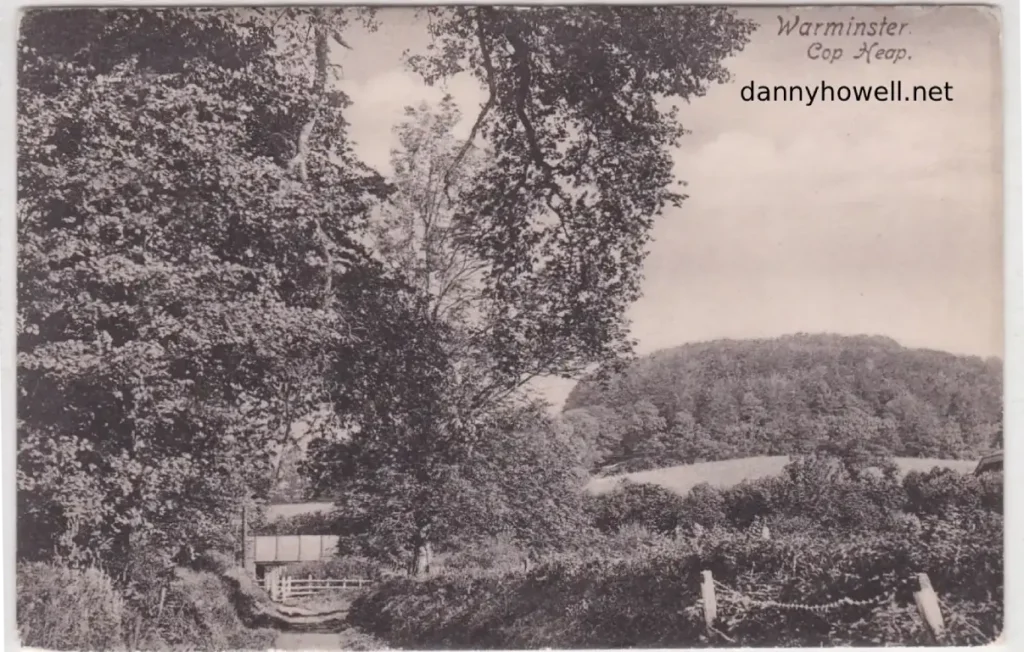
A view north from The Avenue, Warminster, up the little lane towards the railway bridge immediately west of Warminster Railway Station. Copheap in the background on the right. As depicted on a postcard by Lucas Bros, circa 1915.
Although the little lane survives, the areas each side of it have certainly changed since the photo was taken. The Avenue School now occupies the area off of the left of the pic. The railway bridge is still there, of course, giving road access under the bridge to what is now the Railway Station Car Park. But the view to Copheap, in the distance on the right, is now obscured by the apartment blocks of Homeminster House.
But this is not really a post about changes in Warminster. This morning a lady contacted me wanting to know the origin of the name Copheap. I have replied to her. But as it was such a good question, I thought I would share my answer with followers of https://dannyhowell.net/
Copheap has also been shown as Cop Head and Cop Head Hill on old maps.
The word ‘cop’ (sometimes spelt copp in days long gone by) is an Old English word for a hill, peak, crest, head, mound or summit.
So cop is simply a noun from hundreds of years ago meaning “hill”.
Head is also another old way of referring to a hill.
But ‘heap’ is often an old reference to a cairn. As you will know, a cairn is a pile of stones placed by people as a boundary marker or some other marker or where there is an ancient burial.
Of course, Copheap has a Bronze Age burial mound at its summit.
Not sure how often the word ‘cop’ appears in English place names but there is a village on the Cheshire/Staffordshire border called Mow Cop which is on top of a very steep hill with far reaching views for miles around. So again, cop meaning a hill. You may like to know that the word “mow” as in that village name comes from the Old English word ‘muga’ which is an old word for “a heap”.
Hopefully you can decipher something out of what I’ve just typed. Maybe we can conclude “A hill with a cairn” for Copheap.