Friday 12th September 2025
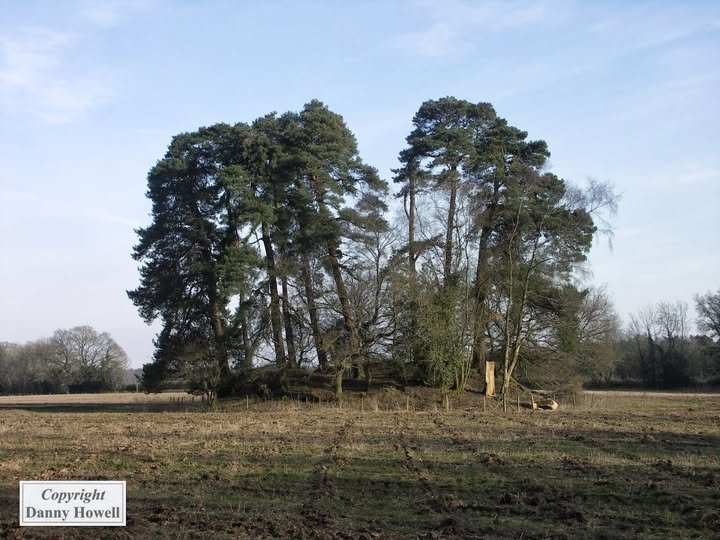
As my page is about Warminster and district, let’s go out of town to look at this photograph which I took on Friday 5th March 2010. It shows ‘The Life Of Man’ barrow in a field adjacent the western end of Bradley Road, near the Ash Oaks junction. When it’s misty or sometimes in tranquil evening twilight this place can seem eerie and atmospheric.
Wilfred Middlebrook, in his newspaper serialisation The Changing Face Of Warminster, published in 1971 noted:
Here [Bradley Road], standing well back from the road, is the Life Of Man barrow or Dead Man’s Island, an impressive and picturesque barrow or burial mound of prehistoric times that occupies the centre of a large field and is crested with graceful firs.
The Life Of Man barrow is particularly charming because of its unique situation: the dark, sombre background of Cannimore Woods emphasising the isolation of this tree-crested mound as viewed from the Bradley Road.
Manley has a word to say about the Life Of Man barrow, “a site that would allow signalling to and from most of the prehistoric camps in the district. A few yards down the field is a circular black earth patch unaffected by ploughing – it might well have been the site of Celtic ceremonial fires.”
Whatever the ancient history of this secluded spot, a huge barrow rising indeed like a veritable Dead Man’s Island in the centre of the field, there must have been an uninterrupted view of the surrounding heights including Cley Hill before the firs of Cannimore were planted. Now it is but another intriguing name on the map of Warminster.
____
The aforementioned Victor Strode Manley, in his Regional Survey Of Warminster, Volume Two (unpublished), compiled c.1930, noted:
Life Of Man ~ Barrow between Warminster Common and Shearwater.
On a sandy upland adjoining the [Bradley Road] Reservoir, and having Cannimore Valley at its north and Shearwater at its south – both places providing springs – reached from Warminster via Bell Hill and Botany Road, or Dry Hill, Crockerton, lies a field known locally as “The Life of Man”. Whether this name is associated with any folklore or is the popular pronunciation of some Celtic place-name, I cannot discover.
At first it looks like a twin-barrow but a closer examination sees it has been a large barrow cut through at some time, perhaps in search of plunder. The site would allow signalling to and from most of the camps in the district.
A few yards further down the field is a circular black earth patch, the same size as the barrow. No ploughing can cause it to disappear.
_______
Of the field itself I (Danny Howell) would like to add:
This field was once part of Warminster Heath and the area of the field closest to Warminster is said to have been the location of a skirmish during the English Civil War (1642 – 1651). When I was working for A. J. Legg & Son, the agricultural contractors of Home Farm, Boreham, in the late 1970s/early 1980s, two teams would go farm to farm around the area, for several weeks each spring, cutting grass, rowing it up and making silage in clamps to provide feed for cattle during winter. One farm we did this for was Tascroft Farm. I’m talking now about the time that Tascroft Farm was farmed by Ted Young. He was a lovely man. He rented the farm from the Longleat Estate. One of the fields we foraged the grass for silage for Ted’s cows was the one referred to above, with the Life Of Man barrow. Ted told me that from time to time he had seen pieces of human bone come to the surface in the field. He reckoned that these bones were from men killed in the skirmish here during the English Civil War. I do know that one day when I was with the silage making team in the field, we stopped when the forage harvester had a breakdown. One of my work colleagues noticed something in the surface of the soil which a tractor had disturbed. He bent down and hooked out of the soil a musket ball. It wasn’t very big but was heavy for its size, so we guessed it had been made of lead. He put it in the cab of his tractor, bagging it as a souvenir. So, it seems this field, like so much of the Warminster area, is steeped in fascinating history.
When I published this photo and accompanying notes on my Facebook page it gained 90 likes and 13 comments including:
Marion Baxter
Such a shame they’ve cut all the trees down on it. Have fond memories of Dead Man’s Island when living in Bradley Road.
Robin Ellison
Marion Baxter when they cut them down?
Marion Baxter
Robin Ellison I think it was some time last year.
Tiffany Jane Williams
I was so so sad they cut done the trees on it… I wonder how they managed to get permission to do that?
Amelia Jane
Tiffany Jane Williams They are obliged to, there would never have been trees planted on a burial mound and tree roots can compromise the archaeology. The owners are actually being brilliant guardians and I was delighted to see they have fenced the mound off to protect it and provided a gate for access.
Charlotte Rivers
Amelia I’m glad you explained that. I was annoyed about it, but I didn’t understand. Thank you.
Geoff Cooper
As a kid in the 70s we new it as dead man’s island.was definitely haunted!
Leonard Crouton
We knew it as “Devils Mount’ when we were kids and the legend I heard was if you walked on it and still had the dirt on your shoes 24 hours after your visit you would die. The same rule also applied if the dirt was transferred onto another persons shoe. Needless to say we never went on it.
Pauline Armour
When I was a young girl living at the Tynings at Bradley Road whenever we passed by there on the way to Shearwater we always had to be quiet so that we didn’t disturb those resting there.
Amelia Jane
Thanks so much for this Danny, I’ve previously searched for more info and drew a blank.
Nina Burton
I never knew that this was it’s name, but I often used to walk our dogs by there and into Cannimore Woods. It was then always very quiet and peaceful.
Amelia Jane
If you visit, please take a rubbish bag as there are often beer cans, etc., left there.
Diane Sketchley
Thank you Danny. all your posts are fascinating and interesting. Keep posting.