Monday 6th October 2025
When I was a small boy in the early 1960s a favourite place to go playing was the wood on the south-facing front of Battlesbury Hill. Back then, it was mainly a deciduous woodland as I remember with beeches, chestnuts, and sycamores, and the odd yew tree – until it was cleared by the War Department, about 1965, and replanted as the more evergreen wood we know it as today.
My friends and I, who all lived at The Dene, would “go up the lane” and over Morgan’s Drove railway bridge and spend practically all day during the school holidays exploring and running about on Battlesbury Hill and messing about in Battlesbury Wood. We would take a bottle of homemade lemonade (made from lemonade crystals soaked in tap water). And mother would let us take some bread and jam with us. We kept track of the time by counting the trains that passed by below, listening out for the REME hooter, and keeping our eye on how low the sun was going down over Cley Hill way,
Battlesbury Wood was an idyllic place to our young minds. I remember at the western end of the wood was a little shed. Sometimes there was a man at the shed – he must have been a keeper or something for Tom Bazley who farmed Boreham Farm. The fields of Boreham Farm stretched as far as Battlesbury and beyond to Sack Hill where there was a thatched field-barn. The man seemed old to us children (mind you, a lot of adults looked old in those days even though they were middle-aged) but he was kind and friendly. Sometimes he would take us boys through the wood, showing us butterflies and fungi and anything else from the world of nature, telling us interesting things about what we saw. It was all very pleasant and part of our fun, but I guess today someone doing something like that would be mistakenly labelled a paedophile risk. How attitudes have changed?
Of course, there are still a lot of beech trees in Battlesbury Wood and box bushes too – the box bushes vividly remind me of my childhood. Back in the early 1960s us boys would look in the box bushes for linnets’ nests. From about the last fortnight of April onwards just about every box bush in the lower part of Battlesbury Wood would have a linnet’s nest. I can “see” those nests now – the archetypal cup shape nest of little birds like finches, built with tiny twigs and the leaves of plants, lined with feathers. Each nest would have four or five eggs. Those eggs were light blue with purple or reddish-brown dots. Of course, being so pretty, they were very desirable to boys who collected birds’ eggs. Those boys would make a little hole in each end of the egg and blow the contents out so they could add it to their collection. I was never one for that. I could never take a bird’s egg. I have loved nature and animals and birds all my life. And, I can hear my mother now telling me (one of the many old wives’ tales she and her contemporaries would often say) that if we took a bird’s egg we would get a crooked finger and everyone would then know what a horrible thing we had done.
Sadly, I don’t think I could find a linnet’s nest in a box bush in Battlesbury Wood now. Probably more difficult to see a linnet, at all, these days. I think I’m right in saying that linnets are on the red list of UK conservation groups now, their numbers having fallen dramatically.
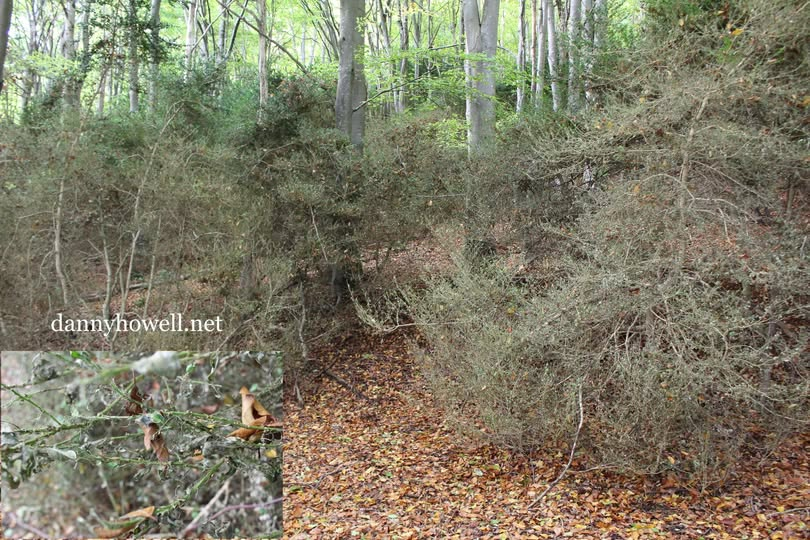
Yesterday afternoon I went into Battlesbury Wood (it’s the time of year for looking for fungi) and I immediately noticed a difference. The lower parts of every box bush have turned grey and brown, the leaves are brittle and there are bare patches. They shouldn’t be like that; they are evergreens. They have obviously succumbed to box blight – a fungal disease that thrives in dry and warm conditions.
I can’t imagine Battlesbury Wood without its box bushes. I reckon they might have been planted by the Temple family, the Lords of the Manor of Boreham, whose land included Battlesbury. Back in the day, box was much admired as an addition to managed woodland and also in gardens where the fact it can be trimmed without adverse consequences made it ideal for little hedges in garden features.
I attach a photo I took yesterday (Sunday 5th October 2025) showing the change in the greenery in Battlesbury Wood. I wonder if anyone (Ministry Of Defence, DIO, Ecologists, Conservation Officers) will do anything to try and remedy the problem?
I posted my notes and photo on my Facebook page and gained 116 likes and 13 comments including:
Liz Duggan
It might not be box blight as this tends to affect plants that have been regularly pruned and are very dense – those plants look like they have plenty of air flow around them. However, it could be the box tree moth caterpillar.
Nick P B Dombkowski
Battlesbury Wood was always my go-to place. I still occasionally go and risk the rope swing. Mind you both box in our front garden are virtually dead. I put it down to the extremely dry spell that we had over the summer months.
Julian Stafford-Wood
Lovely to read, thank you. A lot of boxes have been damaged this year from the box tree moth, essentially an invasive species
Carol Colderick
This brings back so many happy memories . I used to live in Queensway, and just like you spent so many hours playing here with friends. I remember all the violets and primroses in the woods and cowslips on the hills.
Norma Braine
Although I was brought up in Devon so much of this post resonates with me. My playground was the cliff paths and headlands around Torbay.
Bob Davis
I used to spend a lot of time up there and in the woods by Boreham Farm. Remember sliding down the slope on the western end during the winter of 1966.
Jim Finnigan
Watched some awesome firepower demonstrations on top of that hill. A-10’s baaaaaarp!!!
Gordon Davies
You had the best of that woodland, Danny, with the old trees, shame on the WD.
Jezzie Moon
It’s so sad that children don’t learn about the countryside so much anymore x love your stories. Thank you.
Monica Farey
Great memories, the box may well grow back, mine have.
Laurie Anne Collins
I love reading your memories, thank you x.