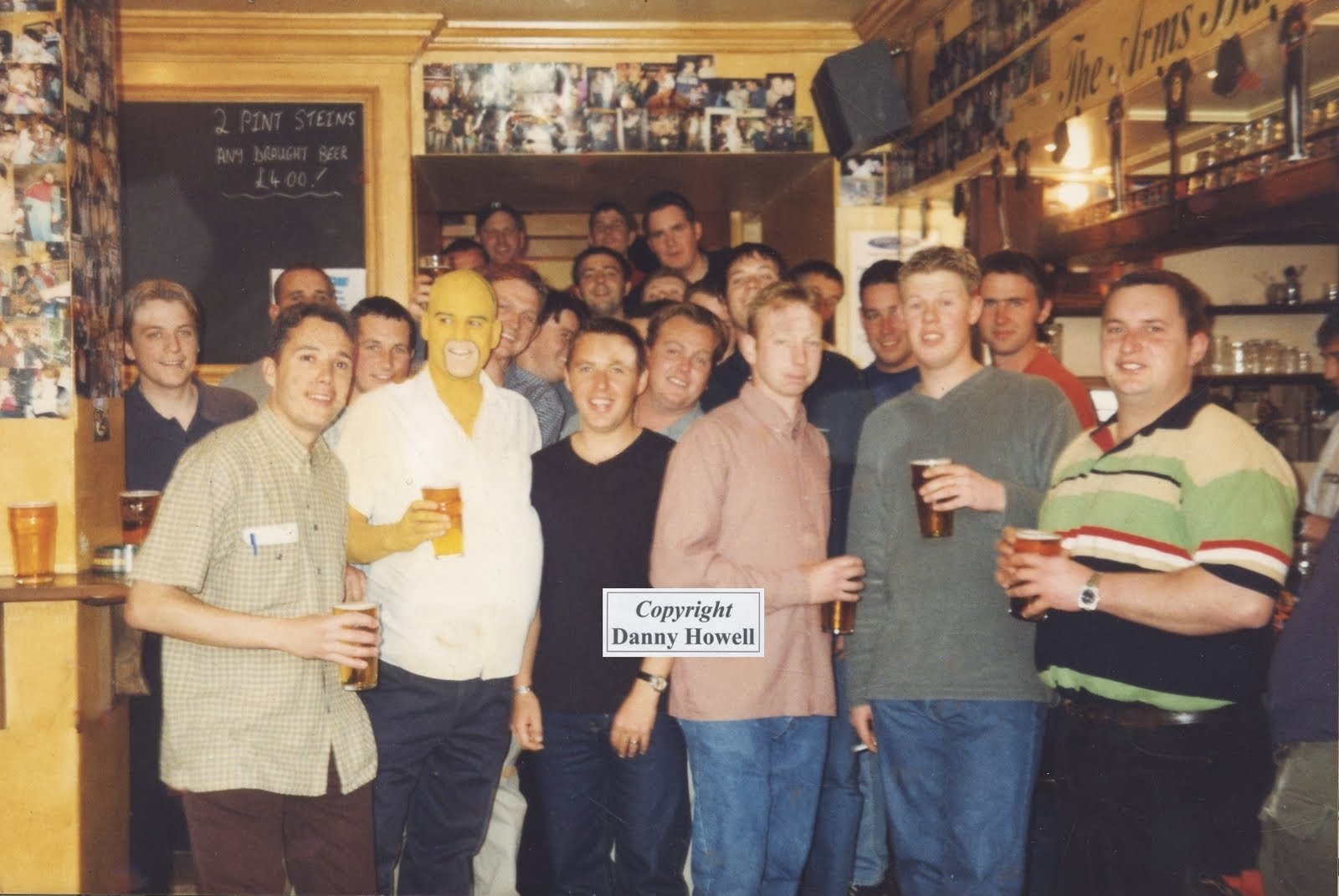
Celebrating Brett Ball’s Stag Night At The Weymouth Arms, Warminster

Brett Ball celebrated his stag night at the Weymouth Arms, Emwell Street, Warminster.

Among the revellers in the photo are: Brett Ball (in the guise of Homer Simpson); Steve Ball, Rowan King, Matthew Carpenter, Alex Marlowe, James Theobald, Mark Jones, Gary Lewis, Tony Casson, Mark Lowther, Mark Bryant, Che Paxton, Vincent Wright, Matthew Hutchins, Mark Harris, Alan Casson and Tony Sheppard.

Brett Ball married Lucy Eyres in June 1999.

Book: ‘Out Of The Rubble’ ~ Includes What Life Was Like In The Haven (The Orphanage Of Pity), A Children’s Home Run By The Ironically Named Sisters Of Mercy In Warminster

1999

The book Out Of The Rubble was published in 1999 by Pauletta J. Edwards of Pump Cottage, Pulteney Gardens, Bath, BA2 4JF. It includes her account of the time she was “just another unwanted brat” in The Haven, a children’s home at Vicarage Street, Warminster, run by the Sisters of Mercy. The Haven was formerly known as The Orphanage Of Pity. Pauletta was about 18 months old when she was taken to the girls-only Orphanage in the mid-1930s. She spent 17 and a half years there “in a state of fear and anger, desperation and desolation, and a deep, deep longing.”

The book has 208 pages, is all text and has no illustrations.

Notes on the back cover of the book include:

“This story tells of a child’s fight to survive in what was, for her, the desolate and often hostile world of her childhood in care. It shows how a vicious spiral can build up through distrust, lack of communication and withdrawal. All this can lead to unimaginable difficulties in responding to warm and friendly overtures. The story gives rare insights into what it takes and how long it takes to pull someone damaged almost beyond salvation out of the rubble of life into love, trust and happiness.”

“The aims of the book are: to increase everyone’s understanding; to show what the needs are of deprived children and adults who have suffered such a childhood; to give pointers to the ways in which adoptive and foster parents, teachers and social workers, the police, magistrates, carers and general public can help.”

Professor J.S. La Fontaine in his Foreword to the book writes:

“This is a harrowing story but it is also full of hope. It shows in the most painful detail what it felt like to be abandoned when only 18 months old and, throughout a loveless upbringing in a children’s home, to have no value as a human being. At its darkest it is a story of cruelty to children, both emotional and physical, at best a catalogue of exploitation and cold, harsh treatment by a Christian group who were named, with bitter irony, the Sisters of Mercy. Yet it is also a moving account of how one of these children was helped through the long healing process that made her into a loving, mature woman. It would be easy to say: ‘Well things are better now’, but recent cases have shown that the inhumanity of adults to children is still a threat to those most vulnerable beings. The hope held out by this book lies in its message, set out with painful honesty, that with patience, perseverance and love these damaged children can be healed.”

In her Introduction to the book, Pauletta J. Edwards writes:

“This is my story – the story of ‘how it was for me’. I have made no attempt to be objective. There is no analysis – only self-analysis – or learned psychological reference. Too much of either would take away from ‘how it was for me’. I leave the reader to do the analysing and referencing. For all of us, how we interpret a situation is how it is – for us. To say: ‘That isn’t really what I meant’ is irrelevant.”

“For seventeen and a half years I had lived in The Haven, in a state of fear and anger, desperation and desolation and a deep, deep longing. Over all this had hung a huge cloud of bewilderment and confusion. It had become darker as I passed from childhood to adolescence and grew in understanding. This cloud arose from the dichotomy between what Sisters of Mercy said and did when they were communing with their God and what they said and did when they were looking after little children. The two parts of this frightening whole never did and never have become reconciled for me; for The Haven was a Children’s Home and it was run by the Sisters of Mercy.”

“The Haven was called The Orphanage of Pity at first. It had been opened in 1850, only sixteen years after the Poor Law Amendment Act of 1834. This Act decreed that life in Workhouses and similar institutions should be made so unpleasant that people would rather stay outside if possible. Whether the cruelty and ignominy sanctioned by this Act was meant to apply to Children’s Homes or not, it certainly did to ours. It also did and has to others, as Peter Lennon’s article in the Guardian of March 1996 shows.”

“For orphans, waifs and strays there was no choice. We were dumped, like pieces of junk, wherever a place in an Orphanage could be found. Forsaken by parents, abandoned on doorsteps or left in the gutter – as we were often told we were – we huddled together seeking a love and warmth which didn’t exist.”

“We were the rubbish, the rubble of life.”

“This book is about the damage done to me in the rubble heap; its extent and depth and my reactions to it. I have written as honestly as possible, though it hasn’t always been easy to tell the truth but had I not done so there would be no point to the book. I have written it in such a way that the reader can come with me; feel how and where the psychological damage came from and how it affected my life; learn how healing took place – the winning, the losing, the fears and the joys; the despair and the hope as they happened and as they gradually broke down my defensive front; how Phyllis (my adopted mother) managed to pull me out of the rubble and slowly and carefully put me back together again. It is about the trauma and hurt inflicted, often unwittingly, by both my adopted mother and me during the restoration period and about the degree to which repair was possible in my case.”

“I don’t say that this is how everyone in the rubble or from it feels and reacts. What the book is saying is: Look under the surface for what is hidden, often very, very deeply, as it was with me.”

“To pull someone damaged almost beyond salvaging out of the rubble of life into love, hope and happiness requires loyalty, steadfastness; the ability and the willingness to withstand the emotional manifestations of the pain, the anger and the fear of betrayal as learning and healing take place; the insight to see the love of a frightened child trying to respond beneath the tough, bolshie, ‘don’t care’ or prickly front. Above all, the total commitment to spend years of loving and caring, waiting for the breakthrough, believing there will be one.”

“In my adopted mother I found all these things.”

“I hope the book will help all those who come in contact with or care for all of us who have been pulled out of the rubble, or more sadly, those who are still in it.”

Footnote by Danny Howell:
Sheelagh Wurr alerted me to the existence of this book. The names given to the nuns mentioned in this book are fictitious, but if like me you have researched or have acquired knowledge of St. Denys Convent and the lives of the nuns, you can work out who some of “the respectable devils” in this story really were.

The Athenaeum Singers, 1999

Conductor: Alan Burgess

Chairman: Angus Mackintosh, St. Algar’s Farm, West Woodlands, Frome, BA11 5ER, Tel: 01985 844233

Secretary: Mrs Ann Coventry, Rainbow, Portway House, Warminster, BA12 8QQ, Tel: 01985 213594

“The Athenaeum Singers” is Warminster’s Choral Society, open to all and no audition required.

The choir was founded in 1977 and sings a range of mainly classical, sometimes contemporary works.

Rehearsals are on Tuesday evenings at 8.00 pm in the Warminster School chapel.

The normal routine is to have two concerts a year. Rehearsals start on the first Tuesday of January for a concert in early June. Then after the Summer break we have the A.G.M. on the first Tuesday of September starting rehearsals the next week for a concert at the end of November or early December.

We occasionally manage other events as well as our regular concerts. For instance, the choir has sung in Marston House and Longleat House in aid of the N.S.P.C.C. In 1991 and 1995 the choir visited Flers, Warminster’s twin and sang with Flers’ “La Lyre Chorale” and they in turn visited Warminster twice, sharing concerts with the Athenaeum Singers.

Our growing reputation and ambition has to be matched by greater efforts at fund raising, enabling us to put on concerts with orchestras and visiting soloists of a very high standard.

To Become A Member
Ring our secretary Ann Coventry for information on 01985 213594.

Come along to the Warminster School chapel at the beginning of a session; September or January. We do not normally allow people to join the choir once we are five weeks into rehearsals.

Subscriptions are £5 in January, April and September, plus 50p each week. The total for the year is therefore about £30 depending on the actual number of rehearsals.

There is no audition and it is not necessary to be able to read music.

Our concerts are usually on a Saturday evening in either The Minster or Christ Church (Warminster).

New members are always made welcome, particularly basses and more particularly tenors which are always in short supply.

To Become A Patron
If you have enjoyed our concerts perhaps you would like to be involved with supporting this important element in the cultural life of Warminster.

The Athenaeum Singers is funded entirely by the subscriptions of the members and help from Patrons or Sponsors.

We try to put on two concerts every year. The cost of a sizeable orchestra and visiting soloists for a concert can be over £2,000. Our ambitions have risen with our reputation, but without help we cannot realize them. An assured income from a list of patrons gives us the security to be able to plan ahead to produce concerts of the highest standard, which are more exciting for both us and our audiences.

We ask Patrons for a minimum contribution of £25 per year. We will keep Patrons informed of future events and send two complimentary tickets for each concert.

For more information contact the Secretary, Ann Coventry, on 01985 213594 or the Chairman, Angus Mackintosh, on 01985 844233.

Registered Charity No. 290909.

MCPG Photographic Exhibition 1999

Warminster Camera Club hosted a MCPG Photographic Exhibition at Warminster Assembly Hall on 13th February 1999. There were demonstrations of equipment and the opportunity to photograph models in studio sets.

Here we see Jo Jones, showing a Hasselblad camera to fellow members. At the back: Ted Rushen, Derek Jones, Joan Barnard, (Konika rep), Margaret Aven, Mike Skuse, John Croad, Hasselblad rep), and Barrie Thomas (Digital Image Speaker).

At the front are Brian Adams, John Hunt, Norman Barnard, and Bill Aven.

The Astronomical Clockmaker Edward Cockey

Tuesday 2nd February 1999

Book review by Tom Spittler:

The Astronomical Clockmaker Edward Cockey And Other Warminster Horologists, by David Pollard. Published in 1998 by Bedeguar Books, Warminster, Wiltshire, BA12 9ER, England. Softbound, 8.5 x 12 inches, 320 pages, 403 illustrations. Available from British horological book sellers such as Rita Shenton or Jill Hadfield or from the publisher for £19.95 ($32.00) plus postage.

Warminster is a town in the county of Wiltshire, about 70 miles west of London. For Americans it is probably best known for being just west of Stonehenge on the Salisbury Plain. For horologists, Warminster is best known for Edward Cockey the maker of magnificent astronomical clocks.

Edward Cockey was one of those enigmas in British clockmaking. Born in 1669 in Warminster to a family of bell founders and braziers, his father had only limited skills as a clock repairer, probably mostly of tower clocks. No evidence exists that Edward ever served an apprenticeship as a clockmaker and he was very busy in business as a bell founder and worker of metals as well as a wine merchant. Suddenly, he bursts upon the scene and produces four magnificent astronomical clocks, all very similar to the one shown with this review and sells them to key Royal figures in Britain, including one given to Queen Anne in 1705. All four of the clocks exist today, some without their original cases, and the heart of this fact filled book concerns those four clocks.

The author does an excellent job in setting the stage for discussion of the four clocks by providing the reader with some background of the Cockey family and the town of Warminster as well as a great deal of documented information about Edward Cockey. The author then turns the discussion of the four astronomical clocks over to other possibly more expert horologists. John Martin has closely examined all the clocks and personally overhauled the first Cockey astronomical clock. He provides a 13 page chapter of his discoveries. An extract of five pages from Tom Robinson’s The Longcase Clock is presented which provides specific information on the third clock. Jonathan Betts concludes the discussion with 13 more pages about all the four clocks, and which one might be the Queen Anne clock which disappeared mysteriously from King William IV in about 1834.

The book has a lot more to offer than a good horological mystery story; 87 well illustrated and superbly documented pages are devoted to other clockmakers and watchmakers of Warminster. The book’s last chapter is an added bonus, 114 pages devoted to the public clocks of Warminster. These pages could well stand alone as a small book. The book concludes with a quality 12 page index – a feature too often missing in many of the recent regional makers books. On the down side the book needs a good map to help orient us Americans.

In addition to his astronomical clocks, Edward Cockey made many typical longcase clocks. If you have one of these or any other clock or watch from Warminster, you should have a copy of this excellent book. If you are related to the American branch of the Cockey family which settled in Baltimore in 1634 you must get a copy.

Intimations Of Siegfried Sassoon

Written by Jane Read; first published in St. George’s Parish Magazine (Warminster), November 1998:

When, almost nine years ago I first found St. George’s Church I heard of the people who had preceded me, amongst whom the war poet Siegfried Sassoon whose work long ago had made a lasting impression.

I was told that he came to worship at St. George’s and always sat in the second row, below the lectern in the Rosary corner. When it was time to process forward for Communion he always vaulted over the front pew, his tall angular frame still athletic. Thus giving an impression of his religious spontaneity and eagerness to share in the feast that is the Eucharist.

It was only later that I heard yet more about him. It was when the late Muriel Galsworthy asked me to tea. She had heard that I had a profound admiration for the work of the dramatist John Galsworthy in whose plays I had been privileged to act professionally. “Oh,” she said, “Uncle Jack” as she used to call him. We spoke of his compassion and balance of social judgment much in evidence in the Forsyte Saga.

Our conversations in her lovely Georgian house would flow. Out of that sensibility came further reminiscences. She described to me her first meeting at St. George’s with Siegfried Sassoon. “I hear you’re a Galsworthy,” he said, “Come to tea, tete a tete, tomorrow at four.”

Their friendship thus begun lasted until his death. Both were deeply Catholic and linked by bonds of literature and family associations. He was also devoted to her “Uncle Jack”.

She came to know of his journey to discover his faith in which a special providence had taken a hand. Someone whom he had never met had made a study of his poems and other writings. This was a nun of the Convent of the Assumption, Mother Margaret Mary, evidently a person of deep discernment. She wrote that she found in his work not only the undeniable and deep compassion for his men (1914 to 1918 was climactic agony), but underlying that, an undeniable search for God. She found him responsive and a meeting at her Kensington Convent took place. She encouraged him to draw deeply upon his mystical gifts and through faith to find the path of transcendence of suffering both his own and that of his men. He made the journey and was received into the Catholic Church at the Benedictine Abbey of Downside.

It was a great comfort to know that he had had the strength and support of two memorable women whose unconscious mercy helped a most necessary process of transformation in the last years of his life.

I had one further privilege yet to come. When it became the time of Muriel Galsworthy’s Requiem, she had asked that I would read out of the collected poems that Sassoon had given her: “Falling Asleep” in which he saw the faces of his men, so many faces.

Sixty Years Of Solid Achievement

Terence Howes, in the St. George’s Parish Magazine, issue No.78, November 1998, writes:

This year [1998] our Diamond Jubilee is an occasion to look back on sixty years of solid achievement. Nine parish priests have presided over many material landmarks, including a parish hall, a primary school, a new porch for the Church, and various refurbishments over the years – to say nothing of the spiritual guidance they will have given to their people with an ever-open Church, daily Mass and access to the seven Sacraments.

And so it was that this year, 1998, Bishop Mervyn Alexander was able to celebrate our Diamond Jubilee Mass on September 29th, in a packed Church, assisted by his Secretary, Fr. Robert Corrigan, together with our own parish priest, Fr. Paul Brandon and former parish priests Frs. John Harding, Michael Larkin and David Ryan. Also celebrating with Bishop Mervyn were the Dean of Trowbridge Deanery, Very Rev. Desmond Millett, and priests from the Deanery, Frs. Joe O’Brien, Liam O’Driscoll and Michael Robertson. We were also extremely pleased to have on the Sanctuary Fr. Vincent Curtis, the first priest of Warminster has ‘produced’, Fr. Raymond Hayne, ordained this year and Canon William Roche, now retired. With such a galaxy of clergy it was fitting that Bishop Mervyn was able in his homily to liken the parish to a real family whose members shared with each other the various joyful occasions of parish life and sustained one another through the occasional sorrows. At the conclusion of the Mass, Bishop Mervyn presented Papal Awards – the Bene Merenti Medals and Scrolls – to three parishioners, Archie Lawson, John O’Brien and Terence Howes.

But the celebrations were not yet over. Bishop Mervyn, with several clergy and many parishioners, made their way to St. George’s School to bless and to formally open the new school hall – completed only that week – together with a new classroom, kitchen and staff room. A brass plaque, unveiled by the Bishop, commemorates the occasion; earlier that day the children had released dozens of balloons to take the good news far and wide, and had celebrated the occasion in their own special ways – hopefully an occasion they will remember for many years.

So our parish goes forward into the next century, giving thanks to God for all that has been achieved in sixty years. It is almost one hundred years since the first Mass since the Reformation was celebrated in Warminster in 1900 and there is every hope that St. George’s, both parish and school, will flourish for many years to come.

Parish Contacts ~ St. George’s Church, Warminster

Sunday 1st November 1998

St. George’s Church, Boreham Road, Warminster.

Parish Contacts

Babies And Toddlers Group: Tina Jones, 301024.

Baptism Preparation: Fr. Paul, 212329.

Bidding Prayer List: Paul Mahoney, 217740.

Bulletin: Fr. Paul or Irene Mahoney, 217740.

Children’s Liturgy: Linda Howlett, 212580.

Church Cleaning Rota: Celia McGarry, 215108.

Churches Together In Warminster: Sheila Toomey, 213674.

Confirmation Preparation: Brenda Wall and Sr. Paula, 01373 826856.

Covenant Secretary: Terence Howes, 213053.

English Catholic History Group: Kevin McGarry, 215108.

Flowers: Margaret Durham, 213294.

Hall (Bookings): Rene Pickford, 212029.

Holy Communion Preparation: Sr. Paula, 217647.

Justice & Peace Group: Michael Tansey, 840683.

Liturgy Group: Sr. Paula, 217647.

Magazine: Kenneth Wood, 01373 827160.

Marriage Preparation: Fr. Paul, 212329.

Ministers of Communion: Fr. Paul, 212329.

Missions Overseas (APF): Promotor, Irene Mahoney, 217740.

PADS (Parents Against Drugs): Helene Meikle, 214822.

Parish Treasurer: Eileen Knowles, 844476.

Pre-School Playgroup: Tina Jones, 301024.

Prayer Group: Helena Meikle, 214822.

Readers Rota: Sister Paula, 217647.

Shekinah Music Group: Mary Lawson.

Social Group: Renee Pickford, 212029.

200 Club: Herman and Ann Torjussen, 216555.

Wednesday Club: Celia McGarry, 215108.

Youth Groups: Anne-Marie Fitton, 850002.

Loitering With Intent?

Sybil Fuller, writing in November 1998, recalled:

I remember going into St. George’s Church [at Boreham Road, Warminster] one day in the 1950s and seeing a shabbily-dressed man wandering around, seemingly inspecting everything. My father, thinking he was a tramp loitering with intent, waited until he went out and then followed him into Boreham Road and bade him ‘Good night’. The man replied in a cultured voice, and my father asked him whether he was just passing through the town, or was a new resident. “Oh no,” said the man. “I live in Heytesbury, my name is Sassoon.” After that, we got quite used to seeing Siegfried Sassoon worshipping in St. George’s – driving up in his equally shabby old high back car.

error: Content is protected !!