Return Of The Heytesbury-Knook Parish Boundary Marker

September 1993

Danny Howell writes:

The Heytesbury/Knook parish boundary marker which was given to the Warminster Dewey Museum in 1993 by the Highways Department of Wiltshire County Council has been returned to them.

The Warminster History Society, which oversees the Warminster Dewey Museum, had not accessioned it but Graham Zebedee had given it an undercoat as the first stage of conservation.

It transpired that the marker is a Grade II listed monument and should have remained in situ.

Danny Howell had received phone calls about it from the County Council and the Department of the Environment requesting its return.

The Highways Department have reinstated the marker, where it was before, adjacent the road outside Bunter’s Cottage, on the brow of Unicorn Hill at Heytesbury.

Wiltshire Museums Education Pack For Schools

September 1993

Danny Howell writes:

Warminster Dewey Museum has received its copy of the Wiltshire Museums Education Pack for Schools.

This has been financially supported by grants from the Museums & Galleries Commission, the Historical Association Young Historian Scheme, the Nuffield Foundation, and the Area Museum Council For The South West.

Copies will be sent to all primary schools in Wiltshire to help them use the county museums more effectively.

Netball Team From Princecroft Primary School, Warminster, Have Won The Carol Munt Trophy

Friday 14th May 1993

The netball team at Princecroft Primary School, Warminster, coached by teacher Angela May, won the Carol Munt Trophy at the local schools tournament recently organised by the P.E. staff from Kingdown School.

The Princecroft team comprised Samantha Whittaker, Claire Sweeney, Maxine Fielder, Catherine Poulton, Kimberley Webb, Carrie-Anne Harse, Catherine Howell, and Laura Bottomley.

The Appearance Of A Huge Dog Was The Reason Why Longbridge Deverill People Discontinued Their Customary Palm Sunday Picnic On Cow Down

Ralph Whitlock in one of his many books (over 100), Wiltshire Folklore And Legends, published in 1992 by Robert Hale, in a chapter titled ‘Black Dogs,’ noted:

“On Palm Sunday the people of Longbridge Deverill walked up to Cow Down where, from time immemorial, they had held a picnic. But one Sunday a huge dog appeared and so frightened them that the festival was discontinued. One would like to know more of the circumstances.”

Warminster Branch Of Amnesty International Established

A Warminster branch of Amnesty International was established in June 1992, when a meeting was held at Teddington House, Church Street, Warminster, the home of book publisher Adrian Phillips.

The decision to start a Warminster branch came about because people in Warminster, if they wanted to attend an Amnesty group meeting, had to travel to Bath or Salisbury.

The committee, formed at the first meeting, comprised: Adrian Phillips, Tricia Rigg, Dorothea Sultana, and Rev. Fred Woods.

Fund-raising was the first aim of the Warminster branch, and Dorothea suggested holding a bring and buy sale and coffee evening at her home, 1 Boreham Road, Warminster.

A meeting was arranged for 21 September 1992, at the Athenaeum, Warminster, with the emphasis towards a campaign to highlight the dreadful plight of children in South America.

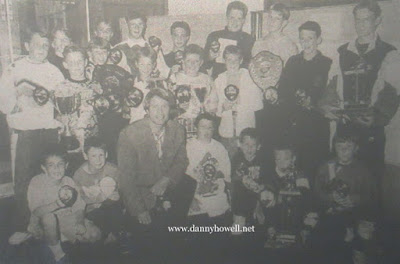
8th Annual Presentation Evening Of Warminster Highbury Youth Football Club, Warminster

The 8th Annual Presentation Evening 
of Warminster Highbury Youth Football Club
was held at Kingdown School, Warminster,
on Friday 5th June 1992.

Swindon Town FC Community Officer 
and former player, Leigh Barnard,
was the guest of honour who presented
a shield to every special award recipient
and a large perpetual trophy to the
Player Of The Year winner in each age group.

He also presented an individual certificate 
to each boy who had represented 
the Highbury club during the season,
which meant he shook hands with about 
160 boys during the course of the evening. 

The special award winners were:

Under 9 years old
Player Of The Year ~ Jamie McGuckian.
Most Improved Player ~ Matt Pearce
Most Sporting Player ~ Lee Bundy.

Under 10 years old
Player Of The Year ~ Jason Guy.
Most Improved Player ~ Stuart Edgar.
Most Sporting Player ~ Richard Mildren.

Under 11 years old
Player Of The Year ~ Ryan Hastie.
Most Improved Player ~ Stuart Stainer.
Most Sporting Player ~ Tim Kent.

Under 12 years old
Player Of The Year ~ Simon Shanks.
Most Improved Player ~ James McCallister.
Most Sporting Player ~ Daniel Minty.

Under 13 years old
Player Of The Year  ~ Andrew Pepler.
Most Improved Player ~ Matthew Hardiman.
Most Sporting Player ~ Richard Merritt.

Under 14 years old
Player Of The Year ~ Neil Dulake.
Most Improved Player ~ Matthew Beales.
Most Sporting Player ~ Andrew Bennett.

Under 15 years old
Player Of The Year ~ Mark O’Driscoll.
Most Improved Player ~ Simon Norris.
Most Sporting Player ~ Paul McClean. 

Pedro’s Disco provided the rest of the evening’s
entertainment after the presentations.

Crypts, Bartons And Ancient Graffiti

Wednesday 27th May 1992

Danny Howell writes:

Twenty members of Warminster History Society made an evening visit on Wednesday 27th May 1992 to the ancient town of Bruton, escorted by Society member Chris Bubb.

Chris showed them the church, the packhorse bridge, and Sexey’s Hospital with its chapel and boardroom.

St. Mary’s Church has two towers: the one next to the north aisle is a century older than the west tower, which dates from 1449-1456, stands 102½ feet high (a typical height for a Somerset tower) and houses a peal of six bells.

The north aisle contains the Royal Arms of Charles II, appropriately a restoration, as they were put back up after being discovered in someone’s shed.

The parish registers, which date from 1554, record both Charles I and Charles II staying and worshipping at Bruton.

The chancel was entirely rebuilt by Sir Charles Berkeley in 1743. The architect was Nathaniel Ireson of Wincanton. The plaster reredos covers the east wall and is an example of the sacramental piety of the period.

A fine tomb chest on the north side of the chancel features the recumbent effigies of Sir Maurice Berkeley, who died in 1581, and his first and second wives who died in 1559 and 1585. The tomb is one of the few in the country to feature three effigies.

The crypt below the church, which may sometimes be seen by arrangement, measures nearly 40 feet square and contains many lead coffins, some of which have burst exposing the bones of those who rest there.

Bruton was once the home of a mediaeval Augustinian Priory and Abbey. The field south of the church is still called Abbey Field. After the dissolution of the monastery in 1539, the family home of the Berkeleys stood there for 250 years.

The 15th century dove-cote on top of the hill and a long buttressed wall in the street called Plox below are visible reminders of the former abbey. A Georgian rectory now stands behind the old buttressed wall.

Bruton features many narrow walkways known as bartons. Members of the History Society made their way over the river Brue via a 15th century packhorse bridge, passing by the Victorian fire-engine house, and into Nathaniel’s Barton, which took them under the houses and into the High Street.

The river looked very shallow. Bruton used to frequently flood, but is now protected by an interesting flood relief scheme. Several signs showing the height of the flood in various years can be seen about the town.

Near the west end of the High Street stands Sexey’s Hospital. The western range dates from 1638. Hugh Sexey, auditor to Queen Elizabeth I, founded the charity which administered these almshouses, and was a vital benefactor to three schools.

The chapel and the boardroom at the Hospital contain fine woodwork. The pews and the pulpit feature some early graffiti. An Armada chest in the hall next to the boardroom has a lid with 24 locks operated by the turn of a single key.

The architecture of Bruton shows a rare continuity, through six centuries, of styles and techniques used where stone meets timber in Wessex.

Many houses survived the fire of 1647. Priory House is a late 15th century half-timbered jettied town house. The pharmacy was a gentleman’s house, and its 18th century façade hides a building dating from the 16th and 17th centuries.

Last port of call for the History Society was opposite Patwell Pump, a communal parish pump in use after 1900.

A vote of thanks was given to Mr. Bubb for a most interesting evening.

Described by the Council for British Archaeology as “of special importance as regards historic quality” Bruton was the first conservation area of East Somerset. Today, Bruton has much to offer the inquisitive visitor, retaining its special historic atmosphere and charm.
Victorian Farming Was Successful

Monday 6th April 1992

Danny Howell writes:

The guest speaker at the April 1992 meeting of the Warminster History Society, held at Warminster Library, was Mr Michael Stratton, who lives at Stockton. He farms at Manor Farm, Stockton, and East Farm, Codford, in the Wylye Valley.

His lecture, on Monday 6th April 1992, was on how English farming changed from centuries of the three-field system to the enclosed farming of the last century.

People in the Middle Ages had used a three-field system. Each parish had three large fields which were divided up into plots, 2 to 3 yards wide but quite long. Each plot was worked by one man and he had to grow the same crop as the others in each third. One large field was wheat, the next was barley, and the last third was left fallow. The crops were rotated each year.

The rotation system worked successfully for hundreds of years. What ended the system was poor fertility, new methods, and the evolution of science to improve the land. And during the 18th and 19th centuries the population increased, which meant much more food was required.

The system was changed by Act of Parliament in the 18th century. The peasantry were dispossessed, common land was enclosed, and large units were formed and these were farmed by one man. New methods came in and these were more economic. There was an eight-year rotation sytem: wheat, barley, turnips, swedes, wheat, barley, and then two years down to grass. This was to help control pests and diseases.

Sheep were used for fertility. The sheep would eat the grass on the downlands during the daytime, and then be brought into the farm fields at night; when their droppings would help to fertilise the land. As a result the downland became very poor in fertility, but this helped the wild flowers grow well.

Up to Christmas the sheep fed on turnips, and then on swedes (which were frost hardy) later in the new year. After the swedes had been eaten the land would be ploughed and sown with spring barley. In May the turnips were sown. June to July was haymaking time. August was corn harvest time. And then the wheat was sown in October to November.

In Victorian times you would expect a yield of one tonne of wheat per acre, but now with modern technology you would expect a yield of 3 tonnes of wheat to the acre.

Michael Stratton concluded by saying that Victorian farming had been very successful.

error: Content is protected !!