Harriet Is Going To Teach In Indonesia

Thursday 8th February 1996

Former Warminster School student Harriet White is going to spend a year off with a difference. She plans to jet off to Indonesia to teach English to college students. Harriet, who is 17 and lives in Bishopstrow, has got to find £3,000 to pay for her journey with The Project Trust. She says: “I’m thrilled to be selected as I want to spend a year off which will be a challenge to me both physically and mentally. It will be a completely different culture but hopefully it will broaden my horizons and boost my confidence and independence. There are going to be some huge hurdles, especially with the fund-raising but I’m sure lots of people will help me. I’m looking forward to it.” Anyone who can help with the money for Harriet’s trip is asked to telephone 01985 212858.

Watercolour Artist Tony Emmerson

1990s

Danny Howell, writes:

Sometimes, during the 1990s, when I went for a regular walk over the top of Middle Hill, Bishopstrow, or the neighbouring hills and fields, I would see Tony Emmerson.

He lived at The Cottage, Bishopstrow, and he was an artist. He used to paint the most delightful watercolours, usually of local scenes.

I can remember seeing him when he was sitting on the edge of the burial mound on top of Middle Hill, painting the view looking towards Warminster. He didn’t have an easel up, he just had a sketch pad on his lap and a brush his hand, with his paints beside him.

Whenever he saw me he would always have a little chat with me, while he painted. He was very sociable. I always found him very pleasant and very modest about his pictures.

You could buy greetings cards featuring his watercolours, in Boreham Post Office. I believe the proceeds from the sales of those particular cards were donated to St. Aldhelm’s Church, Bishopstrow.

(Danny Howell wrote these notes in 2010).

130th Anniversary Celebrations Of St. John’s Church, Warminster

Friday 22nd September 1995
Flower Festival opens at St. John’s Church.

Saturday 23rd September 1995
Flower Festival.
Exhibition by Danny Howell: 130 Years Of St. John’s Church.
12 noon to 2 pm Ploughman’s Lunch.
2 pm Rehearsal for choir members past and present to
prepare for evensong, followed by tea.
5 pm Choral Evensong sung by augmented choir,
guest preacher Rev. James Lovell.
Director of music Dr. Lionel Dakers, ex-Director
Royal School of Church Music.
5.30 pm AGAPE, a simple shared meal, devotions and music.

Sunday 24th September 1995
10.30 am Festival Eucharist
Guest preacher Rev. Richard Press.
Contributions from Youth Activities Day.
Blessing of Kneelers, Banners and Icon.
Followed by Anniversary Buffet Lunch.
2 pm Grand Finale for all, young and old.
130th Birthday Party with stalls and sideshows
organised by the Youth Leaders.
4 pm Tea
5 pm Compline.

The Real Meat Company

Some notes first published in the Heytesbury Extravaganza Souvenir Programme, Saturday 9 September 1995:

The award winning Real Meat Company offer an alternative product and service to that available from the dominant supermarket led retailing business.

The company was founded in 1986 by the husband and wife team: Richard Guy and Gilly Metherell, operating from East Hill Farm, Heytesbury. The guiding principles of the business are Quality, Purity and Welfare. These principles are maintained by adherence to a self imposed set of codes for the raising, transportation and slaughter of livestock.

The Real Meat Company Codes:

* Ban all growth promoters and reserve drug use to therapeutic use only.

* Ban all practices which affect the animal’s freedom and/or well being and which are performed solely to cheapen livestock production.

In order to monitor these strict codes on the home farm and other Company supply farms, random checks are carried out by the Bristol University School of Veterinary Science, a body independent from the Company and the meat industry in general. Additionally, members of the public are granted instant access to any of the supply farms upon request, and can see for themselves this unique farming practice,

The Company campaigns strongly against the practices of intensive factory farming and supermarket control by producing its own Real Meat News Letter which highlights some of the extreme practices and misleading wording common in certain quarters. They strongly believe that the best traditional farming methods not only benefit the livestock but offer the customer a product of the highest quality, food without unnatural additives,

Farming based upon such an ethos in today’s “fast, efficient” western world has its critics and problems. Cost is usually highlighted as the major problem. The Real Meat Company is a sustained commercial organisation which obviously needs to trade successfully. They do this by offering consumers a very high quality product of exceptional taste. The Company is now in its tenth year of operation, demonstrating that there is a long term market for the traditional meats no longer available in modern supermarkets.

Should you require further information about the Company then please telephone Warminster (01985) 840436 or write direct to them at East Hill Farm, Heytesbury, Wiltshire, BA12 0HR.

Photograph Showing The Dining Room/Sandwiches Room At The Avenue Primary School, Warminster

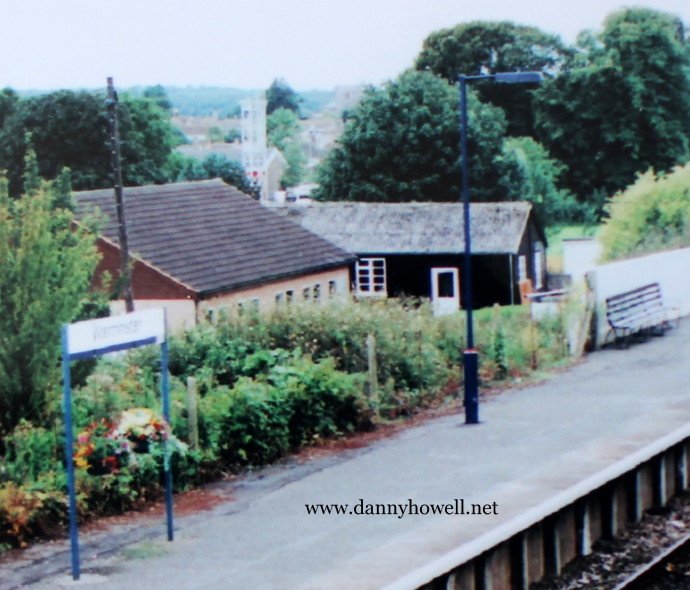
Photograph taken in 1995, of the view south-west from the footbridge at Warminster Railway Station. 

On the left is the Baden Powell Scout Hut. Adjacent is a building (black sides, white doors and windows, and a grey roof) in the north east corner of the grounds of the Avenue Primary School.
This particular building was the dining room/sandwiches room at the Avenue School, where children ate their sandwiches.

The building burnt down in a fire (started accidentally) 
circa 1997. 

In the background can be seen the drill tower at Warminster Fire Station.

A Fragmented Portrait Of Codford

May 1995

Book:
STERNER DAYS, CODFORD DURING THE SECOND WORLD WAR
Romy Wyeth

This is a fragmented portrait of one Wiltshire village during an extraordinary period of history, a period still within living memory. The storytellers allow us to glimpse, through their eyes and their voices, one of the most important chapters in the annals of world history.

In 1939 the first troops since the First World War arrived in Codford, the vanguard of a massive military build-up which was to culminate with Operation Overlord, and the invasion of Europe five years later.

The area east of the road from Codford St. Peter to Manor Farm was the location of the main camp in the village during the Second World War. Another camp was situated between Little Wood and the church at Codford St. Mary.

The 6th Guards Armoured Brigade was at Codford between 1941 and 1943. They were given a fond welcome by the people of Codford and are remembered as being the most popular troops ever to have been stationed in the village. When they left they were succeeded by the 11th Armoured Division who remained only a short while.

When American troops arrived in September 1943 they met with wet conditions underfoot, similar to those of the First World War when the village was nicknamed ‘Codford On The Mud’. It was this which prompted the GIs to build their very own ‘Burma Road’, to combat the morass which appeared whenever the erratic English climate chose to open the heavens and flood the landscape.

Codford was home for the U.S. 3rd Armoured Division, 32nd Armoured Regiment, the Maintenanance Battalion and Supplies Battalion, while Stockton House, nearby, saw the soldiers of Combat Command ‘A’, the 45th Medical Battalion and Trains Headquarters. These men vacated Wiltshire for France during the early part of July 1944 but more Americans arrived for a temporary stay afterwards.

A Polish Corps, under the command of General Anders, was in camp at Codford after the Second World War. Stockton House was used as their headquarters. The Poles were at Codford until demobilisation and some of them later took up permanent residence in the village.

This book, Sterner Days, focuses attention on the military and civilian aspects of village life during the war years, through the memories of those who lived or were based in and around Codford.

Some fought for King and Country, while others worked at essential services, growing the food, tending the livestock and keeping the lines of communication open; preparing to defend their homeland in case of invasion. Women learned to make do and mend, to eke out the rations and to take up the duties of the men away in combat. Codford children found themselves surrounded by soldiers and military activity; childhood, for them, became something of a great adventure.

In 1945 the Second World War ended. It had been a time of upheaval and change, a period after which nothing and no one remained untouched by the experience. Those who remember those tumultous times when the forces of evil were poised across the England Channel and the world was in flames, are dwindling voices. They made history, and their stories evoke another time, a time when Britain stood alone and refused to surrender.

In 1941 Winston Churchill said “Do not let us speak of darker days; let us rather speak of sterner days. These are not dark days; these are great days – the greatest our country has ever lived; and we must all thank God that we have been allowed, each of us according to our stations, to play a part in making these days memorable in the history of our race.”

Sterner Days, Codford During The Second World War.
Romy Wyeth.
Softback, 210 mm x 147 mm, 112 pages, 33 black and white photographs and illustrations.
Published by Bedeguar Books.
May 1995.
ISBN 1872818242.
The Scout Hut (That Was In The North West Part Of The Grounds Of Highbury House) At Woodcock, Warminster

Notes researched and written by Danny Howell in 1995:

When 1st Warminster Scouts Were Based At Woodcock (1923-1931):

The 1st Warminster Scouts, who had been meeting in a room in a building behind the Masons Arms public house, East Street, Warminster, moved to new headquarters at Woodcock in February 1923.

Their new base was a hut west of Chancery Lane, on land now forming part of the Robin Close residential estate. The site, part of the Highbury House grounds, was donated to the Scouts by Lady Scobell (who owned and lived at Highbury House). The hut was erected especially for the Scouts by Sidney Day, T. Cooper senior, T. Cooper junior, and W. Long.

Despite bad weather a good crowd was present at the official opening by General Sir Henry Wilson of Bishopstrow, on the evening of Monday 12 February 1923. Among the gathering were the Misses Bayfield Clark, Mrs. Bazley, Mrs. Burton, Miss Clowes, Miss Davis, Mr. Harold N. Dewey, Mrs. Dixon, Mr. W.A. Greenland (Scoutmaster), Mrs. Hogan, Major Houston of Codford, Mrs. Jacob, Mrs. Mortimer, Mr. J. Rutty, Lady Scobell, and Messrs. D. and D.H. Waddington. Apologies were received from Mrs. Erskine, Mr. W.H. Kitley (landlord of the Masons Arms), and Rev. J.S. Stuart (Chairman).

After the opening speeches, Patrol Leader Taylor and Troop Leader Elloway were the opposing sides in a boxing contest. Taylor was the victor. This was followed with the scouts giving gymnastic and ambulance displays. Refreshments were served by Miss Bamlett, Miss Greenland, Miss Hall, Mrs. Silcox and Mrs. Venelle, who had also made the curtains for the hut. Rover mate Mr. M. Levenson gave some large framed pictures, and Lady Pelly of St John’s Lodge offered to the scouts “anything they liked.”

It was announced that the hut would be open every night for the Scouts, a wireless would be installed, the billiard table would be repaired, and gymnastic equipment would be supplied. Gardens were planted around the hut, a grass area was provided for parades and a cinder track around the perimeter was available for running.

The Scouts were based at Woodcock until 1931 when they moved into their new HQ, the Greenland Hut, next to the Lake Pleasure Grounds at Weymouth Street, Warminster.

error: Content is protected !!