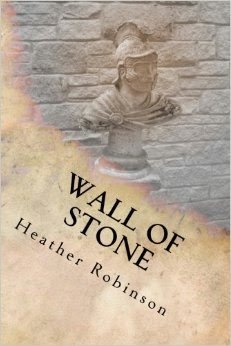
Wall Of Stone By Warminster Author Heather Robinson

Wall Of Stone, a Roman historical novel by Warminster author Heather Robinson*, is available via Amazon, as a paperback (£6.05) or as a Kindle edition (free to read!).

It is AD121 and Legate Maxinius’s Twentieth Legion is becoming demoralised by the covert tactics of the Picts, rebel warriors coming down from the north of Britannia to incite trouble between the invading army and the local Brigante people. Fearing an uprising and with growing frustration at Rome’s lack of support, the legate ignores orders from Emperor Hadrian to consolidate his position without advancing and decides, at the peril of his career, that his legion must act by flushing out the rebels, shattering the peace of the area in the process. Wall of Stone follows the fate and fortune of two legionaries from the Twentieth Legion which intertwine with those of a local Brigante family.

“A very well researched and beautifully written book.”

“Wonderful descriptive elements of both characters and the era.”

“Riveting right from the start. Well written and very expertly researched with a gripping story line.”

238 pages.
ISBN: 978-1500464776
Publisher: Create Space.
First published 26th July 2014.

To see the Amazon page for Wall Of Stone, click here.

*Heather Robinson is also a presenter on Warminster Community Radio (and its Admin Manager). 

Kingdown Community School – Les Miserables – October 2004 -Programme

Programme

Kingdown Community School
– A Sports College –
presents
Les Miserables

pic

13th – 16th October 2004

by Alain Boublil and Claude-Michel Schonberg
based on the novel by Victor Hugo.

Music by Claude-Michel Schonberg.
Lyrics by Herbert Kretzmer.

Original text by Alain Boublil and Jean-Marc Natel.
Additional material by James Fenton.

School Edition specially adapted and licensed by
Music Theatre International
and
Cameron Mackintosh.

pic

Les Miserables: A synopsis

Act 1

Digne: 1815. The convict Jean Valjean is released from
the chain gang. He steals some of the Bishop’s silver.
The Bishop lies to save him. Valjean starts a new life.

Montreuil-sur Mer: 1823. Valjean, now ‘Monsieur Madelene’
is a respected factory owner and Mayor of the town.
Fantine, one of his workers, has an illegitimate child.
She goes onto the streets with the town whores. She is
arrested by Javert. Valjean demands that she is sent to
hospital. Valjean rescues a man trapped under a cart.
Javert tells him the ex-convict Valjean has been
re-captured. Valjean reveals his true identity. Valjean
promises the dying Fantine that he will find and care for
her daughter, Cosette. He escapes.

Montfermel: 1823. Cosette is living with the Thenardieres
and their daughter Eponine. Cosette is badly treated, so
Valjean pays the Thenardieres to let her go. He takes Cosette
to Paris.

Paris: 1832. There is unrest amongst the students and the
poor. Javert rescues Cosette and Valjean from Thenardiere’s
gang. He does not recognise Valjean. Marius, a student, has
fallen in love with Cosette. Eponine, who is in love with
Marius, agrees to help him find Cosette. Lamarque, a
popular leader, is killed. The students take to the streets.
Eponine brings Marius to Cosette. She prevents an attempt
to rob Valjean’s house by her father’s gang. Valjean tells
Cosette that they must leave the country.

Interval

Act 2
The students build the barricade. Marius sends Eponine with
a letter for Cosette. Valjean intercepts it. Eponine returns to the
barricade. There is a battle. Javert is exposed as a police spy.
Eponine is killed. Valjean arrives looking for Marius; he
refuses to kill Javert. The rebels are killed, and Valjean escapes
into the sewers with Marius. He meets Thenardiere, who is
robbing corpses, and then Javert. Javert agrees to let Valjean
take Marius to hospital. Javert commits suicide. Unaware of
the identity of his rescuer, Marius recovers, nursed by Cosette.
Valjean confesses his past to Marius. Marius and Cosette are
married. Thenardiere tries to blackmail Marius: he produces a
stolen ring, telling him that it belonged to Cosette’s father, a
murderer. Marius recognises his own ring, and realises that it
was Valjean who rescued him. Marius and Cosette go to Valjean.
He tells Cosette about her family history, and dies.

France, 1830
Conditions for the urban poor in nineteenth century France
were unimaginably bad. Working up to 18 hours a day in
appalling conditions for low wages, their plight was ignored.
When the barricades went up in Paris in July 1830, the
monarchy was overthrown. The rising middle class reaped
the benefit: the poor gained nothing. Much needed social
reform to help the urban poor failed to happen. Whenever
the dispossessed under-classes of Paris rebelled they were
crushed by the full force of the state. This is the setting
for Les Miserables.

Victor Hugo, author of the novel on which this musical is
based, was very aware of the plight of the urban poor. He
wrote: ‘People reduced to the extremity of need are driven
to the utmost limits of their resources . . . and darkness
enters their hearts. Within this darkness, they appear
utterly depraved, corrupt, and vile . . . and there comes a
point where the unfortunate and the infamous are grouped
together, merged in a single fateful world. They are
les miserables – the outcasts, the underdogs.’

pic

Liberty Leading The People 1830
102″ x 128″ Louvre, Paris.

This picture was inspired by the July Revolution
of 1830. Delacroix had not taken part in the fighting
and felt that the least he could do was ‘paint for his
country’. The red, white and blue of the French national
flag dominate the composition.

CAST
Jean Valjean : Olly Wright
Javert : Charles Taylor
The Bishop of Digne : Paul Barnes
Factory Foreman : Paul Barnes
Fantine : Philippa Griffiths
Bamatabois : Tom Hiscocks
Pimp : Michael Sides
Young Cosette : Sophie Hall
Thenardier : Michael Sides
Madame Thenardier : Gemma Carroll
Young Eponine : Rebecca Thomas
Gavroche : Alex Williams
Eponine : Lucy Ross
Cosette – Laura Hopkins
Montparnasse : Kyle Taylor
Brujon : Paul Barnes

STUDENTS
Enjolras : Tom Hiscocks
Marius : Craig Rees
Combeferre : Kyle Taylor
Feuilly : David Gale
Courferac : Paul Barnes
Joly : Jack Baker
Grantaire : Kyle Taylor
Lesgles / Fauchelevant /
Claquesous / injured man under cart : Luke Williams
Girl 1 : Hannah Shuttleworth
Girl 2 / Whore 3 / Street Urchin : Emily Davis
Girl 3 / Whore 1 / Woman : Laura Steer
Girl 4 / Girl 5 / Whore 2 : Kayleigh Spyers
Onlooker : Laura Brooks

Chain Gang / Constables / the Poor / Factory Workers /
Sailors / Whores / Drinkers / Wedding Guests
played by
Shaun Hurren, Chris Thomas, Rachel Freeman, Jess McCarthy,
Kim Blair, Alison Kimberley, Annie Jessop, Vicki Syrett,
Hannah Johnson, Jess Herring, Alisha Shah, Lauren Edgar,
Rachel Arthur, and members of the cast.

MUSICIANS
Piano : James Brown
Keyboard : Graham Savage
Reed 1 : Michelle Krawiec
Reed 2 : Peter Rees
Trumpet : Mary Kestell
Horn : Sophie Letheren
Guitar / Bass : Kevin Rowe
Percussion / Drums : Steve Jobbins

Les Miserables is produced and directed by
the Creative Arts Department.

Lighting / Sound :
Ben Griffiths, Andrew Quick,
Simon Quick, Matthew Notley, Jenny Weston.

Backstage:
Jeremy Lane, Lotta Welpton, Jenny Weston,
Natalie Williams, Kelly Wilson, Jess Wright.

Special Thanks to:
Andrew Forbes-Lane, David Thomas, John Roberts,
The Site Managers, The Design Department,
Yvonne Syrett, Coral Pickles.

Acknowledgements:
For the loan of furniture – The Top Shop,
Warminster High Street (behind the Old Bell);
The Gorge Inn, Shrewton.
For costume hire – Zenith Youth Theatre Company.
For additional lighting – Enlightened Lighting.
Wool Is The Best Material For Keeping The Body Warm

Friday 1st October 2004

Victoria Coombes has a letter published in The Times:

Sir, With winter approaching why are our shops and supermarkets heated to such a high temperature? While staff sit at tills wearing thin, short-sleeved blouses, customers arrive in heavy clothes to combat outdoor weather conditions.

In the interests of energy conservation wouldn’t it make more sense to reduce the heating in shops and provide staff with a warmer uniform? What has happened to wool? In my experience it is by far the best material for keeping the body warm, but it is becoming increasingly difficult to find any wool clothes in our shops.

Yours sincerely,
VICTORIA COOMBES,
2 Railway Cottages, Bishopstrow,
Warminster, Wiltshire BA12 0ER.

Events Celebrating 20 Years Of Youth Football At Highbury, Warminster

September 2004

Events celebrating 20 years of youth football at Highbury, Warminster, have included a challenge match, an exhibition, and a social evening.

The exhibition which comprises items of memorabilia and many photographs, is organised by Harry Theobald, and held at Warminster Library.

Among the memorabilia on show is a football signed by the Warminster Highbury Youth F.C. team which played in the 1990/91 Wilts County Cup match; a county cap won by Andy Pitman, who is remembered for being so talented that he played well under age in that first squad; an under 13s cup winners medal from 1985/86; the Mid-Wilts League Shield for the under 13s division two; various pennants and several programmes.

The photographs include one of Jamie Pitman pictured with Southampton F.C. Manager Chris Nichol, when Jamie, who had been a talented player with Highbury Youth F.C. first signed for Southampton.

At the 20th Anniversary social evening, held at Warminster Assembly Hall, Robin George, the President of Warminster Highbury Youth F.C. , welcomed past and present players, committee officers and members, managers, as well as guests and supporters.

Robin began his involvement at Highbury in 1985/86, coaching under 15s. He and Bob Pitman were instrumental in starting organised football during the 1990s for age groups down to as young as eight and nine.

Robin said he had many happy memories of the progress of the boys and girls playing football at Highbury. Robin proposed a toast to the last 20 years and wished the club all the best for its future.

Two former chairman of the club, Harry Theobald and Bob Pitman, gave a brief summary of how the Highbury Youth Football Club was formed (it began as the Celtic Boys, Warminster, F.C.) and mentioned many achievements of the players through the years.

The current Chairman of Warminster Highbury Youth F.C., Chris Finch, spoke about the future of the club and how it can provide a natural progression for boys to go on to play as seniors with Warminster Town F.C.

The guest speaker was Barry Stephens, who replied on behalf of the Wiltshire Football Association. He said that Warminster Highbury Youth F.C. was held in high regard within the County Association and had the admiration of other clubs. He expressed his wish that Highbury would get involved with football for girls and that he hoped in future to present the club with the F.A. Charter Standard.

The social evening concluded with a raffle – the prizes were donated by local businesses.

Celtic Boys (Warminster) F.C. – The Beginning Of Youth Football At Highbury, Warminster

The following notes are gleaned from information provided to dannyhowellnet by Robin George:

September 2004

September 2004 is a time for celebrating two decades of youth football at Highbury, Warminster.

Twenty years ago Celtic Boys (Warminster) Football Club played their first game at Highbury. The club was run by Fred Pinnell.

Harry Theobald had chatted with Fred Pinnell about the possibility of organising football matches for Warminster teenagers. Fred introduced Harry to Bob Pitman, who was considering the same idea. The hope was that youth teams could progress to becoming senior players with Warminster Town F.C.

An evening meeting was held on Thursday 19th July 1984 at Fred Pinnell’s home which was at Thornhill Road, Warminster. It was agreed that Harry Theobald would be Chairman, Bob Pitman would be Manager of the Under 13s (the only team at that time), Rod Kitley would be Treasurer, and Peter Farrell would be Secretary.

The football pitch at Woodcock Road, Warminster, which had been used for years previously by Highbury Football Club (a senior team) became the home ground for the Celtic Boys.

Fred Pinnell who also joined the committee, set about finding the money to fund the first efforts of the new club. He asked the company he worked for, McCarthy Information, if they could help. McCarthy Information, who had their headquarters in the old Manor House at Ash Walk, Warminster, generously sponsored the cost of the kit – in green and white colours – for the club.

The first Mid-Wilts League match (for the Minor Cup) for Celtic Boys was played at home on 9th September 1984. The opponents were F.C. Chippenham B. Celtic Boys were the victors, the final score being 9-2. The winning team were Lee Dalton, Robert Hourahine, Eddie Hunt, Rob Morris (Captain), Stuart Hawkins, Terry Hillier, Brian Platts, Karl Pearce, Sean Bowden, Andy Pitman, and James Theobald. The substitutes were Brett Ball, Rob Robson, Ben White and Vinnie Wright. The match referee was John Syme (who later became well known as a Warminster town councillor).

That illustrious occasion was followed by an excellent run of football matches which culminated with Celtic Boys playing in the final against Avon Melksham at Melksham on 5th May 1985. Unfortunately, Celtic Boys lost, 4-1.

During that first season, Peter Farrell wrote the notes for programmes for the home matches. The programmes were produced by the ever-enthusiastic Harry Theobald. Celtic Boys’ opponents during the first season were Avon, FC Chippenham A, Melksham Park A, Amesbury, Shaw & Whitley, Wroughton, Southwick and Biddestone. Celtic Boys finished commendable in the middle of the league table.

Within one year Celtic Boys changed their name to Highbury Youth F.C. Later, another name change happened when, to identify with their home town, the name became Warminster Highbury Youth Football Club.

Celtic Boys (Warminster) F.C. pictured during 1984/85.
Back row, left to right: George Hill, Harry Theobald, Peter Farrell, Bob Pitman, and Ron Macduff.
Middle row, left to right: James Theobald, Vincent Wright, Wayne Purdue, Brian Platts, Terry Hillier, Edward Hunt, Robert Robson, and Robert Morris.
Front row, left to right: Sean Bowden, Andrew Pitman, Lee Dalton, Karl Pearce, and Brett Ball.

Shopping In Warminster Survey

Warminster & Villages Community Partnership
Economy And Tourism Group

A press release from Winifred Charman (Group Co-ordinator), 7 Beech Grove, Warminster (telephone 01985 216195):

As part of the Warminster Festival, the Economy and Tourism Group started to undertake a survey of shoppers in the Market Place on Saturday 18 September 2004. Visitors to the Community Partnership Stand were asked to complete a simple three point questionnaire asking
What existing shops and services do you value and why?
What other types of shops and services would you like to see in Warminster?
Do you live in the town, a village or elsewhere?

The Survey is on-going and there will be many more opportunities for residents to pick up questionnaires in the next few weeks. Some shoppers chose to take their questionnaires away to complete at home (in the dry!) and these will hopefully be returned to the Community Mailbox in the public Library.

An analysis of the replies received so far reveals (the figures are approximates)
2% say that their shopping needs are met in the Town Centre
24% would like to see a good men’s outfitters/bespoke tailors
21% expressed a need for good women’s clothing/lingerie shop

Among other “demands” were for good teenage/children’s fashions, another shoe shop, independent food retailers, speciality/craft shops and a furniture shop.

Readers who still want to take part in the Survey should look out for opportunities to pick up a survey form from various locations. The Survey Team will again be in e.g. Three Horseshoes on future occasions. (Some shoppers on Saturday were not interested in taking part. If they change their minds there will be other opportunities!)

Final results of the Survey will be made available to the Chamber of Commerce, the Independent Traders Association, the Agents marketing the empty shops in the town centre – and of course the Press.

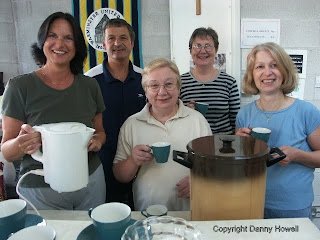
Church Coffee Morning For Sudan Appeal

A coffee morning held in the foyer of the
United Reform Church, at George Street,
Warminster, during August 2004,
was a big success for a desperate cause.
The sale of coffee and the proceeds from stalls
selling bric-a-brac, books, plants and cakes,
raised £198.04p for the Sudan Appeal.

The photograph, taken by Danny Howell,
shows, left to right:
fundraisers: Yvonne Syrett, David Syrett,
June Laird, Marion Barton and Hilary Reynolds.

Warminster U3A ~ The Enjoyment Of Music

Friday 30th July 2004

“Don’t count sheep, think of all the hymn tunes you know and you’ll be asleep in no time,” is Derek Wilkinson’s advice for insomniacs.

This little gem and others like it were revealed during Derek’s talk called The Enjoyment Of Music, which he gave to Warminster U3A at the Assembly Hall in July.

Derek is the musical co-ordinator of the West Wilts U3A and for him the pleasure of listening is the primary purpose of music. He said a good tune is most important.

Making music with other people and choral singing, he suggested, are also tremendously satisfying. He is a member of a recorder group which he said was very good fun too.

Derek mentioned that attempts by students at composing may not always be successful but this does help to appreciate the awesome craft of the great composers. A knowledge of music analysis should not interfere with the simple enjoyment of listening. A sense of rhythm and understanding the jargon of music and harmony help but are not essential to enjoyment.

Derek’s endearingly comfortable and relaxed style perfectly complemented his choice of a musical potpourri which included Purcell’s Nymphs and Shepherds, sung by the fresh young voices of the Manchester Girls Choir; Schubert’s Trout Quintet, Ravel’s Bolero, Haydn’s Clock SymphonyPraise My Soul The King Of Heaven, and Derek’s own “tingle factor’ – a slow movement of a Mozart piano concerto.

The Padstow Lifeboat, a witty march by Malcolm Arnold, introduced the thunderous Padstow foghorn at frequent intervals, and Shostakovitch’s Turkey Trot, an exercise in full-blown orchestration of the song Tea For Two (composed in one hour for a challenge), concluded an enjoyable afternoon.

Report by Biddy Shephard.

error: Content is protected !!