Victor Strode Manley, in his Regional Survey Of Warminster And District, compiled in the 1920s and 1930s, referring to place names, noted:
Reeve Hames – old name at Longbridge Deverill.
A geographical dictionary providing reference information about places and place names in Warminster and other civil parishes in the surrounding area.
Victor Strode Manley, in his Regional Survey Of Warminster And District, compiled in the 1920s and 1930s, referring to place names, noted:
Reeve Hames – old name at Longbridge Deverill.
Victor Strode Manley, in his Regional Survey Of Warminster And District, compiled in the 1920s and 1930s, referring to place names, noted:
Rogediche – old name at Longbridge Deverill.
Victor Strode Manley, in his Regional Survey Of Warminster, Volume Two (unpublished), compiled c.1930, noted:
Life Of Man ~ Barrow between Warminster Common and Shearwater.
On a sandy upland adjoining the [Bradley Road] Reservoir, and having Cannimore Valley at its north and Shearwater at its south – both places providing springs – reached from Warminster via Bell Hill and Botany Road, or Dry Hill, Crockerton, lies a burial mound known locally as “The Life of Man”. Whether this name is associated with any folklore or is the popular pronunciation of some Keltic place-name, I cannot discover.
At first it looks like a twin-barrow but a closer examination sees it has been a large barrow cut through at some time, perhaps in search of plunder. The site would allow signalling to and from most of the camps in the district.
A few yards further down the field is a circular black earth patch, the same size as the barrow. No ploughing can cause it to disappear.
Prehistoric – Life of Man ‘black patch’. The Keltic ceremonial notes “must have been kindled at some spot not very remote from the community whose hearth fires had been extinguished, probably a place where it could easily be seen by all. As a solemn act of ritual it required a locus consecratus . . . . “a circular precinct”. This may explain why some circles have no interment. Cf. Bridgwater November bonfire, which was one of the best in England, and until the roads were tarred, was burnt in the space in front of the Blake monument.
Victor Manley, in his Regional Survey Of The Warminster District, Volume Five, compiled in the 1920s and 1930s, listed and attempted to explain the meaning of local place names. He included The Avenue in his list, saying “The Avenue or Beastleaze” was the “lane from Station Road to Portway. Apparently part of the Roman-British track from Pitmead – Woodcock to Minster (Coldharbour).”
Residents at Three Horseshoes Yard, Warminster, 1929:
A. Smith, 1 Three Horseshoes Yard.
E.W. Blake, 2 Three Horseshoes Yard.
F. Webber, 3 Three Horseshoes Yard.
F. Coleman, 4 Three Horseshoes Yard.
F.H.G. Cornish, 5 Three Horseshoes Yard.
C. Dredge, 6 Three Horseshoes Yard.
J. Dredge, 7 Three Horseshoes Yard.
A. Withers, 8 Three Horseshoes Yard.
C. Collier, 9 Three Horseshoes Yard.
J. Parker, 10 Three Horseshoes Yard.
Writing in 1928, Victor Strode Manley, as part of his Regional Survey Of Warminster And District, made the following notes concerning Upton Scudamore:
South of the church, near Bear Close Cottages, is seen a barrow, once left in the middle of a ploughed field but now pasture. It has recently been protected as an Ancient Monument.
I have noted at least five ochreous boulders in the village, of a geological period not now represented in the locality. One of these still lies at the south side of the barrow and most likely the others were removed from the same place and it would be rendering good service if they were replaced there now that the barrow is protected. The others are:- At the road corner opposite N.W. of the church wall, at Temple Farm entrance and nearly opposite the Chapel. It was sometimes customary to surround a barrow with upright stones, the circle being sacred and inviolate.
There are other places outside the churchyard which seem to have been earthworks.
On the south side of the [Biss] Bottom are broad lynchets of uncertain age and use.
Opposite the village on the Downs is Calloway Clump [Colloway Clump] with its holloway leading to the summit and the barrows en route. The valley east of the road at this point is Fernicombe.
The Tynings, at Bradley Road, Warminster, in 1928, comprised about 27 acres which were divided into allotments.
Victor Manley, in his Regional Survey Of The Warminster District, Volume Five, compiled in the 1920s and 1930s, listed and attempted to explain the meaning of several local place names. He included Rack Close in his list, saying it was in Common Close. He wondered if Rack Close was derived from Rick Close. Later, in another part of his list, Manley, referring to the Rack Close again, notes: “Common Close in 1756 “afterwards a farmyard’ where Wesley preached on May 5th, History Of Warminster, page 217, under “Wesleyans’-“
From The Warminster Official Guide And Souvenir 1928 (penned by Victor Strode Manley):
Heaven’s Gate is not easily found without enquiry. Approaching through the third gate on the right after turning out of the Frome Road, a seductive emerald path leads through an avenue of gorgeous rhododendrons o’ertopped with lordly trees. Soon a superb prospect is unveiled. Deep down in the dell, as though delicately chiselled from a block of ivory, stands Longleat House –
“Where sloping hills around enclose,
Where many a beech and brown oak grows,
By Nature’s beauties taught to please.”
So entrancing is this woody theatre with the antlered deer roaming over the greensward and the hills beyond melting into blue oblivion, it seems a fantasy. Hallowed by inspiring memories of Bishop Ken released from the Tower of London to find shelter at Longleat, his hymns written here (3 and 23) re-echo around:-
“Teach me to live that I may dread
The grave as little as my bed.”
Silver firs like natural spires rise to 150 feet amid many rare trees imported from other countries.
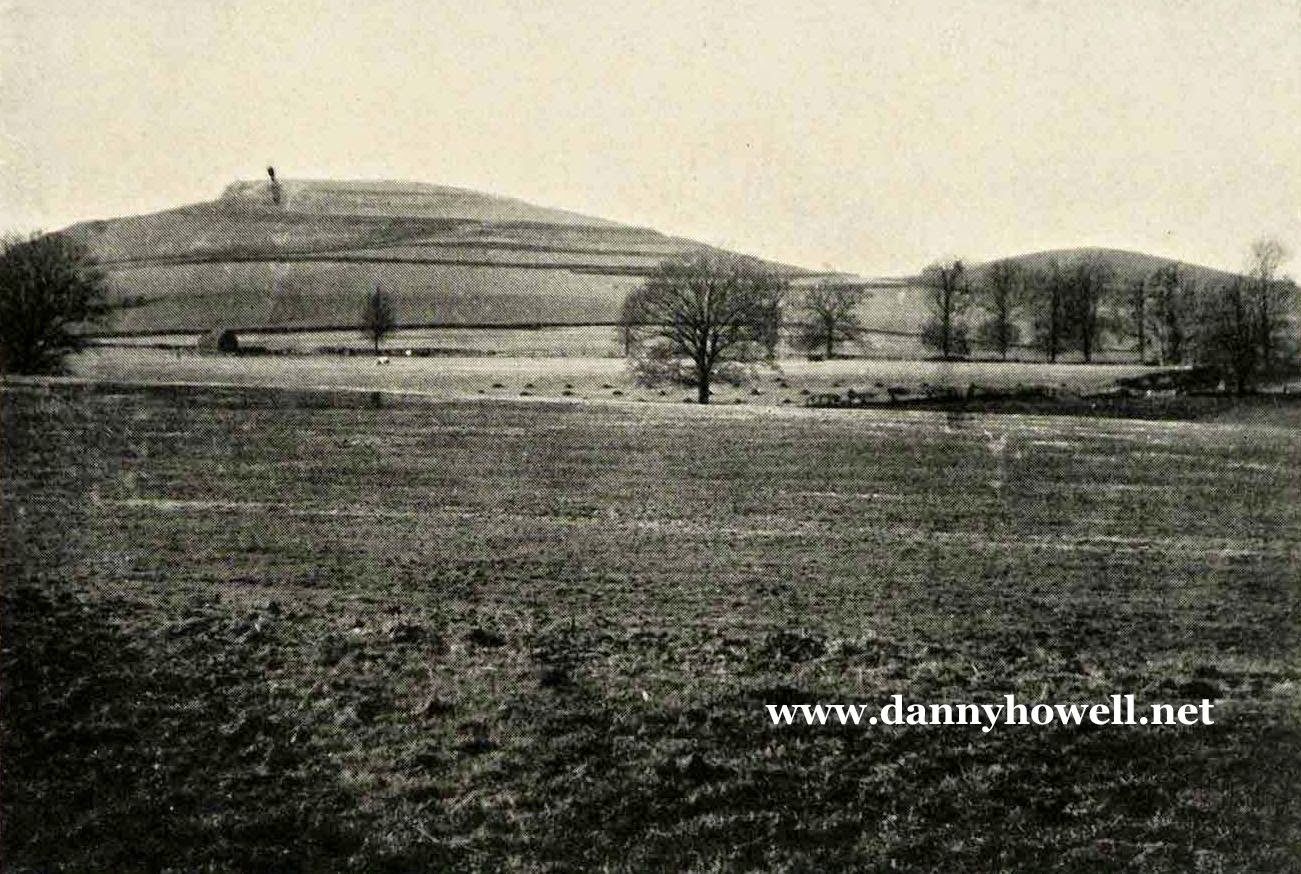
The view from the Half Mile / Bugley area
of Warminster, looking over the fields of
Bugley Barton Farm to Cley Hill.
The photograph was taken in 1926.