The Archaeology Of Arn Hill, Warminster

Some notes compiled by Danny Howell in 1990:

Arn Hill has no elaborate fortifications or ramparts and cannot be described as a contour hill fort but does include some interesting earthworks and burial mounds. Perhaps the most noticeable and unusual features of the Arn Hill landscape are the humps and hollows between what is now the Club House of the West Wilts Golf Club and the old chalk quarry. This area is marked on old maps as a camp and has been described as “a small hill fort.” It is, perhaps, more accurate to call this feature ‘an enclosure.’ Occupying a rectangular site, this part of the hill has been damaged by the extraction of minerals in the 18th and 19th centuries, although the western corner together with a ditch on the east side have survived quarrying.

The aforementioned ditch runs in a northerly direction. Marked on early maps as “Old Ditch” it is now much more shallow than it would have been in Iron Age times. It was probably more than 10 feet deep in its original condition. It could have been constructed as a defensive line or, as the Warminster schoolteacher and amateur historian Victor Strode Manley (1894-1965) suggested in the 1920s, it could have been a hollow way enabling “the inhabitants to move to and fro without being visible on the skyline.”

Near the centre of Arn Hill is a bowl barrow surrounded by a ditch and an outer bank. The barrow is 49 feet in diameter and three and a half feet high; and the ditch is 8 feet wide and six inches deep. The outer bank measures 11 feet wide and is 6 inches high. A small causeway runs across the ditch and bank on its east side.

The barrow was excavated by Sir Richard Colt Hoare, about 1800. In his Ancient History Of South West Wiltshire (1812) he noted “. . . a circular barrow, which from its singularity deserves notice. It is surrounded by a ditch, having a vallum without, through which are two entrances pointing east and west. On making a large section in it, we discovered at a depth of about eighteen inches, an article of iron resembling the head of a spear or halberd, and near it the halves of two horseshoes. In our progress to the floor of the barrow, we found a great many flat-headed nails, and pottery similar to those found in the British towns, together with charred wood; and on the floor of the barrow was a small circular cist containing a very few black ashes. We also met with considerable quantities of stiff clay, which is remarkable, as none is produced by nature on this down.”

Unfortunately the barrow was damaged by digging on its eastern side somewhen during the early part of this century.

Two round barrows within yards of each other once existed on the south western edge of Arn Hill, north of the wooded area. They were destroyed in December 1911 when the smaller one to the south was heaped on top of the other to make a golfing tee for the West Wilts Golf Club.

Artefacts found in what was the smaller, southerly, barrow are now kept at Devizes Museum and include two well-made cinerary urns dating from the Bronze Age. One was found inverted over an interment of burnt bones and features a collar around the rim with rows of punched holes arranged in groups of three at both top and bottom of the collar. Between the rows of holes is an impressed design of triangles. The other urn, a smaller one, was discovered in January 1912. It was found upright and contained a second interment of burnt bones. Its collar features two lines of herringbone pattern. Both urns were baked red.

The barrow also yielded a whetstone of a slate type rock. This was found among the bones in the smaller urn. An additional find from the barrows was three stone floor ’tiles’. One of these measures one foot by nine inches and has a hole at each corner. Another is eight inches square, has no holes, but features an unusual surface. The third ’tile’ measures ten inches by six inches and has no holes. These ’tiles’ are of doubtful origin.

At Colloway Clump, to the north of Arn Hill, is a long barrow orientated south west/north east. It measures 132 feet long, 75 feet wide, and averages 10 feet high. The maximum height at the south west end is just over 10 feet but it is lower and narrower at the north east end. The ditches which surrounded the long barrow have been ploughed out and the area is now tree covered. The barrow was excavated by Colt Hoare’s colleague William Cunnington in 1802.

Colt Hoare wrote “On the edge of . . . . Arn Hill, over looking the Westbury road, is a long barrow, newly planted, and which was partially opened by Mr. Cunnington in the year 1802. At the south end was a sarsen stone five feet high, terminating almost in a point, and placed in an upright position. Near it lay the bones of three skeletons, which appeared to have been deposited on the south and south-east of the stone, with the heads towards the east. They were all placed on a rude pavement of marl, and over them was thrown a pile of loose stones. There are probably other, and more ancient interments in the tumulus; but the contents of the long barrows have proved in general so very uniform and uninteresting that we have not been tempted to make any further investigations on it.”

Just south east of the Colloway Clump long barrow is a small bowl barrow measuring 14 paces in diameter and about one foot high.
The Archaeology Of Copheap, Warminster

Some notes compiled by Danny Howell in 1990:

Copheap, the nearest hill to Warminster town centre, was formerly known as Cop Head Hill and features a Bronze Age burial mound at its summit.

Sir Richard Colt Hoare in his Ancient History Of South West Wiltshire noted ” . . . Cop Head Hill . . . situated at the back of the town of Warminster, is by nature of a conical shape but rendered more so by art, as its apex has been evidently formed into a tumulus. Like many of the barrows on our plains, it was encompassed by a ditch and bank which are still apparent. Its summit presents a most beautiful panorama of wood, hill and vale, and the interest of the antiquary is increased by the numerous British works which may be distinguished from this elevated point. We opened this barrow, which is only three feet in elevation, in October 1809, and at the depth of two feet on the south-east side, discovered a skeleton lying nearly north and south, the head towards the latter point; but several of the bones had been disturbed by planting a tree at the top of the barrow. With the skeleton were deposited some pieces of flint, which appeared to have been polished by use, some fragments of stag’s horns, the butt end of one of which had been cut off and perforated, and from its appearance used as a hammer. On the west of the tumulus, at the depth of about three feet, and a little below the floor, was another skeleton, with the head towards the west, but unaccompanied by any arms or trinkets. On the north side we found a cist nearly two feet deep, in which were two skeletons, and an interment of burned bones; but I conceive these interments had been disturbed by planting, as towards the feet of the skeletons there was a great deal of vegetable earth intermixed with the bones. In this cist we discovered the remains of an infant, and by its side those of a female adult, probably its mother, both lying from north west to south east. In examining the cist, near the body we met with burned bones, and a few ivory beads of the pulley form; and on the floor of the barrow was a little heap of burned bones, nearly half the original interment. There were six beads, and a sea shell (a nerite); the former certainly belonged to the interment of burned bones; the latter probably to the infant skeleton.”

Near Henford Farm, Warminster ~ Fallowdown Fisheries And Hunter’s Moon

Friday 27th October 1989

Danny Howell in a lecture “Changing Faces Of Warminster” which he gave at the Athenaeum, Warminster, during October 1989, said:

“Near Henford Farm, Warminster, anglers have the facilities  of Fallowdown Fisheries and the Hunter’s Moon lodges.”

A Visit To Manor Farm, Codford

Danny Howell writes –

Twenty members of Warminster History Society visited Manor Farm, Codford, on the afternoon of Sunday 7 May 1989, at the kind invitation of Mr. John Collins, to see his private museum of farming and rural bygones.

A large room at the western end of the farmhouse contains more than 650 artefacts gathered by Mr. Collins over the years. The room, which is the oldest part of Manor Farmhouse, was formerly used by shooting parties for beer and lunch after a day’s sport, and the collection began when one or two old objects were hung on the walls for decoration.

Further bygones were added after Mr. Collins restored and cleaned up items from the surrounding farm buildings for a two-day show called “Vanishing Wiltshire”. He then realised how the everyday objects of his youth were fast disappearing and has been rescuing and making additions ever since.

His collection includes horseshoes from Roman and Celtic times to the present day, packhorse and sheep bells by Wiltshire makers, horse brasses, bottles and earthenware jars from local breweries, copper powder flasks and farriery aids. A good variety of lethal traps was also on display. These included two enormous gins, a fox trap, a pole trap made illegal in 1906, a spiked mole trap, and two rare traps for catching kingfishers.

The unusual items included an early form of fire extinguisher – a blue bottle containing a fire repellent powder, a nutcracker-like squeezer for altering the sizes of corks to fit various bottles, two different door keys hinged together, a hot cross bun marker, some children’s ice-skates, and a policeman’s rattle from the days before whistles were issued to constables. Another law enforcement item was a set of handcuffs from Northumberland dating from the early 1800s.

A huge fireplace in the room featured roasting equipment, a revolving trivet, and a griddle for scones. A device, made of iron, standing in the hearth, was once used for cleaning the long churchwarden pipes. Pub landlords, years ago, owned pipes which were loaned to customers for smoking, and the pipes were cleaned by baking them in the embers of the inn’s dying fire after closing time.

Among the local items was a First World War saddle bag, later used for collecting the fares on Couchman’s bus, which took passengers to and from Codford and Salisbury. A good variety of branding irons included some from the late Henry Wales’ Quebec Farm, near Chitterne. These particular ones were last used with paint, not tar, for numbering sheep. Others were used to brand rams for Wilton Fair. A wooden shovel and a fork had seen many years of hard use at the maltings in Warminster.

When asked about a ditching knife, Mr. Collins explained that it was used by William Whatley, the last “drowner’ on Manor Farm. Water-drowning was the practice of shallow flooding the meadows, by using a system of hand-dug ditches and dykes, to ensure an early bite of grass in the spring for cattle and sheep.

The men responsible for this now defunct craft were known as drowners, and Mr. Whatley worked on Manor Farm for about 50 years. Other ditching tools and scythes included examples from the Fussell’s iron foundry at Mells.

Every object had a story associated with it, and Mr. Collins’ anecdotes of times past and some of the characters who had worked in the Wylye Valley, made the afternoon pass all too quickly.

A vote of thanks was given by Danny Howell and the visit concluded with tea and delicious cake made by Mrs. Collins. A collection for St. Mary’s Church, Codford, raised £20.

A Brief History Of The Wiltshire Farming Club

1989

The Wiltshire Farming Club
President: Mr. W.J. Gale.
Chairman: Mrs. A. Bucknell.
County Secretary: Mrs. K. Telling, The Old School, Great Somerford, Chippenham. Telephone Seagry 720760.

The Wiltshire Farming Club – A Brief History

The Wiltshire Association Of Dairy Students (WADS) was founded in 1927 by the late Mrs. Ida M. Bull.

Agricultural education was in its infancy; Mrs. Bull having been a demonstrator in butter and cheese making, and following the discontinuation of travelling schools, she resolved to maintain contact with her ‘students’ within the county.

In those pioneering days of mechanisation and the need to feed the nation, the role of the association was an important part of modern-day agriculture, beside the social aspect. Lifetime friendships were forged, and indeed a good many matrimonial ones during those times (the Young Farmers’ movement had not yet begun in Wiltshire.

In its heyday, the association had nine branches throughout the county. Membership ran to over 1,400 in the early fifties. A member journal was produced, and a county agricultural show was held annually. During this time strong links were forged with the Lackham College of Agriculture from its inception in 1945 until the present day.

The winter programme of county meetings are still held in the Avon Hall at Lackham.

1973 brought about inevitable change, marked by the death of the indomitable Mrs. Bull. Her position as county organiser was never filled. The county journal was published for the last time after 45 years. Some branches ceased to exist or were amalgamated, and in an effort to attract a broader spectrum of the farming community, the association changed its name.

The Wiltshire Association of Farming Folk (WAFF) was not a popular title, and regarded by some as portraying a ‘yokel’ image to the club.

The Wiltshire Farming Club (WFC) was born out of this in 1976, and today has five thriving branches: Chippenham, Malmesbury, Marlborough, Poulshot and Warminster. Current membership within the county numbers around 250.

The County President, Mr. Bill Gale, is one of many 2nd generation members; his father Mansell Gale being a prominent and active personality in the Warminster branch in his day.

The Wiltshire Farming Club and its origins are unique.

Membership is open to anyone with an interest in agriculture, both young and old.

Smallbrook Farm ~ Book Introduction

SMALLBROOK FARM, 1905-1965, WARMINSTER by Danny Howell.

BOOK INTRODUCTION

Smallbrook Farm no longer exists; it is just a memory to those who are old enough to recall what formerly occupied the area now taken up with the “Prestbury Park” residential estate – Prestbury Drive, St. John’s Road, Southleigh View and Willow Crescent.

Smallbrook Farmhouse, demolished soon after 1964, was situated very near today’s junction of Prestbury Drive and Southleigh View. It was probably built in the 1830s. Its site was on or near that of Olwey, the Manor House of Smallbrook, a small manor (mentioned in the Domesday Book) which also included additional parcels of land at Sambourne, Bugley, Chedlanger and Upton Scudamore. The Reverend John J. Daniell in his History Of Warminster, first published in 1879, gives an account of the lords of the Manor of Smallbrook, and he adds “The mansion of Olwey, ‘a fair country house, with a small park overlooking a fine valley,’ was pulled down within the last fifty years: the site is occupied by a small farmhouse; two pillars of the old gateway still remain, and the private road from the Warminster Highway, guarded by a chain.” The “private road” referred to by Daniell still exists today, though it is now modernised and used as a public thoroughfare, connecting Boreham Road (opposite Chancery Lane) with the junction of Smallbrook Road, Gipsy Lane, Southleigh View and Sandy Hollow. It is currently known as Chain Lane; its name reminds us of the means that made it private in Daniell’s time and before.

Smallbrook Farm could be approached by several ways: the aforementioned Chain Lane; Smallbrook Road (formerly known as Dutch’s Lane), which runs south-east from Boreham Road near the junction with Imber Road; via Sandy Hollow, the steep incline from Calveswater and Henford Marsh; and by Smallbrook Lane and a footpath, both running west from Boreham. The farm comprised nearly 60 acres of mostly good dairying pasture, reaching from Boreham to Wheeler’s Nurseries, and those who worked the land here were able to enjoy the relatively unspoilt view over the Marsh and the River Wylye to Eastleigh and Southleigh Woods. The last to farm at Smallbrook was Bert Dowding (born 1915), who followed in the footsteps of his father, Albert Dowding (1875-1959). The latter commenced farming at Smallbrook in 1905, taking over the holding from his brother-in-law, George Baker.

During the spring of 1986 I had the good fortune and pleasure to make a tape-recorded interview with Bert Dowding, whose Wiltshire brogue and sense of humour, coupled with an accurate recall of times past, made for a most enjoyable conversation lasting over three hours. In December 1987 I was likewise able to record an interview with Bert’s sister, Mrs Beatrice Young (born 1909), who also supplied me with several pages of written notes. Beatrice also kindly loaned to me many of the photographs and pictures for reproduction within the following pages.

I have, for the purposes of publication, mixed the words of Bert and Beatrice, as transcribed from the tapes of the interviews, to form the bulk of the text of this book. For those readers who always want to know more I have also included other information concerning some of the people, places and events mentioned by my two interviewees. This broadens the scope of the book and makes it much more than just an account of the Dowding family and their lives on and away from the farm. These extra items appear within the text in ‘boxes’ and readers may decide for themselves whether they only want to enjoy Bert’s and Beatrice’s personal recollections, or whether they want to read everything including details of my avid researches.

Either way, I hope that you will find this form of presentation acceptable. I am sure that older Warminster residents will be stirred by the contents of this book, and younger ones and newcomers will certainly be able to glimpse what is now another part of Warminster’s history. I am pleased to know that I have, once again, been able to publish something ‘new’ about Warminster’s past; and I am glad to have had both the chance to meet Bert Dowding and Beatrice Young (charming people) and to record in print an account of Smallbrook Farm for all to read and enjoy.

Danny Howell, April 1988.

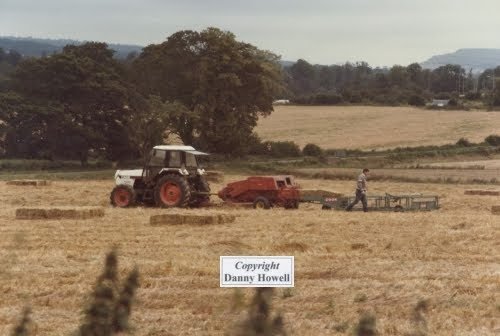
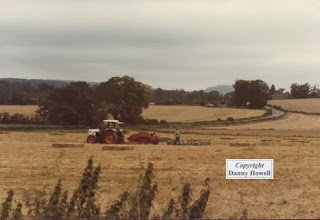
Baling Straw At Norton Bavant

Two photographs of John Parker,
an employee of Sir John Jardine Patterson,
using a Case tractor, a New Holland baler,
and a Cook’s bale accumulator,
baling straw in the Railway Field,
South Farm, Norton Bavant.

The view looks south-west from near the bridge
that carries the North Farm Road
over the railway. The Tynings, Yew Tree Cottages,
and Bishopstrow Farm are in the background.

The photographs were taken by Danny Howell
during August 1986.

error: Content is protected !!