From a list of items in Harold Nelson Dewey’s diaries 1919-1947 (list made by Percy Trollope):
9th February 1932
Mr. Harold Nelson Dewey photographed by H.F. Joyce for U.D.C. collection of past Chairmen photos.
Topics about organisations and activities in Warminster.
From a list of items in Harold Nelson Dewey’s diaries 1919-1947 (list made by Percy Trollope):
9th February 1932
Mr. Harold Nelson Dewey photographed by H.F. Joyce for U.D.C. collection of past Chairmen photos.
Victor Strode Manley, in Volume 10 of his Regional Survey of the Warminster District, compiled in the 1920s and 1930s, includes the following note:
Narrator: Mr. Foreman, West Street, Warminster. April 1931.
Re-told by R. Davis.
He worked as a shepherd until lately on Mr. Stiles’ Farm on Warminster Down. No one could be got to remain in the farmhouse because it was said to be haunted. The crockery rattled and fell, doors shut of their own account and were only opened afterwards with difficulty, so it was demolished.
(Query – Was this the same place as mentioned in the tale of the haunted sheepskin?)
Some years ago he took a flock of sheep from there to Tilshead, and returned via Imber, where he had a pint at night. When he reached the foot of Sack Hill, a white form came from the direction of Battlesbury, but it had no definite form. It stood in the middle of the road in front of him and remained there until his near approach, when it glided into a copse at the side of the road. There was no wind but a rustling sound came from the copse.
The same thing happened to him on another occasion.
7th March 1931
Contrary to what some people think, the Scouts didn’t acquire the land near the south west corner of the Lake Pleasure Grounds (Town Park), where the Greenland Hut was erected. The land belonged to Warminster Urban District Council who gave permission for the hut to be built there.
The hut was not second-hand. It was built by Messrs Holdoway of Westbury, who submitted a much lower tender than any other of the local tenders received for the work. The cost was £300.
The specifications included “An excellent floor will be laid so that dances in aid of Scout funds can be periodically held there, and also other entertainments staged.” The money was loaned upfront to pay the cost and the Scouts repaid it over a long period by holding dances, whist drives and other events.
Lord Bath officially opened the hut on Saturday 7th March 1931. That evening a whist drive was held in the hut to raise funds towards the building costs.
The hut was to measure 60ft by 24ft (some reports say 60ft by 20ft) and was to be able to seat 300 persons at events and to store the equipment and gym items of the Scouts. It was lit by electric and heated by gas.
The previous scout hut at Woodcock (where Robin Close was built much later) had been in use about seven years and had been the initiative of W. A Greenland, who had in turn been a scout, scoutmaster and district commissioner. The new hut at Weymouth Street was named the Greenland Hut after him, “whose energy was due not only to the maintenance of interest in scouting in Warminster but also to the formation of other troops in the neighbourhood. In recognition of all he has done in this direction, it is proposed to name the new hut The Greenland Hut.”
Mr Greenland had already left Warminster before the hut was built, and he was unable to attend the opening ceremony.
Victor S. Manley in his Regional Survey of the Warminster District, complied in the 1920s and 1930s, in Volume 7, noted:
THE CASE OF J.E. HALLIDAY, of East Street, Warminster, versus REV. SIR. J.E. PHILLIPS, Bart., and the Parish Church-warden.
The claim was for wrongfully interfering with, and pulling down a pew of the plaintiff’s in the south aisle of the Parish Church at Warminster, on or about 24th December 1887.
The defendant denied that the plaintiff was possessed of, or in occupation of the pew, but had been permitted to occupy it, and it was removed owing to the church restoration.
The question was whether he was entitled to the pew at common law as appurtenant to the dwelling house or as a freehold.
The title of the occupation of the house in the hands of the plaintiff’s family dated from 1644, and from that time down to the present uninterruptedly from father to son they had occupied the house.
In 1832 by deed, the plaintiff’s grandfather acquired by purchase the house, and in that conveyance it was expressed that the pew in question was conveyed. Pew rent had been paid since at least 1680 for the “ground”, sometimes called “seat”. In 1780 the parish first purported to regulate the sale and purchase of pews, all being bought for three lives. In 1833 all pews falling in were not to be renewed but were let for “rents”.
Judgement was that the plaintiff’s title was irregular though the pew had been used by the family for 200 years as it was not connected with the mansion house which was asked to be equivalent to a Bishop’s faculty. There was no lawful title to the pew, hence judgement was given for the defendants with costs.
Later Halliday won an appeal in the House of Lords and in 1897 replaced the pew, arousing such indignation locally that his effigy was burnt. One night it [the pew] was removed from the church and set alight in the Church Fields but little damage was done. Mr. Halliday patched it up and again replaced it. A donkey in spectacles was then led round the town to represent the gentleman.
After his death, his widow, whom he had married in his latter years, removed the pew to appease popular feeling, in 1913.
Manley adds the following footnotes:
J.E. Halliday, as a Nonconformist, did not use the pew, but insisted on it remaining after all other rented pews in the Minster had been removed.
An article written by Victor Strode Manley, 23rd January 1931:
The Gilded Cock In Folklore
Apropos the Supper of the Cock Inn Sick Benefit Club [Warminster] last week, the following notes should interest many. Fortunately, the beautiful gilt Cock still adorns the entrance to the Inn [at West Street, Warminster], and Mr. John Price, whose family so honourably upheld the best traditions of the hostelry for two hundred years, still treasures the other and also the last silk banner.
A recent visit from a former resident, a native of Warminster, enables me to give details of the former glory of the Club, which seems to have been inaugurated in 1820, the year of accession of George IV, but the Club Day was, with one exception, always on Whit Tuesday. In 1873 a junior branch was started, the senior branch then removing the Cock from the entrance to carry it aloft at the head of the procession, whilst the smaller one was borne by the junior branch. It was compulsory at first to wear top hats adorned with a cockade and streamers of purple and orange, but about 1860 the colours were changed to patriotic red, white and blue, and, lastly, in 1873, white favours were adopted instead. Members were then mostly content to adorn their “Jim Crow” hats. Each carried a halberd tipped with a spear-head in brass of a special pattern, until 1872. The first banner required two men to carry it, and bore a device of the Good Samaritan with the motto – “Go and do thou likewise.” The next banner, still retained by Mr. Price, has a blue silk field on top with the words in gilt, “Success to the (here follows a centre picture of a gilt fighting cock without comb) Club.”
The Wilts Friendly Society, patronised by the nobility and gentry, joined their procession until a dispute arose, as the Cock Club claimed precedence, since the Society only dated from 1830. The Oddfellows and Foresters, all in their regalia, also joined in, a gay scene being presented when all the banners hung from the old gallery in the Parish Church. Owing to the dispute with the Wilts Friendly Society and class bias, for several years the Club attended Christ Church, but space proving insufficient, a return was made to the Parish Church. The preacher of the special sermon on these occasions was presented with a guinea which he touched and returned.
The Nonconformists objected to the conviviality of the proceedings, and, as a counter demonstration, solemnly paraded the Town on Whit Mondays.
The Cock procession danced in front of various taverns en route, and by the time it reached headquarters its members were decidedly lively, and so the sports were held on the following Wednesday.
The Club Walk, called “beating the boy,” is no longer. It began in a time when there was a superstitious custom of beating the bounds to drive evil influence from the district and to establish proprietary rights; it continued as a social institution for mutual assistance in sickness and at death. With better wages than the eight to twelve shillings a week of former days, the insurance agent partly usurped the purpose of the Club, but there are still old members who sigh with regret when they think of the processions with band, banners and gaudy streamers, and the happy gathering when the Cock was toasted so uproariously, the same custom which Kim saw in the Officers’ Mess of the Irish Regiment with its Red Bull.
Origin of the cock
The symbolism of the Cock has come down to us from immemorial antiquity when it was the totem of a nation. We see it in the Gallic Cock which is still remembered in France, the animal-familiar of the harvest deity. Thus, religion is at the bottom of it all. Most probably it originated in Ancient Egypt, where first Horus and then Ra was the Sun God, both symbolised by the Hawk because that bird was supposed to reach the Sun to convey the souls of the righteous thither. At his temple at Heliopolis, near Cairo, I saw the obelisk engraved with hieroglyphics of birds on a single stone seventy feet high. And this was the now solitary companion, in 14 B.C. of “Cleopatra’s Needle” on the Thames Embankment. At Stonehenge the same idea is embodied in the Heel Stone. Heol being the Sun. These standing stones were phallic symbols of fecundity. Surmount the obelisk with the Sun Bird and one has the church steeple with its weather-cock facing heaven, showing the continuity of religious symbolism, the gilding representing the sun’s brilliance. With the Cock Club, the gilded Cock was raised high on a pole, carried at the head of the procession, a religious idea employed for a secular purpose.
In parts of Austria the figure of a cock is borne in front of the harvest wagon, when Cock Beer is served, which gives another clue to the religious idea of the bird.
Ancient religious rites have often degenerated into games and sports, and so Caesar has observed that the Britons were much addicted to cock-fighting, although it was impious to eat the bird. Perhaps some augury was deduced from the result. Tradition still speaks of the cock-fights at Cley Hill on Palm Sunday in times past. So popular must the cruel sports have been that Acts of Parliament were passed against it in 1365, 1654, and 1849, though it continued in secret. The fighting changed to throwing sticks at cocks in Lent, the “cock-shy,” a sport called La Jouote in Jersey. Wishford supplies evidence of this.
Curious are various stones said to crow when they hear a certain hour strike, just as the phoenix eagles at Portway House come down to feed when they hear the one o’clock hooter!
Notes by Victor Strode Manley, written in January 1931:
The Cock Inn Sick Benefit Club
Fortunately the beautiful gilt Cock still adorns the entrance to the Cock Inn [West Street, Warminster], and Mr. John Price, whose family so honourably upheld the best traditions of the hostelry for two hundred years, still treasures the other, and also the last silk banner.
The Club seems to have been inaugurated in 1820, the year of accession of George IV, but the Club Day, was with one exception, always on Whit Tuesday. In 1873 a junior branch was started, the senior branch then removing the Cock from the entrance to carry it aloft at the head of the procession, whilst the smaller one was borne by the junior branch.
It was compulsory at first to wear top hats adorned with a cockade and streamers of purple and orange, but about 1860 the colours were changed to patriotic red, white and blue, and lastly in 1873, white favours were adopted instead. Members were then mostly content to adorn their “Jim Crow” hats. Each carried a halberd tipped with a spear-head in brass of a special pattern until 1872.
The first banner required two men to carry it, and bore a device of the Good Samaritan with the motto – “Go and Do Thou Likewise.” The next banner, still retained by Mr. Price, has a blue silk field on top with the words in gilt, “Success to the (here follows a centre picture of a gilt fighting cock without comb) Club.”
The Cock procession danced in front of various taverns en route, and by the time it reached headquarters its members were decidedly lively, and so the sports were held on the following Wednesday.
The Club Walk called “Beating the Boy” is no longer. It began in a time when there was a superstitious custom of beating the bounds to drive evil influence from the district and establish proprietory rights; it continued as a social institution for mutual assistance in sickness and at death.
With better wages than the eight to twelve shillings a week of former days, the insurance agent partly usurped the purpose of the Club, but there are still old members who sigh with regret when they think of the processions with bands, banners, and gaudy streamers, and the happy gathering when the Cock was toasted so uproariously.
The symbolism of the Cock comes down to us from immemorial antiquity when it was the totem of a nation. We see it in the Gallic Cock, which is still remembered in France, the animal-familiar of the harvest diety. Thus religion is at the bottom of it all.
Most probably it originated in Ancient Egypt where first Horus and then Ra was the Sun God, both symbolised by the Hawk because that bird was supposed to reach the sun to convey the souls of the righteous thither. At his temple in Heliopolis, near Cairo, I saw the obelisk engraved with hieroglyphics of birds on a single stone seventy feet high. And this was the now solitary companion, in 14 B.C., of “Cleopatra’s Needle’ on the Thames Embankment.
At Stonehenge, the same idea is embodied in the Heel Stone, Heol being the Sun. These standing stones were phallic symbols of fecundity. Surmount the Obelisk with the Sun Bird and one has the church steeple with its weather-cock facing heaven, shewing the continuity of religious symbolism, the gilding representing the sun’s brilliance. With the Cock Club, the gilded Cock was raised high on a pole, carried at the head of the procession, a religious idea employed for secular purposes.
Tradition still speaks of cock-fights at Cley Hill on Palm Sunday in times past.
Victor S. Manley in his Regional Survey of the Warminster District, complied in the 1920s and 1930s, in Volume 7, noted:
The Chapel of St. Nicholas once stood in the grounds of the Manor House in Ash Walk. Only part of a buttress remains in the wall of the stable.
It was founded and endowed by the Mauduits and may have been discontinued when they added their chantry, now the Lady Chapel, in the Parish Church, in Tudor times.
St. Nicholas, being the patron saint of children, the idea of family heirs suggests itself.
It was in use as early as 1268 (see History of Warminster, page 124). “The Chaplain received certain rents, he held meadow, pasture, and arable lands, with right of feeding pigs in the lord’s woods, and sheep on the Common; he was allowed a liberal supply of fuel, and took his principal meal at the lord’s table.”
Speculation on the origin of the name “Warminster” led Hoare to state:- “Tradition, however, has preserved it from oblivion, the spot being called “THE NUNNERY’ and a walk up the side of the neighbouring down being called “THE NUNS’ PATH’.” The question arises of the origin of the tradition, was it ancient or invented by the speculators. (See History of Warminster, page 123).
Victor Strode Manley, in Volume 10 of his Regional Survey of the Warminster District, compiled in the 1920s and 1930s, includes the following:
45 East Street, Warminster has the reputation of being haunted as stated by several persons.
In May 1931 I was given two incidents by Mrs. – who used to live in the terrace adjoining the house. It was about eleven o’clock one night when she was going home, and near the house she could see a woman with long sleeves. The stranger gave her a poke in the back and was asked if there was not room for both on the pavement. The stranger crossed the road and then rose from the ground and passed out of sight.
Her father was going to work very early one morning and is positive he saw a spectral figure come from the house, cross the road, and disappear up the lane by the posts.
George Strode Manley informs me he remembers a Mr. Petherbridge living there. He was engaged in making ploughs.
No explanation has been offered.
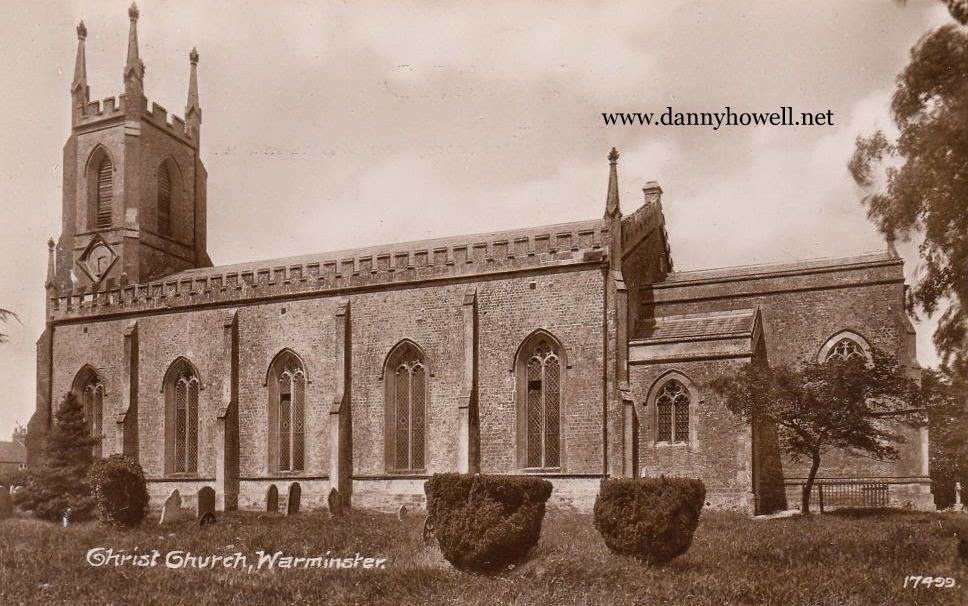
The south-facing side of Christ Church,
Warminster, circa 1930.
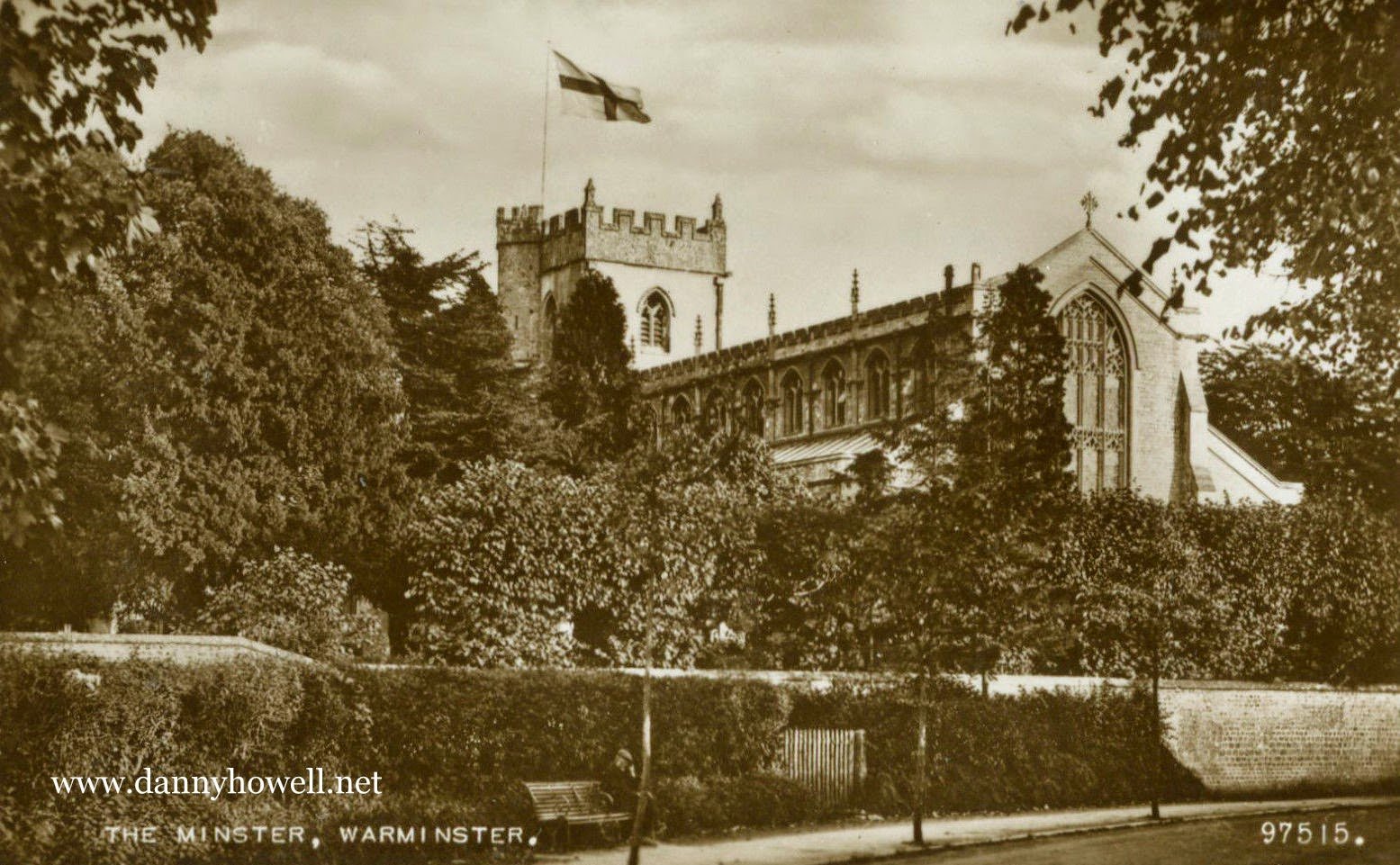
The England flag of St. George flying on the
tower of The Parish Church of St. Denys,
The Minster, Warminster, in this postcard view
from the Bath Road, circa 1930.