The Boreham Road Nonconformist Cemetery, Warminster

Wilfred Middlebrook, in The Changing Face Of Warminster, first written in 1960, updated in 1971, noted:

There is a little cemetery on Boreham Road, with an imposing entrance inscribed “Mors Janua Vitae,” meaning presumably that “Death is the birth of a new life.” This ground was bought in shares, in 1822, for the burial of nonconformists, and in 1950 it was made into a garden of remembrance at the initial cost of Miss May Bradfield of Bath; the ground being levelled and turfed, and all the legible gravestones arranged neatly against the surrounding walls. A far different story to that of the old Quaker burial ground at Bugley, now ploughed out of existence.

St. Boniface College, Warminster

Extract from The Changing Face Of Warminster by Wilfred Middlebrook, published in 1971:

Across the street [Church Street], further along, are the imposing and lofty buildings that once housed St. Boniface Theological College, giving an atmosphere of quiet scholasticism as one walks along this pleasant street, curving continuously towards the town. An old resident of Coldharbour recalled the first building of St. Boniface, springing as it did from a small house which was enlarged as time went by. Nearby was a block of cottages on the site later occupied by the Warden’s residence.

The founder of the College was the Rev. James Erasmus Philipps, M.A., one-time Vicar Of Warminster, who was born at Boyton in 1824 (his father, the Rev. Sir James Erasmus Philipps, was assistant curate at Boyton). He was Vicar Of Warminster from 1859 to 1897, and succeeded his father as 12th Baronet in 1873. He had a passion for building, being the originator of St. John’s Church (1865), St. John’s School (1868), the Cottage Hospital (1866 – rebuilt 1928), the Orphanage Of Pity (1867), St. Denys’ Home (1868) – the first three Sisters were professed in 1879, St. Denys’ College and St. Monica’s School. He also restored the Parish Church Of St. Denys, also known as the Minster, at a cost of about £10,000, practically rebuilding it except for the tower, the south porch and the Lady Chapel.

The Warminster Mission House, as it was first called, was a small house nearer the church, across the road. A larger house was taken in 1863, now called the Old Building, a spacious house with lovely gardens valued then at £1,100, and held on a yearly tenancy until a Mrs. Torrance of Norton Bavant House gave £1,000 towards its purchase. Byne House stands directly across the road from the Old Building. There is a story to the effect that the Old Building was erected by the brother of the builder of Byne House in order to spoil the view, and there is no doubt about the fact that it has certainly succeeded in its purpose if such were the case.

The name of the Mission House was changed to St. Boniface in 1871. The Warden had received a letter from Bishop Cotton of Calcutta expressing a wish “to see a body of men at work on the old Columba and Boniface systems.” The following day there was dug up in the terrace behind Portway House, at a depth of nine feet, a leaden “bulla’ on which was stamped the name of Pope Boniface IX, once Pope of Rome. The co-incidence was too great to be ignored, and the College took its new name of St. Boniface. 

This fine building, with its spacious grounds and lovely chapel erected in 1927, was attached to King’s College of London as a post-graduate college for theological students after the last War, but is now used by the Lord Weymouth’s Grammar School.

A feature of St. Boniface College in its heyday was the annual July Festival, when countless visitors and friends attended the College. A mammoth procession of students and clergymen from all parts of the Diocese wended its way from the College grounds to the Minster Church for the Anniversary Service. This was followed by luncheon in a large marquee in the College grounds. This annual procession with colourful banners attracted large crowds.

A farewell party for nearly a hundred people was held in May 1969 before the College was transferred to St. Augustine’s College, Canterbury. 

During the last War, the premises were occupied in turn by the Brigade Of Guards, the United States Army, and Salisbury Teachers’ Training College. In 1948 the College was re-opened by King’s College of London. Now, a newly-painted board announces the ownership or tenancy of the Lord Weymouth Grammar School.

St. Monica’s School, Warminster, Formed From The Main Block Of Langley’s Farm

Wilfred Middlebrook, in his newspaper serialisation The Changing Face Of Warminster, written in 1970 and published in 1971, noted:

St. Monica’s School [at Vicarage Street, Warminster], enlarged and improved at a cost of over £37,000 in 1961, was formed from the main block of what was once Langley’s Farm, which dates back to the 15th or 16th century. The half-timbering and stone-facing is still preserved.

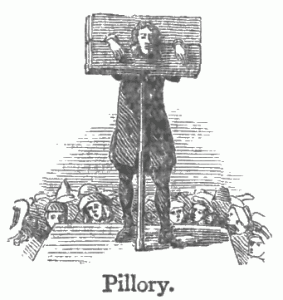
The Ducking Stool And The Pillory In Warminster

Exract from The Changing Face Of Warminster, by Wilfred Middlebrook, published in 1971:

There are several references to the Sloper family in the 17th century Quarter Sessions records.

For example, in July 1607, it was recorded that a “cooking stoole!’ was needed in the town of Warminster, to be made and maintained by Simon Sloper.

Thirty years later, in 1637, the Jury at Warminster present “that they have neither a cucking stool (ducking stool) nor pillory in Warminster, and that William Sloper must maintain and put them up.”

It seems as though the present century has no monopoly in procrastination, for in 1647 comes: “We present that we have noe stocks in the towne of Warminster in default of William Sloper” (ordered to be provided before August under penalty of 40/-).

In 1650 the presentment to the Jury states “that their church is mightily in decay insomuch that the pishoners (parishioners) are afraid to assemble there,” and in 1669 we find “Simon Sloper Junior presented for not setting up a Pillory and Cookinge Stoole in Warminster.” They must have been a kind-hearted lot, these Slopers of Ash Walk.

Nonconformity

Extract from The Changing Face Of Warminster by Wilfred Middlebrook, published in 1971:

As previously described in connection with the Avenue, a barn in Beastleaze was first used for worship in 1687. This place of service was superseded in 1704 by the erection of the Old Meeting in North Row; a substantial building still standing, bearing the title “Girls British School.’ This has been named as the original Old Meeting, but this seems hardly likely to me. This school is now used by the Wiltshire County Council Department Of Further Education.

Nonconformity preaching was a risky business in those far-off days of the Restoration after Cromwell. Edward Buckler of Boreham was Chaplain to Oliver Cromwell, but when the monarchy was restored he saw his brother, John Buckler, languishing in Fisherton Gaol for preaching the Gospel.

The Old Meeting started as a Presbyterian movement, following the establishment of the Scottish Presbyterian Chapel in 1566 at Horningsham, when Longleat House was being built. Later it tended to favour Unitarian doctrines, and the congregation gradually dwindled away until it died out in 1860 and the Old Meeting House was sold. The British School for Girls, first established in Ash Walk, removed to Common Close in 1837, and was finally transferred to the old Unitarian Chapel in 1874.

The Langleys were an old Warminster family, named in parish registers of the early seventeenth century. An old chalice, dated 1682, bears the name of John Langley as churchwarden at the Minster Church, but he later favoured the Nonconformists, and bequeathed £400 to the Trustees of the Old Meeting House. The interest on this money was to be given every Christmas Day to persons attending worship there, to be transferred to sixty-four poor parishioners – who would get five shillings each – if the Old Meeting House was disbanded, which it eventually was. John Langley was the uncle of Mr. Temple, who inherited from him his Bishopstrow estate.

John Pearce, the grandfather of William Morgan the brewer, lived in Meeting House Lane, and for sixty years he and a few friends conducted brief religious services at his home every Thursday and Sunday night. John Pearce died in 1809.

The Reformatory School

Extract from The Changing Face Of Warminster by Wilfred Middlebrook, published in 1971:

A footpath climbs up through Nutball Wood from Cannimore, passing what was once the Reformatory School at Tascroft. It was later a dairy farm and is now converted into modern flats. The footpath rejoins Folly Lane before finally descending to join the Frome road.

The Reformatory was built in 1856. A report for January of that year stated that “a site has been selected for the Reformatory School at Bugley, near the Half Mile Road, called Tascroft. The site is of rare salubrity. A tender of £800 has been accepted for the building.”

The following year, the Chapel Of St. Laurence in Warminster was re-opened for services on Sunday mornings for inmates of the Union or Workhouse and the sixteen boys from the Reformatory. These lads had a special treat when the Diamond Jubilee of Queen Victoria was celebrated, being brought in wagons to Sambourne Cricket Ground to see the firework display. As an added precaution the wagons were surrounded by hurdles to prevent the boys escaping.

The late Mr. James Rutty, J.P., of Upper Marsh Road, was at one time a carpentry instructor at the Reformatory School.

The Lock Up In The Avenue, Warminster

Extract from The Changing Face Of Warminster by Wilfred Middlebrook, published in 1971:

There is a curious roundhouse in front of the Avenue School, a tree-shaded building of weathered brick with small apertures closed by rusting iron plates. According to Mr. Samuel Smart, who owns the nearby scrap metal business, this is an old lock-up, where drunks were incarcerated in olden days .

Charities Associated With The King’s Arms Inn, Warminster

Extract from The Changing Face Of Warminster by Wilfred Middlebrook, published in 1971:

The Co-operative buildings end this side [north side] of the Market Place at North Row or Meeting House Lane. This was once the site of the King’s Arms (not to be confused with another inn, with the same name, in Weymouth Street). The old King’s Arms, on the corner of Meeting House Lane, was used as a source of Warminster charities. King’s Charity, named after a London silk merchant called William King, first decreed that the rents of all his lands in Warminster should be divided among four deserving persons, who should not receive any other alms. These lands produced forty shillings a year in 1772. William King died in 1769.

After the Enclosure Awards of 1783, allotments in Chedlanger Field, near Brick Hill, were awarded to the Churchwardens and Overseers in lieu of the former lands and let at six pounds a year. For many years this sum was divided among fifteen men at eight shillings each, altered in 1833 to ten shillings each for twelve persons and paid on St. Stephen’s Day. This charity was not actually paid out at the King’s Arms, but the original source of King’s Charity was derived “from tenements or houses thereunto belonging known by the name of the King’s Arms Warminster.”

Slade’s Charity was payable out of the King’s Arms inn, when “twenty poor housekeepers of the Parish, who received nothing of the collection for the Poor,” received twenty half-crowns around 15th January every year. William Slade died in 1723, and a rent-charge of fifty shillings “on a freehold property situate at the entrance of Meeting House Lane” was distributed as Slade’s Charity at Christmas.

St. George’s Church And School, Warminster

Wilfred Middlebrook, in The Changing Face Of Warminster, first written in 1960, updated in 1971, noted:

The Catholic Church of St. George, a modern red-brick building with a stone statue of England’s patron saint above the doorway, was built in 1922. A priest used to travel from Frome to administer to this new church, but as time went on there were increasing signs that Warminster was to become a military town. In 1938, when the Tank Barracks were being constructed, this little Catholic Church was also enlarged and a priest’s residence added.

Mention of this Catholic Church brings us to another big change in the face of Warminster, where Boreham Farm has been demolished at Boreham Crossroads, and a vast level playing field created there. At the Woodcock Road corner of this field is the newly-erected Catholic School, the first of its kind in Warminster.

Mother Goose ~ Pantomime By The Athenaeum Variety Group, Warminster, 1974

The Athenaeum Variety Group
presents
Mother Goose

Written and Produced by Geoff Payne

Athenaeum Arts Centre
Warminster

Monday 4th February to Saturday 9th February
and
Thursday 14th February to Saturday 16th February
1974

Doors Open 7.00 p.m. Curtain up 7.30 p.m.

Seats 40p and 35p.
Children (under fourteen) and Senior Citizens 25p.

No smoking in the Auditorium.

Cast
Wendy – Glenda Murray
Tom – Susan Reynolds
Dame – John (Taffy) Jenkins
Baron Goodyear – Richard Owen
The Goose – David G. Payne
Dock (policeman) – Archie Lawson
Green (policeman) – Bert Clews
Zeke (robber) – Len Jenkins
Sam (robber) – Barry Mole
Jake (robber) – W. David Payne
Merlin – Geoff Payne
Fairy Nuff – Dorothy Fear

Dancers
Nicola White and Elizabeth Cotton

Chorus
Deborah Sheil
Carol Pimm
Susan Fox
Barbara Grevatt
Laonie McNulty
Shirley Hampton
Debbie Reynolds
Sandra Balderstone
Pat Kinman
Marlene Hancock
Silvanna Holton
Valerie House

Act One
Scene One – Market Place
Richard Owen, Glenda Murray, Taffy Jenkins,
Archie Lawson, Bert Clews,
Susan Reynolds, Goose, Chorus.

Scene Two – The Wizard’s Cave
Dancers, Geoff Payne, Susan Reynolds,
Goose, Dorothy Fear.

Scene Three – The Road To The Woods
Barry Mole, Len Jenkins, David Payne,
Susan Reynolds, Goose, Archie Lawson,
Bert Clews, Glenda Murray,
Taffy Jenkins, Richard Owen.

Interval

Act Two
Scene One – In The Woods
Barry Mole, Len Jenkins, David Payne,
Goose, Susan Reynolds, Geoff Payne,
Dorothy Fear, Archie Lawson,
Bert Clews, Taffy Jenkins.

Scene Two – Market Place
Richard Owen, Glenda Murray,
Taffy Jenkins, Archie Lawson,
Bert Clews, Susan Reynolds, Goose.

Scene Three – The Carnival
Full Cast.

Dancers trained by Miss Gloria Sloper.

Script by Geoff Payne.
Music by Bernie Reynolds.
Drummer Steve Reynolds.
Produced by Geoff Payne.
Costumes by
Eileen Jenkins, Carol Barnett, Peggy Reynolds.
Scenery Design by Barry Mole.
Sound and Effects by Harry Barnett.
Props and Scenery by
Barry Mole, Archie Lawson, Ann Curtis
Alan Curtis, John Curtis and Richard Owen.
Lighting by Barry Wright.
Stage Manager Tony Barnett.
Front-House Manager Harry Barnett.
Assisted by Tony Lapham.
Publicity by Richard Owen.

The Athenaeum Variety Group wish to thank
stage-crew, usherettes, and others
not mentioned in the programme
who have willingly given their help
to make this show possible.

Box Office – Athenaeum Arts Centre,
Warminster, Wilts.
Open Monday to Saturday, 10 a.m. to 12 Noon.
Telephone Warminster 3891.

error: Content is protected !!