The Heytesbury Blacksmith

7 December 2000

One hundred and seventy-five years ago today, on 7th December 1825, Charles Dyer was born at Berwick St. James, where his father and grandfather were both blacksmiths.

At the age of eight, Charles worked in the fields, when men earned eight shillings a week with an extra shilling when they were married.

He later found employment at Southampton and walked the 30 miles or more to his home each weekend; returning to the south coast port for work on Mondays.

About 1853 he settled at Heytesbury, running his own smithy and living at The Hollow.

Charles Dyer reached the grand old age of 101. “Na’ar a man in ‘Yetsbury ‘ave worked ‘s ‘ard as I av” was, he said, the reason for his longevity, aided by a quart of beer at meal times. Tea was such a luxury that it was only drunk on Sundays! And no barber had ever cut his hair.

Among his earliest memories was the time when, about 1830, there were riots by labourers protesting about the introduction of machinery. The rioters started at Bristol, touring the country, smashing up machines on their way. When they demonstrated outside his parents’ home at Berwick St. James, his father gave them half-a-crown and gently persuaded them to go away without doing any damage.

On his 100th birthday, Charles Dyer received a letter of congratulation from the King and Queen; the village bells were rung; he was presented with an illuminated address and a rug; and he was photographed for the London press.

His son, Alma, was in June 1928, still continuing in business at the Heytesbury smithy.

Another smith in the village had, at this time, already converted his workplace into a petrol station.

Loitering With Intent?

Sybil Fuller, writing in November 1998, recalled:

I remember going into St. George’s Church [at Boreham Road, Warminster] one day in the 1950s and seeing a shabbily-dressed man wandering around, seemingly inspecting everything. My father, thinking he was a tramp loitering with intent, waited until he went out and then followed him into Boreham Road and bade him ‘Good night’. The man replied in a cultured voice, and my father asked him whether he was just passing through the town, or was a new resident. “Oh no,” said the man. “I live in Heytesbury, my name is Sassoon.” After that, we got quite used to seeing Siegfried Sassoon worshipping in St. George’s – driving up in his equally shabby old high back car.

Heytesbury Extravaganza Sponsors

Heytesbury Extravaganza

Saturday 9th September 1995

List of Sponsors

Once again Sponsors have dug deep into their pockets. Through their generosity over £400 has been raised to support the Extravaganza’s fund raising effort. All of the sponsorship money goes back into our community, the cost of producing the souvenir programme being met by equally generous advertisers. Val Rex and her dedicated team have once again worked extremely hard to produce a marvelous result.

The Andrews.

Everett Ball.
Pamela Ball.
Emily Banks.
Oliver Banks.

The Bernstorff-Gyldensteens.
Brian Bilton.
Gillian Bilton.

J. Blackwell.
The Blenkarnes.
Cheryl Bligdon.

The Bonds.
Mrs. Bryant.
A. Buchanan.

The Cahills.
Oliver Castle.
The Charlesworths.

The Cloughs.
Michael Coleman.
Audrey Coleman.

D. Connebeer.
J. Connebeer.
D.E. & F.E. Curd.

S. Daley.
Joyce Davey.
Louis Davey.

The Dippers.
Joyce Dobson.
Tim Dobson.

C. & R. Dohnoheu.
Rose Donaldson.
Bert Dowding.
The Downes.
The Duffs.

Peter Early.
The Easons.
The Eaton-Harts.
The Everards.
The Fillinghams.

Margaret Fishley.
Dora Fitch.
Margaret Fitch.

The Fitzgeralds.
Ian Fraser.
Wenna Fraser.

Joan Freeland.
Russell Freeland.
Mr. & Mrs. Frost.

The Garthwaites.
Hilary Gibson.
Mike Gibson.
P. Giessler.

The Gilberts.
Jean Grace.
Mrs. Gready.
The Gross’s.

S.P. Heath.
The Hisketts.
The ‘Orrible’ Etts.

The Howard-Vyses.
Thee Howletts.
E. Humphries.

Janet Jay.

The Katons.

Daphne Ladd.
The Lawes.
Tony Lawrence.

The Lemans.
The Lester-Cards.
Geoff Lewis.

Jean Lewis.
The Lindsays.
Mr. Lock.

E. Mansfield.
Dawn McEvoy.
The McLarens.

Mr. Mitchell.
The Moraths.
The Morrisons.

The Mulhollands.
Joan Murray.
Keith Murray.

T. Northeast.

The O’Connors.
Annie Onraet.
The Osbornes.
Joan Oxenham.
John Oxenham.

Helen Pearce.
W. Pearson-Gee.
R. & P. Penny.
Mr. & Mrs. Piechowski.

T. & C. Poolman.
D. Porter.
The Pottows.
Gill Prior.

K. & S. Rea.
Rex & Regina.
Angie Reynolds.
J. Reynolds.

Heytesbury Resident Awarded The B.E.M.

Friday 1st June 1984

Heytesbury resident Miss Millicent Williams was presented with the British Empire Medal by the Lord Lieutenant of Wiltshire, at a special ceremonial reception at Heytesbury School on May 18th.

Colonel Hugh Brassey read out a letter from the Queen who regretted that she was unable to make the presentation personally. Also during the reception, which was organised and paid for by members of Heytesbury Parish Council, Miss Williams received several bouquets and baskets of flowers from many of the fifty guests present.

Miss Williams, who heralds from Dilton Marsh, was awarded the BEM for her services to the Heytesbury community. She came to the village, when she was twelve years old, in 1921, to work for the Misses Sarah and Alice Adlam, the then owners of Heytesbury village shop. Miss Williams took over the shop in 1944 when the second Miss Adlam died, and ran it until her retirement in 1976.

Miss Williams, who lives in the High Street, is currently keeping busy, visiting the sick and the lonely in the village, and she also arranges the flowers in the Parish Church of St. Peter and St. Paul.

Report from the Wylye Valley Life magazine.

Heytesbury – Recollections Of An Old ‘Un

Recollections Of An Old ‘Un

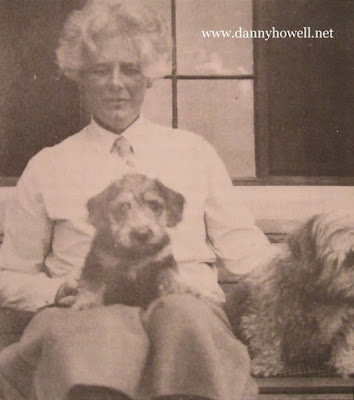
Nancy Bouverie, pictured circa 1930,
with two of her dogs, Whisky and Soda. 

Miss Nancy Pleydell Bouverie, who died on 30th October 1972, aged 87, and is buried near the north-east corner of Heytesbury Churchyard, left the following written memories, which she called Recollections Of An Old ‘Un. They provide a picture of Heytesbury from 1911 to 1950, a period interrupted by two World Wars, and portray the way life was in the village. This is what Nancy recalled:

“In 1911 we came to Heytesbury, three sisters and a brother and all the furniture. It was carted up from the Station by Mr Pike and his merry men who were such a help that I shall be eternally grateful. Everyone was kind to us young things and when we found that we had everything necessary in the house except matches to light the lamps we went down to Miss Daly’s (now Mr Davis’ shop) who not only provided the matches but offered to light the lamps for us.”

“The first excitement was the arrival of the mail cart from Bath, an old gentleman and his little white dog sitting on the box. In those days Her Majesty’s mail was too precious to be trusted to those new-fangled railways and was transported by horse and coach. The postman came from Bath in the morning, as far as Wylye, and collected the letters on his return in the evening; and the letters were delivered in London the next day without fail and all for a penny.”

“The village in those days was, of course, much quieter, with only the occasional cars going through. We had to amuse ourselves more and there were lots of activities. One activity was polo. Heytesbury had quite a good polo team which played in Mr Osborne’s field. People brought their own ponies and a good time was had by all.”

“There were some funny habits in the village, as there still are; Margaret Lady Heytesbury was a bit of a character and disapproved of the draught in the church, well known to all of us. When it was particularly bad she sat under an umbrella.”

“The declaration of war, in 1914, stands out in my memory. There was only one telephone in the village, at the Estate Office. There was always a large crowd there on August 3rd and 4th, waiting for news. They included an old man called Twabeard, who was so called because he had a two-pronged beard. He became a great friend though I never discovered his real name.” 

“Then the war broke out and we all worked hard in the Red Cross detachment tent in the village; every afternoon we all gathered and weaved straw mattresses for the sick and injured recruits encamped at Sherrington. Otherwise they had to sleep on the ground. We went in rota to wash the sick before they were sent to the base hospital. They appreciated that because the Sergeant-Major only allowed hot water when the ladies came. For the next few years the detachment was dispersed all over the country.” 

“The next great event was the declaration of peace and the joyful celebrations. The highlight was the cricket-match between the ladies and gentlemen. The star of the match was Miss Dolly Maslin (later Mrs Frank Whitfield) who, wearing a very long fashionable hobbled skirt and high heels, ran with a floppy hat in one hand and the bat in the other. She made ten runs (top score) and carried her bat. There was a large bonfire as near the top of Cotley Hill as we had the energy to carry the wood. From the top we could see bonfires on the top of every hill above every village as far as the horizon.”

“The first year that women had the vote was memorable though not at all appreciated by the men folk. Before this they had a great time having magnificent fights protecting their candidates. Old Mr Bill Field told me that he and Mr White, the blacksmith, were escorting the Conservative candidate, Mr Challoner, down the High Street one night and Mr White hit several people whom he could not even recognise in the dark. There were many black eyes the next morning but nobody bore any grudges.” 

“After the War one of my sisters married and we had to move from the Vicarage and we built Bunters and moved there. Bunters was on the site of an old Army camp used during the War and was a jungle of nettles, barbed wire and rubbish. Even now an occasional 1914-18 bottle or bullet is found when ploughing the field next door. We moved, carrying our effects in a horse and cart, assisted by the donkey and cart for carrying odds and ends like chickens, and with a baby donkey running behind.”

“Time passed happily and we came to the Second World War. At the tender age of 55 I was made the head of the Defence Committee, set up to defend the village, composed mostly of old men and useless women. Every able-bodied man had been taken for the army or the Home Guard. We were told that any holes in the road were to be filled immediately. The only labour available was the old men in St. John’s Hospital and the women – willing but weak.”

“There were other precautions. I moved my beehives, under order, near the road so that if the German tanks came I was to tip them over to sting the Germans and hold up their advance. Of more use was the cave dug in the bank and filled with incendiary bombs which were to be thrown into the road when the enemy came.” 

“Heytesbury House was full of revolting biscuits and valuable books from London. There were other large food piles.” 

“In those days Queen Mary was a frequent traveller through the village as she was living at Badminton and I remember that she was once held up in the village street by George Rendell’s cows coming home to be milked. She smiled and bowed to all of us who were waving to her.”

“We had three bombs in the Park which did no damage but the blast behaved in a peculiar way as Bunters, some way from the village, was shaken to the foundations and the walls cracked; but down in the village, Miss Joyce Bartlett thought that a reel of cotton had fallen off the dresser. Three bombs fell by Knook Camp, of  which I still have several bits (quite harmless).”

“I have less dangerous recollections of the war. Some German soldiers walked up and down Warminster Market Place and nobody took the slightest notice; in fact they were Englishmen from the Ministry testing out the alertness of the population.”  

“We were having a Civil Defence exercise once and some joker told the pensioners of St. John’s Hospital that they would not be safe without their gas masks and so they all went down to church wearing top hats, red cloaks and gas masks.”

“Peace came again and life reverted to normal except for more cars and more houses. Great changes have come to the village, some good, some bad. The post takes two days to get to London for four pence but Heytesbury is still Heytesbury.”
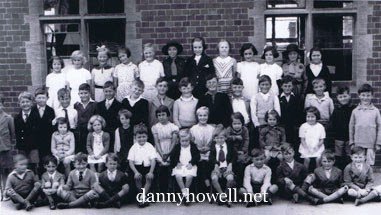
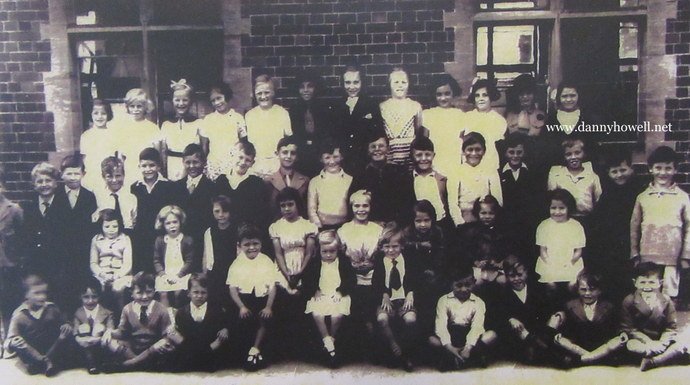
Heytesbury School, 1939

Pupils at Heytesbury School in 1939.

Back row, left to right:
Betty Hoddinott, Eileen Fisher, Evelyn Ryall,
Jean Gilbert, Margaret Pearce, Agnes Dredge,
Jean Hughes,   -  Kitley, Muriel Tongs,
Eileen Stickland,     ?   ,  Kathleen Hallett.

Second Row (from back), left to right:
John Fincham (of Norton Bavant),
? , ? , ? , Gerald Hoddinott, ? ,
Dennis Hill, ? , Ken Irish, ? , ? , Alan Fitch,
William Potter, Peter Goodenough,
David Williams, Jack Williams.

Third row, left to right:
Hazel Fielding, Audrey Elloway,
Isabelle Burroughs, ? , Hilda Goodenough,
Georgina Potter, ? , Linda Hoddinott.

Front row, left to right:
Ernie Dredge, Leslie Tongs, Peter Mintoe,
David Harford, ? , Betty Bray, Glyn Routley,
Rowland Elloway, ? , Tony Maslen, Ken Northeast.

Pupils At Heytesbury School In 1939

Pupils at Heytesbury School in 1939.

Back row, left to right:
Betty Hoddinott, Eileen Fisher, Evelyn Ryall, Jean Gilbert, Margaret Pearce, Agnes Dredge, Jean Hughes,   -  Kitley, Muriel Tongs, Eileen Stickland,     ?   ,  Kathleen Hallett.

Second Row (from back), left to right:
John Fincham (of Norton Bavant), ? , ? , ? , Gerald Hoddinott, ? , Dennis Hill, ? , Ken Irish, ? , ? , Alan Fitch, William Potter, Peter Goodenough, David Williams, Jack Williams.

Third row, left to right:
Hazel Fielding, Audrey Elloway, Isabelle Burroughs, ? , Hilda Goodenough, Georgina Potter, ? , Linda Hoddinott.

Front row, left to right:
Ernie Dredge, Leslie Tongs, Peter Mintoe, David Harford, ? , Betty Bray, Glyn Routley, Rowland Elloway, ? , Tony Maslen, Ken Northeast.