Details of Church Services
at Corsley and Chapmanslade during October 2011.
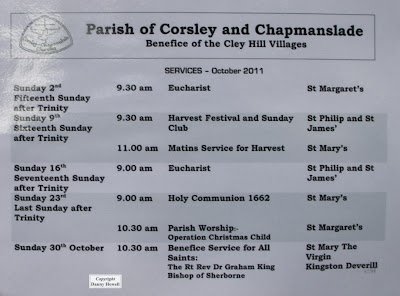
Details of Church Services
at Corsley and Chapmanslade during October 2011.
March 2011
Advertisement –
Squires Coal,
Corsley.
Suppliers of all Solid Fuels
Competitive Prices
Regular Deliveries
48 hour Emergency Service
Cash And Carry at our yard, Lane End, Corsley.
Telephone 01373 832296.
Wednesday 4th August 2004
A driver who crashed his car on the A362 Warminster to Frome Road, near the Royal Oak public house, at Corsley Heath, suffered minor injuries, during the evening of Wednesday 4 August 2004. No other vehicles were involved. Warminster Fire Brigade was called to the accident at 7 p.m. and made the vehicle safe.
In December 1990 Mrs. Stephanie Chandler made the news, with her attempt to get the business rate for Corsley Sub-Post Office reduced. Mrs. Chandler, who rented her home from the Longleat Estate, said the Post Office and Shop was open five mornings a week, but in an effort to lessen the rate she was paying (£400) she had stopped selling grocery items during the previous two months. The District Valuer, Mr. D. Farris, was quoted in the press as saying: “If the size of the shop is reduced, the business rate will be reduced and back-dated to when the alterations were made.”
October 1990
Potatoes
28lbs. for £1.50.
R. Jones,
Manor Farm, Corsley.
Collection only.
Eight members of the public attended the Annual Meeting of Corsley Parish Council, held at the Reading Room, Corsley Heath, on Monday 10 March 1986.
The Chairman, Mr. John Alexander, paid tribute in his report to the work of Mrs. Joy Hares who has been Clerk to the Parish Council for 14 years. Ill health forced her to resign last year. Mr. Alexander also thanked Commander Chapman for standing in as clerk until the appointment of Mr. G. P. Dawson early in 1986.
It was made known that residential development in Corsley is mainly determined by the provision of sewage disposal facilities. A scheme for the village could prove very costly. The parish council has also considered the provision of local housing with the West Wilts Housing Association but Mr. Alexander said he could not forsee any action by the council in the near future.
Concerns were expressed by Mr. Alexander and also the local police, regarding the incidence of minor crime in Corsley. Mr. Alexander proposed that a meeting be arranged with the police authority to discuss what individual householders in the village could do to minimise the risks.
Wednesday 8th December 1982
Mr. T. Quincey has submitted a planning application for a two-floor extension at 114 The Hollow, Corsley.
Friday 26th February 1982
A Ford Escort estate hit the roadside bank and overturned on the A362 road at Whitbourne Springs, Corsley, on Wednesday night last week. The driver, John Abrahams, of Ledbury House, Chewstoke, Bristol, was unhurt.
Corsley W.I. Annual General Meeting, April 1978
Corsley W.I.’s 57th A.G.M. was well attended and there was a special welcome for Mrs. Hanna and Mrs. Luard who returned after absences.
Arrangements were made for the May meeting to be held at Chapmanslade, for discussion of Resolutions being brought before the National A.G.M.; also for the Group meeting at Boreham in June.
Members were asked to support the forthcoming Arthritis and Rheumatism Council’s coffee morning in Frome.
This year, the rose bowl awarded for highest marks in the year’s monthly competitions was won by Mrs. Kaye, and awards for full attendance at meetings went to Miss Edwards, Mrs. J. Forward, Mrs. Kaye and Mrs. Fitzpatrick.
The treasurer, Mrs. Bastin, reported a balance of £49, and was thanked by Mrs. K. Pike.
A special vote of thanks was proposed by Mrs. Kaye to the secretary Mrs. S. Forward.
The President, Mrs. Watts, was warmly thanked after her address by Mrs. Hayward.
An interesting talk by the V.C.O., Mrs. Hodgson, on the possibilities and scope of the W.I. movement was directed particularly to new members but appreciated by all.
Mrs. Watts was re-elected President for the coming year and all nominees to the committee. After which, the meeting enjoyed a delicious fish and chip supper.
The monthly competition for a decorated plate was won by Miss Edwards, Mrs. Fitzpatrick and Miss C.M.H. White.
The fundraising competition was won by Mrs. Vallis, Miss Edwards and Miss Atherton.
K.H. Rogers, in Wiltshire And Somerset Woollen Mills, published by the Pasold Research Fund Ltd., in 1976, noted:
Corsley Mill
The history of Corsley Mill as a grist mill, part of the Longleat estate, can be traced from the sixteenth century. A new lease was made in 1778 to Mary Webb, widow, one of the lives being her brother, William Hooper. At her death in 1798, the lease passed to Robert Hooper, of Bradford and John Hooper of Westbury, surgeons, who were probably her nephews. They obtained a new lease in 1803, which lasted until 1861.
In 1800, the mill was underlet to two clothiers from Trowbridge, John Hooper Taunton and Thomas Vine. A letter written by Robert Hooper to Thomas Davis, the Longleat steward, in 1806, gives such a clear picture of the arrangements that it is worth quoting at length:
When Messrs. Taunton and Vine applied to me to take the mill for their uses, they offered us £150 per annum for the same on condition of our building the factory, and other needful repairs, etc., but we afterwards agreed to take a rent of £100 a year, to advance them such sum of money as they should lay out thereon on their paying us the interest thereon and the principal by instalments, which according to their calculations would amount to £150 per annum. But that proving deficient by £300 (though they had a regular estimate), that increased their annunity from £50 to £80 per annum.
Hooper, who was evidently a conscientious landlord, was worried about what rent he should charge his tenants after the expiration of their first fourteen-year lease, when they would ha laidve paid off the capital sum laid out on the factory. They declared that they could not afford more than £150. Since they had been there the price paid for scribbling and carding wool had dropped so much, and the price for grinding corn had risen 6d. a sack, that they would have preferred the mill in its former state. It did, in fact, retain three pairs of stones, but only one could be worked at a time, and then only if the clothing machinery was stopped. Hooper believed that they could not afford more rent, and went on:
I am sure no one else could, as when they have employment they are always in the factory 20 hours out of the 24. If the mill was within a mile of Bradford or Trowbridge it would be worth £100 per annum more . . . the additional expense they are at and the losses they sustain in consequence of the distance is more than that.
Taunton and Vine also suffered from disputes with the neighbouring farmer over the watering of the meadows below the mill. Previously the water had been available to the meadows from the end of the mill’s working on Saturday until early morning on Monday, but after the machinery was installed more water was needed, and the hatches were put down on Sunday evenings to allow the pond to fill.
In spite of the difficulties of the position, the mill remained active as a cloth and grist mill until the death of John Hooper Taunton in 1848. In 1849 a half share of the leasehold mill was offered for sale. The corn mill contained two pairs of stones, two dressing machines, and a wheel of 10 h.p. In the cloth mill were three scribblers, three carders, three billies, five jennies, two broad gigs (one of which could be altered to a brusher as necessary), a tucking machine and three broad cutters. The advertiser rather plaintively excused himself from not continuing the factory by saying that Taunton’s will had made it necessary to sell, and asserted that £500 a year had been realised there (he did not say when). There was no taker, and soon the clothing machinery was for sale.
Although a map of Corsley in 1828 shows a considerable group of buildings on the site, the main mill of c.1800 was small. It was a brick building of five bays, of three storeys and attics in a mansard roof, with stone windows of standard design and a central doorway. Only the lower storeys now remain. Nearby is the fine miller’s house of c.1700.
WRO, 845, lease books, letters, etc.;
DG, 21.6.1849, 13.9.1849.