

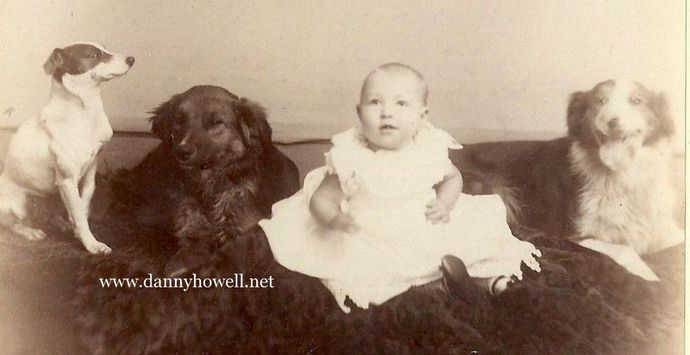
Photograph of a baby (name unknown) and three dogs, taken by Frederick Futcher in his studio at 36 High Street, Warminster, circa the 1890s.
Information and pictures for trade, industry, and occupations in Warminster.
Photograph of a baby (name unknown) and three dogs, taken by Frederick Futcher in his studio at 36 High Street, Warminster, circa the 1890s.
Sunday 5th April 1891
The 1891 Census for Warminster, taken on Sunday 5th April 1891, records a malthouse at Vicarage Street, Warminster.
The census enumerator recorded it between Golspie House and 13 Vicarage Street.
___
Number on schedule: 7a.
Road, Street, &c., and no. or name of house: Vicarage Street, Malthouse.
Name: William Brown.
Relation to head of family: –
Condition as to marriage: Widower.
Male or Female: Male.
Age last birthday: 63.
Profession or occupation: Maltster.
Employer, Employed or neither: Employed.
Place where born: Corsley, Wiltshire.
From the Warminster & West Wilts Herald, Saturday 20th April 1889:
The price of sugar. A meeting of local grocers was held at the Anchor Hotel, on Wednesday evening, when it was unanimously decided to raise the price of sugar a half-penny a pound.
In the Warminster entries of Kelly’s Directory For Wiltshire, 1889, Charles Whittington, of Brook Street, Warminster Common, is listed as a chimney sweep.
The Warminster And West Wilts Herald, Saturday 18 June 1887, reported:
UPTON LOVELL.
THE WOOLLEN MILLS. – Mr. Walker, the enterprising proprietor of the Woollen Mills here, is just having erected in the mills a huge boiler, weighing thirteen tons, ten cwts. It arrived at Warminster station on Tuesday, and was conveyed to Upton Lovell on Wednesday, taking twelve horses to draw it along on a timber carriage. When the boiler is erected, the factory will be in full working order, and a larger number of hands will be employed.
The Devizes & Wiltshire Gazette, issue dated Thursday 18th November 1886, reported:
“Upton Lovell cloth mills, for many years carried on by Colonel Everett, have lately been purchased by Mr. Walker of Trowbridge, and will shortly be restarted.”
Friday 16th July 1886
Preliminary Notice Of Sale.
To Engineers, Ironfounders & Others.
Mr. James Low begs to announce that he is instructed to sell by auction on Monday, 26th July, 1886, at the King’s Arms Inn, Warminster, all that substantially-built Freehold Dwellinghouse, with the extensive Workshops and Foundry adjoining, commanding an excellent frontage to the main road from Warminster to Salisbury [Boreham Road], and known as Dutch’s Foundry. Full particulars will appear in future advertisements.
Friday 9th July 1886
To be let, by tender, the Warminster Lime Kiln [at Arn Hill] and Field adjoining, for a term of Seven, Fourteen, or Twenty One years. It is now and has been for many years past in the occupation of Mr. R. Butcher. Tenders are to be sent to Henry Trollope. No.3 Silver Street, Warminster, on or before the 9th day of August next. H.T. does not bind himself to accept the highest or any tender. – Silver Street, July 9th, 1886.
Some notes gleaned from the Warminster Herald:
There was formerly in Warminster a bell foundry of considerable repute. During the greater part of the eventful 17th century – probably from about 1610 to 1710 – this bell foundry carried on somewhat extensive operations in what was then known as the Common Close, but is now simply known as The Close.
From about 1620 to 1686, the name of the proprietor of this foundry is mentioned as John Lott. Whether there were two John Lotts we have no means of knowing, but it seems improbable that the foundry was managed by one man for over sixty years. In 1707 we hear of a Richard Lott, under whom, however, the foundry does not seem to have flourished. He recast the great bell of Warminster Church in 1707 for £46, but it appears not to have lasted long, for thirty years later the present Tenor was supplied by Abel Rudhall of Gloucester, for £190.
John Lott cast or recast the old bells hanging in Warminster Tower in the 17th century. He also cast the great bells at Chippenham and Frome, besides many other bells great and small in the county and neighbourhood of Wiltshire.
The following entries are in the Church books of Churchwardens’ payments (which commenced in 1567), at Frome Church. Amongst these items are the following entries relating to Warminster:-
“1621. Payd Richard Cockey of Warminster, the Pewterer, for casting of 8 Braces of the Bells which was 86 lbs of brass – 43/-.”
(In 1621 it appears that the Frome Churchwardens went to Warminster, to a Mr. Richard Cockey, for bell casting. About a century later the Warminster Churchwardens went to Frome to a Mr. Wm. Cockey, and paid him fourteen guineas for casting a bell. Later on he cast two other bells for the Warminster Church. Probably these individuals were related).
“1633. Payd John Lott for casting two Bells £22 1s. 0d.”
(As will be seen by the price, and by the agreement below, these bells were only recast. The Tenor did not last long, but, as will be noted, had to be recast in 1662. It featured upon it a coat of arms, and the inscription, “1662 I L”, between the I and the L was John Lott’s trade mark, a curious representation of a very primitive-looking bell. The other bell [the Fourth Bell] featured upon it the original date of its first casting, for it noted the following inscription in large uncouth letters: “I AM HEE FOR IOTH LOTT MADE MEE ANNO DOMINI 1624.” This second bell featured an elaborate embossed design, containing the Prince of Wales’ Plume, and the motto “Ich Dien.”).
“Payd for expenses at Warminster and at Frome when the Bells were cast £1 9s. 0d.”
“Payd Rogers and John Biss for carriage of the Bells from Warminster, £2.”
“Payd for hanging the Great Bell and mending the Stocks and Brasses, £2 12s. 8d.”
All the bell metal appears not to have been used, as the following entry occurs in the same year:-
“And the said Churchwardens, R. Whitechurch and W. Hackett, doe acknowledge that they have in their hands, belonging to the parishioners of Froome, fowre hundred and 16 pounds of Bell mettle, which mettle they doe promise to give up into the hands of the parishioners of Froome upon demande, or the uttermost value thereof.”
The contract for casting these Bells is entered in a wrong page of the Church book, and among the charges for 1648, but is dated 1632, as follows:-
“The Parishioners of the Psh. Of Frome bargaineth with John Lott of Warminster, Bellfounder, for the new casting of their tenor and the fourth Bells now in the Tower there. He is to cast them ruleable and tuneable, to go with and sounde in perfect and tuneable manner with other three bells there. He is to have twenty pounds of lawful money of England for casting the said Bell as foresaid. He is to be allowed two pounds and a half for waste of each hundred of mettle that he doth cast. He is to take down the said Bells out of the said Tower; to hang them up again out of his owne charge; for performance hereof to give security to the said Parishioners when he doth take downe the said Bells out of the said Tower. In witness the said John Lott hath hereunto sett his hand this 27 day of May of the Raine of our Sovereign Lord Charles that is now King of England. Anno Do. 1632. Witness hereunto:- S. WHITECHURCH. JOHN LOTT. R. STYLES.”
As mentioned before, these Bells were paid for in 1633, but the Tenor cracked again in 1662, and at this date are the following entries:-
“To Mr. Avery for drawing a bond and articles about the grete Bell, 8/8.”
“Spent at waiting the grete Bell, 10d.”
“Spent in beare the daie that the Bell was hanged, 1/-.”
“Paid John Lott the fourth qr. for the new casting of the grete Bell, and new mettall, as appears by his resaite, £19 3s. 4d.”
This sum being almost as much now for one bell as he had in 1633 for casting two bells, when the contract was for £20. In 1882 it was recorded that the bell in Frome Tower was in good condition, was signed John Lott, and weighed 36 hundredweight.
In 1633 the new bell appears to have been brought into requisition upon the important occasion of Charles the Second’s visit to Longleat:-
“Paid the Ringers when his Majestie came through the Towne of Longleate, 20/-.”
Later on is the following entry:-
“Paid for Ringing the grete Bell at Christmas, 2/6.”
From The Warminster Herald, Saturday 28 April 1883
On Monday last, at an invitation kindly given by Messrs. Adams and Chambers, we had the pleasure of visiting their factory in East Street, and certainly were very much pleased with our survey.
Situated contiguous to the garden of the Pack Horse Inn stands this factory, which in olden times had been appropriated to the production of strong beers and ales, making fortunes for some, and misfortunes for others; for these premises have, like most other hostelries, changed hands, until it has fallen into those of the present proprietor, who, in conjunction with his partner, Mr. Chambers, has metamorphosed everything, substituting waters for beer, an engine for the work of man’s hand, and a machine which seems set to act without human guidance.
We enter, and are escorted into the upper storey, where a large tank is being filled by the engine pumping water at a marvellous pace from some 200 feet below. From this tank pipes in various directions are running, supplying the whole factory with water by gravitation. Immediately below the tank stands a very unique gas boiler, which, we presume, though not being in the secret, is used in the production of the various syrups required in the manufacture of the various waters, and which, by the simple turning of a tap, passes them downward into circular pans, where they undergo a flavouring manipulation, and from thence through block tin pipes and silvered taps into tanks below, admirably adapted for the production of the various beverages. Here too, we observe a considerable quantity of chrystalline sugar, which looks and tastes like the very best in the market.
We now go down to the first floor, where all is bustle, for it is at this time a busy bottling day, and the hands are at work in turning out that best of all beverages, “Ginger ale,” which one of the partners hands to us in a bottle, with the colour of gold. Pop goes the stopper, and the foaming ale overtops the glass, and we drink success to the new undertaking; observing, as we finish the bottle, that such nectar is “fit for the gods,” and we cease to wonder why the “blue ribbon” is so popular, with so much effervescence behind it. The bottles are fast filling with what looks like flowing honey, and by a most simple and beautiful process each bottle receives its full charge, and no more, when they are passed on to the filling machine, where the bottler stands armed like a warrior of old, in visor strong to guard him from accident, if the charge of gas should burst the bottle; but here he stands as active as a bee, filling at a rate of 48 dozen per hour the bottles, corking, or rather stoppering them at the turn of the wrist; and here we cannot help reverting to the bottle adopted at this factory, as they entirely supersede the antiquated cork, containing as they do a small glass ball, which is so arranged that it falls to the bottom without interfering with the exit of the waters, and is certainly the most perfectly constructed, consistent with utility, that we have ever seen, and for cleanliness and quickness of opening cannot be surpassed.
On our right is a 1-horse power gas engine, working away in beautiful regularity, giving life to the whole without smoke or fuel, causing one to wonder from whence, and how came all its power. But the greatest wonder is to come, for there stands a little puzzle, which is neither an engine or machine, but a combination of the two, and a perfect marvel of invention, and such a one of its kind which no one in this, or adjoining counties, we are informed, can at present boast of. In it all the carbonic acid gas is manufactured, and that, too, in exact proportions as it is required; thus varying and improving on the old systems by which a large quantity of gas is formed, and as it becomes exhausted loses it power, hence the reason of bottles being filled unequally with gas. This little machine with its brilliant copper dome pumps its own water, makes its own gas, carries it into the bottle, and indicates by a dial the exact gas pressure without the least danger to anyone, for if the least hitch occurs a globe of water boils over and at once tells the tale, and entirely prevents any injury to pump, pipe, or valve.
We pass on, and then have before us a patent “Bottle washer,” by which many dozens of bottles can be soaked, brushed out, and rinsed with manual labour almost nil, as fast as one person can hand them to the boxes; the gas engine supplying hot water, and power for soaking, brushing, and rinsing.
The water pump, too, deserves a parting word, for here we have one which is no larger than a sewing machine, which pumps and carries water several hundred feet without an apparent effort.
We have thus surveyed this little factory, where everything to avoid manual labour has been effected, where cleanliness seems the first law of its nature, and where, if our own tastes be a guide to those of the public, the waters probably will become as popular as those of Schweppe, Summers, and other great makers; and where, we are confident, the Warminster consumers will run to satisfy their requirements, and thus, whilst obtaining cheapness with quality, render the factory in every way a success.