The Wiltshire And Swindon History Centre, at Cocklebury Road, Chippenham, Wiltshire, SN15 3QN, holds the following document:
Boot and shoe dealer’s daybook. Possibly Hubert Dodge of 6 George Street, Warminster. 1897-1908. Reference 2102/1.
Information and pictures for trade, industry, and occupations in Warminster.
The Wiltshire And Swindon History Centre, at Cocklebury Road, Chippenham, Wiltshire, SN15 3QN, holds the following document:
Boot and shoe dealer’s daybook. Possibly Hubert Dodge of 6 George Street, Warminster. 1897-1908. Reference 2102/1.
Thursday 30th May 1907
For the best Geraniums, Asters, Stocks and other bedding plants and annuals of all descriptions, also out-of-door Tomato plants. Henry Scott, Boreham Road Nurseries, Warminster.
From the Warminster Parish Magazine, November 1902:
Mrs. Gilbert, Pound-row, will be glad to undertake a little plain washing.
Mrs. Whytehead has a list of charwomen, &c., willing to go out to ladies’ houses.
The Wiltshire And Swindon History Centre, at Cocklebury Road, Chippenham, Wiltshire, SN15 3QN, holds the following document(s):
Bishopstrow. Correspondence and estimates for the installation of a church clock by John Smith & Sons, clockmakers of the Midland Steam Clock Works at Derby. 1900-1901. Reference PR/Bishopstrow: St. Aldhelm/1705/15.
Saturday 11th May 1901
Algernon W. C. James, apprenticed to John Wallis Titt, engineer and ironfounder, of Warminster, 6 years, £20, 11th May 1901.
From The Pictorial Record Volume III, No.26, September 1900:
One of the biggest industrial enterprises in Warminster is that now, and for the past 40 years, carried on by the firm of Messrs. John Hall & Co., first as nail makers, and for 12 years as Paint and Lead Manufacturers.
When Mr Hall first took over the business it was nothing like in extent what it is now, the premises including over 20 show and store rooms besides kilns, grinding mills, and other departments necessary to the work. The firm are manufacturers of paints, white leads, putty, enamels, sanitary distemper paints, patent driers, colours and stains, and in oil, water, or varnish, lubricating oils and greases. They also deal in hardwares, locks, latches, bars, bolts, pulleys, nails, screws, hinges, glass paper and sash line, coffin furniture and inside trimmings, cement, plaster, size, felt, glass, paint brushes, sash tools, painters’ sundries, &c., &c. Almost everything, in fact, in the way of estate and builders’ sundries is supplied, and one would go far to find a larger, better, or more comprehensive stock, which must be of immense convenience to estate owners, builders and contractors in a country district such as this is.
The premises have large yard as well as storage space, and the newest grinding machinery, &c. is thoroughly up to date and equal to turning out goods of the best quality. Price lists of the various articles made and sold are issued, which give most comprehensive information regarding price, size, &c., and these we recommend to all by whom such goods as we have mentioned above are required. When Messrs. Hall and Co. were merchants of paint only, and not manufacturers, complaints as to quality were frequent, and analysis revealed the fact that it was mainly due to the cheap German and other foreign lead and substitutes used; to avoid this the firm built a factory and began to manufacture for themselves, the primary objects being to secure reliable quality, and to use nothing but British products where possible, without detriment to quality.
These aims are being strictly adhered to, and – other things being equal – British productions always secure the preference. Mention of this during our interview with Mr Hall led to a very interesting dissertation from him on a subject in which he is keenly interested, and which he has advocated ever since 1860, viz., fair trade.
The Pictorial Record, Volume III, no. 26. September 1900, included:
Among the most important of local concerns is the large building and contracting business of Messrs. R. Butcher & Son, which dates back some seventy years. A great uncle of the present proprietor, who carried on the trade of a plasterer only, was the founder of the concern, but in the hands of his successor, Mr. James Grant, it became a general decorating business. Then the present owner’s father became proprietor, and since his decease, building, joinery, masonry and other departments have been added. Mr. Butcher also trades extensively as a line burner and lime merchant, renting the quarries on the Downs near the town, where the lime burning has been carried on for generations. The product is a very superior one, and is in demand practically in every centre of the building trade in England, Mr. Butcher’s enterprise being mainly responsible for this, he having made what was previously a local trade into one of large outside connections.
The general building and storage yards are at 14 Church Street and 2 Silver Street, there being at both places a large and comprehensive stock of builders’ and contractors’ materials. There are good joinery shops, stores for painters’ and decorators’ materials and impedimenta, masons’ sheds, glaziers’ shop, stables and other indispensable adjuncts of an all-round business.
Scaffolding, flag stones and stone rough or wrought, can be supplied in any quantity, as well as timber, lime, cement, and the materials of the building trades generally.
The firm contract for the erection and equipment of buildings, and have a large general jobbing business. As paper hangers and decorators, too, they hold a leading place, and are equally at home in plain and elaborate work of this class. Estimates in this or other departments are furnished free, and work can always be put in hand and finished promptly. Mr. Butcher personally superintends everything, and being himself a thoroughly practical man, bred to the business, this is a guarantee of satisfaction to his clients.
From The Pictorial Record Volume III, No.26, September 1900.
THE BREWERY
The above title, although certainly as brief as it well could be, very aptly describes the industrial enterprise at Warminster conducted under the style of Bartlett & Co., inasmuch as it is now the only large brewery the town possesses.
Its history is an interesting one, and moreover a story of continued progress, based entirely on the excellent quality of the ales brewed. The founder, Mr James Bartlett, was some fifty years ago butler in a gentleman’s family, and those being the days when home-brewed ale was in its zenith he also acted as family brewer and had a great reputation for the splendid ales he produced. Eventually he quitted private servive and started as a brewer in small premises, occupying part of the site that the present extensive brewery now covers.
At the start Mr Bartlett only employed one horse and cart, and the rest of his plant, &c., was on a correspondingly small scale, but being already noted for his skill as a brewer his trade rapidly increased, and was on a fairly extensive scale when the business was sold to another firm in the town in 1887, who greatly enlarged the premises and purchased several hotels and inns in and near Warminster.
In 1898 the business was again sold, this time to Messrs. Garton, owners of the famous Anglo-Bavarian Brewery at Shepton Mallet. They have not, however, incorporated it with larger concerns, but having purchased another local brewery – Messrs. Morgan & Bladworth’s – they amalgamated the two and carry them under the title stated, Bartlett & Co.
Since in Messrs. Garton’s hands, the brewery has been again enlarged and improved, new plant and machinery has been put in and over 60 hotels and licensed houses in the neighbourhood are owned, so that ample channels are found for the output, large as it is. Besides these there are agents in almost every town within a fifty-mile radius of Warminster, and very large contracts with the War Office are in hand for supplying Salisbury Camps.
A fine suite of offices has just been built close to the brewery, which is itself one of the most imposing buildings in the town and quite an architectural achievement in that class of work.
Going through the premises, one is struck by the good order and cleanliness that prevails everywhere, every utensil and vessel is thoroughly cleansed before using a second time, and the whole place is as light and spotless as hard work and constant supervision can make it.
The firm make all their own malt and crush it the day before using in the malt mills, from which it is carried by elevators to the first bin over the mash tun. From thence the operations go forward in the usual way, mashing, boiling with the hops, cooling, fermenting, skimming, vatting and racking, until it reaches the consumer, bright, wholesome and delicious.
The fermenting room has eleven vessels capable of holding 2,500 gallons each, and in the cellars are 18 large store vats holding from 1,000 to 6,000 gallons each. Both ales and stout of the very best quality are brewed, and, in addition to supplying the firm’s own houses, a very widespread family trade is cultivated, the ales, especially those of the light bitter class, being in high repute for table use.
The brewery staff numbers about 40 hands, besides seven engaged in clerical work, and about a score of carts and drays are used for the local traffic. It not infrequently happens that when a large firm buys up local concerns their value to the town as wage-payers, &c., is very largely diminished, but the reverse is the case here, as the brewing interest is more strongly represented in Warminster and employs more people since Messrs. Garton took over the Brewery than was the case before.
1899
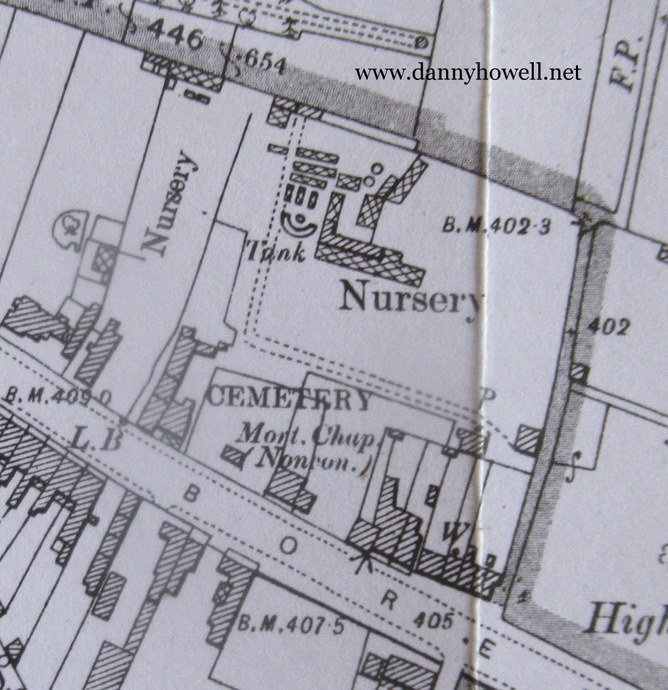
Part of the 1899 Ordnance Survey map of Warminster, showing the Nursery at Boreham Road (run by Henry Scott).
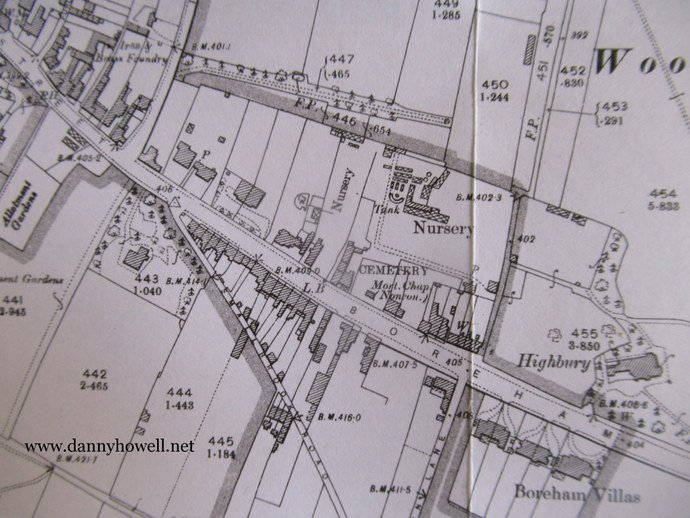
The Nursery was immediately north of the Non-Conformist Cemetery, Boreham Road, Warminster.
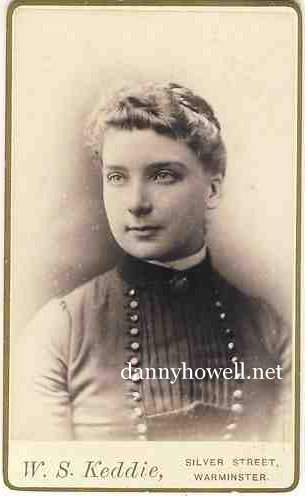
A carte de visite photograph of a woman
(name unknown) by W.S. Keddie, photographer,
of Silver Street, Warminster, Wiltshire, circa 1890s.