Jennie Moore Was Full Of Love

Sunday 6th June 2010

In memory of Jennie Moore – Danny Howell writes:

Jennie Moore will long be remembered as a woman who was so full of love that she was able to share it with her family and pass it on to everyone she met.

Jennie was born at Burnley, Lancashire, on 27th August 1930. She was the daughter of Harold Payne, who owned a car sales garage, and his wife Ruth who was a bus conductress.

An accident in the home when Jennie was 18 months old left her with a broken hip. Unfortunately it was not immediately treated and it was the beginning of a difficult childhood. She spent at least ten years as a permanent resident in hospital. Her mum and dad could visit only once a month, as per the hospital rules.

Also, thanks to the broken hip, Jennie contracted bovine tuberculosis. Eventually she left hospital and went to a TB Sanitorium. It overlooked Lake Windemere. Jennie recalled that even in the cold of winter she and the other children in their beds were pushed outside on to a verandah, as part of the treatment.

Hospitalisation meant that Jennie only received one year of schooling. With the encouragement of the nurses she taught herself to read and write and, to her credit, she excelled at arithmetic. The nurses also showed her how to knit and sew, something that held her in good stead for the rest of her life.

Having reached working age, Jennie became a tailoress for a large department store in Lancashire. Her tailoring and embroidery skills were so great that she was able to make her own dresses and also those for friends, copying the desired fashions of the day.

Tragedy came calling in 1949, when Jennie’s mother died. Jennie’s father soon remarried and started a new family. After that, Jennie only ever saw her father once again. Fortunately, she had the determination to make her own way in the world.

It was at this time that she found herself a pen-pal, a young Liverpudlian soldier called Frank Moore who was serving in the Middle East. They corresponded and after a while they agreed to meet each other for the first time on the platform of Lime Street Station, Liverpool. It must have been love at first sight because Frank asked her there and then to marry him. They obtained a special licence and were married just five days later. That was in May 1952.

Frank’s military career took them to Kenya, Germany, Northern Ireland and elsewhere. Along the way they became the proud parents of two daughters and a son, and became the legal guardians of two of their grandsons. And everywhere that Frank was posted, Jennie fostered and brought up babies and children. She loved to be surrounded by them. She became Brown Owl for the Garrison Guides and Brownies. She certainly enjoyed the Army life.

Frank’s final posting was to Warminster. After demob, he got a job, working for the Army, but things were not meant to be. In 1977 he died suddenly of a heart attack, – he was only 47. In 1983 Jennie moved into a new bungalow, specially built for a disabled person, at the Maltings. She became the first person in Warminster to have a mobility scooter.

Jennie immersed herself with many pastimes and hobbies. She went to craft evenings, she knitted and crocheted, she embroidered tapestries, and she built and furnished dolls houses. Jennie also enjoyed listening to music, particularly Country And Western and Irish folk. She was also computer-literate, and enjoyed surfing the net and e-mailing with her lap-top.

Jennie loved not only people but also animals and birds. Over the years a menagerie of pets came and went. Dogs, cats, parrots, fish, tortoises, and guinea pigs, all lovingly cared for. She also enjoyed watching the wild birds in her garden. She marvelled at Mother Nature.

She was constantly smiling, ever cheerful, she hated no one, and forgave anyone for their faults or misdoings. She was also generous, regularly donating to charities, and she had a wonderful sense of humour.

Jennie’s greatest attribute though was her inner strength. She had overcome adversity in her childhood, coped admirably with her disablement, and in her final years, she dealt with illness and pain. She may have been disabled and not in the best of the health, but she played an active part in the community. She never wanted to be left out of whatever was going on around her.

Jennie’s family and friends may take comfort in that there was an abundance of love in Jennie’s world. Jennie firmly believed in God. She enjoyed worshipping in church but to her the denomination was not important. She was simply a Christian soul and her faith, above all, was one of love, friendship and hope. 
Roy Middlebrook, Born In Warminster 1936, Died On The Isle Of Wight 2009

From the Isle Of Wight County Press, Friday 20th March 2009:

A pioneer of the Island folk revival scene, Roy Middlebrook, has died at St Mary’s Hospital, aged 72.

Roy was born on June 27, 1936, in Warminster, Wiltshire, and attended Trowbridge High School for Boys. He moved to the IW in 1954 after winning a student apprenticeship at Saunders Roe, in East Cowes.

Roy gained a degree in mechanical engineering from Southampton University, which he followed up with post-graduate studies in aeronautics at Cranfield College. On his return to the Island, he worked as part of the team at Highdown, near Alum Bay, developing the Black Knight rocket.

During the 1970s Roy took further studies in computing and served for many years as head of engineeering computing at Westland Aerospace until his retirement in 1996. He was a founder member and regular performer for the Island Folk Song Club, which met weekly at the Sloop Inn during the 1960s.

When Men of Wight Morris started in 1970, he embraced that tradition with enthusiasm – playing, dancing and teaching.

Roy was a skilful accordion player, had a keen interest in local and family history, and was chairman of the Friends of Carisbrooke Castle Museum, and vice-chairman of the IW Family History Society.

He married Barbara Ann Mew in 1961. She died of cancer in 2002. Roy found love again in later years with Di Harding, but she, too, fell victim to cancer late last year.

Roy was taken seriously ill at the end of February and died at St Mary’s Hospital on March 8.

Roy, who lived in Newport, is survived by his two children, Kay Arnold and Ian Middlebrook, and five grandchildren – Jonathan, Emily, and Jeremy Wells, and Alex and Zoe Middlebrook.

Tributes To Musician And Fundraiser Marjorie McAdams

Danny Howell writes –

Marjorie Elizabeth McAdams was born in Keynsham, near Bristol, on 30th August 1927. She was a talented musician, a modest person, and a keen fundraiser for Arthritis Research. She spent the latter part of her life in Warminster, living with her brother Roderick (a teacher at Warminster School) at Ash Walk, but after his death she moved to Homeminster House, the retirement apartments, at Station Road, Warminster.

Miss McAdams died, suddenly, at Salisbury District Hospital, on 24th May 2006. She was 78. Her funeral service, conducted by Canon Tony Watts, was held at the Parish Church of St. Denys, The Minster, Warminster, at 1.30 p.m., on Thursday 8th June 2006, and was followed by interment at Pine Lawns Cemetery, Folly Lane, Warminster.

I include here two tributes to Marjorie; the first is penned by Ms. Pam Treasure, the house manager at Homeminster Court:

Marjorie attended the Royal Academy of Music between 1945 and 1949, and trained as a classical concert pianist, eventually having her own classical music programme on BBC Radio. She taught music all her adult life, finishing at Oldfield Park School for Girls in Bath.

She moved to Homeminster House in Warminster, from Ash Walk, Warminster, in 1993 after the death of her beloved brother, Roderick McAdams, who himself was an accomplished musician and an academic in maths.

Marjorie’s sudden death in May came as a blow and a very big shock to al her friends in Warminster, particularly the residents of Homeminster House, and her friends and colleagues in the Warminster branch of the Arthritis Research Campaign, especially Fran Pearson who worked closely with Marjorie, and where Marjorie dedicated 18 years of her life as a volunteer.

I, as house manager of Homeminster House, and a classical music fan, live in the apartment directly above Marjorie’s apartment, and whenever Marjorie went into her apartment to practice her piano, which she did regularly in order to keep her fingers nimble as she, too, suffered from arthritis, I would go and sit on the loo in order to get the full benefit of sound and I would sit and listen to her playing. The acoustics in the bathroom were almost as good as today’s surround sound and was very convivial to Marjorie’s classical music repertoire.

I always felt very privileged to have that “front row seat’, and as Marjorie had very acute hearing she always maintained that music should should be listened to and enjoyed, and not be used as a background to other activities.

Other residents also enjoyed Marjorie’s practice sessions and they used to stand and listen to her playing from outside her apartment front door. One lady in particular, Mrs. Joan Handley, says: “I miss Marjorie’s playing so much as I pass her apartment door, now all is quiet and things are not quite the same.”

Marjorie also played the organ in the communal lounge at Homeminster House for the monthly church service that is held there for the residents of Homeminster and their guests, and of all denominations. She also played the church organ at the Minster Church on occasions in the earlier years.

Marjorie was a lively, outgoing, member of Homeminster House and a very integral player in everything going on here. She will be sorely missed for all her hard work and effort, and, of course, that winning smile of hers. She was a kingpin at Homeminster House and was loved by everyone.

She was a very modest person, she had a wonderful sense of humour, she had a warmth that couldn’t be abated by even the coldest of weathers, and a most beautiful smile. She also had the most tranquil of grace and serenity about her. Never a wrong word came from her lips, and she was loved and respected by everybody who knew her.

Marjorie was Homeminster House, and I know that I speak on behalf of everyone here, all of her friends and colleagues, and on behalf of her massive collection of teddy bears, over 200 in all, when I say we will all miss her dearly. May she rest in peace.

Mrs. Fran Pearson, of the Warminster Branch of the Arthritis Research Campaign, also paid tribute to Marjorie McAdams, summing up her own personal recollections of Marjorie’s 18 years collaboration with the ARC:

Majorie was one of the founder members of the ARC in Warminster. She was fondly known as the “raffle queen’ during all of those years. She always insisted that the raffle prizes were her way of contributing to the campaign and refused any offer of payment, and everyone knew that this area of fundraising would be correctly undertaken, because she was completely reliable and likeable in every way.

How thankful the Committee is on reflection now that she terminated her role on the committee in the summer of 2005, giving all of us the opportunity to thank her properly with cards and flowers. On the occasion of her retirement from the Committee, she had her photograph taken with the Mayor of Warminster, Les Rose.

Marjorie’s parting words were: “I have thoroughly enjoyed my years of volunteering with the Arthritis Research Campaign. I suppose there is a little bit of self interest involved as I suffer arthritis myself. I would recommend volunteering to anybody. It is a wonderful way to meet people, and over the years I have made many friends. I am very sad to be retiring.”

All of us who have worked alongside her are very sad indeed that we must now say a final farewell and goodbye to a very dear and loyal friend, but we do so with our hearts full to the brim with gratitude.

Unclaimed Estate Of A Silver Street, Warminster, Resident

October 2002

Teodor Maliszewski, who lived in his final years at Silver Street, Warminster, died on 25th October 2002. His estate is as yet unclaimed.

Reference Number: BV2025729/1
Date of birth: 20/12/1917
Place of birth: Chwarzenko, Poland.
Date of Death: 25/10/2002.
Place of Death: Warminster,. Wiltshire.
Marital status: bachelor.

www.unclaimedestates.com/estates/teodor-maliszewski-124168

John Davenport Marriott ~ A Man Of Many Parts

Written by Mary Button; from Now, Then And In Between, a Miscellany Of Writings by Warminster W.I., first published in 1994:

I first met my father-in-law to be, John Davenport Marriott, in the early 1940s, when I alighted from the Reading to Newport train at Badminton. He drove me from the station in a pony and trap; the pony, Pat, had once belonged to a traveling gipsy. We trotted along through the peaceful village of Acton Turnville, to the Wiltshire hamlet of Littleton Drew, where my future in-laws had a bungalow. Where there had once been a derelict cottage, J.D.M. had built his bungalow with local help, using some of the stones from the old cottage, and it was there he and my mother-in-law settled in the early days of the Second World War, on his (official) retirement.

My father-in-law was born in 1878 in Weston-Super-Mare. His father and family farmed for many years at Wybostob in Bedfordshire. His great-great-grandfather had been a commander of the Scots Guards at the famous battle of Minden in the mid-18th century. The author, Charles Kindersley, was also a descendant of that same commander.

In his late teens J.D.M.’s parents sent him to live with a wealthy uncle and aunt in California who wanted him to be their heir, but he couldn’t settle to a life of ease, so he went lumberjacking in Canada to earn his passage home. In 1898 he returned to his family and then went to London where he worked on the administrative staff of the Northampton College of Advanced Technology until his retirement, apart from army service as Colour Sergeant in the First World War.

Having settled in Wiltshire, he became a member of the Home Guard (Dad’s Army) until he became too old, and on Sunday mornings paraded on the village green outside his bungalow. When the village postmistress died, no-one was able to take over, so J.D.M. converted part of his home into a part-time local post office, which he ran well into the 1960s. In addition to his post office work he helped a local farmer in both the yard and the fields, refusing to take any payment. When newspaper deliveries stopped, as young men were called up, he stepped into the breech and took over, giving the profit to the Bristol Royal Infirmary, who made him a life governor. As well as these activities he made regular reports to the Met. Office of the local rainfall and weather conditions. After the war he became the village librarian, and he found time to learn to drive at the age of 69, which he did until he was 80.

When he was 83 he was awarded the B.E.M., a proud moment! Whatever the fashion, I well remember my father-in-law was nearly always attired in plus-fours, and my mother-in-law in ankle-length dresses. He was a highly intelligent man, and I found him a most interesting person to be with. I remember his doctor saying to me “If my mind is as sharp as his when I am 95, I’ll die a happy man.” My father-in-law finally died aged 97 and my mother-in-law at 93. Such people are the backbone of any rural community, and age did not deter him from doing his bit. What a loss his passing must have been to that village.

Remembering A Friend ~ Eddie Stainer’s Tribute To Charles Murby

Charles Murby, of Warminster, died on 30th March 1993, and was laid to rest at St. John’s Churchyard, Boreham Road, Warminster, on 6th April 1993. The following tribute, written by Eddie Stainer, was published in the May 1993 edition of Focus, the parish newsletter for Bishopstrow and Boreham:

When I was asked if I would write something as a tribute to our dear friend Charles Murby, whose recent sudden death came as a great shock to many of us, my immediate reaction was “Oh, no! I don’t think I could find the right words” – though I knew in my heart it was something I very much wanted to do, and now I am grateful for the opportunity.

How does one sum up the life of a good man? So forgive me if I use the words of William Shakespeare, who says it in very few words (where I might take a whole page!)

That best portion of a good man’s life,
His little nameless unremembered acts of kindness and of love.

My own association with Charles goes back some 25 years or more, when for many years we were both members of the PCC, and very much involved with the life of the parish. Charles was a server, and for a number of years a Churchwarden, and continued to act as a sidesman till the time of his death.

His was an unassuming character, with his own brand of quiet humour, which endeared him to all who had to do with him. A devout Christian, with a dedicated sense of duty and loyalty; I for one am proud to have been counted as his friend.

Charles would not wish to be remembered with sorrow. His was a happy and fulfilled life, so may I conclude with the words of Mother Teresa –

“A joyful heart is the normal result of a heart burning with love. Never let anything so fill you with sorrow, as to make you forget the joy of Christ arisen.”

Donald Meadows ~ Sub-Postmaster At Codford

Sunday 7th June 1992

Donald H. L. Meadows became the new Sub-Postmaster at Codford in January 1980.

Donald Meadows was born at Northampton in 1933. He graduated from Queen Mary’s College, London, having studied physics and chemistry. He was a teacher until 1979, being employed at Northampton Trinity High School, Hatfield School, Chard Independent School, and was finally at King Edward VI School in Lichfield, where he also umpired at cricket.

When King Edward VI School became a comprehensive, Don Meadows resigned, and he and his wife, Pat, began to look at post offices from Oxford to Teignmouth, Don having decided to make a career change from teacher to sub-postmaster. The decision to take Codford Sub-Post Office came after Don and Pat Meadows met and spoke to Jill McQueen, the head teacher of Codford School. She was painting the Pratten Hut at the time.

And so it was that the Meadows moved from Lichfield to Codford. At that time the local post round was still part of the duties for sub-postmasters in rural areas, and Don Meadows soon became a familiar sight on his pushbike delivering the mail in Codford. With hard work he soon built up the business side of Codford Post Office, as well as taking an active part in village life. He was, for a period, the Chairman of Codford Gardening Club. Gardening and classical music were his two great loves. He was a keen and inventive cook, and many fund-raising lunches at the Codford Club featured one of Don’s homemade soups on the menu. In his early years at Northampton he had belonged to the Gilbert and Sullivan Society, and the Harpole Theatre Club. In Codford he took the ticket bookings and did “front of house” at the Woolstore Country Theatre. Although brought up a strict Baptist, Don Meadows changed over to the Church of England faith, and in Codford he served on the P.C.C. of St. Mary’s Church. Don’s wife, Pat, became a librarian at Andover. She and Don had married at Coventry Cathedral in 1964. Their sons, Philip Meadows and Timothy Meadows, were born in 1968 and 1975 respectively.

In October 1985, a letter by Don Meadows was published in the Wylye Valley Life magazine. Mr. Meadows wrote:

“To the Editor, Wylye Valley Life.
Dear Sir, 
This letter is written on behalf of all local members of the National Federation of Sub-Postmasters. We have recently seen the last of the emergency pension and allowance payments period and, hopefully, all local Sub-Post Offices are now back to normal. It seems an appropriate time, therefore, to thank all our customers for the patience and co-operation they have displayed during the last very difficult twelve months. Some delays were inevitable, due to the substantial increase in workload, but because of the friendly co-operation and understanding way in which our customers appreciated our problems, we were able to cope with even the greatest difficulties. The need for an emergency payment procedure was due directly to industrial action taken by computer operators at the Department of Health and Social Security’s central office. Their ability to disrupt the system clearly demonstrates the vulnerability of centralised computer controlled payments. It was thwarted only by the adaptability of the Sub-Post Office network. Sub-Postmasters are not electronic machines but are human beings genuinely interested and concerned about the welfare of their customers. They often go to great lengths to ensure that payments are made on time to customers.”

Mr. Meadows continued: “We now wish to alert customers to a campaign that will be mounted by the DHSS in the coming months. Their intention is to encourage pensioners and other beneficiaries to have their payments credited directly to bank accounts. They play down the fact that it would be monthly and in arrears. We seek public support by asking customers to continue to have their payments over Sub-Post Office counters. If they switched to Automatic Credit Transfer, they would be using a system which could be cut off by a few operators at the computer centre. If the public wish to maintain the services of Sub-Post Offices in this area, it is essential that they use them.
Yours sincerely,
D.H.L. Meadows, Committee Member for the Warminster and Wylye Valley.”

Unfortunately, Don Meadows succumbed to cancer and died in Salisbury General Infirmary on 23rd May 1992. His funeral was held at St. Mary’s Church, Codford, and among the mourners were six members of the National Federation of Sub-Postmasters: Mr. J. Anderson, Mr. T. Broadwita, Mr. Ian Brown, Mr. N. Cowell, Mr. J. Lewis, Mr. L. Parfit, and Mr. G. Scott.

It was said: “Don Meadows will be sorely missed. He has carved a place for himself within the fabric of village life, and his contribution to Codford will be long remembered.”

Frank Moody Took A Prominent And Active Role In The Public Life Of Warminster

From Yesterday’s Warminster by Danny Howell, published 1987:

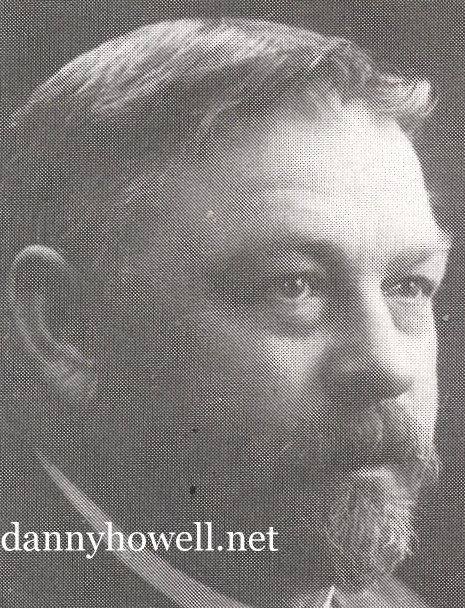
Frank Moody, pictured circa 1910.

Frank Moody was born on 5th July 1858 in a small cottage at The Marsh, Warminster. He was the youngest son of market-gardener Richard Moody and he left school at Christ Church when he was eight years old, to work for his father’s horticultural business. He attended evening classes, instructed by Mr. Crispin, the Headmaster of the Church School, remembered for the way he administered punishment by rapping his knuckles on erring pupils’ heads. 

When Frank was twelve he met with a nasty accident while playing a game of ‘duck’ with one of his brothers. A sharp stone badly gashed his head and Dr. R.L. Willcox, assistant to Dr. Grubb, said he had narrowly escaped death. When he was 16, he was pushed off a rick, with a pitchfork in his hand. The steel prong went through his thigh and came out of his knee. He fully recovered soon afterwards and left Warminster for South Wales, where he was apprenticed to a miller at Llandaff, near Cardiff. This only lasted three days because he was poorly fed and the mill was plagued with rats. He soon returned to Cardiff where he found a job as a wholesale salesman in the fruit and vegetable trade.

Six months later Frank came back to Warminster, as a fish salesman at Stephen Francis’ shop at 28 East Street. Frank’s future wife was the manageress of the shop, which later became Mills and Son’s; they married in 1877. Frank Moody then took a small shop at 7 Fore Street, Warminster Common, which only had one little window, and he began with a single box of bloaters, soon expanding to a wide range of groceries.

Although he had no practical experience he saw the need for a small bakery and he added one to the shop, later securing the contract for supplying bread to the Warminster Union. The bakery was in operation for a few years until he closed it down, and heeding his life-long motto ‘Look ahead for progress, he bought for resale six chairs from Mr. Thorne, a chairmaker at Horningsham. Conditions were so cramped in Frank’s shop, he had to keep the chairs behind the door, but he soon sold them to Charles Eacott, a sand merchant who lived at The Willows, 39 South Street, Warminster Common. Frank then bought some more chairs, and that’s how Frank Moody’s furniture department began.

Butchery had begun at the shop in a small way too, with the selling of one pig a week in small joints. 

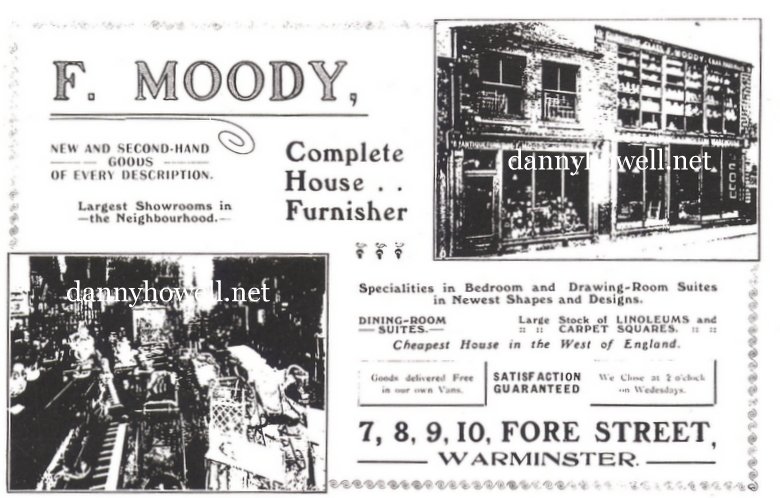
Being thrifty, Frank and his wife saved enough money to buy four cottages adjoining the shop, and in 1900 he converted these to shops, which included a showroom 60 feet long and 12 feet wide. Using the pattern of a shop at Castle Street, Bristol, he carried out all the work with direct labour. A large plate glass window was installed and this met with a great deal of ridicule. Groceries, coal and furniture were sold from the new premises, with the business growing year by year, and a bicycle and pram department and more offices were soon added.

Advertisement for
Frank Moody’s furniture department,
from the Warminster Town Guide 1907.

Frank Moody also dealt in pig meat and henges which are the heart, liver and lights of a pig still attached to its windpipe, hung on a rail for all to see. Most customers bought three penn’orth of pork cuttings or backbone at a time. Pigs’ snouts and trotters were other specialities and some folk thought nothing of asking for a pig’s tail to eek out an extra meal.

Seeing an opening in the wholesale market for pork, bacon and hams, Frank Moody appointed a Mr. Marsh as his agent at Cardiff. Mr. Marsh acted for him for 14 years and built up a wholesale trade throughout South Wales.

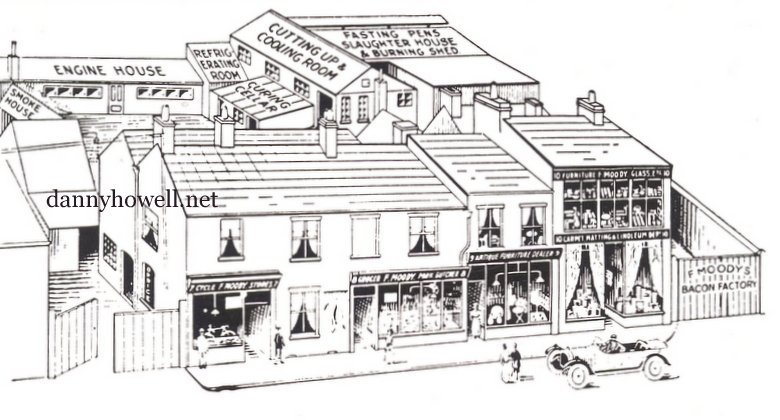
Then Frank Moody built a bacon factory at Fore Street in 1921. As he had done with his shops, he designed the building himself and erected it by direct labour, and it was soon classed as ‘the finest modern small bacon factory in the west of England’. In 1922 the output was 70 fat pigs a week and the number of hams cured for the wholesale trade ran into thousands. At the Fore Street factory, slaughtered pigs were weighed and moved automatically through the various departments to the curing cellars and the refrigerator plant. Frank Moody had wanted to install an oil-powered singeing machine, at a cost of £400, but this met with opposition from his clients when he consulted them about the idea. They preferred the straw-burnt bacon because of its delightful flavour and the mild-cured Wiltshire bacon had no rival. When he was asked to what he attributed the rapid and successful growth of his business, Frank Moody said: “I always make a point of paying spot cash, thereby securing discounts.”

An illustration from the
Warminster Town Guide 1924,
showing Frank Moody’s bacon factory,
cycle shop, house-furnishing and furniture
department at Fore Street,
Warminster Common.

Frank Moody died on 8th September 1930, shortly after from returning from a holiday at Brighton. His last words were: “I am ready to go,” and his death was felt not only at Newtown (Warminster Common) but throughout Warminster, because he had taken a prominent and active role in the public life of the town. He had been dubbed the ‘father’ of the Warminster Urban District Council, to which he was first elected in 1893, when Frank Morgan was Chairman. Frank Moody served for over 30 years on the Council and was Chairman twice. 

Frank Moody was also a magistrate for Wiltshire; a Commissioner of Income Tax; a member of the Joint Isolation Hospital Committee; a member of the Warminster Cottage Hospital Committee; the founder and Chairman of the Warminster Hospital League; Chairman of the Managers of Newtown Day School; a Governor of the Warminster Secondary School; a Deacon and Trustee of the Congregational Chapel at Common Close, Warminster; Chairman of the Warminster Town Band Committee; Chairman of the Warminster Nursing Association; Vice-President of the Warminster Town Football Club; and a Superintendent of the Warminster Salvation Army Sunday School for over 20 years. He had started the school with 12 scholars and there were 145 when he resigned.

error: Content is protected !!