Friday 20th January 2017
A memorial service was held at the Church of St. Cosmas and St. Damian, Sherrington, on Friday 20th January 2017, for the late Albert Charles Imber (Bert Imber), of Sherrington (latterly at The Wingfield Care Home, Trowbridge), who passed away on Saturday 31st December 2016.
The service was conducted by the Rev. Jane Shaw. The hymns sung were Morning Has Broken and All Things Bright And Beautiful. There were two readings: Wisdom, Chapter 3, verses 1-5 and 9, The souls of the righteous are in the hand of God; and John, Chapter 14, verses 1-6, In my Father’s house are many dwelling-places. The poem Feel No Guilt In Laughter was read by Shaaron (one of Bert’s daughters).
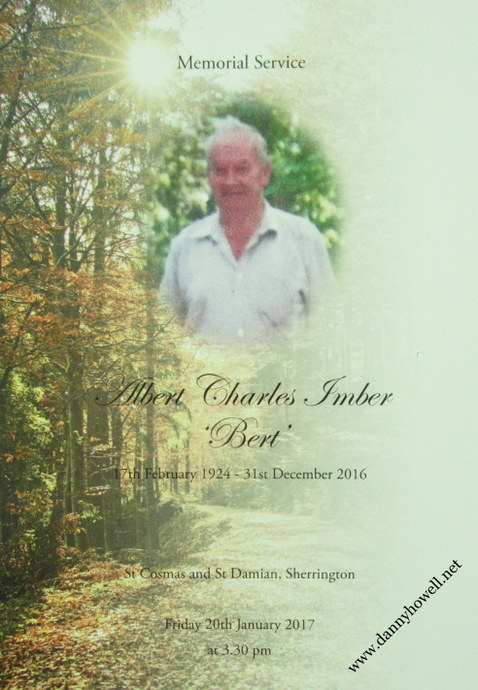
Rev. Jane Shaw read out the following tribute to Bert:
“It’s a personal pleasure for me to be able to pay tribute to Bert – and I’m also grateful to the family, Betty Lewis, Alan Nash and others who have provided such rich insights. I hope this will do justice to a very special man.”
“Bert was born in Sherrington in 1924, in the little house across the road [from the church], No.23, where his family had always lived – he told me once that his parents had kept the village shop there. There is a long record of Imbers in Sherrington, and indeed in this part of Wiltshire, and when Bert’s ashes are laid to rest in the family plot just outside the [church] door, he will be joining several generations of Imbers. He was also proud to tell you that in W.H. Hudson’s book ‘A Shepherd’s Life’, the person of Caleb, the chief character, was based on Bert’s great-uncle. It is a fascinating account of rural Wiltshire life around 1900.”
“Bert had three older siblings, Charlotte, Joe and Patty, so he had to learn to hold his own from the beginning. He went to Codford School till he was 11, then won a scholarship with the 11+ exam to go to Trowbridge Boys High School (now John of Gaunt Secondary School). In those days he could walk to Codford Railway Station to catch the train to Trowbridge . . . or sometimes cycle. The train was very proper – girls in one carriage, boys in the next – and he remembered hearing the pigs squealing at Bowyers meat factory in Trowbridge, as he got off the train.”
“In August 1940 Bert sat the exam for the RAF apprenticeships, and came 39th out of 3,000, so joined RAF Apprentice College at Halton and gained a first class Technical Education. His subsequent jobs included working on planes such as the York, Lancaster and Blenheim aircraft . . . and I have actually flown in a York, not very comfortable. While in the RAF he took up boxing, and sparred among others with Ted ‘Kid’ Lewis, who was twice world welterweight champion . . . I would love to imagine the outcome! On one occasion, so Bert used to relate, he was coming home on leave but fell asleep on the train and missed his stop in Westbury, ending up in Frome. Instead of walking from Frome to Warminster, he hitched a lift on the footplate of a goods train back to Westbury . . . and then walked to Warminster. He explained he didn’t know where Frome was, as it was in a different county!”
“He stayed with the RAF all through the War, but in 1946 he had an accident in which his hands were burned, and he was invalided out of the service. He returned to Sherrington and took various jobs including bus ticket collector, chimney sweep, and grave digger. Nothing if not versatile was Bert. Then, in the 1950s he built his first timber haulage lorry, and called it Bitsa, because it was built from bits of different lorries. He would haul timber from woods all over the country, and became known as ‘Titch Timber’ or ‘Timber’ and then ‘Tim’ for short. He started his own sawmill in the garden, then developed a saw mill and yard at the top of the village – and eventually employed a number of other people. He would deliver wooden products all over the country – pit props to mines up north or in Wales, and broom handles to local hardware stores. One such journey took him to Hexham, in Northumberland, in dense fog at a top speed of 30 mph. On arrival, Bert decided that the best thing to do was to follow the service bus around the town until he found where he was due to deliver. So he tailed the bus all around town, even through the local army barracks, till it arrived at . . . the bus station. Eventually he had to ask for directions.”
“In 1970 Bert rejoined the RAF as a civil servant, and there he met Elvira – they were married in 1973, and Shaaron, Lesley and Aubrey were born to them in the 1970s. I was talking this week to a neighbour who remembered Elvira, and described her, with a smile, as a jokey sort of person – one who might quietly tie your apron strings to a bit of furniture, and walk away leaving you tied there . . . but all in good humour. You’ll have worked out that Bert was nearly 50 when they married – he used to say, with that twinkle in his eye: ‘I was a long time free-range before I went battery’.”
“Life in the Sherrington cottage was enriched by lots of animals. Bert once had a large white pig, which would often escape and roam the village. There was always a dog in the cottage, usually an Old English Sheepdog, but once a bearded collie, a rescue dog. He helped with the Old English Sheepdog rescue scheme during the 1980s, and at one point there were five Old English sheepdogs in the cottage . . . Bert would say it was like having an animated hearth rug in the house. There were also rescued cats, rabbits and guinea pigs, birds inside and an aviary outside, pond full of fish, you name it. In fact, after the last of the dogs there was a vacancy. It was eventually filled by a large black and white cat. A bit of a footloose feline he had wandered down from Sutton Veny way, liked what he found in Sherrington and moved in with Bert and Rosemary where he spent the remainder of his nine lives, a mutually agreeable arrangement. Bert called him Matey, and he was good company . . . but in my experience always the wrong side of the door.”
“Bert also helped in the community, transporting school children on outings in the VW camper-van, helping with the local St John Ambulance, and helping maintain the churchyard – a personality in this small village. At one stage he even had a model railway in the top of the Woolstore building in Codford. He was also a wonderful raconteur of village life as it used to be; an hour in his company would fly by as he remembered local personalities – such as when the Rector fell into the ditch coming out of the scout hut after a party . . . what were they drinking?”
“Bert finally retired in 1985, and decided he would build an extension to the cottage. He did all this himself, with only a little help from a local carpenter, and included a garage; the house was painted overall in a rather challenging pink, quite a talking point in the village!”
“He was a keen gardener and his garden was a sight to behold, full of chrysanthemums, sweet williams, and dahlias (as well as his fruit and veg), roses climbing up the walls – and many of the flowers were for the church. At Harvest Thanksgiving, Bert would arrive at the church door with a wheelbarrow full of vegetables, and the church would glow with dahlias. Similarly at Easter there would be masses of daffodils. He was an active supporter of the church; the choir used to robe in No.23 and then process to the church, and he kindly allowed the congregation to park by his garage. At one time he took on the mowing of the churchyard and the hedge cutting.”
“Later in life he developed a skill for wood turning and became a skilled and expert craftsman, creating beautiful bowls, platters and clocks. Proceeds of any sales went to church funds and he sometimes took a stall at village fetes, for fundraising. He fashioned a replacement oak beam for the church bell tower on which to re-hang the bell. This was a skilled operation as it had to match the original to the last millimetre. It lives after him and could last 50 years. One friend remembers being taken by Bert to choose the wood for a bowl he had commissioned – they went down to Yandell’s in Martock, where Bert was well known, and he discoursed with great knowledge about the different woods and their characters and uses.”
“In the 90s he acquired eight grandchildren – Josh, Lucy, Jasmine, Jordan, Charlie, Sophie, Emily and Lexi. He was always interested in Josh’s work as a long-distance haulier, and would ask, even in his last days, how the work was going. But 1995 brought grief when his wife Elvira, after two years battling cancer, finally died. He continued on his own, until in 1999, out of the blue, he received a phone call and a voice said: ‘Is that Tim?’ It was Rosemary, who had been a land girl during the war, at the Rectory [in Sherrington], and then went to Australia; she was visiting Dorset, and was determined to look up her old friend. The friendship ripened, and Bert – not a great international traveller – flew out to Australia, to help Rosemary move back to England. They were married later in the same year, and had ten happy years until Rosemary’s death in 2010.”
“Bert’s last years were a struggle against failing health and memory, but he kept going and remained in his own home as long as he could. He acquired a mobility scooter, a smart and shiny model from the Netherlands, of which he was very proud, calling it his chariot – I remember being taken to admire it in his garage – and he rode it at alarming speeds around the neighbourhood, even to Codford along the main A36; he took it into Warminster for his fish and chips, and more frequently it could be seen parked outside the Carriers in Stockton. He was well supported by Lesley, by several friends in the village including Bob and Linda [Beagley], Betty and Gaby, and Mandy who started as a cleaner but became more of an adopted daughter. And by home care assistants (including one he called ‘Paracetamol Polly’), until he moved to The Wingfield [care home] at Trowbridge. I remember visiting him there for the first time in some trepidation, as he had always vowed he would never accept residential care – but I found him smiling, cheerful, and saying several times: ‘This is a good place.’ It was a comfortable and safe place to be, and he was well looked after – especially by Tanya and Jolie, who were very good to him.”
“So Bert had a good, rich and fulfilling life, enjoyed his memories, and has left a legacy of good friends and a burgeoning family. May he rest in peace – we shall not see his like again.”