Bowls Barrow Bustard Given By Tom Silcox To Harold Nelson Dewey

From a list of items in Harold Nelson Dewey’s diaries 1919-1947 (list made by Percy Trollope):

Friday 17th February 1933 (uncertainty about this date – needs checking?)

Mr. Tom Silcox, Avenue School teacher, gave Mr. H.N. Dewey, the Great Bustard shot at Bowles Barrow circa 1867.”

Percy Trollope remarks that this bustard is now in the Dewey Museum.

The Bustard

From The Modern Encyclopedia, published in the early 1930s:

Bustard (Old Fr, bistarde; Lat. avis, bird; tarda, slow). Group of large, stoutly-built birds. The common bustard (otis tarda) was formerly common in Great Britain, but is now only occasionally found in the S. counties. Standing over 3ft. in height, it is a handsome mottled with grey, brown, and black. It lives mainly on corn and young shoots, but will also devour frogs and other small animals. The nest is merely a hollow in the ground.

A Fine Elm With A Human Face In Profile At Sutton Veny

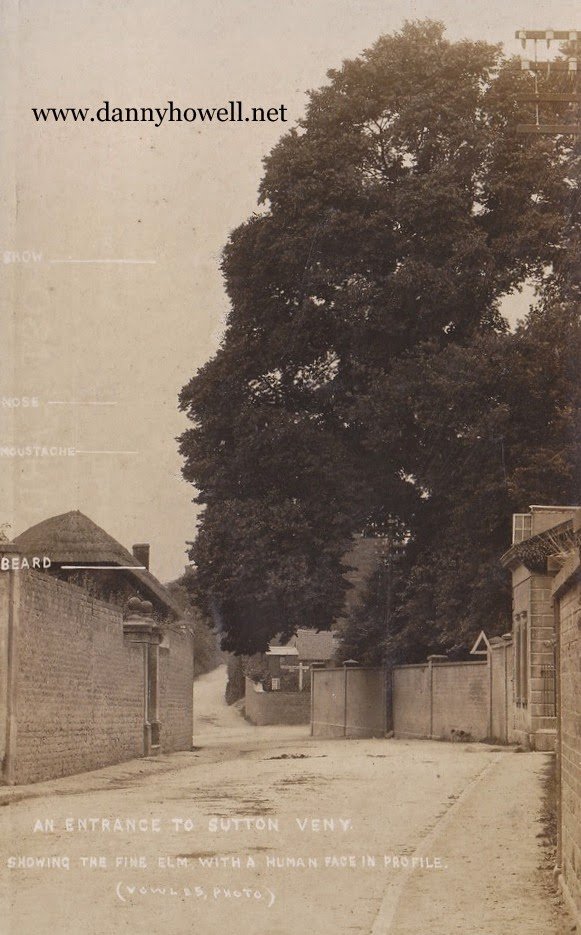
A picture postcard produced by Alfred Vowles showing the view west along Norton Road, Sutton Veny, from near the south lodge of Greenhill House (later renamed Sutton Veny House) looking towards the crossroads by the Woolpack.

Mr. Vowles, who was from Somerset, took many photographs of scenes in the Warminster area, particularly of the military  camps during the First World War. He usually penned a title for each scene he depicted and this card was no exception.

He titled it: ‘An entrance to Sutton Veny showing the fine elm with a human  face in profile.’ The outline of a forehead, eyebrow, nose, moustache, mouth, chin and  beard can be seen on the left side of the tree’s branches and foliage.

The photograph was taken in 1915.

Salmon In The Street At Wilton

From The Wiltshire Times, Saturday 23rd January 1915:

Wilton. Salmon In Street.
Owing to the floods at Wilton the road in many places is washed out in channels and in places looks like a pebble beach.

A salmon was stranded in the main road opposite The Island, the home of Lady Forester-Walker. It weighed 24 lbs and was 40 inches long.

Bustards On Salisbury Plain

Frank Heath writing in The Little Guide, Wiltshire, (first published March 1911 – revised by R.L.P. Jowitt, 1949), referring to Salisbury Plain, noted:

Many famous birds, once denizens of the Plain, have now vanished for ever. Chief among these was the bustard, which has not been seen since 1871. Chafin, writing about twenty years before, tells of putting up no less than twenty-five of them at once. There is a stuffed group of them to be seen in the Salisbury Museum.

The Man Who Collects Slugs

At the meeting of the Wilts Archaeological Society at Warminster, on Tuesday 12th July 1904, Mr. Goddard read a letter from a Leeds slug collector wanting specimens from North Wilts. The Daily Mail, of Thursday 14th July 1904, contained some particulars about this slug collector:

There are few people (says the article) who on finding a slug in their garden do not instinctively shrink from it and are loath to touch it. Yet there is a Yorkshireman who has made slugs his hobby for twenty years. Mr. Denison Roebuck was the first person in Great Britain to specialise in slugs. In two or three years he was able to obtain some thousands of specimens from different parts of the British Isles. There are only seventeen species known to this country, and Mr. Roebuck has discovered from anatomical evidence five of them. Thus his hobby has been of service to science.

On Wednesday 13th July 1904 he explained that he had been a naturalist for some years before he found his distinctive study.

“Finding that slugs had been neglected,” he said, “I devoted my attention to them. I have been assisted by naturalists all over the country. There are only four counties in Great Britain from which we have not received some specimens – Hunts, Oxford, North Wilts, and Carmarthen. I am specially anxious to get living specimens from most counties except Yorkshire and the Midlands, which we have pretty well finished. Large and small slugs, common or rare, will be thankfully received. They must be alive, and should be packed in moss or grass in airtight tin boxes. The boxes must not have holes in them, and it is very important that the date and place of collection be given. Slugs are not all destructive, and only two are enemies of the gardener – the little black, tough-skinned slug of the garden known as Arion Hortensis, and the yellow slug of the field, the Agriolima Agrestis.”

Mr. Roebuck’s address is 259 Hyde Park Road, Leeds.

The results of Mr. Roebuck’s work will be published in the next volume of a monograph on land and fresh water mollusca of the British Isles, which is being edited by Mr. John W. Taylor, another distinguished Leeds naturalist. Mr. Roebuck and Mr. Taylor founded the Conchological Society and the Journal of Conchology, and Leeds has a Conchological Club, which is quite a model, for out of eleven members there is an average attendance of ten at the meetings.
Bees In Bishopstrow Church

From the Hull Daily Mail, issue dated Tuesday 23rd November 1897:

Bees in church. – On Sunday evening the congregation of the parish church at Bishopstrow, Wiltshire, were startled by the appearance of a number of bees. By the time the Psalms were reached, the building reminded one of “swarming time.” The Vicar [George Atwood] struggled bravely until the sermon, when the bees stung the reverend gentleman so badly that he was forced to beat a hasty retreat from the pulpit and leave his flock without a sermon. The churchwardens too were singled out for the bees’ attention, and about 20 of the congregation were also stung. In the end the irreligious bees carried the day, and the service to abrupt termination.

A Stork At Codford

The Warminster Herald, Saturday 9 September 1882, reported:

Successful capture of a stork at Codford.

On Monday last, Mr. Coles, brewer, of this village, shot a stork of large dimensions. It appears that while he was at dinner, this bird pitched in the yard of the George Inn, and flew from there to the chimney stack of his brewery. A messenger came for him, and informed him of the imposing object. He seized his gun, but on arriving at the spot the bird made its escape into some adjoining fields where, after a rather long chase, Mr. Coles succeeded in bagging it. The bird stands 4 feet high, and measures 6 feet 6 inches from one wing tip to the other, and weighs six pounds. Numbers of visitors have called on him to see the bird, which is being preserved. Another stork was also seen the same evening in the neighbourhood of the Rifle Butts.

error: Content is protected !!