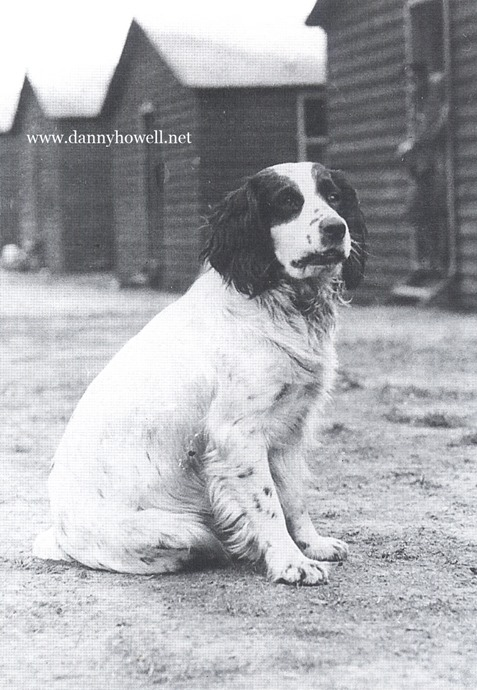
Pongo, The Much-Loved Mascot Of The 7th Wiltshire Regiment

Tuesday 25th June 2019

Danny Howell writes –

For all the dog-lovers out there, here’s a photograph taken about 104 years ago by S.J. Vowles whose images of military scenes in Warminster and in the army camps around the district during the First World War appeared on many (now very collectable) postcards. But the subject of this photograph is not a soldier, at least not a human one. It portrays Pongo, the much-loved mascot of the 7th Wiltshire Regiment, recorded by the camera outside some of the wooden huts in one of the army camps at Sutton Veny. I love this photograph and I consider myself lucky to have it among my collection. Thought I would like to share it here. Enjoy!

Can You Verify A Fight Involving Soldiers At Sutton Veny?

Tuesday 16th May 2017

An email from Danny Howell to Philip Clark:

Hello Philip,
At this year’s ANZAC Service at Sutton Veny you asked me if I could verify something you had read (but forgot where) about a fight involving soldiers at Sutton Veny which resulted in the soldiers having to be separated.

Could it be that you read this in Gertrude McCracken’s booklet Looking Back On Seventy Years Of Sutton Veny, published in June 1981?

The last paragraph on page 17 reads:
“The British troops were eventually moved out of the village and the Australian soldiers moved in. Around the same time, soldiers from Canada and New Zealand moved in to Codford and the Wylye Valley. Not long after they arrived a fight started between all three nationalities near Pine Cottages on the Tytherington road. Two men were killed and it was rumoured that forty had been injured. The New Zealanders were then moved onto Salisbury Plain and the Canadians transferred elsewhere.”

Regards, Danny.

Philip Clark has replied –

Thank you, Danny. You’re a STAR!
Regards,
Philip.

The ANZAC Connection With Sutton Veny

Thursday 5th April 2012

The following notes are taken, by permission, from a leaflet in the ANZAC Memorial Chapel at St. John’s Church, Sutton Veny:

In the Great War of 1914-1918 Sutton Veny became a centre for army camps. Fourteen sprang up on the area called the Common, situated between the Warminster and Longbridge Deverill roads. During the latter part of that war these camps were mainly occupied by Australian troops. At least one camp was entirely a hospital and many casualties from the Western Front were brought there. A railway line was built from the former Heytesbury Station, along the river to the Common, to transport the many wounded. Some died and were buried in St. John’s Churchyard, Sutton Veny.

In 1918-1919 a devastating influenza epidemic hit the country, causing two million deaths. The Australians at Sutton Veny did not escape unscathed. Sadly, having survived the horrors of war, a number died away from home and lie buried in the churchyard here. Of 170 war graves, 145 are those of Australians, a large number of whom died of influenza.

The Commonwealth War Graves Commission erected a fine memorial and accepted responsibility for the care of the graves.

After the Great War the south transept of St. John’s Church was converted into an ANZAC Memorial Chapel. The Rising Sun badge, which can be seen in the chapel, came from one of the camps in Sutton Veny, and on the walls are pictures of Australian soldiers, both in the camps at Sutton Veny and in action on the Western Front.

Alongside the altar stands the Roll of Honour, proudly displaying the names of those 143 soldiers and 3 nurses of the Australian Forces who died and lie in peace in the Churchyard.

April the 25th is the day set aside to commemorate the heroic actions of the Australian and New Zealand Auxiliary Corps during the landings at Gallipoli in 1915.

Each year on the Sunday nearest this date the children from Sutton Veny Primary School, which adjoins the Church, lay special posies of flowers on the graves in the Commonwealth War Graves Commission’s area of the churchyard. On the Sunday following this there is held a moving service of remembrance attended by the Australian High Commissioner or his representative, Australian officers and NCOs serving in England, local branches of the British Legion, representatives from the Warminster Garrison, the British Australian Society and other Australian charities, together with a large congregation of local people.

In 1982 it became evident that the Church of St. John in Sutton Veny would have to be re-roofed. This involved a heavy expense for the villagers. When informed of the church’s needs the Australian Government and the Australian Returned and Services League together subscribed very generously towards the cost.

In 1992 a further grant of money was forthcoming to enable the Church Council to establish a permanent memorial to commemorate the sacrifice of those who served in the forces of Australia and New Zealand – the southern transept of St. John’s Church, Sutton Veny, being transformed into what the village is now proud to call “The Anzac Chapel.”

Thus, Sutton Veny maintains its close links with Australia and New Zealand. The Parochial Church Council appoints a representative to liaise with the Australian representatives over the organisation of the special Anzac Day Service.

Almost ninety years have passed since the end of the Great War in 1918, but many visitors from Australia and New Zealand still come to St. John’s Church, Sutton Veny, to pay their respects. A glance at the Visitors’ Book, reveals the names and comments of some of those from “down under” on its pages.

“The people of Sutton Veny are very proud of this association and will continue to foster this in the years to come as they have in the past, honouring the selfless contribution given by those so far from home to our country and freedom. We will remember them.”
The War Memorial In St. John’s Churchyard, Sutton Veny

The wording on the war memorial in St. John’s Churchyard, Sutton Veny, reads:

TO THE GLORY OF GOD
AND IN HONOUR OF THE MEN
OF THIS PARISH WHO FELL
IN THE GREAT WARS
1914 – 1919
1939 – 1945

1914 – 1919

ERNEST J. HIBBERD PTE 5th WILTS

SIDNEY A. HINTON Br. R.M.A.

HERBERT H. HOOKER A.B., R.N.

ARTHUR C. POND PTG A.I.F.

FRANK SNELGROVE PTE R.A.M.C.

THOMAS WEBB TPR WILTS YEO

HECTOR T.S. HICKS PTE 2nd L.R.F.

F. STANLEY DOUGHTY TPR K.E.L.H.

HARRY BARTER PTE R.M.L.I.

ROBERT A. COLVIN CPT & AJT W. YORKS

GEORGE N. COOPER PTE S.L.I.

HAROLD C. COOPER LC CPL 9th E.S.

WALTER CROUCH PTE 2nd WILTS

SIDNEY C. EVERETT PTE 3rd WILTS

REGINALD A. HAINES GNR R.G.A.

1939 – 1945

FRANK I. HASKELL LDG STR R.N.

JOHN B. HINTON CHF PTY QFR R.N.

PETER G. HOBBS MAJOR R.H.A.

W. PAUL HOBBS LT COLONEL R.A.

CYRIL E. HUDD PTE Q.R.R.

IVAN W. MITCHELL LC BDR R.A.

HUBERT S. PICKFORD R.W. YEO

Foes In That Great Sleep Where Enmities Are All Forgot

In the Wiltshire volume of The King’s England‘s series, first published in 1939 but compiled in 1938, just prior to the outbreak of the Second World War, Arthur Mee, in his capacity as editor, began the section  on Sutton Veny, which was titled “Far From Home’, by writing:

“Here, in a corner of a land far from their homes, lie friends and foes in that great sleep where enmities are all forgot. This fair garden of our England has something that is For Ever Australia, For Ever New Zealand, For Ever Germany.”

“In the green peace of the churchyard sleep about 160 brave men who came across the world, from New Zealand and Australia, to fight and die, and with them lie about 40 men who died prisoners here. Germans far from home, they lie three and four together, their names and the date of their deaths on small tablets level with the green turf over them. Over them rises the fine cross of sacrifice placed here by the Imperial War Graves Commission.”

dannyhowell.net footnote: St. John’s Churchyard is still to this day [in 2011] “For Ever Australia, For Ever New Zealand,” but is no longer “For Ever Germany,” for in 1963 (following an agreement made between Britain and Germany in 1959, the remains of German military personel and German civilians interred in various graveyards and cemeteries throughout the UK were to be reinterred in a single commemorative cemetery) the remains of those German prisoners of war who died at Sutton Veny, were exhumed and re-interred at the German Cemetery, at Cannock Chase, in Staffordshire.

The 2/6th London Regiment (City Of London Rifles) ~ The Cast Iron Sixth ~ At Sutton Veny

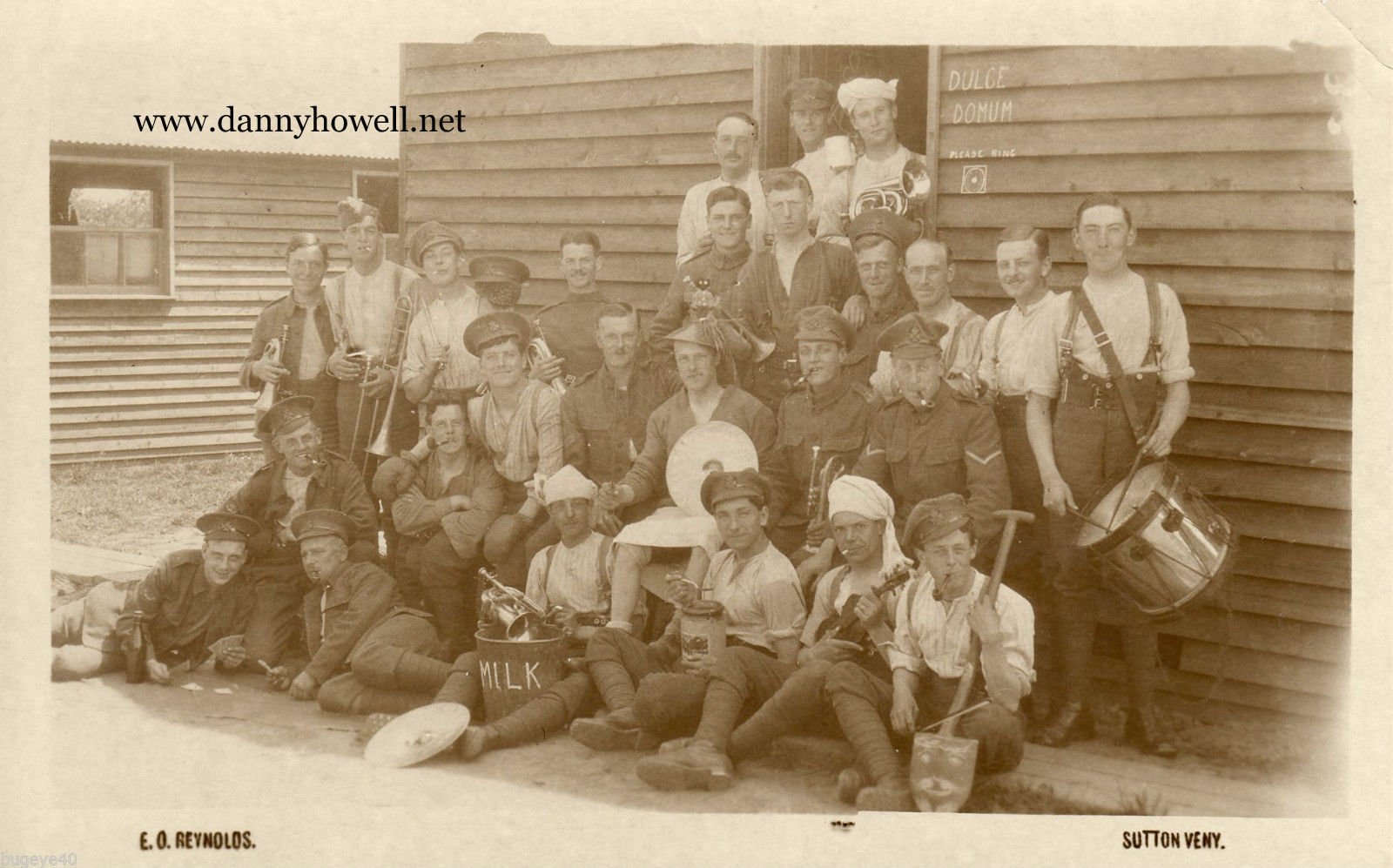
Photograph by E.O. Reynolds, taken at Sutton Veny, during the latter half of 1916.  It shows some of the serving soldiers in the 2/6th London Regiment (City Of London Rifles) nicknamed the Cast Iron Sixth.

It seems these men had a great sense of humour and enjoyed some fun. The words ‘Dulce Domum’ are written to the right of the hut doorway. Dulce Domum means “Sweetly at home.” It is coincidentally the name of a song written by Robert S. Ambrose in 1876 (not to be confused with another song of the same name sung at Winchester School). Underneath ‘Dulce Domum’ someone has chalked or painted a depiction of a door bell with the words: ‘Please Ring.’

Some of the soldiers are smoking cigarettes, some of the others are smoking pipes. Some have bugles, one has a trombone, one has a drum, and there are two cymbals. Another soldier has a violin. The soldier next to him has the violin bow and is bowing it across the handle of a shovel (the shovel has a face drawn upon it).

One soldier has a bucket with the word ‘milk’ on it. Another soldier has a spoon and is eating something out of an earthenware jar. Another soldier appears to have a toy monkey on what looks like a lampshade or a funnel he is wearing as a hat on his head. He has a towel over his lap and is either wearing shorts or his trousers legs are rolled up. He is holding what looks like a swagger stick or a riding crop. Two others have wrapped towels or scarves or some type of material round their heads in the style of turbans.

The battalion was at Sutton Veny from July 1916, doing final training there before going to France and the Western Front in January 1917.

error: Content is protected !!