Ricky Sampford Is Trying To Get Hold Of The Street Sign That Was At Queensway, Warminster

Wednesday 21st December 2016

Richard Sampford writes ~

“Danny,
I have been contacting so many people. I am trying to get hold of the old QUEENSWAY sign where I was born and lived for many years (and still live here). Any suggestions? I’ve tried most council offices. Many thanks and have a great Xmas. 
Ricky.”

Danny Howell replies ~

“Hello Ricky, I have no idea what became of the sign but I would guess it might have gone for scrap and if so, is more than likely untraceable now. I do know much of the rubble from Queensway and Boreham Field was taken away by tractors and trailers and used to make up the surfaces of farm tracks at Tytherington.”

Where Was The Gate Made Of Horseshoes?

Saturday 26th November 2016

Geoff Sims, of Victoria Road, Warminster, writes –

Some years ago I took part in a car treasure hunt and one of the clues led us to a gate made entirely of horseshoes. I can’t remember now for the life of me where it was. Does anyone recollect or know of the whereabouts in the Warminster area of a gate made entirely of horseshoes? I would love to know where it was/where it is!

Information Sought On The Whitsuntide Club At Sutton Veny

Monday 14th November 2016

Phillip Hoyland writes:

Hello Mr. Howell,
I am trying to find some information on the 19thC friendly society in Sutton Veny, known as the ‘Whitsuntide Club’.

A couple of weeks ago an example of the brass emblem carried by the members on the annual feast day came up for sale on e-bay.

I have an example of the brass but my interest was roused by the fact that, as far as I could make out, this brass was on its original pole!

Needless to say that not too many of the original wooden poles have survived the passing of the decades. I should point out that my bid to buy it was unsuccessful.

Do you have any information concerning the old Club? Dates of formation and winding up, did they have ribbons and if so what colour were they, what was the colour of the pole and was it decorated????

I know the Club met at the Bell Inn and that they may have purchased their brasses in around 1861.

I have contact with Helen Taylor and her last e-mail had an attachment from your book, ‘Wylye Valley —-‘. The photograph of the group parading with a banner, in about 1910, could easily be of the local Friendly Society. However, as there are no poles and brasses in sight it could be that the old Club had been superseded by one of the national fraternal societies, Oddfellows, or Foresters for example. Many of the village/parish Clubs suffered this fate.

Any information you may be able to give me would be most welcome, and appreciated.

Regards. Phillip Hoyland. Burnham on Sea, Somerset.

Historic England Asking The Public To Record Witches’ Marks On Buildings

Monday 31st October 2016

From BBC News ~

Members of the public are being asked to help create a record of ritual markings on buildings that were once believed to ward off evil spirits.

The “witches’ marks” were often carved near entrances to buildings, including the house where Shakespeare was born and the Tower of London.

The symbols were believed to offer protection when belief in witchcraft and the supernatural was widespread.

But heritage agency Historic England says too little is known about them.

This Halloween it is calling for people to document the marks, which can be found in medieval houses, churches and other buildings, most commonly from around 1550 to 1750. 

‘Easy to overlook’

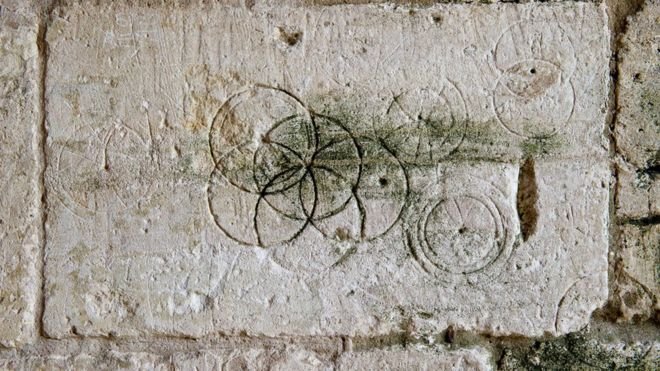
The symbols, which were intended to protect inhabitants and visitors of buildings from witches and evil spirits, took many forms, including patterns and sometimes letters.

The most common type was the “Daisy Wheel”, which looked like a flower drawn with a compass in a single endless line that was supposed to confuse and entrap evil spirits.

They also took the form of letters, such as AM for Ave Maria, M for Mary or VV, for Virgin of Virgins, scratched into medieval walls, engraved on wooden beams and etched into plasterwork to evoke the protective power of the Virgin Mary.

Known examples include several found at Shakespeare’s birthplace in Stratford-upon-Avon, Warwickshire, carved near the cellar door where beer was kept, and at the Tithe Barn, Bradford-on-Avon, Wiltshire, to protect crops.

Others have been found in caves, such as the Witches’ Chimney at Wookey Hole, Somerset, which has numerous markings.

Duncan Wilson, chief executive of Historic England, said: “Witches’ marks are a physical reminder of how our ancestors saw the world. They really fire the imagination and can teach us about previously-held beliefs and common rituals. Ritual marks were cut, scratched or carved into our ancestors’ homes and churches in the hope of making the world a safer, less hostile place.  They were such a common part of everyday life that they were unremarkable and because they are easy to overlook, the recorded evidence we hold about where they appear and what form they take is thin.”

http://www.bbc.co.uk/news/uk-37817785

Where Was The Treasure Trove Of A Shop In Warminster That Sold Toys, Sweets And Loads Of Lovely Stuff?

Wednesday 21st September 2016

Mrs Cecilia Wright writes ~

“Hello, 
I do hope you can help me. From 1976-1979 we lived in Sambourne Gardens, Warminster, in a newly-built house. My husband was in the Army posted to Warminster. We loved Warminster and were very sad to leave there. A few weeks ago, we returned to Warminster and tried to find some of our old haunts. The Three Horseshoes Walk looked very different and we couldn’t find The Gorge Cafe; or Safeways and realised that is it now Iceland!”

“I could not remember the Cornmarket Shopping Mall being there during our time, but can remember a lovely shop which from memory was at the entrance to an “alleyway” which could be the Cornmarket Shopping Mall. This shop was a treasure trove of a place and sold toys, sweets and loads of lovely stuff.  As well as the entrance off the Market Place, there was another exit from the shop which brought you out onto this ‘alleyway’. I have made some enquiries and looked online and M & Co is there now and they tell me that a shop called Cristettes, was there before them, and previous to that Gateway’s.” 

“We are now racking our brains trying to remember just where this treasure trove of a shop really was – please help!    I do remember that it was not far down from where Pearson’s Estate Agents used to be at No. 67 Market Place and near to the bus stop, where my children would get the bus to St. George’s R.C. School.” 

Danny Howell replies ~

“Hello Cecilia Wright,

Thank you for your email.

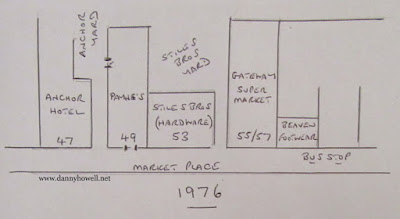
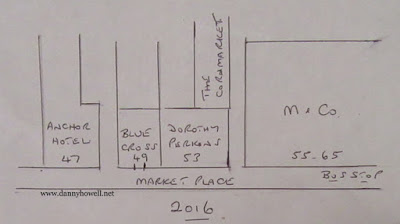
Yes, there certainly have been many changes in Warminster in the last 40 years. The shop you are recalling was Payne’s, which was a newsagents and toy shop at No.49 Market Place, Warminster. It also sold confectionery, greetings cards, stationery, local books, postcards, maps and travel goods, etc. It also offered photocopying and was a parcel agent for the Wilts & Dorset bus company. Father Christmas in his grotto was a regular feature every December. The shop window also displayed Warminster Carnival photos each year, allowing people to order prints. On the first floor of the building was Polly’s Tearoom which was also very popular. You are quite right when you say the shop had an entrance off the Market Place and another entrance on to ‘an alleyway’. The alleyway you are referring to was part of the Anchor Yard on the west side of Payne’s, between Payne’s and the Anchor Hotel. Payne’s and Polly’s Tearoom were owned by Alan Gallagher who was much respected and well-liked by his staff and customers. Payne’s shop was much loved by the people of Warminster. Alan retired in 1989, because of ill-health, and the business passed to Balfour News. Alan’s hopes of spending a long and happy retirement in Salisbury, enjoying music and going to the theatre, were soon dashed. Not long after he moved from Warminster to Salisbury he died (in 1997). The Co-op acquired Balfour News in 2003 and eventually closed down the shop in Warminster. No.49 Market Place is now a much smaller retail outlet, being a charity shop, raising funds for the Blue Cross. There is a photo of Payne’s shop on this website. And there’s also here a photo of the Blue Cross charity shop. I attach a couple of sketch maps I have drawn to show you the location of the shop, then and now.

With best wishes from Warminster,

Danny Howell.”

Payne’s (second from left), 
between the Anchor Hotel and Stiles Bros.

Now (2016) the Blue Cross charity shop
between the Anchor Hotel and Dorothy Perkins.

In Search Of Wanseys In The Salisbury, Wilton, Wiltshire Area Over The Period 1350 To 1600

Wednesday 17th February 2016:

Roger Barnett writes ~

Dear Mr Howell,
Some years ago I got married to a member of the Wansey family. She claimed she could trace her ancestry back to 1066, but . . . . .

We all agree that you can trace the family back to the 1550’s or thereabouts . . . earlier than that is mired in mystery!

Having looked at all the Wanseys that I could find, they seemed to fit into a pattern:-

~ Warminster Wanseys going back to Henry Wansey who died in 1546.
~ The Wanseys in Somerset ( South Petherton / Eason Wanseys).
~ Maiden Bradley going back to John Wansey who died in 1631.

I then traced the Wanseys from 1066 and found the branch living in Astwell, Northamptonshire, to be of interest. This branch can be traced clearly from the 1100’s until about 1390 when Robert Wauncy dies leaving a son William and two daughters: his brother John also dies at about the same time. Christina, wife of the late John, then marries John Wodeworth, a glover of Salisbury. In the late 1500’s I have found Wanseys living in Salisbury.

I know that some of the Wanseys in Warminster were glovers also; is this a clue?

I am trying to find out anything I can about glovers and Wanseys  in the Salisbury, Wilton, Wilts area over the period 1350 to 1600. If you have any suggestions or could give me any guidance where to look, it would be very much appreciated.
Best wishes,
Roger Barnett.

Danny Howell replies ~

Dear Roger,
Thank you for your enquiry.
I don’t think I can add to your researches at the moment. 
My interest in the Wansey family has been confined mainly to Warminster. So, to date, I have only published on this website a couple of articles concerning the Wansey family in Warminster.

I would suggest you consult, if you haven’t already, the following online link to see if you can glean further information:

Notes by Nick Delves, Hillside Farm, Field Lane, Kirk Ireton 

http://www.nickdelves.co.uk/wansey/wansey/1925_06Wansey_Family_Tree_Pages_23-34_transcribed.pdf

If I do come across any references to the Wanseys in Wilton and Salisbury, particularly pre-17th century, I will gladly let you know. And it is to be hoped that anyone reading this page, who has the information you seek, will get in touch too.

Bonny Bright Eyes ~ A Pair Of Heads In The USA

Thursday 14th January 2016

Chris, writes ~

“Hi there,
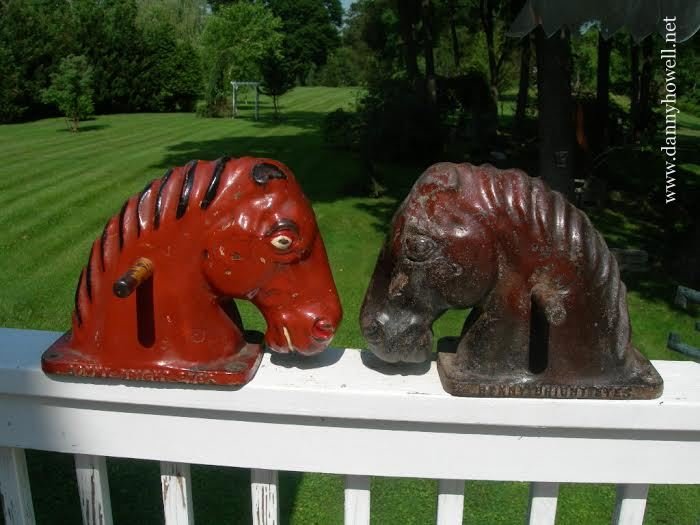
I just happened across your 2014 post re: Bonny Bright Eyes and thought that you might enjoy seeing two ‘critters’ which have swum across the Atlantic and now live in the U.S. Thanks for your fun and informative post, Chris.”

Danny Howell replies ~

“Thank you Chris for your photograph and for letting us know. Not one but two Bonny Bright Eyes together, who emigrated west. If they could talk, what would their stories be?”

In Search Of The Beaminster / Bemister Family

Tuesday 13th October 2015

Susannah Crossman writes ~

Dear Mr Howell,
I hope you won’t mind my contacting you but I’m afraid I have rather an ‘addiction’ to finding my family’s roots & have quite recently discovered those roots may well be in wonderful & beautiful Wiltshire – Melksham Forest, Heytesbury, Knook, Mere, possibly Horningsham – with connections extending to Frome & possibly Bruton in Somerset, possibly Hampshire & maybe Dorset!  Oh & I almost forgot – the Beaminster family in Sell’s Green – & I’ve just found, through your wonderful website, possibly Wylye – & possibly more!

I would like to say a huge THANK YOU to you for your wonderful & informative web site – I am so looking forward to exploring it fully!

I am so excited to have family connections to Wiltshire & Hampshire & Dorset!   I am still researching & wondering if my family(ies) of Be(a)mi(n)ster travelled along the water ‘motorways’ of their day & moved from Christchurch through Hampshire to Wiltshire & also if my family’s Be(a)mi(n)sters are related to the Bemisters of Newfoundland!

I will have to wait until this evening to research/investigate more but just had to send you a message to say ‘Hello!’ & ‘Thank You!’ for your wonderful website!!

Most sincerely – & with an enormous mound of appreciation!!

A Query Regarding Edward Buckler Whose Wife Alice Was Buried In Warminster In 1636

Saturday 19th September 2015

Judy Venables writes ~

Dear Mr. Howell,
After having traced my Buckler line back, I find that I have an Edward Buckler born c1525 to Alexander who married Elizabeth Watkins circa 1524.  I am not sure of the location.

Now, the information I am using says that Edward Buckler got married about 1600 and had 10 children between 1600 and about 1627.  His wife dies in 1636 and he dies in 1649, leaving a will.  Now, her name is Alice and she is buried at Warminster but I could not find his burial anywhere even with his death date (I was hoping for an age!?!).  

Edward Buckler is supposed to have probated his mother’s will in 1580.  But I find it very hard to believe that he was 124 years old when he died and that he didn’t have his children until later in his life (I have not found a previous marriage).  Edward, I assume, is the one who moves to Warminster from Dorset.

My ancestry is Jane Buckler through John born 1695 to Humphrey (rector at Batcombe, Somerset), to Thomas who married Elizabeth Pilton, to Edward who married Alice in 1600.  That is where I’m stuck because his birth would be about 75 years before!?!

My research sources include: Familysearch.org; FindmyPast; Ancestry.com; Google Chrome; Rootsweb; FreeREG; Dorset OPC; (I don’t have much luck on Wiltshire OPC).

Thank you for your time.”

Danny Howell replies ~

Thank you Judy for your enquiry.

Your information with regard Edward Buckler being the son of Alexander Buckler and Elizabeth (nee Watkins) and that Edward was executor to his mother’s will in 1580, appears to tally with Bucleriana: Notices of the Family of Buckler collected by Charles Alban Buckler, Surrey Herald Extraordinary, AD 1880, published by Mitchell and Hughes in 1886 for private circulation. 

http://ketchcetera.com/ARTIFACTS/Pedigree_of%20Buckler_of_Causeway.pdf

In Bucleriana, in the section: ‘Pedigree of Buckler of Causeway and Wolcombe Matravers, Dorset,’ (page 3), it is indeed written that: 

the will of Elizabeth Buckler (nee Watkins), wife of Alexander Buckler, was dated at Wolcombe Matravers, 15 Nov 1579, proved in London 6 Feb 1580, and that she is buried at Melbury Bubbe (Dorset). It also states that one of her sons Edward Buckler was executor to his mother in 1580 and that his will is dated 8 May 1649. The same publication also confirms that Edward’s wife Alice was buried at Warminster 16 May 1636.

____

But it is of course beyond the realms of possibility that Edward was 124 years old when he died. I believe the first sentence of your enquiry to me: “Edward Buckler was born c1525 to Alexander who married Elizabeth Watkins circa 1524” has to be incorrect.

A quick look at other websites (family central, wiki tree, etc.) has Alexander Buckler listed as born in Somerset in 1541 and Elizabeth Watkins born in 1541 or circa 1541. Those dates are more likely, and if they are correct it means Alexander and Elizabeth could not have married circa 1524 as you say and that Edward their son could not have been born circa 1525 as you also say.

Those other websites suggest Alexander and Elizabeth  were married circa 1565 in Somerset (Holwell?). This would suggest that Edward was born after 1565. If the family tree in Bucleriana is correct, Edward’s older siblings were John, Alexander, Christopher, Katharine and Mary ~ so Edward may have been the sixth child, and may have been born circa 1571. If that was the case, it means Edward may have only been about nine years old when executor of his mother’s will in 1580; that he was 29 years old when he married (if he married in 1600); and that he died aged about 78 if his death was in 1649. Those ages and dates seem far more plausible.
Does The House At Vicarage Street, Warminster, Where Alice Maud Gaisford Was Born In 1880, Still Exist?

Saturday 22nd August 2015

Martin Pomeroy, who lives in Johannesburg, South Africa, writes ~

“Hello Danny
I found your photos of Vicarage Street most interesting.

My grandmother, Alice Maud Mary Gaisford, was born at 51 Vicarage Street in 1880. Her father was local builder, Joseph Gaisford, who later moved to 39 George Street, Warminster. The house at George Street, including a workshop and sawmill, was sold in about 1903 to R. Butcher and Sons, well-known Warminster builders. The building is now a grade 2 listed building, photo attached.

Above: 39 George Street, Warminster, and the builder’s yard of 
R. Butcher & Son, in days gone by.

I am interested to know if the house at 51 Vicarage Street still exists. I was told that the houses in Vicarage Street were renumbered, possibly in the 1950s.

With your obvious interest in Warminster, I wondered if you could assist in identifying the house.

My Gaisford family were wheelwrights, carpenters, builders and landowners in Warminster from the late 1700s until the early 20th Century.”

Danny Howell replies ~

Hello Martin,
Thank you for your enquiry and I will do my best to answer it for you, although I am aware you asked the same question on the Warminster Forum website back in March 2009. 

There has indeed been re-numbering at Vicarage Street, and what was number 51 in 1880 is now number 18 today [2015].

The Gaisford family obviously moved from Vicarage Street to George Street between the time of the 1881 Census and 1891 Census because the latter shows John Henry Ponton, builder, and his wife, Mary Lester Ponton (nee Furlonger) at what was No.51 Vicarage Street. Henry and Mary Ponton had previously lived on the opposite side of Vicarage Street.

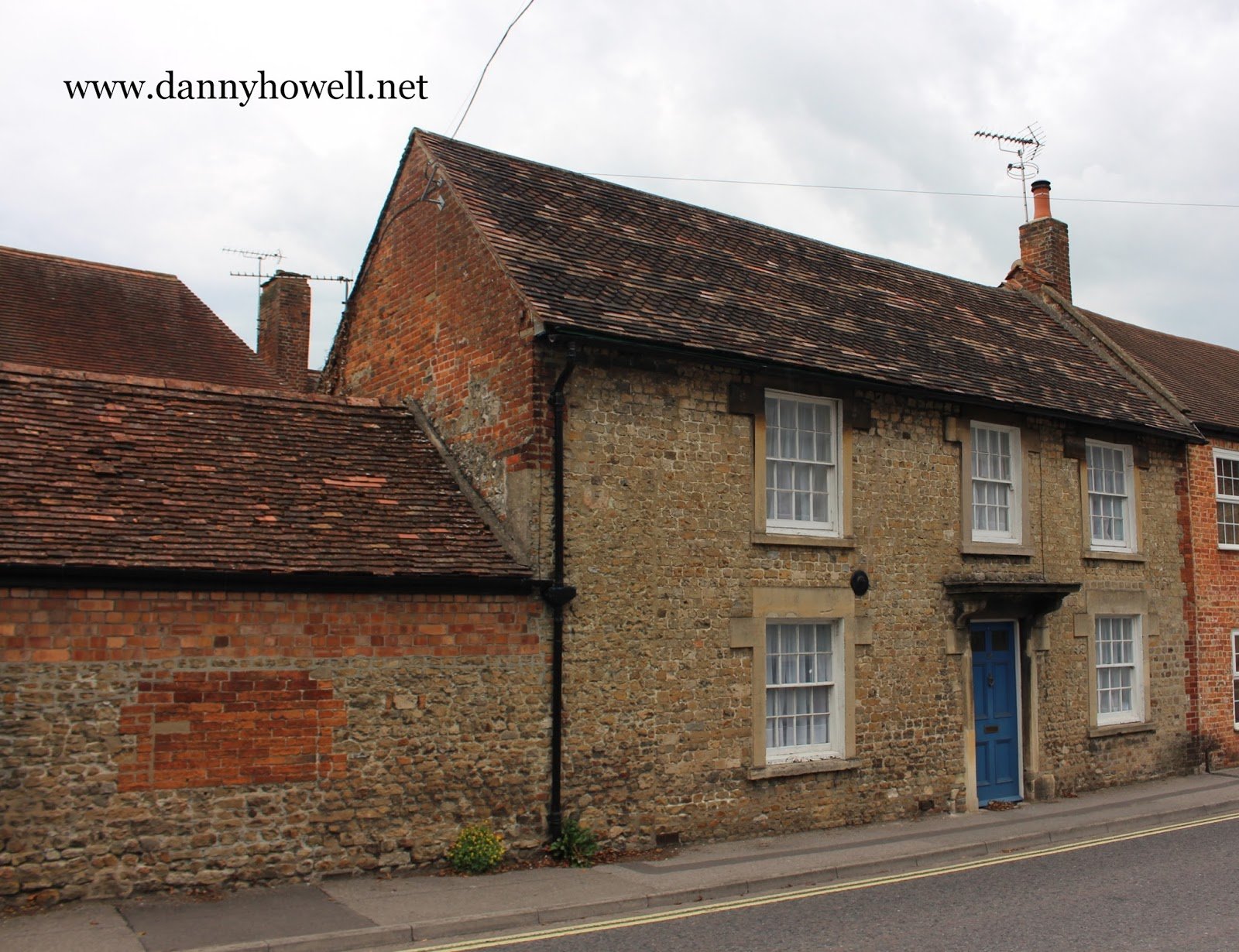
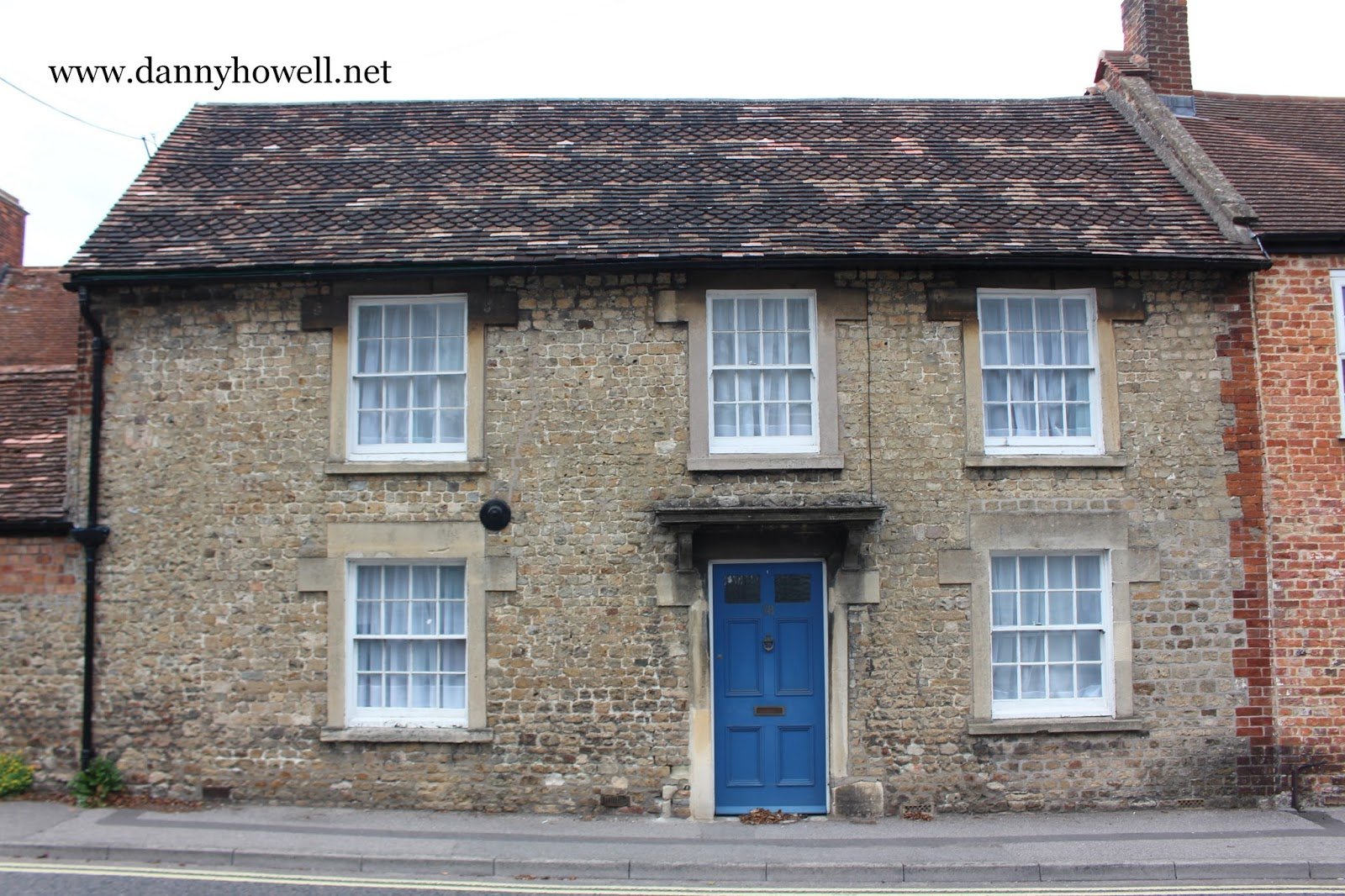
With regard your question, does the house still exist, the answer is yes. Below are three photographs I took of the house today, Saturday 22nd August 2015.

 18 Vicarage Street, Warminster.