Witches In Warminster

Thursday 30th October 2025
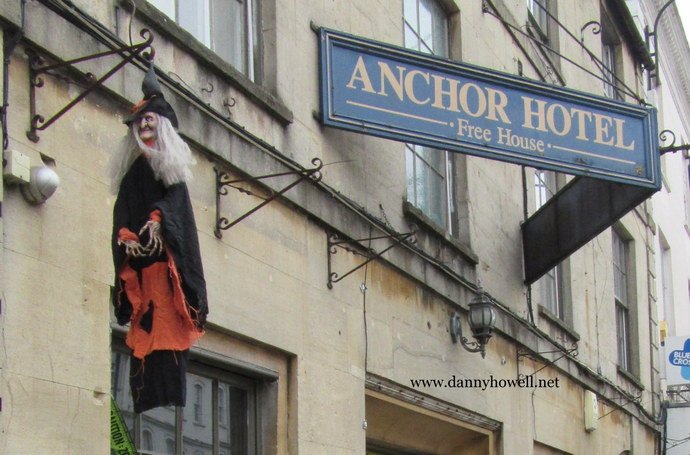
A photograph I took 9 years ago, on 30th October 2016, of a witch on the wall of the Anchor, Market Place, Warminster.

Danny Howell writes:

Witches In Warminster

Writing in the 1920s, Victor Strode Manley, who not only was a teacher at Sambourne School, but was also a keen local historian, mentioned a possible witch in Warminster. In his ‘Regional Survey Of Warminster And District’ (unpublished) he made a reference to a woman who lived in a little thatched cottage on West Street. He noted that her name was Tilly Flaherty and that she was a reputed witch. He gave no other details and we are left to wonder at what time period Tilly Flaherty lived and as to why she was thought of by others as a witch.

But we do have some historical information regarding witchcraft in Warminster in the 17th century – information re-published in the early 1970s by Wilfred Middlebrook, another of Warminster’s amateur local historians.

He wrote: In days gone by, witchcraft was as prevalent in Warminster as in any other part of the country, and there are several cases of witchcraft or complaints of witchcraft in the records of the county of Wilts., the Great Rolls of the seventeenth century Quarter Sessions.

In 1650 a Warminster woman complained to the Justices that a neighbour called her a “bun’ or witch.

And some 37 years previously: In 1613, at Marlborough Quarter Sessions, Margaret Pilton of Warminster was accused of being a witch by Avis Glasier. During Lent the two women met at the house of William Mathew at “Borom,” [Boreham, on the east side of Warminster], where Avis had gone to take a breakfast to her betrothed husband. As the two women walked back to the town of Warminster – probably along Smallbrook Lane, or across the neighbouring fields [on which the Prestbury housing estate was built in the 1960s] – “Margrett did desire the said Avyes to gyve her her soule or spirit,” promising that Avis would live twenty years the longer and recover her health. Avis refused but the witch “drew her home to her house and made her drinck [drink] some of her drinck,” and said if Avis told her friends she should live longer in her pains, and made her promise to send for her before she departed this world.

Some weeks later, in July, Avis sent for the alleged witch Margaret Pilton. Margaret ordered everyone out of the house and asked Avis whether she had told anyone. “And then she said Margrett departed from the sayed Avyes and after her departure she said Avyes fell into a mervellouse Traunces as thoughe ye should have departed strayghte.”

It sounds as if the marvelous “traunce” was some sort of trance that put Avis into a death-like state.

The story was sufficient for Margaret Pilton to appear in court, on a charge of witchcraft.

Margaret Pilton’s version of events when she was examined by Edward Ludlowe on 27th July 1613 was that she was being kind enough to treat Avis for an abscess. Margaret explained that as she and Avis walked home from Boreham, Margaret asked Avis the cause of her sickness which proved to be an abscess or “imposthume,’ and “it was impossible for Avis to recover from it.” At her house in Warminster Margaret gave her friend a medicinal drink “as shee did drincke of herselfe”; on departing, Avis entreated her to come if she should send for her.” In other words, Avis was ill and sent for her. Margaret denied asking Avis for her soul.

There doesn’t seem to be any record of whether Margaret Pilton was found guilty of being a witch or not. No mention is made of any sentence in the published report of the court, though at that time most towns were equipped with a ducking stool (also called a cucking stool or a cooking stoole) for dealing with witches. Ducking stools were also used to punish women who were considered “scolds” or spreaders of untrue gossip. Basically, the punishment was really about including humiliation.

The ducking stool consisted of a wooden chair attached to a see-saw like beam. The alleged witch was held in the chair by an iron band so that she could not get out. A magistrate could say how many times a suspected witch could be ducked into the water. If she drowned she was proclaimed not guilty, but she was of course then dead. If she didn’t drown, but “floated” then she was deemed to be at work with the devil and proven guilty. If found guilty a witch could be executed in various ways, including hanging, or being strangled or crushed and then burnt. The destruction of the body was to ensure a witch couldn’t come back to life.

A man called Simon Sloper was responsible for providing and keeping in good repair a ducking stool in Warminster. Simon Sloper was the owner of Black Dog Wood and he lived in a house along the narrow road we now call Ash Walk. In the first half of the 17th century, the present Ash Walk was called Sloper’s Walk.

Wilfred Middlebrook wrote: There are several references to the Sloper family in the 17th century Quarter Sessions records. For example, in July 1607, it was recorded that a “cooking stoole’ [ducking stool] was needed in the town of Warminster, to be made and maintained by Simon Sloper. Thirty years later, in 1637, the Jury at Warminster present “that they have neither a cucking stool nor pillory in Warminster, and that William Sloper must maintain and put them up.” It seems as though the present century has no monopoly in procrastination, for in 1647 comes: “We present that we have noe stocks in the towne of Warminster in default of William Sloper” (ordered to be provided before August under penalty of 40/-). In 1650 the presentment to the Jury states “that their church is mightily in decay insomuch that the pishoners (parishioners) are afraid to assemble there,” and in 1669 we find “Simon Sloper Junior presented for not setting up a Pillory and Cookinge Stoole in Warminster.”

Wilfred Middlebrook concluded: “They must have been a kind-hearted lot, those Slopers of Ash Walk.”

I suppose the question we must ask ourselves now, if Warminster had a ducking stool for dealing with alleged witches, where was it used? On the River Wylye perhaps? Or some pond in Warminster? It is known that ducking stools were not always permanent features but were often on wheels so they could be taken to the bank of any chosen river or pond.
Historic England Asking The Public To Record Witches’ Marks On Buildings

Monday 31st October 2016

From BBC News ~

Members of the public are being asked to help create a record of ritual markings on buildings that were once believed to ward off evil spirits.

The “witches’ marks” were often carved near entrances to buildings, including the house where Shakespeare was born and the Tower of London.

The symbols were believed to offer protection when belief in witchcraft and the supernatural was widespread.

But heritage agency Historic England says too little is known about them.

This Halloween it is calling for people to document the marks, which can be found in medieval houses, churches and other buildings, most commonly from around 1550 to 1750. 

‘Easy to overlook’

The symbols, which were intended to protect inhabitants and visitors of buildings from witches and evil spirits, took many forms, including patterns and sometimes letters.

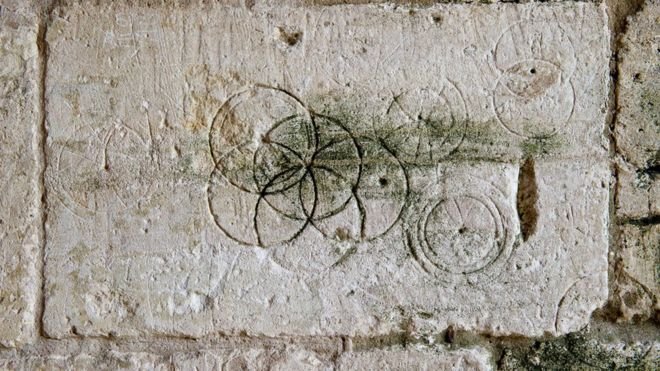
The most common type was the “Daisy Wheel”, which looked like a flower drawn with a compass in a single endless line that was supposed to confuse and entrap evil spirits.

They also took the form of letters, such as AM for Ave Maria, M for Mary or VV, for Virgin of Virgins, scratched into medieval walls, engraved on wooden beams and etched into plasterwork to evoke the protective power of the Virgin Mary.

Known examples include several found at Shakespeare’s birthplace in Stratford-upon-Avon, Warwickshire, carved near the cellar door where beer was kept, and at the Tithe Barn, Bradford-on-Avon, Wiltshire, to protect crops.

Others have been found in caves, such as the Witches’ Chimney at Wookey Hole, Somerset, which has numerous markings.

Duncan Wilson, chief executive of Historic England, said: “Witches’ marks are a physical reminder of how our ancestors saw the world. They really fire the imagination and can teach us about previously-held beliefs and common rituals. Ritual marks were cut, scratched or carved into our ancestors’ homes and churches in the hope of making the world a safer, less hostile place.  They were such a common part of everyday life that they were unremarkable and because they are easy to overlook, the recorded evidence we hold about where they appear and what form they take is thin.”

http://www.bbc.co.uk/news/uk-37817785

Witchcraft

Wilfred Middlebrook, in The Changing Face Of Warminster, first written in 1960, updated in 1971, noted:

In his Regional Survey Of Warminster And District [1920s & 1930s] Victor Manley cites the case of a woman still living on the Common at the time, who had earlier been sentenced for prostitution. Whilst in prison her neighbours made a full-size effigy of her and sat it in a chair on her doorstep all one day, then burnt it in the evening.

Such practices savoured of witchcraft, and Manley proceeds to quote an incantation over a sick child suffering from burns: “Four holy angels from the north. Out fire, in frost. In the name of the Father, the Son and the Holy Ghost, Amen.”

This is an example of white witchcraft, or healing of which I had an example during my boyhood days in the Lancashire Pendle Forest witch district. I was suffering from a large boil on the back of my neck, which refused to respond to the usual remedies of sugar poultices and the like, so my mother said “Call round the back-to-back houses and see old Mary o’t’one arm.” The tiny cottage door was opened by a wizened old woman who had indeed only one arm. “What’s troubling thee lad?” she asked, so I told her. On the hob was an iron pan full of a concoction of herbs, and this she put on the fire. How she managed the operation with her handicap I never really knew but I have a feeling that she took the pan from the fire under the stump of her missing arm. My next recollection was a large wooden ladle full of scalding herbs being slapped on the back of my neck, and the old crone had it bandaged in a trice. Black or white magic, perhaps, but it worked!

The Witchcraft Concern

A letter published in the Warminster & West Wilts Herald newspaper, Saturday 23rd November 1889 ~

The Witchcraft Concern
“To the Editor of the Warminster and West Wilts Herald.
Sir,
i seen in the Paper on Saturday a bout the Witchcraft in our Town of Warminster i was a talking to the Person this week a bout it and they said 3 Women but you got 2 and they will give the names in full and the suffers to in the Next Letter and then the Police can do as they like with it for they will tell all. Mr editor i have just learn that there is 2 more Women will be had up when it do com up to the Town Hall and if they dont speck the Truth i will have them i am for the Person.
i am yours &c.
E d S.”

Witchcraft In Warminster In The 17th Century

Wilfred Middlebrook in his newspaper serialisation, ‘The Changing Face Of Warminster,’ first published in 1971, and again (by Danny Howell / Bedeguar Books) in 2003, made the following notes about Witchcraft in Warminster in days gone by.

After making a reference to a woman who lived in a little thatched cottage on West Street, Warminster, saying her name was Tilly Flaherty and that she was a reputed witch, Wilfred Middlebrook went on to write of witchcraft in Warminster in the 17th century. He noted:

In days gone by, witchcraft was as prevalent in Warminster as in any other part of the country, and there are several cases of witchcraft or complaints of witchcraft in the records of the county of Wilts., the Great Rolls of the seventeenth century Quarter Sessions. In 1650 a Warminster woman complained to the Justices that a neighbour called her a “bun’ or witch, while Victor Manley gives a more modern version when he describes how, in living memory, women of Warminster Common made a full-sized effigy of a woman who had been sentenced for prostitution. The effigy was seated all day on a chair by the door of the woman’s house, and in the evening was burnt; a true revival of witchcraft practices.

In 1613, at Marlborough Quarter Sessions, Margaret Pilton of Warminster was accused of being a witch by Avis Glasier. The two women met at the house of William Mathew at “Borom,’ [Boreham] where Avis had gone with her betrothed husband’s breakfast. As they walked back to Warminster – probably along Smallbrook Lane, or across the fields by a footpath that still threads its way precariously through the new Prestbury housing estate – “Margrett did desire the said Avyes to gyve her her soule or spirit,” promising that Avis would live twenty years the longer and recover her health. Avis refused but the witch “drew her home to her house and made her drinck some of her drinck,” and said if Avis told her friends she should live longer in her pains, and made her promise to send for her before she departed this world. This was the first week in Lent. In July, Avis sent for the witch, who ordered everyone out of the house and asked had she told anyone, “and then she said Margrett departed from the sayed Avyes and after her departure she said Avyes fell into a mervellouse Traunces as thoughe ye should have departed strayghte.

No mention is made of the sentence in the published report, though at that time most towns were equipped with a ducking stool for dealing with witches, but it is only fair to give Margaret Pilton’s version when she was examined by Edward Ludlowe on 27th July 1613. As they walked home from Boreham, Margaret asked Avis the cause of her sickness which proved to be an abscess or “imposthume,’ and “it was impossible for Avis to recover from it.” At her house in Warminster Margaret gave her friend drink “as shee did drincke of herselfe”; on departing, Avis entreated her to come if she should send for her. Then Avis was ill and sent for her, and Avis sent her company out of the house. Margaret denied asking Avis for her soul.