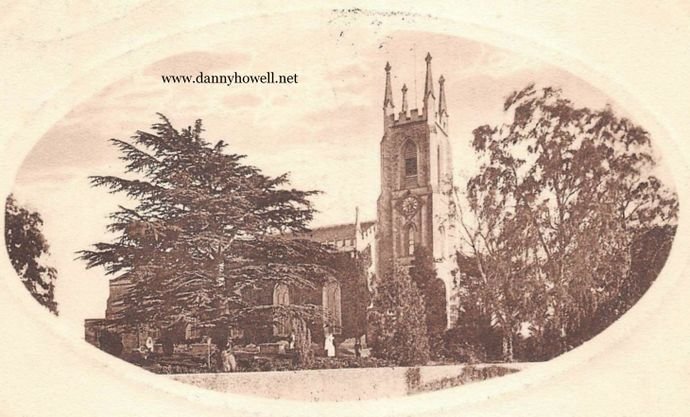
Rambles In and Around Warminster, published in 1883, noted:
CHRIST CHURCH
Although the visitor to Warminster should by no means fail to make an inspection of Christ Church, he will do well to remember before-hand the benediction which attends those who are moderate in their expectations; and the malediction which is invariably fulfilled in the case of those who expect too much. He should also bear in mind that whilst distance lends enchantment to the view, proximity very often leads to disenchantment. As we look at Christ Church from the opposite hill, and see its imposing position, its ancient looking pinnacled tower, its ivy-clad walls, and its sloping churchyard with its many mounds and monuments, we might easily suppose that it was the venerable parish church of Warminster, and that that out-of-the-way building at the North-West corner of the town, dedicated to St. Denys, was perhaps a chapelry attached. But as we approach the building, we find that the architecture is anything but perfect, that the pinnacles are clumsy and disproportioned, that the substantial looking tower is merely built of brick, and that the building is, in short, of entirely modern construction.
Christ Church, in fact, has had a short an uneventful history. Previous to the year 1830, no Church of any kind existed in the district known as Warminster Common, and little attention was shown to the spiritual wants of that portion of the town. A small Nonconformist Chapel was erected there in 1802, and in 1827 a larger one was built, chiefly through the exertions of Mr. W. Daniell, who was known as the “Bishop of Warminster Common,” and who for many years ministered in it. In 1825, the Rev. W. Dalby was appointed Vicar of Warminster, and he at once announced his intention of attempting to do something for this, the poorest, and at that time the most degraded, portion of the town. On April 2nd, 1826, he started services on Sunday evenings at the Workhouse. Mr. Daniell, writes in his diary of this date the following:- “I am bold to affirm that this was the first Church of England service ever performed on a Sunday at Warminster Common from the foundation of the world .” It appears, however, that as far back as 1798 the Rev. R. Herbert, curate of Warminster, had held week-day services at the same institution.
Mr. Dalby’s services attracted large congregations, but, strange, to say he met with a good deal of moral opposition from the Guardians and well-to-do residents in the town, as well as considerable physical obstruction from the inhabitants of the Common. The way in which the services were interrupted is forcibly illustrated by the following extremely characteristic quotation from Mr. Daniell’s diary, February 28th, 1828:- “An awful Visitation has lately occurred at the Common. A youth, who came to our Chapel, evidently to be idle, went the next Sabbath evening to the Church service at the Workhouse, for the same wicked purpose. Whilst at his Sport, disturbing the people’s Devotions, he was suddenly seized with a severe pain in his shoulder, which carried him into Eternity that day week!”
On the 25th May, 1827, a vestry meeting was held to consider the desirability of building a new Church at the Common. This seems to have been the first occasion on which the idea was publicly ventilated, and the reception it met with was certainly not very encouraging. The Vicar’s proposal that a Church should be built was lost by a majority of 102 votes. But Mr. Dalby was undaunted, and in spite of this severe rebuff, he exclaimed publicly, with a confidence very remarkable under such dispiriting circumstances, “Never will I cease to pray and labour till there is a new Church erected.”
He appears certainly to have worked most assiduously for the accomplishment of his object for four months afterwards, on the 27th September, the following entry occurs in the diary which we have already quoted:- “The Vicar’s zeal has waxen very hot indeed! It appears that a new Church, after all, will be the result. He has been very diligent in applications for subscriptions, and also very successful; and the thing is decreed surely to come to pass.”
Upon the 15th April, 1830, an important double event took place in the town. The foundation of the new Church was laid by Mr. Dalby, and the foundation of the new Town Hall was laid by Mr. Phipps. It might give rise to a misunderstanding to say that upon this day Warminster contrived to kill two birds with one stone, as there is no doubt that two separate stones were used upon this memorable occasion; but it certainly is a remarkable fact that two such similar events both so important to the town should have happened to occur on the same day of the same year.
The following is the inscription engraved on brass and let into the foundation stone of Christ Church: – “The first stone of Christ Church, Warminster, was laid on the 15th day of April, in the year of our Lord 1830. Glory to God in the Highest, and on Earth Peace, Goodwill toward men.” The ceremony was no doubt somewhat enlarged from the fact that the foundation of the Town Hall was being laid on the same day. A sermon was first preached at the Parish Church, by the Rev. Dr. Griffith (Master of the Grammar School), and a procession was then formed from St. Denys’ to the site of the new building. The procession, consisted, we are told by an eye-witness, “of magistrates, constables, churchwardens, clergymen, gentry, tradesmen, all the national school children, and an immense concourse of spectators.”
It may be mentioned here that Mr. Dalby was from the first extremely anxious that the church should be built, further from the town, and in the midst of “The Common.” Unless this were the case he maintained that the whole object of the Church would be frustrated; but in this matter his views were over-ridden by those of a very decided majority of his parishioners.
In a little more than a year the Church was consecrated. This ceremony was performed on the 13th May, 1831, by Bishop Burgess. A very large gathering of clergymen attended, and the Marquis of Bath, with a number of the magistrates and gentry of the neighbourhood, was also present. It has been remarked of this event that “Christ Church was the only church that Bishop Burgess consecrated in the county of Wilts – and that was a chapel! Considering that Bishop Burgess presided over the see for twelve years (1825-1837), this fact does not speak very highly for the Church building enterprises of this particular period.
Christ Church was at first made a district Chapelry, and as such was by an Act passed in 1847, empowered to summon a vestry and appoint Churchwardens for Ecclesiastical purposes only. But by an Act passed in 1854, it became a new parish, distinct for all ecclesiastical purposes from St. Denys’ parish. In 1869 this separation was made complete by the abolition of Church rates, a measure which made the new church entirely independent of the older one.
The building of Christ Church was at first estimated to cost £2400, but as is usual in these cases, it actually cost about double this sum, namely £4708. Of this, nearly £3000 was raised by subscriptions, the rest being principally derived from a grant by the Parliamentary Commissioners. It was built upon land belonging to the Astley family.
The first incumbent of the Church was the Rev. J.H.A. Walsh, who, in 1859, resigned the living for the Rectory of Bishopstrow. He was succeeded by the Rev. R.R. Hutton, who resigned after a charge of six years. The present Vicar (Rev.W. Hickman) succeeded him in 1867.
We have already alluded to the fact that Christ Church was the only Church built and consecrated in the diocese of Salisbury, during the episcopate of Bishop Burgess. This is saying a good deal for the benighted condition of the diocese at large; but it may be further stated that of that diocese the Archdeaconry of Wilts was, in this particular, the darkest and most depraved portion. Within this Archdeaconry the only gleam of church-building enterprise that appeared during the two episcopates of Bishop Fisher and Bishop Burgess, a period of no less than thirty years, was to be found in the erection of this church at Warminster.
Possibly, however, this fact is another testimony to the “eternal fitness of things,” for if Christ Church may be taken as a fair specimen of the church-building taste of this particular era, we need not feel any very keen regret that such structures were not multiplied to an indefinite extent.
The stranger who inspects the modern interior of the Church will probably consider that these are “hard sayings’ in more senses than one, and may be at a loss to understand how they can apply to a building which, at any rate within, is quite in conformity with modern taste, and has many pleasing architectural features.
The fact is that the present arrangement of the interior of the Church is almost as different as possible from the original design; and indeed on comparing the two it is difficult to imagine how so complete a transformation could have been accomplished, without pulling down and rebuilding the greater part of the old structure.
Soon after the present vicar had assumed office, and scarcely more than forty years after the church had been built, it was decided to add to it a chancel. This work was completed in November 1871, the architect being Mr. Wyatt, and the builders Messrs. B. Parsons and W. Dutch, of Warminster. Exactly ten years later (in November 1881), a still more extensive and important alteration was effected, namely the substitution of the present pews for the original high “boxes’; the removal of the old flat ceiling, in favour of the modern open timbered roof; the abolition of a gallery at the west end; the introduction of two rows of handsome Bath stone arcades; the addition of new windows; new gas fittings; new porches; new doors; new tiling; and in fact the alteration of almost everything that could possible be altered, to an extent rather uncomplimentary and hardly respectful to the taste of the original designers and builders. One of the most difficult, and at the same time the most important, of the improvements made, consisted in the raising and embellishing of the chancel arch, which now spans the church at an elevation of 25 feet, instead of as formerly 21½ feet. Mr. Vialls of London was the architect of these works, and Mr. Gaisford, of Warminster, the contractor. It should also be mentioned that the renovation scheme included the abolition of pew rents. The church now contains about 705 sittings, all of which are free. In order to accomplish this, £1,520 was handed over to the Ecclesiastical Commissioners. Including this amount, it may be roughly estimated that the cost of the renovation and Chancel with £350 expended on a new organ in 1871, must have been equivalent to considerably over £4,000, or about the same sum as was originally expended on the building of the church.
Within the church are several monumental tablets. Amongst these is one to the memory of the Rev. J.H.A. Walsh, the first incumbent of the church. He came to Warminster in 1828 as curate of the Parish Church, and was appointed incumbent of Christ Church when only twenty-five years of age. The inscription on the tablet is as follows:-
“Sacred to the memory of the Rev. J.H.A. Walsh, M.A., the first Incumbent of this Church, and for 28 years the faithful and affectionate Pastor of the people committed to his charge. He became Rector of Bishopstrow in 1859, and died there May 17, 1871, aged 66 years.”
Mr. Walsh was buried in the church-yard of Christ Church, and a handsome monument, inscribed with his initials, still marks the place of his interment. Most of the Communion Plate belonging to the church was presented to it by him on the day of its consecration.
The handsome stained East Window representing “The Crucifixion,” was given by Mrs. Cockrell. It stood at the East End of the Church before the Chancel was added, and was removed to its present position when that work was undertaken. It was then somewhat increased in its proportions, by the addition of the singular jumble of fragments of glass, which now compose the lower portion of the window. The two-light window on the North Side of the Chancel represents “The Raising of Dorcas,” and was presented by the Rev. W. Hickman, in memory of his mother. It is inscribed “In memory of MARGARET HICKMAN, who died at Warminster, March, 1872.” That on the South Side representing “The Resurrection and the Ascension,” was given by Mr. W. Chapman. These windows are all by Messrs. Horwood, of Frome, who, at their own expense, inserted the window in the Vestry, a representation of our Lord, inscribed “Salvator Mundi.” The ten coloured windows of the aisles were provided by a legacy from Mrs. Poore.
As may be supposed, there are few monuments in the Churchyard of very remarkable or general interest. Near the principal entrance to the Churchyard are four stones, all situated together and erected to the memory of four persons who met with accidental deaths within a few months of each other. They were SILAS PAYNE, who was killed at Wentworth in Dec. 1874, aged 25; JOHN GRIST, who died by accident in 1873; EBER GEORGE MINES, killed at Winchester in 1873, aged 22; and HENRY SPAREY who was accidentally killed at the Warminster Brewery in 1873, aged 30. There is a singular inscription on Silas Payne’s headstone, as follows:-
“To the memory of SILAS PAYNE, who was accidentally killed at Wentworth, Yorkshire, on the 2nd Dec., 1874, in the 25th year of his age. The following lines was found in his pocket book after death:-
“Mother and friends do not repent,
For unto you I was but lent,
My debt is paid, my grave you see;
Wait but awhile, you’ll follow me.”
On the South side of the Church is a stone to the memory of a person who died as master of the Workhouse, in 1855, but who, as will be seen by the following inscription, had “known better times.”:-
“In memory of HUNGERFORD LUTTRELL, formerly as officer of rank in the Columbian service under Bolivar, and afterwards a Captain in the British Legion, under General Evans in Spain. He was a lineal descendant of the ancient and illustrious families of the Hungerfords of Cadenham, and the Luttrells of Dunster. He was an affectionate husband, a fond father, and a sincere friend. He died at Warminster, Nov. 21st, 1855, aged 62 years.”
The following is the inscription upon the oldest stone in the Churchyard:-
“In memory of ISAAC AXFORD, who died July 2nd, 1840, aged 52. Also of MARY AXFORD the beloved relict of the said Isaac Axford, who died Feb. 14th, 18-9, aged 74.”
There were however, many burials previous to 1840. The first entry on the Register of Burials was singularly inauspicious. It is as follows:-
“George Wetherill, a travelling shoemaker, from Bath; died of Malignant Cholera on the 24th August 1832; buried on the evening of the 24th – before the consecration! W. Dalby.” The Churchyard was consecrated on the 9th August, 1833.
The Tower of Christ Church, measured from the summit of the pinnacles to the ground, is 99 feet high. It is substantially built of stone, and from the top an excellent view may be obtained of the town and the surrounding country.
The Belfry contains only one bell, but we may take this opportunity of impressing upon those who are interested in Bell-ringing the fact that there is plenty of room for seven more. Indeed the present Bell, hanging as it does all alone in the large empty Belfry, looks extremely insignificant, and has anything but a cheerful and inspiriting appearance. We would therefore warmly second the lines recently addressed to it by a local writer, in the columns of the Herald:-
“O Bell of fifty years’ lone influence!
Which wondrously hast done thy duty well,
Cry now for some congenial aid; that hence
Thy message, multiplied, may blessings swell.
Thy gentle call, though useful past our thought,
Repeated from thy lofty Tower’s height
With frequent best intentions rightly fraught,
Has seldom echoed mid sin’s darkest blight.
* * * * * * * *
Enlarge thy powers, then, sacred little Bell!
Spread thy dimensions into six, or eight:
Let a full peal Love’s heavenly tidings tell,
And Mercy’s invitations emulate.”
The bell was re-cast in 1838 by Warner and Sons, having previously been accidentally broken.
The clock in the Tower is the oldest object in the Church. It has upon it the inscription “Aug. 24th, 1758, Joseph Neighbour; John Clark, fecit.” The works are old-fashioned and complicated, but the clock keeps remarkably good time. It was, we believe, purchased second hand from Bristol.
The font of Christ Church is of handsome proportions and design. It is of Caen stone with four small Devonshire marble columns, and was placed in the Church in 1866.
The present organ stands in the organ chamber on the South side of the Chancel. It is by Vowles of Bristol, and cost £350. The first organ was placed in the Church in 1843, and stood in the gallery at the West End.
The organ is well adapted to the building. It is a two-manual instrument with 20 stops, 2½ octaves of pedals, and 5 composition pedals, divided 3 to great, and 2 to swell. The stops include cornopean, claribella, and clarionet.
There are several charities in connection with Christ Church, amongst them being the yearly rent of a farm (about £25) left by Mr. Elling, to be distributed each Christmas; £2000 to be given in coals at Christmas, or at other times during the year, bequeathed by Mr. Matthew Davies; £424 3s. 5d., consuls, left by Mr. Charles Bleeck in 1878, the interest to be annually given to the poorest in the parish; and £1000 left by Mr. Matthew Davies towards the support of the Mission School at the Common.
The following inscription has recently been painted upon the board at the West entrance to the Church:-
“This Church was restored and reseated A.D. 1881, at a cost of £1400, raised by subscriptions aided by a grant of £ 0 from the Diocesan Church Building Society. A further sum of £1420, including an anonymous donation of £1000, was at the same time raised to abolish the Pew Rents of the Church, and to replace them by an annual income to the vicar of £54. WILLIAM HICKMAN, Vicar. WILLIAM CHAPMAN, CHAS. ALBERT BLEECK, Churchwardens.”
Hence the following:-
Restored the Dictionary says
Means “altered back again.”
Was Christ Church ever built before
As now? and if so, when?
It’s evidence there must be some
Mistake about this Board;
The Church was altered, let us hope
It ne’er will be restored.