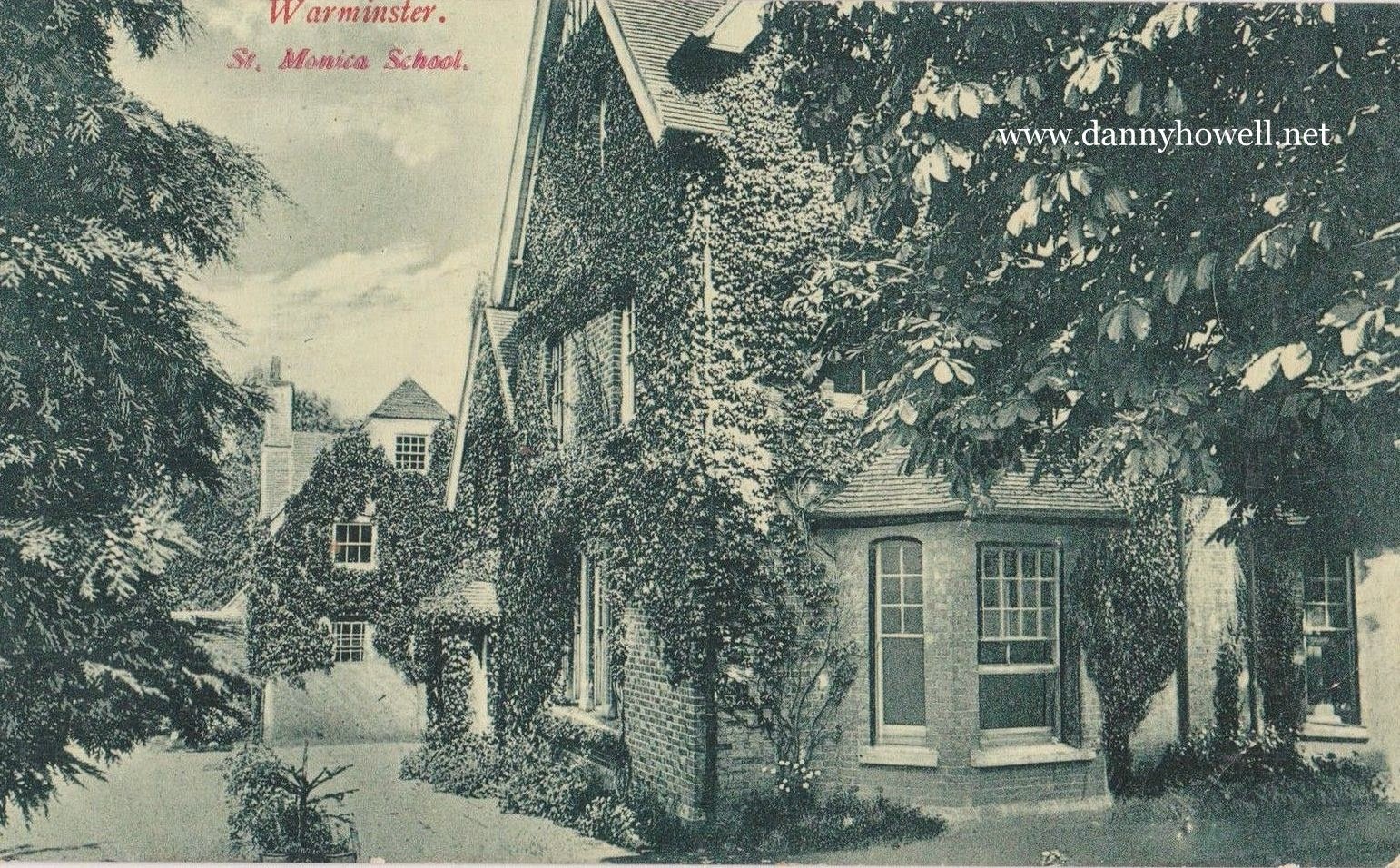
St. Monica’s School at Vicarage Street, Warminster, during the 1930s.
Topics about organisations and activities in Warminster.
St. Monica’s School at Vicarage Street, Warminster, during the 1930s.
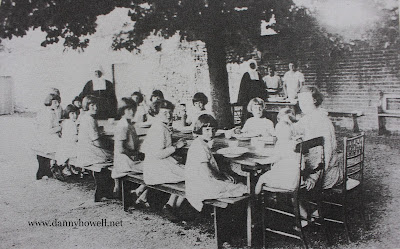
Girls having their tea outdoors at the Orphanage,
West Street, Warminster, during the 1930s.
Two of the nuns (the Sisters of St. Denys) who ran
the Girls Orphanage are in the picture.
BENEFACTIONS DISTRIBUTED AT WARMINSTER, WILTSHIRE,
CHRISTMAS 1933.
Vicar: Rev. A.R. Bellars, M.A.
Churchwardens: Mr E.E. Shore Mr Hedley Curtis.
Trustees appointed by the Warminster Urban Council: Mr George Bush. Mr H.B. Edwards.
Mr W.R. Hill. Mr C.W. Turner. Mr S.C.H. Perry. Mr James Rutty.
Clerk to the Administering Trustees: W. Randall.
List first published January 1934:
The Gift of the late GEORGE WANSEY, Esq.
£1,250 Stock – £31 5 shillings.
To Poor Aged Widows – One pound each:
Ellen Bassett, 51 Brook Street.
Margaret Blake, 30 Victoria Road.
Sarah Bristow, 16 The Furlong.
Mary Ann Brown, 26 Chapel Street.
Louisa Burgess, 89 West Street.
Mary Ann Burt, 16 Brook Street.
Margery Burton, 21 Brook Street.
Emily Doel, 5a East Street.
Annie Fielding, 33 South Street.
Emma Foreman, 37 Vicarage Street.
Elizabeth Gilbert, 22 Emwell Street.
Mary Grist, 23 West Parade.
Mary Haines, 36 Brook Street.
Rose Hill, 7 Brook Street.
Julia Ingram, 5 Ebenezer Place.
Mary James, Coldharbour.
Margaret Jones, 49 Brook Street.
Fanny Marsh, 33 Fore Street.
Jane Munday, Ash Walk.
Caroline Parker, 32 Bread Street.
Ann Prince, 12 Marsh Street.
Kate Powell, 30 Marsh Street.
Ann Maria Price, 1 Marsh Street.
Edith Scott, 38 Sambourne Road.
Louisa Sims, 12 Bleeck’s Buildings.
Alice Slade, 16 West Street.
Mary Symes, 49 Grange Lane, Boreham.
Emily Jane Turner, 33 Bread Street.
Louisa Titt, 96 Pound Street.
Annie Whatley, 22 Princecroft Lane.
Sarah Jane Whatley, Cromwell Gardens.
_______
The Gift of the late FRANCIS HENRY LANGLEY, Esq.
£1,000 Stock – £25.
Thirty Men and Women of or about 50 years of age, selected by the Vicar and Churchwardens from the Necessitous Poor residing in the Parish:
Charlotte Adlam, 23 Vicarage Street.
Mary Ann Blake, 2 Horse Shoes Yard.
Sarah Bundock, 44 Sambourne Road.
Harriet Burbage, 85 Portway.
Nathaniel Burt, 13 Bath Road.
Eliza Carr, 17 Emwell Street.
Maria Cockrell, 74 Portway.
Fanny Cundick, 11 Woodcock.
Eliza Curtis, 66 West Street.
George Day, 13 Emwell Street.
Harriet Elloway, Portway.
Edward Garrett, 6 Oxford Terrace.
Florence George, Silver Street.
Edith Ann Hooper, 23a Emwell Street.
Robert Keel, 29 Silver Street.
Jane Laing, 10 Pound Street.
Mary Ellen Ling, 24 Victoria Road.
James Oldnell, 6 Ash Walk.
Florence Ellen Pearce, 64 West Street.
Hester Player, 38 Pound Street.
Sarah Player, 15 Pound Street.
Sarah Ann Price, 13 Bath Road.
Emily Sims, 84 West Street.
Elizabeth Amelia Thompson, 17 North Row.
Rhoda Wheeler, 56 Boreham Road.
_________
The Gift of the late RALPH HOTCHKIN Esq.
£166 13 shillings and 4 pence. Stock – £4 3 shillings and four pence.
To Widows and Persons with Large Families – Ten Shillings each:
Dorcas Daniells, 91 Pound Street.
Sarah Eacott, 42 Pound Street.
Amy Hill, 14 Sambourne Road.
Margaret Holton, 24 Church Street.
Annie Jones, 42 East Street.
Henry Kemp, 69 West Street.
Harriet Till, 15 Woodcock.
Frank Titford, 3 The Furlong.
________
The Gift of the late MRS ELIZABETH TOWNSEND.
£326 0 shillings and 8 pence. Stock – £8 3 shillings.
Coats to Poor Old Men; Cloaks to Poor Old Women:
Cloaks:
Elizabeth Clifford, 7 Bread Street.
Elizabeth Emma Ralph, 8 Oxford Terrace.
Coats:
Charles Collier, 9 Horse Shoes Yard.
George Davis, 37 Bread Street.
Frank Price, 1 Horse Shoes Yard.
Albert Taylor, 7 Imber Road.
George White, 83 West Street.
________
The Gift of the late MRS JANE BENNETT.
£109 5 shillings and five pence. Stock – £2 14 shillings and 8 pence.
To Five Poor Widows of this Parish – Ten shillings each:
Rosina Dredge, 10 Henford’s Marsh.
Sarah Dyer, 10 Horse Shoes Yard.
Alice House, 1 Imber Road.
Harriet Minty, 7 Pound Street.
Mary Ryall, 2 Pound Street.
Louisa Sims, 13 Woodcock.
________
The Gift of the late JOHN SEAGRAM HALLIDAY Esq.
£109 17 shillings and six pence. Stock – £2 14 shillings and 8 pence.
To Poor Persons – Ten shillings each:
Emily Curtis, 4 Cromwell Gardens.
Mary Jane Elloway, 26 Fore Street.
Emily Field, 24 East Street.
Martha Hicks, 11 East Street.
Frederick James Norris, 17 Hillwood.
________
The Gift of the late WILLIAM KING, Esq., Silk Merchant.
Rent of Land near Brick Hill, Warminster – £4.
To Deserving Poor not receiving any other Alms – Ten shillings each:
Sarah Jane Baker, 43 Brook Street.
George Brown, 9a The Close.
Ellen Gilbert, 40 Vicarage Street.
William Grant, 30 King Street.
Henry Lakey, 38 Church Street.
John Staunton, 23 Woodcock.
George Whatley, 10 Bleeck’s Buildings.
Kate Wickham, 4 Oxford Terrace.
_________
The Gift of the late MISS WYCHE.
£106 6 shillings and two pence. Stock – £2 13 shillings.
To Five Poor Widows – Ten shillings each:
Blanche Andrews, 9 Deverill Road.
Emily Croom, 7 Bleeck’s Buildings.
Mary Mizen, 23 George Street.
Kate Shergold, 6 Woodcock.
Lucy Taylor, 3 Jubilee Terrace.
Emma Weakley, 44 West Parade.
_________
The Gift of the late STEPHEN PILCHARD Esq.
Rent-Charge upon the Organ Inn and adjoining Premises – £7. 4 shillings.
To the Minister for a Sermon in the Parish Church, Ten Shillings.
To Twenty Old and Needy Persons born in the Parish – 6 shillings and 8 pence:
Emily Airey, 19 Vicarage Street.
Philip Allen, 13 Fore Street.
John Curtis, 3 Smallbrook Road.
Francis Forde, 8 North Row.
Alice Fielding, 22 Chapel Street.
Ellen Giles, 18 Emwell Street.
James Harding, 3 Bread Street.
Rosalie King, 83 Portway.
Emily Marsh, 41 Brook Street.
George Pearce, 4 Bleeck’s Buildings.
Reginald Pearce, 5 Bleeck’s Buildings.
Nellie Phillips, 43 Boreham.
Charles Pinnell, 38 Fore Street.
Martha Pressley, 29 Fore Street.
William Reynolds, 15 Marsh Street.
Robert Scott, 34 Fore Street.
Louisa Thornton, 67 West Parade.
William Wade, 9 West Parade.
Alice Whatley, 29a West Street.
Edith Wright, 3 West Street.
________
The Gift of the late MISS ALDRIDGE.
£100 Stock – £2 16 shillings.
To Poor Parishioners – Six shillings each:
Maud Bendle, 10 Ash Walk.
George Foreman, 9 Bread Street.
Alice Hudd, 1 King Street.
William King, 8 Bread Street.
James Mead, 39 Fore Street.
Charles Prince, 8 Bleeck’s Buildings.
William Talbot, 9 Sambourne Road.
John Taylor, 73 Pound Street.
Albert Young, 8 Brook Street.
Lily Young, 1 Bell Hill.
_______
The Gift of the late MRS LAWES.
£96 6 shillings and five pence. Stock – £2 8 shillings.
To Deserving Poor Persons who do not receive Parochial Relief – Five Shillings each:
Harry Brown, 8 Pound Street.
Annie Carter, 20 Chapel Street.
Constance Fox, 4 Prospect Cottages, East Street.
Harry Fry, 2 King Street.
Robert Parker, 17 Marsh Street.
Ellen Payne, 2 Pound Street.
John Prince, 27 Pound Street.
Alfred Rowe, 37 West Parade.
Emily Trapp, 73 Pound Street.
Ada Trussler, 84 Pound Street.
_________
The Gift of the late JOHN LANGLEY Esq.
£1,400 Stock.
To Poor Parishioners not receiving constant Alms – Five Shillings each:
Ethel Adlam, 24 Chapel Street.
Ernest Ball, 12 The Furlong.
Walter Ball, 28 Woodcock.
Walter Bassett, 4 Jubilee Terrace.
Alfred Baverstock, 1 Coles’ Buildings.
Edith Baverstock, 14 The Furlong.
Joshua Blake, 21 Vicarage Street.
Mary Ann Bray, Botany Cottages.
Arthur Butcher, 99 West Street.
Charles Burton, 47 Pound Street.
William Cable, 29 King Street.
George Carpenter, 44 Brook Street.
Percy Carroll, 5 Beech Avenue.
Elizabeth Christopher, 65 Pound Street.
Frederick Cockrell, 4 Beech Avenue.
Teresa Coleman, 4 Horse Shoes Yard.
Gerald Conway, 10 West Street.
Alfred Cope, 19 King Street.
Jane Cope, 39 Pound Street.
Thomas Cooper, 44a Vicarage Street.
Annie Compton, 8 Jubilee Terrace.
Sarah Jane Culley, 6 Brook Street.
Rosa Cundick, 18 West Parade.
Stanley Cundick, 2 Pickford’s Lane, West Street.
William Cundick, 21 West Street.
Charles Curtis, 85 Pound Street.
George Curtis, 34 Bread Street.
Rowland Curtis, 9 Marsh Street.
Walter H. Curtis, 28 South Street.
Percy Daniells, 92 Pound Street.
Annie Davis, 5 Fore Street.
Arthur Davis, 6a Brook Street.
Herbert Dredge, 27 West Street.
James Dredge, 7 Horse Shoes Yard.
Edward Dyer, 39 Vicarage Street.
Elizabeth Eacott, 24 Marsh Street.
Alice Farley, 61 Pound Street.
Harry Fear, 45 Brook Street.
Bessie Ferris, 8 King Street.
Tom Ferris, 20 Princecroft Lane.
Augusta Ford, 46 Portway.
Frank Foreman, 27 Bread Street.
Ellen Hann, 9 Folly Lane, Bugley.
William Herridge, 71 Portway.
Fanny Hill, 32 King Street.
Ada Hinton, 9 Obelisk Terrace.
Harriet Hudd, 7 Marsh Street.
Peter Hudd, 50 Brook Street.
Leonard William Ingram, 3 Coles’ Buildings.
Jane Jay, 9 Beech Avenue.
Jane King, 33 Fore Street.
Maria King, 7 Oxford Terrace.
Leonard Kitley, 63 West Street.
Elizabeth Moore, 7 Jubilee Terrace.
Henry Nix, 25 Pound Street.
George Norris, 14 Boreham.
Henry Ovens, 79 Pound Street.
Stanley Pearce, 18 Pound Street.
John Penn, St Laurence Cottage.
Susan Penny, 1 Park Cottages, Boreham.
George Phelps, 8 Marsh Street.
George Pinnell, 11 Marsh Street.
Stanley Pinnell, 5 Ash Walk.
Albert Prince, 3 Princecroft Lane.
Ernest Prince, 42 West Parade.
George Prince, 32 Brook Street.
Richard Robson, 40 Brook Street.
Alfred Rose, 9 Pound Street.
Edward Searchfield, 11 Chapel Street.
Cornelius Shepherd, 64 Pound Street.
Emily Shepherd, 24 Vicarage Street.
Alice Snelgrove, 10 Hillwood.
Edward Snelgrove, 9 The Furlong.
William Snelgrove, Minster School House.
Sarah Tanswell, 28 West Street.
Henry Tinnims, 20 Emwell Street.
William Titchener, 6 King Street.
Charles Trollope, 58 Pound Street.
Daisy Tubby, 43 Boreham.
Frank Vallis, 2 Bread Street.
Percy Webb, 36 Church Street.
Alfred Weeks, 93 Pound Street.
Joshua Wheeler, 22 Woodcock.
Jesse Wilkins, 28 Portway.
Stephen Williams, 12 Emwell Street.
Charles Wills, 6 Beech Avenue.
James Yeates, Triangle Cottage, Pound Street.
______
The Gift of the late HENRY SMITH Esq.
Part of the Rent of a Freehold Estate at Stoughton, near Leicester – £10.
To Poor Persons resident in the Parish – Bread, Meat, Grocery or Drapery Goods:
Richard Adlam, 19 Bread Street.
Ada Banks, 31 Silver Street.
Sarah Bright, 4 Marsh Street.
Amy Brown, 41 Pound Street.
Rhoda Butcher, 13 Deverill Road.
Ivor Bridewell, 8 Coles’ Buildings.
May Bright, 55 Pound Street.
George Claridge, 42 Vicarage Street.
Florence Curtis, 6 Coles’ Buildings.
Harriet Cox, 35 Fore Street.
Emma Critchell, 9 Oxford Terrace.
Edward Cundick, 4 Obelisk Terrace.
Minnie Dorsett, 3 Cromwell Gardens.
James Earney, 4 Smallbrook Lane.
John Finch, 32 Marsh Street.
Alice Ford, 76 West Street.
Frank Ford, 16 Woodcock.
George Ford, 16 Emwell Street.
Albert Foreman, 1 Pickford’s Lane, West Street.
Lily Foster, 28 Pound Street.
Henry James Gilbert, 72 West Street.
Worthy George Grist, 15 Princecroft Lane.
James Hardiman, 9 Emwell Street.
Alice Harris, 27 Victoria Road.
Sarah Holton, 5 Princecroft Lane.
Violet Holton, 18 King Street.
Charles Knee, 41 Chapel Street.
Edmund Lidbury, 15 Hillwood Lane.
George Macey, 1 Prospect Cottages, East Street.
Rose Marsh, 46 Brook Street.
William Marsh, 2 Bangor Cottages, West Street.
Edward Mead, 4 Bread Street.
Arthur Miles, 26 West Street.
Charles Mitchell, Ebenezer Place, George Street.
Frank Norris, 12 Hillwood Lane.
Phoebe Norris, 31 Marsh Street.
Charles Ovens, 1 Bread Street.
Ellen Owen, 47 Portway.
Robert Parker, 42 Chapel Street.
Tom Payne, 10 Brook Street.
Robert Peck, 11 Princecroft Lane.
Elizabeth Pitcher, 4 West Street.
James Reed, 42 Boreham.
Beatrice Sanger, 15 Brook Street.
Margaret Scammell, 43 West Parade.
Edward Stone, 11 King Street.
Elizabeth Trivett, Haygrove Cottage, Bugley.
Frederick Whatley, 4 Ebenezer Place, George Street.
Charles Wheeler, 40 West Parade.
Edward Young, 6 Bread Street.
_______
The Gift of the late WILLIAM SLADE Esq.
Rent-Charge upon Freehold Premises adjoining the Market Place and North Row, now in the possession of the Warminster Industrial Co-operative Society – £2 10 shillings.
To Twenty Poor Housekeepers, not receiving Parochial Relief – Two Shillings and six pence each:
Alfred Ball, 31 Bread Street.
May Burgess, 25 Chapel Street.
George Curtis, 25 Fore Street.
Charles Goodwin, 7 Coles’ Buildings.
Frank Gray, 82 Pound Street.
Emma Heard, 54 West Street.
George Hennessey, 14 Portway.
George Hudd, 5 Marsh Street.
William Hughes, 38 South Street.
Herbert Ingram, 14 Princecroft Lane.
Harry Maddock, 30 Brook Street.
Florence Maidment, 33 West Parade.
Herbert Norris, 10 Princecroft Lane.
Joseph Randall, 6 West Parade.
Annie Smith, 12 Silver Street.
Anna Spencer, 11 Beech Avenue.
Charles Sims, 74 West Street.
Beatrice Trimby, 44 Boreham.
Alec Whitmarsh, 12 Beech Avenue.
Stanley White, 11 South Street.
________
The Gift of the late JOHN WADMAN Esq.
A Rent-Charge upon Flintford Farm, in the Parish of Frome Selwood, Somerset, now in the possession of R. Awdry, Esq. – £2 10 shillings.
To Old and Poor Persons – Two Shillings and Six Pence each:
William Besant, 83 Pound Street.
Tom Carpenter, 30 West Street.
Wilfred Clifford, 4 Princecroft Lane.
William Albert Clifford, 10 Bread Street.
William Curtis, 1 Chapel Street.
Albert Foreman, 94 Pound Street.
Thomas Gilbert, 8 Princecroft Lane.
Dorothy Hicks, 19 Princecroft Lane.
William Legg, 27 Portway.
William Henry Moody, 22 Vicarage Street.
Ernest Norris, Holly Cottages, Bugley.
Amy Pearce, 36 Fore Street.
William Pearce, 28 Fore Street.
George Randall, 34 Marsh Street.
Maurice Sawyer, 27 Brook Street.
Elsie Turner, 24 Pound Street.
Rosina Twitchen, 33 King Street.
William Webber, 3 Horse Shoes Yard.
John Whatley, 4 The Furlong.
Benjamin Withey, 4 Fore Street.
__________
The Gift of the late JOHN DOEL Esq.
£117 3 shillings and 9 pence. Stock – £4 8 shillings and 4 pence.
Boots for Old Men and Women:
Edward George Butcher, 63 Pound Street.
Harry Foreman, 11a The Close.
James Hampton, 2 Emwell Street.
Albert Holloway, 82 West Street.
Arthur Henry Meaden, 52 West Street.
George Albert Moody, 21 Fore Street.
Edward Payne, 37 Pound Street.
Fred Penny, 10 Emwell Street.
William Prince, 95 Pound Street.
Fred Spencer, 6 Princecroft Lane.
List copyright Danny Howell.
From The Warminster & District Parish Magazine, August 1933:
Warminster, St. John’s. Rowland Fitz
On St. James’s Day we laid to rest the mortal remains of Rowland Fitz, who has passed on to his rest after many months of weary suffering and acute pain. The choir was present, and the hymns “”Fight The Good Fight” and “”Glory Be To Jesus” were sung and a large congregation were present.
It is wonderful what the influence of a good, quiet man can have in the vicinity in which he lives. Wherever one went, people were deeply moved at the news of Rowland Fitz’s death at such a comparatively early age. A man of fine physique, a zealous and most conscientious workman, home-loving, deeply religious without any outward show or boast, and devoted to his wife and children. Such men form the backbone of English character. Even men who were seldom in his company readily testify to his fine Christian character and his charm and gentle manner. By his death St. John’s has bid farewell to a son of whom she is proud.
Our deepest sympathy goes out to Mrs. Fitz and her daughters in their irreparable loss. No patient was ever nursed with more tender devotion, patience and care, night and day, than was Rowland Fitz by his wife and daughters. Even when on the verge of exhaustion they carried on, hoping against hope. Such love and charity are never wasted, even though they may seem to us to be. These deeds are noted in the Book of Life. We pray for the comfort of the Holy Spirit for those who mourn his loss and that eternal rest may be granted to him who is gone before.
Burial. July 25th – Rowland Fitz, of 27, Boreham, aged 53 years. R.I.P.
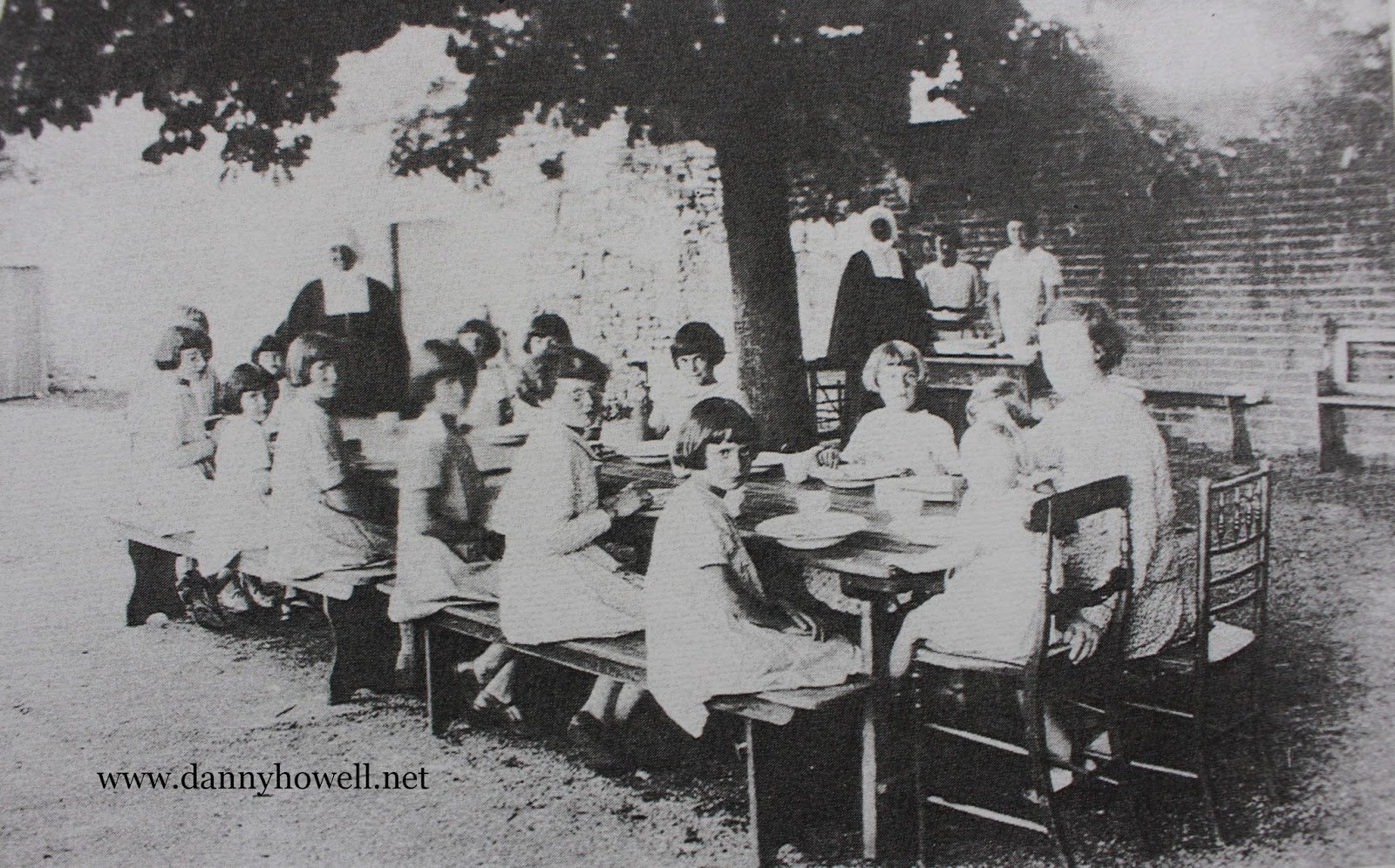
Girls having their tea outdoors at the
Orphanage, West Street, Warminster,
during the 1930s. Two of the nuns
(the Sisters of Denys) who ran the
Girls Orphanage are in the picture.
From a list of items in Harold Nelson Dewey’s diaries 1919-1947 (list made by Percy Trollope):
Friday 17th February 1933 (uncertainty about this date – needs checking?)
Mr. Tom Silcox, Avenue School teacher, gave Mr. H.N. Dewey, the Great Bustard shot at Bowles Barrow circa 1867.”
Percy Trollope remarks that this bustard is now in the Dewey Museum.
1932 – 1934
In a chalk district such as this, where clay underlies the chalk layers, springs are numerous and, up to the present day, are the only source from which the inhabitants can obtain their water supply.
To trap and conserve sufficient spring water for the houses, wells have been made, so that in every village, where possible, each house has a well or at least there is one well between three or four cottages. This is sufficient, except in times of extreme drought, which are not often experienced.
Some houses are provided with simple wells, with a chain and bucket attached to a windlass to obtain the water. They are covered by a wooden lid which is either removed bodily or opened in part for the bucket to be plunged into the water. At Hanging Langford the wells have not all a windlass. In some cases the inhabitants obtain the water by slipping the bucket on to a hook, securely fastened to the end of a long pole. This is put into the well and it is possible to imagine what a difficult and arduous task the men and women must accomplish before the day’s supply of water can be obtained. On laundry days it is all the more difficult, as the supply needed is necessarily greater.
Other houses have wells permanently covered in, and the water is obtained by pumping. Then there are wells in the valley from which the water supply is pumped to outlying farm buildings. At Wylye is a wind pump designed for this purpose, is in a field near Wylye Station. The wind pump (or pumping engine when wind is not sufficient) draws the water from a 53 feet deep well and supplies water to Bilbury Farm buildings, pumping the water 235 feet upwards in a distance of three quarters of a mile. There, it is stored in a tank capable of holding 3,000 gallons, which can be filled in 24 hours when a strong wind is blowing.
Several wind pumps of this type are to be found in this district, but not all of them are supplied with pumping engines for use at times when the wind is not strong enough to do the pumping by moving the great wheel (or sails of the pump). These wind pumps also supply water to the downlands for the cattle. This is the only way of providing the downlands with a good supply of water, for it would be far too costly, and possibly useless, to attempt to sink wells in upper chalk land districts, 500 or more feet above sea level.
Wells in the villages vary in depth, but are generally between twenty and thirty feet. The one providing Bilbury Farm buildings with water is 53 feet deep, as before mentioned, and has a bore of 20 feet. At present it is estimated that there is about 20 feet of water in this well. In Wylye Cow Down Bottom there are two wells. This Bottom was in all probability a river valley in prehistoric days, and one of the wells is situated near what would have been the source of the river, while the other would have been in the middle course. This latter well, the one nearest Wylye village, is 90 feet in depth, and a well house, which is kept locked, has been built round it. In 1933 after a summer drought period, the poultry farmer who uses this well could obtain no water from it and had to get water for his fowls from Bilbury buildings. The well near the head of the valley is 100 feet deeper than the other, and really consists of a well and a bore. It supplies the Wylye Down buildings with water. It is a comparatively recently made well – dating from 1923 or 1924 – and has a fairly good supply of water throughout the year. Its depth, compared with that of the other well in the valley, shows how much deeper the water level must be within half a mile of the first well, and about 350 feet above sea level.
The method of well making is simple. First comes the water diviner with his hazel twig. He finds the place where water is likely to be obtained most easily, and is followed by the well diggers. They begin by marking out a circle of about three feet in diameter, then start digging. Generally two men only are needed for this work. When the hole is too deep to be worked from above, they take it in turn to work from inside, first, throwing up all the earth with their spades and later making use of a basket and rope, with the aid of which loose earth may be removed from the hole. As the hole gets deeper a ladder is attached to the top, so that the men may easily get in and out of it. So the digging continues until water is reached. Then the well is “bricked in’ for about three quarters of its probable depth, and is made deeper so that plenty of water bubbles into the well from the springs in the soil. If a well has been dug to a great depth and no water has been obtained, a bore is necessary, and this means extra expense as boring apparatus is required. A bore was necessary in the making of the Wylye Cow Down Bottom well, and several times it was almost decided to cease work as water was so difficult to obtain, but eventually the subterranean waters were tapped and the well received water.
1932 – 1934
The prevailing winds of this district come from the south-west, although in the winter months north-easterly winds are frequent and make the valleys very cold. The south-westerly rain-bearing winds are far more pleasant than those from the north-east, which sweep bitingly through the valley and rage unheeded across the downlands. They are too chilly to be pleasantly bracing except in summer when they are not frequent.
Possibly, Wylye situated as it is on the southern side of the river valley, with half a mile or more of low lying water meadows between it and the downlands on the northern side, which would afford some shelter from the cold winds of the north and north-east feels these winds more than do Codford and Steeple Langford. These two villages are on the northern side of the valley and more exposed to the pleasanter effects of the south-westerly winds. Wylye is sheltered from these winds by the downlands lying south of the village, and in the summer months when a south-westerly wind is blowing across the downlands it is stiflingly hot in the village, with scarcely a breath of air to cool the hot and tired inhabitants.
Sudden weather changes are frequent in the district. Generally in summer one day might be very hot and the next of a wintry character, this all depending on prevailing weather over Britain, which in turn is dependent on the low pressure centres so often situated over Ireland, and the high pressure areas in Southern Europe in the winter months and over the Atlantic Ocean in the summer.
Sometimes there are long periods of drought, which are generally experienced when England as a whole is having hot, rainless days. Such a drought season occurred in 1921, when numerous wells in this district were dry and the river was very low. Nothing has since been done to provide a more adequate water supply for the villages, and again in 1933 (summer) the water shortage caused anxiety. The winter 1933-34 has been an extraordinarily dry one, and following on a summer drought period, it seems likely that should this coming summer be as hot as the previous one, the shortage of water will be a very acute problem indeed. In these chalk regions the water supply is entirely dependent on the rainfall.
Usually the yearly rainfall total for this district varies from 30.25 inches to 32.37 inches. On the 4th of August 1931 an extraordinarily heavy downfall was recorded. The day’s rainfall was 5.18 inches, and of this amount 5.10 inches fell in two hours during a thunderstorm. This was the heaviest day’s downpour experienced for many years, and caused the pond at the west end of the village to overflow and made the streets like rivers, whilst the ploughed fields on the downland slopes were cut in many places by miniature river valleys.
On the whole there is no very high daily or seasonal range of temperature. In the winter months it is not generally below 40 degrees Fahrenheit, although on March 18th 1930 18 degrees of frost was recorded. This was a very unusual temperature however. The usual temperatures experienced in July are between 60 and 70 degrees Fahrenheit but in August, if the weather is fine and the sky cloudless, temperatures are often higher, being sometimes more than 80 degrees Fahrenheit. In 1933, during August, a temperature of 89.6 degrees Fahrenheit was recorded.
The watermeadows contribute to the general humidity of the air and very often heavy mists arise from them in the mornings.
Snow is seldom seen here in December – when January comes the inhabitants expect to see snow, but not generally before then. Heavy falls have been known, and drifts are frequent in the lanes and along the road sides. More than once Wylye and other villages in this district have been isolated from each other by heavy falls of snow, occurring in the latter half of the winter or the early spring months.
Occasional thunderstorms disturb the serenity of the Wylye Valley during the summer and early autumn. When they come they are generally bad storms, for the thunder clouds seem to gather and stay over the valley, as if hemmed in by the downlands. Heavy downpours of rain sometimes accompany these storms and can cause havoc in the corn fields, especially before the harvest.
Victor Strode Manley, in Volume 10 of his Regional Survey Of The Warminster District, compiled in the 1920s and 1930s, noted that in 1932 a coin was thrown up by a fallen tree in Gasson’s Field, on the Tilshead Road, Chitterne.
Describing the coin, Manley wrote; “The lettering is corroded almost beyond recognition, but Mr. H.J. Wheeler was of the opinion it as a Constantine. If so it would probably be that of Emperor Flavius Claudius Constantine, the second Constantine of thirteen, 312-340, as he ruled over Britain and Gaul. The coins were minted at Constantinople. The first Constantine ruled the whole Empire, and except for the second, the others were mostly concerned with the Eastern Empire only.”
Some notes by Harold Nelson Dewey, dated 11 March 1932:
Victor Strode Manley’s references to Warminster in America leads me to suppose that it would be of interest to give publicity to some further information on this subject which is in my possession.
I presume his statement to be based on a paragraph in the Rev. H. Mayo Gunn’s “History of Nonconformity in Warminster,” published in 1853, and well worth perusal by those interested in the past history of our ancient town. He says:
“Some of them (i.e., Warminster Nonconformists of the time of the repressive period of the Restoration) also emigrated to North America and bought a tract of land in the state of Virginia, where they built a town, and called it Warminster, after their native place. It is described in “Brook’s Gazetteer,’ as “a town of Virginia, in Amhurst County, seventy miles from Richmond’.”
I remember when I first read this, many years ago, being surprised at their not joining their Puritan friends in New England instead of choosing a part of North America which had become a refuge for Cavalier emigrants during the Commonwealth regime.
Two years ago I thought I would take advantage of my Chairmanship of the Warminster Urban District Council to get in touch with our daughter town across the Atlantic, and as a preliminary I made enquiries of the American Ambassador. I received in return the surprising intelligence that there are two Warminsters in the States, one in Virginia and the other in Pennsylvania. Presumably this was unknown to Gunn, and my doubts revived strongly. Such information as I have, unfortunately very incomplete, suggest that it was the Pennsylvanian Warminster which was the one founded by these old Wiltshire Nonconformists, a much more likely theory, it seems to me, than Gunn’s. I shall be interested to see if this article produces any facts as to his sources of information.
I immediately wrote to both towns in search of information. In both cases I was unsuccessful at the first attempt, but a second attempt proved more satisfactory. I don’t know whether any local official noted with interest a letter come through with the postmark, “Warminster, Va.”
I am indebted to Mr. J.M. Carr, of Hartsville, Pennsylvania, for the following information as to our New England namesake:
“Warminster is a township in Bucks Co., Penna. At a cross roads there is a blacksmith’s shop and garage and about five houses, also a post office, which is called Warminster. It is about 18 miles from City Hall, Philadelphia, and on the Old York Road, on which the mail was carried from New York to Philadelphia by stage coaches some years ago. Also at this cross road is a monument to mark the spot on which John Fitch stood when he gave his first idea of a steam-boat.”
In passing it may be of interest to say that Fitch was born in Connecticut in 1743, and led an adventurous life. He was a gunsmith to the American revolutionaries, and also fell into the hands of Indians whilst trading in the West. In 1785 he brought out a model steamboat with side wheels, and one of his larger vessels of a later date was for some time employed as a passenger boat. Some of his plans are said to have fallen into Robert Fulton’s hands, and given him the idea of his steamship. Fulton’s vessel attained the prodigious speed of five miles per hour on the Hudson River. Like so many pioneers, Fitch was discouraged during his life time, and committed suicide in Kentucky in 1798. Fulton (1765-1815) subsequently invented the submarine in France (1801).
I am afraid V. S. Manley’s account of an interchange of greetings between the respective Mayors on the two sides of the Atlantic must be somewhat exaggerated, as I imagine our two daughters must be as innocent of this adornment as the mother town.
The Virginian Warminster, which, by the way, is in Nelson County on the James River, seems to have been much larger before the American Civil War, when it was entirely destroyed by fire, and all records of the original settlement destroyed, including the original grants of land from the King. I am indebted to Miss Louise B. Horsley for some very interesting information, including the above. She is a descendant of the original settlers on the opposite side of the river in Buckingham County.
“Warminster is reputed to have been founded by a Dr. William Cabell, a Naval surgeon, whose English home is varyingly stated as being in Wiltshire and Devonshire. Visiting this colony during his naval service he was so pleased with it that on his retiral, in 1724, he took up large grants of land on the upper James. His seat was at Warminster, in a section famed for its beauty and fertility. He became a very wealthy man and founder of a distinguished family. A lofty elm, said to shade his grave, may still be seen in the family graveyard. His descendants still occupy Edgewood House here. At present this and its tenant houses, a railroad station, a filling station, a store and post office are all that remain of what, in early colonial days, was a flourishing village of several hundred inhabitants, and a shipping point for tobacco by bateaux down the James River.”
The naval records of the period may throw some light on the connection of Dr. Cabell with our town. They are, I am informed, at the Public Records Office, but so far I have not had the necessary leisure to make a search in them.
I have carried out a search in the Parish records, but can find no record of the name nearer than 1588. At that time, there was a family of the name here. September 25th, 1559, shows the marriage of Thomas Cabell to Jane Holowway, and their children are presumably Elizabeth Cabell, born February 20th, 1561, died in childhood March 12th, 1663; and Giles Cabell, born October 24th, 1563. The name also occurs in two further marriages: September 20th, 1585, John Turner and Margaret Cabbell; November 24th, 1596, Richard Slade and Eliza Cabell. And three deaths: Alice Cabell, November 27th, 1569; William Cabell, of Bore. (Boreham), October 18th, 1572; and Thomas Cabell, February 13th, 1588. I can find no record of the Horsley family, but I believe it was a common name in Dorset.
These facts do not form sufficient basis for any very dogmatic theories, but I think we may take the following as legitimate hypotheses for further investigation:
(1) That it was to Warminster, Pennsylvania, that the Presbyterian exiles of the 17th century made their way in search of the religious freedom denied them at home.
(2) That Dr. Cabell was either a native or had close connection with our town, and chose its name to give to his new home in Virginia. He may, like W.H. Hudson, have been impressed by its “nobler-sounding name than any other in Wiltshire,” but one likes to think that it was a deeper affection than this.
I propose, as time and opportunity occur, to continue my enquiries on this subject, and shall be glad to receive any information which may come the way of any interested reader of this article.