1949
The Minster Hotel And Cafe
Proprietor: Mrs. I.D. Ward.
Residential, General and Commercial.
Silver Street, Warminster, Wilts.
Telephone Warminster 68.
Topics about organisations and activities in Warminster.
1949
The Minster Hotel And Cafe
Proprietor: Mrs. I.D. Ward.
Residential, General and Commercial.
Silver Street, Warminster, Wilts.
Telephone Warminster 68.
1949
Electricity supply for –
Home, Shop, Farm, Factory.
Southern Electricity Service.
information and advice freely available
at your local showroom and service centre:
Southern Electricity Board,
8 Market Place, Warminster.
Telephone 139.
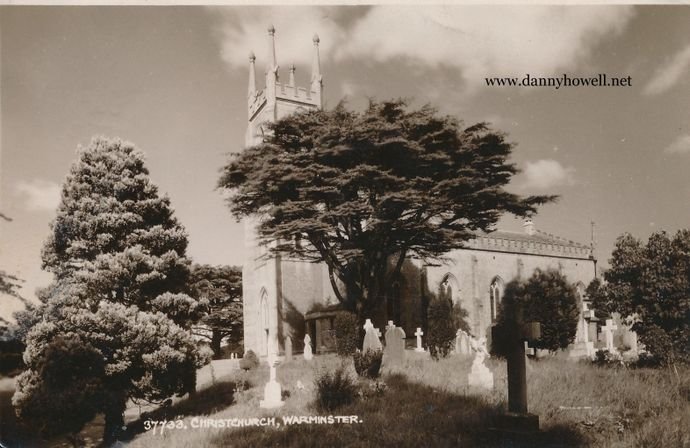
Christ Church,
seen from Deverill Road, Warminster,
as depicted on a postcard produced by
Sweetman and posted in 1948.
The Wiltshire And Swindon History Centre, at Cocklebury Road, Chippenham, Wiltshire, SN15 3QN, holds the following document(s):
Correspondence. Arn Hill Borehole. 1940-1943. Reference K4/140/35.
On Tuesday 2oth July 1943, Mr. H.E. Chappell, who had been on the staff at the Avenue School, Warminster, since its inception in 1931, as a teacher of manual handicrafts (wood and metalwork), for the boys of both senior schools in the town, concluded his services. Previous to the reorganisation of Warminster schools, Mr. Chappell had for many years conducted manual classes in Warminster and Westbury with conspicuous success. He retired from active teaching and took up residence at Dartmouth, Devon.
The book From Dusk Till Dawn, by the Wiltshire farmer and broadcaster A.G. Street (who lived at and farmed Ditchampton Farm, near Wilton), was first published in February 1943 by George G. Harrap & Co. Ltd., of 182 High Holborn, London, W.C.1.
In this book Arthur George Street (1892-1966) put on record the story of the Home Guard from its birth, through its teething troubles and adolescence, to the mature and efficient force that it was by the end of 1942. As a farmer and an enthusiastic country member of the Home Guard, Mr. Street told the story of the fictional Sedgebury Wallop Platoon in the Wessex district. It was men such as Walter Pocock, ‘Shep’ Yates, Tom Butler, and Sir Robert Enfield, who first made the Home Guard into cohesive defence units. The Force itself was an example of British improvisation, and every one of those early volunteers – officers and men – improvised in a thousand ways to give his unit the highest possible efficiency in the shortest possible time, for in 1940 an invasion was generally expected. There is humour in the telling of this story that sometimes provokes a loud laugh, sometimes an approving smile. A chapter on the Home Guard in Scotland was contributed by Alexander Keith.
“Warminster people must realise that the population of the town has doubled in recent months and they should not complain of the poor pressure of water.”
– said Mr. Neville Marriage, at a meeting of the Warminster Urban District Council, on Monday 10th March 1941.
When the mains were put in they were of ample capacity for the pre-Second World War supply and Mr. Marriage went on to say the Urban District Council had no control of the difficulty. Had they known, they would have acted accordingly, but the Council, stated Mr. Marriage, could not be blamed for the shortage and he added that it was no good people complaining.
Reg Cundick and Danny Howell, writing about The Bunch Of Grapes public house, in the book The Inns & Taverns Of Warminster, published in November 1987, stated:
During the Second World War tanks were parked at Weymouth Street, Warminster. The first of these belonged to the Guards Armoured Division. One of their tanks rolled into the front of the Bunch of Grapes, causing a fair amount of damage. Fortunately, no one was injured. Repair work to the property was carried out by F. Curtis & Son of Portway, Warminster.
Danny Howell writes:
Ernest Warren’s successor as Postmaster at Warminster was Arthur James Bartholomew – a son of Mr. and Mrs. F. Bartholomew of Carlton Villa, Portway, Warminster, and uncle of Freddie Bartholomew, the little boy who left Warminster for Hollywood and film star fame.
Arthur James Bartholomew’s appointment as Postmaster at Warminster in 1935 marked his return to the town after an absence of 23 years. He had been at one time a sorting clerk and telegraphist at Warminster Post Office but in 1912 left for the Central Telegraph Office in London. He held several subsequent appointments and prior to coming to Warminster was, from 1926, at the Highbridge Sub-Office, Bridgwater, Somerset.
Mr. Bartholomew resided at 11 Bath Road, Warminster. He left Warminster in July 1940 to be Head Postmaster at Blandford in Dorset. Mr. Read (Post Office Supervisor) continued the duties of Head Postmaster until a successor to Mr. Bartholomew was appointed (W. Smart).
From The Wiltshire Times, Saturday 3rd February 1940:
Warminster. Motor Lorries For Refuse?
Refuse collection in Warminster may shortly be carried out by motor lorry instead of horse and cart, if the Ministry Of Health sanctions a loan for the purchase of a motor lorry by Warminster U.D.C.
The Public Health Committee reported that an experiment with a motor lorry had shown that a driver and two loaders could deal with all the refuse from the town and the barracks in five days, with a little overtime on Monday and Friday. It was estimated that with reorganisation, and the employment of only one loader instead of two, the extra cost of using a motor vehicle would not be more than £85 a year.