Codford St. Mary Mentioned In Upstairs Downstairs

Friday 20th February 2026

They’ve been repeating the television series Upstairs Downstairs on television. The series was made in the 1970s and portrays the lives of the Bellamy family and their servants.

One of the episodes I saw recently was The Beastly Hun (Series 4, Episode 3). Written by Jeremy Paul, it is set in May 1915, and in London there is much anti-German feeling and talk of spies.

Edward Barnes, the footman, has enlisted and is away serving in the army.

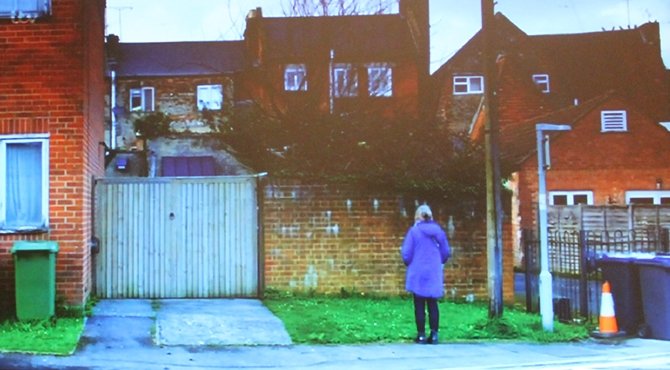
In one scene, his wife Daisy (played by Jacqueline Tong) goes to a local bakery to buy bread from Albert Schoenfeld (played by Gertan Klauber).

As Daisy goes to leave the shop, Mr. Schoenfeld asks her: “How is Edward getting on?” Daisy, having reached the door of the shop, replies: “Oh, alright. I get nice cheerful letters.” Mr. Schoenfield says: “From the Front, eh?” Daisy answers: “No, Codford St. Mary, his camp on Salisbury Plain.” Mr. Schoenfeld remarks: “Tell him to stay there.” Daisy responds: “I will. Bye!”

Glimpses Of Wilton Sheep Fair With Jack Hargreaves On Out Of Town “Calendar”

Sunday 28th July 2024

In an episode called Calendar, made in 1980 and first broadcast in 1981, as part of the 21st anniversary of the Out Of Town series produced by Southern Television, we see a short piece of film – just 87 seconds – glimpsing Wilton Sheep Fair with a commentary by Jack Hargreaves. This episode was re-broadcast, today, Sunday 28th July 2024, on Talking Pictures TV, and is available to view (in the United Kingdom and Ireland) until 4th August 2024 on the Talking Pictures TV Encore website.

The episode, in which Jack says “Today, more and more people are not doing what their parents did,” has a running time of 24 minutes and 38 seconds. It features the subjects for calendars; a pony riding competition for children in the New Forest; a riding lesson for the sons of sheikhs in a desert in the Persian Gulf; grandfather clock making by the Tribe family who had a shop on London Bridge (Jack notes that a current member of the family wears a digital watch while doing the craftmanship that has been carried out since the time of the Great Fire of London); making lace and how bobbins were once love tokens; lobster catching off Swanage which mentions Tom Harris who had the contract to supply the Savoy Hotel; sea fishing 45 miles off Poole Harbour where there are unchartered wrecks; catching conger eels; a riverside garden maintained by a busy wife; a poultry show in the ballroom of a Bournemouth hotel; fishing for barbel on the river Kennet; and the three lives of the extraordinary mayfly.

Wilton Sheep Fair is the penultimate item in the programme, commencing at 17 minutes and 21 seconds from the start. The glimpses of the sheep fair commence with a long view to Wilton which Jack describes as “a little town in the middle of Wiltshire.” Then we see some of the haulage lorries with the names, addresses and telephone numbers painted on their doors – from as far afield as Blagdon; Lyons Gate, Cerne Abbas; Stanford In The Vale, Faringdon, Berks; and Mere, Wilts. Two well known hauliers’ names are seen: A.E. George of Bruton, Somerset, and A.J. Stokes & Sons of Codford, Wiltshire.

Jack, who is bearded, wears glasses and smokes a pipe, tells us that there has been an annual sheep fair at Wilton ever since the days of sheep being brought many miles over downland, with dogs to help the shepherds.

We see the booth of the auctioneers Woolley & Wallis. Referring to the name Woolley, Jack muses “I always like to believe the auctioneer collected that name many years ago, as a nickname from the shepherds, when his great-great-great-grandfather was selling sheep.”

We also see what Jack calls “the other fascination” for him: the hurdles for the pens, stacked in a barn and being used on fair day. He says “It’s the only place I know where there are over 10,000 handmade hazel wattle hurdles. It’s amazing they go on and on using the same [type of hurdle] that was made in Anglo-Saxon times, because it is the best thing to pen these thousands and thousands of sheep every year for the Great Wilton Sheep Fair. I wonder how long [the use of] wattle hurdles will last? Someone will want to find a plastic substitute for those before we go on very long.”

Jack sums up Wilton Sheep Fair by saying “It is a scene I can’t resist. I shall see it again next year and I hope I shall go on seeing it every year for the rest of my life.”

Jack Hargreaves died in the Winterbourne Hospital, Dorchester, on 15th March 1994. He was aged 82.

Longleat: British TV Series, The Runaways

The Runaways by Victor Canning was first published in Great Britain by William Heinemann Ltd., in 1972, and again as a Puffin Book by Penguin in 1978.

The Puffin paperback (190 pages) has the following introduction:

The Runaways
‘Samuel M.,’ he said, ‘you got to think this out. You’re wet and muddy and half naked. Your clothes is all soaked and your belly’s rumbling a bit now and then because all you’ve had in the last two days is them eggs just raw and nothing to write home about. You are wanted by the police. Like a real criminal, which you aren’t.’

On a night of wild storms, Smiler (Samuel M.) escapes from a police car – he’d absconded from an approved school and the police were taking him back. On the same night, only ten miles away, Yarra, a female cheetah, escapes from the Longleat Wild Life Park.

Both boy and cheetah are determined to stay free – Smiler because he’s waiting for his seaman father to return and help to prove he is innocent of the charge that landed him in trouble, Yarra, because she wants a safe, private place in which to have her cubs.

The hunt goes up both runaways – and as the days pass, Smiler feels that Yarra is his mascot. That while she’s at liberty, all will be well for him. Yet both are in considerable danger, from other people and from each other, as they find out how to live their separate secret lives on the edge of Salisbury Plain. This story combines an exciting adventure with a love of animals and of other wild things. It is the first in a series of three stories about Smiler. The others are Flight Of The Grey Goose and The Painted Tent, also now published in Puffin.

Danny Howell writes: Victor Canning was born in 1911 and died in 1986. He wrote over 60 short stories, novels and thrillers. Although The Runaways is fictional, the text mentions Longleat, Warminster, Crockerton, Heytesbury, Imber and the Wylye Valley. At one point in the story, the lead character Smiler goes into the Warminster branch of Woolworths to buy an alarm clock. The postscript to The Runaways reads: ‘Joe’s old green van was found by the police late that afternoon. It was abandoned in a lay-by on a main road twenty miles from Longleat. Lying on the driving seat was a note that read: This van belongs to Joe Ringer of Heytesbury. Say to him the old grey goose is still flying.’

Danny Howell adds: A tv movie was made of the book, filmed at Burbank Studios, California, produced by Lorimar, and was released in the USA in 1975. But later on, and it must have been in the late 1970s or the 1980s or 1990s, The Runaways was made into a children’s tv series and broadcast on British television at teatime. It was filmed locally. I can remember seeing how the production team made a community camp at Norton Common, Corsley, for filming some scenes and when I watched the series on tv (at which time I was an adult) I was able to recognise many places and roads in the Warminster area. Does anyone else remember this series, whether it was called The Runaways or something else, who filmed it and who were the actors in it?

‘Long Lost Family’ To Feature A Woman Who Was Abandoned As A Baby In Public Toilets, Warminster

Thursday 22nd May 2020

Born without trace. Long Lost Family, ITV, Tuesday 2nd June 2020, 9.00 p.m. Nicky Campbell and Davina McCall help a woman who was found as an abandoned baby in the public toilets (long since demolished) at Emwell Street, Warminster.

Bad Show, The Quiz, The Cough, The Millionaire Major

Saturday 31st January 2015

Bojangles Books have published Bad Show, The Quiz, The Cough, The Millionaire Major, by Bob Woffinden and James Plaskett.

The blurb inside the jacket front cover reads:

When Major Charles Ingram won the £1 million prize on ITV’s top-rated show Who Wants To Be A Millionaire?, glitter and confetti showered down on him and his wife, Diana. He was warmly congratulated as the programme’s third million-pound winner.

But within a week his triumph had turned to dust. The show’s producers believed that he had cheated. They accused him of having been guided to the correct answers by the coughing of a fellow contestant and called in the Metropolitan Police.

The possibility that there had been such brazen cheating on what was then the world’s leading TV quiz show instantly became headline news internationally. Newspapers and television stations the world over rushed to report details of the ‘coughing’ plot.

Eighteen months afterwards, at a criminal trial in London, Charles and Diana were both found guilty. Ingram had to resign his commission in the army and faced life as a ruined man. He lost not only the million-pound prize but also everything he already had. Today, more than ten years later, he is still paying the fine imposed by the judge.

But what really happened?

Bad Show tells the true story of the events of that night, what occurred during the months beforehand and what happened afterwards.

It is a story that, for all the unprecedented levels of publicity that the affair generated, has never been told before.

Hardback. 404 pages. ISBN 978-0-9930755-2-0.

Countryfile Finds Out How Wiltshire Inspired Siegfried Sassoon And Includes A Visit To Heytesbury Wood

Wednesday 26th February 2014

Danny Howell writes ~

Countryfile on Sunday 2nd March 2014 will focus on Kent but also in the programme will be an item on how the Wiltshire landscape inspired the First World War soldier, poet and novelist Siegfried Sasson, CBE, MC, who lived at Heytesbury House from the 1930s until his death, one week before his 81st birthday, on 1st September 1967. He died of stomach cancer and is buried in St. Andrew’s Churchyard at Mells, Somerset. 

Presenter Helen Skelton will visit Heytesbury Wood, the subject of one of Sassoon’s poems. Sassoon was also a keen cricketer, playing and involved until late in his life in the village eleven. Countryfile is on BBC1 on Sunday 2nd March from 7.00 p.m. to 8.00 p.m. and can be watched again during the following seven days on BBC Iplayer. For further details about the programme, click here.

Also, on the subject of Siegfried Sasson, Andrew Pinnell, tells me some other news. Andrew, during his time as Captain of Heytesbury Cricket Club, edited the book Siegfried Sassoon: A Celebration Of A Cricketing Man, published by Making Space in 1996. It features a selection of articles by and about Siegfried in celebration of his cricketing life and association with Heytesbury Cricket Club.

Andrew not only tells me the book may hopefully be reprinted but also that recently a couple of albums of Sassoon family photos were found in an outhouse, providing images unseen by the public before. No doubt, Robert Pulvertaft, of Heytesbury, who is the step-son of the late George Sassoon, son of Siegfried, will be able to tell us more about this. Robert has a website about Heytesbury Wood as an events venue (Woodside Events) and it features some notes and photos of Siegfried Sasson, click here.

Flog It! From Warminster Repeated Today

Saturday 28th December 2013

Flog It! on BBC2 today at 4.00 p.m. is a repeat of the programme featuring Warminster, when local people took their antiques and collectables along to what was the Assembly Rooms (now the Civic Centre), with some items being chosen to be taken to auction at Henry Aldridge’s salesrooms in Devizes. Among the sellers was David Dodge of East End Avenue, Warminster.

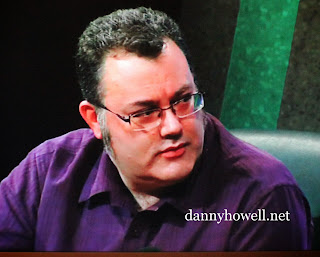
Simon Thomas “From Warminster, Wiltshire” In University Challenge Team

Monday 14th October 2013

Tonight (Monday 14th October 2013)
on University Challenge on BBC2 was
a contestant who introduced himself as
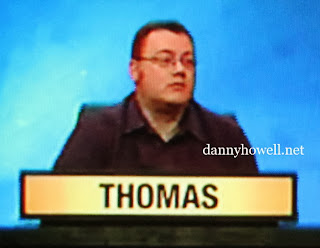
“I’m Simon Thomas, from Warminster, Wiltshire,
working towards a Masters in Strategic Studies.”

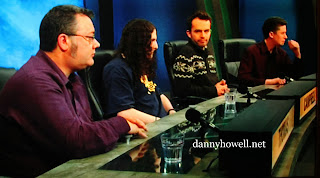
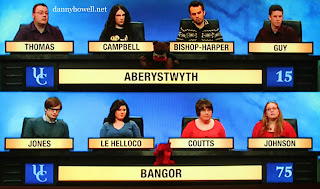
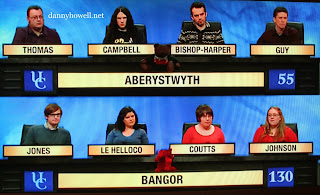
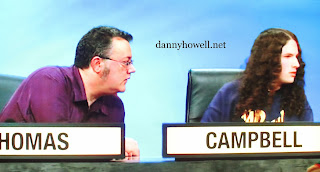
Simon, seen here far left, was a member of the team 
from The University Of Aberystwyth
which has 15,000 students in total.
The average age of the Aberystwyth 
team was 30.

Aberystwyth were competing against
Bangor University in the last
of the first round matches.
As can be seen from the scores above,
Bangor got off to an early start by quickly
answering a string of questions correctly.
Bangor were a younger team
with an average age of 23.

To his credit, Simon was able to successfully
answer two starter (10 point)
questions during the tough quiz.

As just over 17 minutes into the quiz had passed,
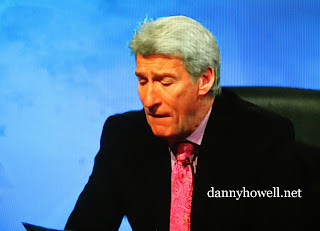
Quizmaster Jeremy Paxman 
asked the starter question:
“Rising in defence of the Glorious Revolution
which English philosopher outlined his political
theory by attacking the notion of the Divine
Right of Kings  . . . ” but Paxman was interrupted
when Jones from the Bangor team buzzed in
and incorrectly answered “Hobbs.”

Jeremy Paxman was then able to complete the starter
question for the benefit of Aberystwyth:
“. . . in the 1690 work Two Treatise On Government?”
Simon then correctly answered the question
“John Locke” which gave his team
three questions for five points each,
the answers to which were words that
could be made out of any of  the eight letters
in the word ‘marzipan’.

The quiz continued but Bangor maintained
 a substantial lead, thanks mostly to
the knowledge of their captain Christina Coutts.

Coincidentally, the Bangor team also had
a contestant from Wiltshire, Anna Johnson,
seen here lower right, who said she was
from Chippenham.

At just over 22 minutes into the half hour
programe, with the score at 
Aberystwyth 100, Bangor 155,
Jeremy Paxman asked the starter question:
“Formerly used to produce acetylene
in lamps, which solid grey compound . . . “
at which point he was interrupted by the
buzzing in of Simon.

Simon correctly interrupted with the 
answer “Calcium Carbide”
which then gave Aberystwyth the advantage
 with three 5-point questions on Henry VIII.

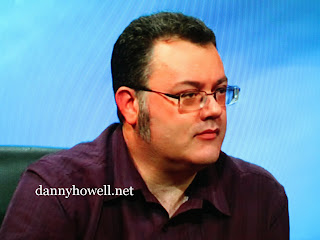
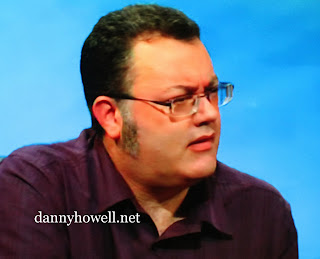
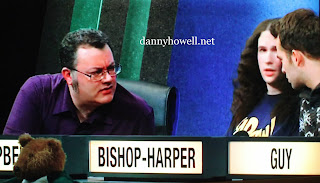
Simon (left) conferring with his team mates.

Simon’s hands gripped together during the quiz.

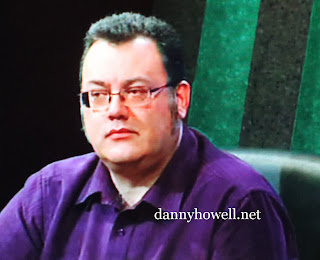
Simon Thomas.

Unfortunately, no amount of conferring
or getting starter questions correct
by Aberystwyth
could make for playing catch-up with
Bangor who continued to forge brilliantly ahead. 

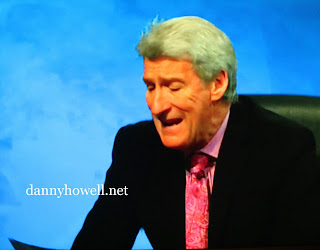
Jeremy Paxman announces the final score:
Aberystwyth 110, Bangor 230.

Hard luck to the losing team.
You were good but your contenders 
were twice as good on the night.

Jeremy Paxman offers his commiserations
to Aberystwyth.

Jeremy offers his congratulations
to the winners of this battle
Bangor University, who now go forward
to compete in the next round of the quiz.

Farewell Fat Man On A Bicycle

Saturday 28th September 2013

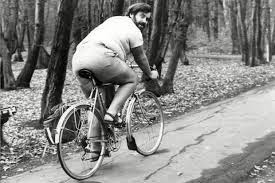
Fat Man On A Bicycle – Tom Vernon [Photo: Rex Features].

Danny Howell writes ~

There’s an obituary for Tom Vernon ~ aka “Fat Man On A Bicycle” ~ in today’s Western Daily Press. Tom died on Wednesday 11th September 2013, aged 74, and there’s no doubt he will be remembered as a larger than life personality, in more ways than one, by everyone he came into contact with. I met Tom some 19 years ago when he came to Warminster purposely to see me. The occasion still stands out vividly in my mind, and for the benefit of dannyhowell.net readers, here’s a piece I wrote about it (written in December 2012).

People Come And People Go
December 2012
Fat Man (Without A Bicycle) Came Calling It was the summer of 1994, when I was the Curator of the Dewey Museum in Warminster. Tom Vernon, aka “Fat Man On a Bicycle,’ (the title of his first travelogue television series broadcast in 1979) came into the Library, looking for me. He was accompanied by his wife, and he said he wanted to have a chat. He quickly suggested swapping the leisurely confines of the bookshelves and the archives and artifacts for the pleasures of an alehouse. So, Tom, his wife Sally, myself, and Glenn Head (the Deputy Curator of the Dewey Museum and my trusty friend) walked through the Three Horse Shoes Mall to the Market Place and the Bath Arms. Tom got the drinks in and we sat by a window, next to the pub’s front door, where we could see the pedestrians and the motorists passing through the historic main street. We had the lounge bar of the Bath Arms almost to ourselves; just us and a member of staff and a couple other patrons.

Of course, I had heard of Tom Vernon and I had seen his programmes on television, such as the aforementioned Fat Man On A BicycleFat Man On A Roman Road (1983) and Fat Man At Work (also 1983). There were other series too and I thought all of them were very good. I knew Tom had once been a presenter/interviewer on BBC Radio 4 but that’s about the sum total of what I knew of the famous Mr. Vernon at the time.

Tom and I, sitting, both bearded, face to face, did nearly all the talking; Tom’s wife Sally and Glenn said very little but they were avidly listening (or so it seemed) to what we were saying. Sally, I believe, was involved in some capacity with Tom’s film-making company, Fat Man Films Limited. 

Tom didn’t reveal to me the full details of his forthcoming venture but it was obvious he had plans to make a tv programme about Wiltshire, or even a series of programmes about people and places in Wiltshire. He had a reason for coming to see me, he wanted to know what single thing summed up the county for me. And that was easy for me to respond to.

I said Wiltshire was a county divided – “a county of chalk and cheese.” Where I live, in south-west Wiltshire, we traditionally grew corn and grazed cows and sheep on the chalkland of Salisbury Plain. In the top half of the county, Swindon way and beyond, it was fill-pail cows and plenty of good cheese making. I told Tom that I am a Moonraker – a resident of Wiltshire – but my Wiltshire is really south and west Wiltshire. The northern part of Wiltshire is, for me and others, another distinctly defined place, a northern land, although not the north of England or the far north as we know it, but considered definitely north nevertheless when compared to the part of the shire where I live, work and play.

Tom, who was exceptionally jovial, and a slimmer reincarnation of his chosen personal epithet, appeared to absorb everything I had to say. But time soon passed quickly by. Another drink – in my case, a lager shandy – and about an hour later, it was time for Tom and Sally to leave, to return home. We stepped outside the Bath Arms, saying our thanks and goodbyes under the inn sign with its golden stag and scarlet lion both rampant and its inscription “iucundi acti labores” – Latin for “work that is all done is delightful”.

Glenn and I made our way back up through the generally-considered bland, concrete-like, 1970’s precinct that was the Three Horse Shoes Mall, to the contrast of the dark reddish brown brick of the John Hazel designed Library and Museum. As we passed Artichoke, S&K Fruits, Etre Belle, the Corden Bleu frozen foods centre, and Lo-Cost (all closed after the day’s trading, because it had gone 6.00 p.m.), Glenn seemed happy and said he had enjoyed not only meeting Tom but also listening to Tom and me discussing things. It had been something out of the ordinary.

Tom did indeed go on to make some programmes about my home county, and the series was appropriately called Fat Man In Wiltshire. The series was shown on television in 1995. Among the places and things featured were Salisbury Cathedral and the Oak Apple village of Great Wishford, the Stone Circle at Avebury, dowsing at Stonehenge, sheep shearing on Salisbury Plain, old bicycles, and the trade in Wiltshire bacon – and if I remember rightly, Tom also took a look at a Hercules plane at RAF Lyneham – what you could refer to as: “Fat Man meets Fat Albert.”

Tom, I believe, made one more series of films, broadcast the following year, in 1996 – a series called Fat Man In Kent. But that appears to have been his last media venture.

I still see Tom’s books occasionally on sale at book fairs and car boots. I once bought a cookery book he did, although I hasten to add that I’m no preparer of culinary cuisine, or of any cuisine for that matter. I would have certainly been a sore thumb in Tom’s kitchen in Muswell Hill, London, where he filmed his Fat Man In The Kitchen series (in fact, two series, 1985 and 1986, broadcast on BBC). I am a prime example of “can’t cook, won’t cook,’ and, dare I say it, also ‘don’t cook’ but we had better leave it at that.

I have not seen Tom or heard from him since that one and only meeting in Warminster eighteen years ago, which is a pity, because he was such good company. Looking on the internet in 2012 I came across a forum, on which someone had noted that Tom, who is now nearing his mid-seventies, is now living in a little village in the Massif Central, France, where he has forsaken his bicycle but is apparently growing lots of fruit and vegetables. It seems, for Tom, that “work that is all done is delightful”.

BBC News, The Telegraph and The Guardian also have obits for Tom online. To read them, click on the links below:

http://www.bbc.co.uk/news/entertainment-arts-24146612

http://www.telegraph.co.uk/news/obituaries/10337217/Tom-Vernon.html”

http://www.theguardian.com/media/2013/sep/18/tom-vernon