Victorian Farming Was Successful

Monday 6th April 1992

Danny Howell writes:

The guest speaker at the April 1992 meeting of the Warminster History Society, held at Warminster Library, was Mr Michael Stratton, who lives at Stockton. He farms at Manor Farm, Stockton, and East Farm, Codford, in the Wylye Valley.

His lecture, on Monday 6th April 1992, was on how English farming changed from centuries of the three-field system to the enclosed farming of the last century.

People in the Middle Ages had used a three-field system. Each parish had three large fields which were divided up into plots, 2 to 3 yards wide but quite long. Each plot was worked by one man and he had to grow the same crop as the others in each third. One large field was wheat, the next was barley, and the last third was left fallow. The crops were rotated each year.

The rotation system worked successfully for hundreds of years. What ended the system was poor fertility, new methods, and the evolution of science to improve the land. And during the 18th and 19th centuries the population increased, which meant much more food was required.

The system was changed by Act of Parliament in the 18th century. The peasantry were dispossessed, common land was enclosed, and large units were formed and these were farmed by one man. New methods came in and these were more economic. There was an eight-year rotation sytem: wheat, barley, turnips, swedes, wheat, barley, and then two years down to grass. This was to help control pests and diseases.

Sheep were used for fertility. The sheep would eat the grass on the downlands during the daytime, and then be brought into the farm fields at night; when their droppings would help to fertilise the land. As a result the downland became very poor in fertility, but this helped the wild flowers grow well.

Up to Christmas the sheep fed on turnips, and then on swedes (which were frost hardy) later in the new year. After the swedes had been eaten the land would be ploughed and sown with spring barley. In May the turnips were sown. June to July was haymaking time. August was corn harvest time. And then the wheat was sown in October to November.

In Victorian times you would expect a yield of one tonne of wheat per acre, but now with modern technology you would expect a yield of 3 tonnes of wheat to the acre.

Michael Stratton concluded by saying that Victorian farming had been very successful.
Warminster Camera Club Barbecue

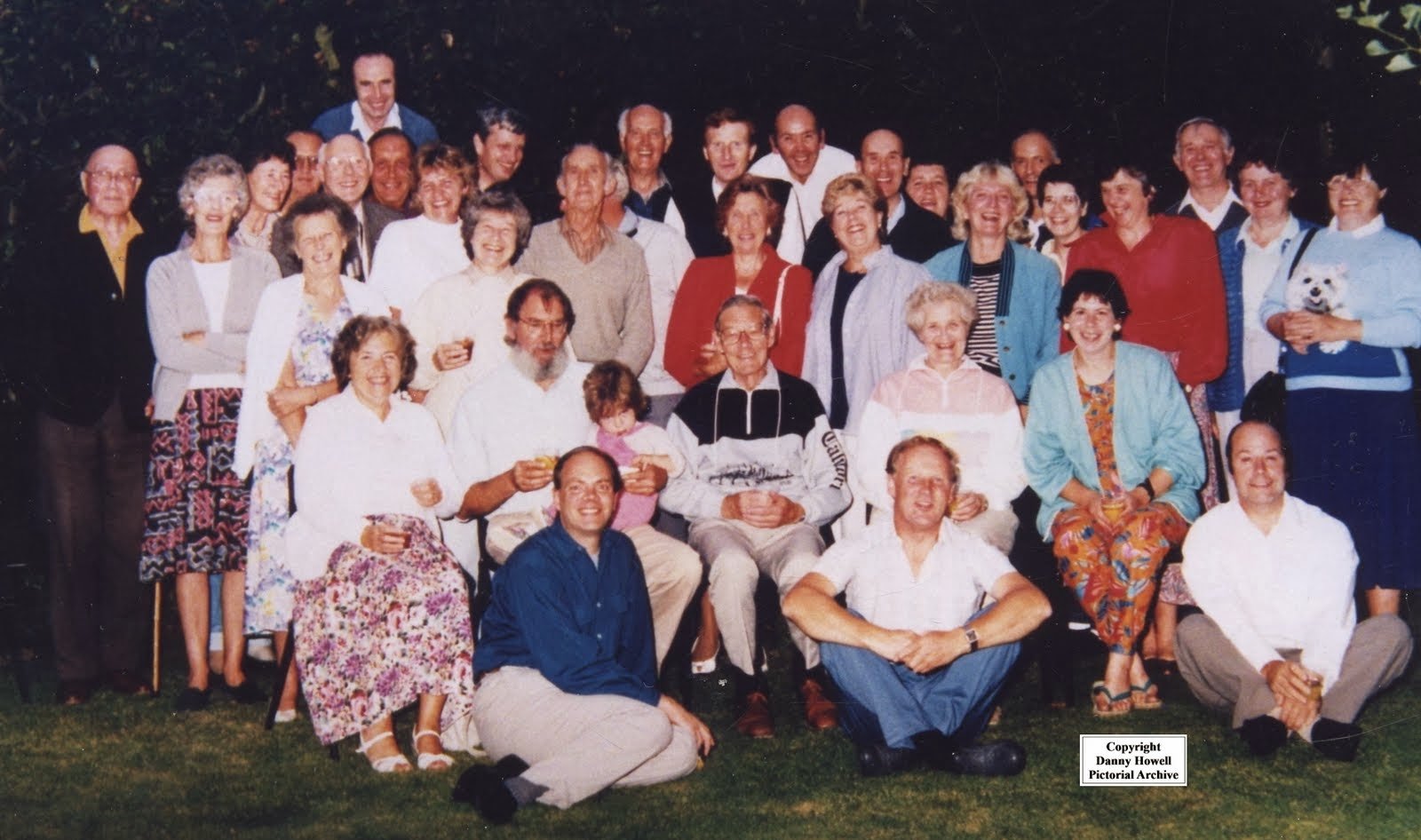
Members of Warminster Camera Club gathered together at a barbecue held in Bill and Margaret Aven’s garden at 47 Sambourne Road, Warminster, during the summer of 1991.

At the back: John Croad. In front of him: John Tiling’s uncle, Joan Tiling, Margaret Davey, Bill Parker, Dennis Davey, John Tiling, Margaret Aven, Matthew Butcher, Ted Rushen, Dave Pinnell, Derek Lawson, Derek Clarke, Barbara Dale, Colin Harrison, Audrey Harrison and Geoff Sims.

Next row: Jean Lawson, Joan Barnard, Norman Barnard, Tony Boulter, Dot Boulter, Yvonne Rushen, Eve Tiley, Suzanne Wiltshire, Doreen Sims, and June Windess.

Seated: Joan Baker, Geoff Hall, Amy Hall (on Geoff’s lap), Francis Dobson, Maureen Dobson, and Lynette Hall.

On the ground: David Wiltshire, Bill Aven and Ken Windess.

Civic Trust Environment Week 1991

Wednesday 22nd May 1991

Activities in Warminster to celebrate Civic Trust Environment Week included a display, a competition, a walk for Civic Trust members, and the Trust’s regular surgery giving residents the chance to express their concerns on environmental matters.

The display in Warminster Library drew attention to the Trust’s work dealing with a wide range of issues, from planning and traffic management to building preservation and jobs.

The Environment Week competition ‘Where in Warminster?’ was won by East Street resident Miss Kay Walker, who successfully guessed the whereabouts of several local features from a selection of photographs. Miss Walker received her prize, a pair of framed historic prints, from Civic Trust chairman Mr. Chris March.

Civic Trust members took part in a leisurely stroll in the rural parts of Boreham and Bishopstrow. Their guide for the afternoon was local historian and Trust member Mr. Danny Howell. The walk was blessed with fine weather, and was followed by tea and biscuits in the gardens of Boreham Grange, Grange Lane, Warminster, courtesy of Mr. and Mrs. John Holman. The walk raised £30 for Civic Trust funds.

Warminster Civic Trust chairman Mr. Chris March said: “Environment Week is really a week which lasts all year, because the Trust is continually fulfilling its objectives to ensure that Warminster’s growth occurs in a manner which both conserves and enhances its attractive heritage.”

Warminster Civic Trust ~What Is Happening In Warminster (Problems Aired)

Wednesday 15th August 1990

Danny Howell writes:

By taking part in a national audit of the environment, “hard facts about what is happening in Warminster” have been aired by Warminster Civic Trust.

The Trust Chairman, Councillor Chris March, said “The Trust is committed to promote high standards of planning and architecture, but within the current planning regulations this is practically impossible. The result is shoddy, characterless, out of keeping estates going up on every available piece of grassland.”

Mr. March continued “Developers are already poised, just waiting to build along the route of the recently opened bypass. Farmers and landowners will find it hard to resist the offer of astronomical sums when they are made. The County structure and local plans at present do not allow for further large developments, but we are told by the District Council planning department that they cannot withhold permission indefinitely. The developers, who have got time on their side, will eventually get their way.”

Mr. March was commenting on Warminster Civic Trust’s part in the audit of the UK environment. He said “We were delighted to take part in the audit because it will highlight environmental issues concerning everyone in Warminster, ranging from planning and architecture to traffic and transport.”

Mr. March added “We saw this as a chance to air some of Warminster’s problems at a national level and we didn’t pull any punches with what we had to say. Hopefully, our grass roots opinions, with others gathered by the audit, will help to shape future policies nationally, which in turn will be realised on a local basis.”

The questionnaire submitted from Warminster noted that although the town has been described as unattractive, it does have a pleasant mix of style of buildings, but new properties are out of keeping with the traditional scene.

Warminster’s litter problem was described as “bad”, the problem being that people don’t use the bins, and the fine for dropping litter is no real deterrent. More litter wardens are needed.

Fouling by dogs, on footpaths and verges, was another problem, and ‘no go’ areas , says the Trust, should be designated.

The majority of Warminster residents appear happy with their household rubbish collection, but the Trust has noted that when rubbish is dumped in wrong places it attracts more to the same site.

Warminster has an adequate public tip, and although the town also has a bottle bank and containers for waste paper collection, it has no such facility for can recycling.

Holes in the road were a notable problem in Warminster. A new bill could be put through Parliament to ensure liaison between those who dig up the roads, plus prompt reinstatement of any road works.

The number of occupied shops in the town centre has decreased says the Trust. Accommodation above some shops is underused, which has led to the buildings looking scruffy. The overall variety of shops, in the last five years, has decreased and the loss of department stores is regretted.

More pedestrianisation is called for.

Warminster Civic Trust, in an effort to continue tackling planning and environmental matters affecting the town, has now revamped itself by setting up four working parties.

The planning working party will examine planning applications and anything concerning the town structure plan. It will be chaired by Helen Rowley.

The environmental working party will focus on matters including litter and graffiti, and will be chaired by Elisabeth Collyns.

The amenities group aims to help promote all forms of leisure facilities from sports grounds to footpaths and rambling. It will be chaired by John Peddie.

The public relations working group will handle the Trust’s publicity, advertising and promotional events. It will be chaired by Danny Howell.

An Evening Walk On Whitesheet Hill

July 1990

Danny Howell writes:

Seventeen members of the Warminster History Society, accompanied by three dogs, took an enjoyable evening walk over Whitesheet Hill, near Kilmington.

Their guides were Society member Mr. Chris Bubb, who is a gardener for the National Trust at Stourhead, and Simon Evans who looks after Whitesheet Hill for the Trust. Mr. Bubb gave the walkers an insight into the archaeological remains on the hill, and Mr. Evans enlightened everyone with facts about the flowers and plants.

The hill is certainly rich in flowers and grasses, and can boast 95 different species including orchids, chalk milkwort and salad burnett. This is the result of controlled grazing by sheep and rabbits.

Britain’s uncultivated downland acreage has decreased dramatically since 1940, but 70% of what is left is in Wiltshire, thanks to the National Trust and the Ministry of Defence.

Whitesheet’s Iron Age hill fort is an impressive almost triangular feature. It is surrounded for half its circumference with a triple bank and ditch on its flatter north-east side. A single rampart complements the remaining steep slope. The fort appears to have seen three phases of construction during its lifetime. The National Trust own about half of it. The double fence of the Mere/Stourton parish boundary crosses the fort.

Just outside the camp overlapping a ditch, is a large bell barrow, opened by Richard Colt Hoare and William Cunnington in 1807. They found that it had been excavated before, but a skeleton was still in situ.

A further 14 burial mounds lay scattered over the fort, including bowl barrows. Some of the mounds, dating from Bronze Age times, have been damaged by quarrying. Chalk was extracted during the 1800s and before.

Next to the clearing (now used as a car park) below the hill, a cottage stood until about 1900. A limeburner called Gatehouse once lived and worked there. It is just possible to see the remaining foundations of the cottage.

An unusual circular earthwork within the hill fort, and measuring some 20 paces across, still baffles archaeologists. Colt Hoare suggested that it might have been a “tree ring”, although the tree was not in existence during his time.

Another explanation for the feature is that it was once used as the site of a beacon. Whitesheet Hill was recorded as Beacon Hill on Saxton’s Map of England and Wales in 1576.

Just as interesting at Whitesheet are several pillow mounds. These are near to the western foot of the hill and are of later date than the nearby strip-lynchets.

The majority of the pillow mounds are low rectangular mounds and two are constructed up a steep slope. They date from the Middle Ages and just after, and served as places where rabbits were kept and reared for food.

Also nearby is a Celtic field system.

Recent excavations by Wessex Water for laying a pipeline between Ilminster and Codford, have come close to Whitesheet and revealed more archaeological finds, shedding new light on how Iron Age man used to live. The discovery of snail shells dating from Neolithic times suggests that the area was once wooded.

Whitesheet Hill, at just over 800 feet high, gives fine views in all directions, particularly to the south and south-west. The Black Mountains of Wales can be seen on some evenings, particularly after stormy weather.

Clearly visible was a clearing through a clump of trees on an adjacent hillock. This is the result of an aeroplane crash in 1945. A Dakota taking off from the now disused airfield at Zeals failed to gain sufficient height and hit the trees, killing 21 people.

All that remains of the aerodrome at Zeals today is the former control tower, now converted into a private residence.

The whole of the parish of Kilmington could be seen from Whitesheet, including the straight alignment of the Hardway and Long Lane, which form part of the former London to Barnstaple drove road. This is shown as a stagecoach route on Ogilvy’s Map, and is one of the oldest trackways in England.

Members descended the hill by way of the old coach route, passing an ancient milestone. Some took the opportunity to call in at the Red Lion, at Kilmington, which is a former drovers’ pub.

Kilmington is traversed by old drove roads, and once featured many small paddocks where cattle were kept overnight while the drovers rested. A house near the present Home Guard Club in Kilmington was once a pub called The Jolly Drover. It closed about 1900.

A pint and a natter brought the evening to a close, and a vote of thanks for an interesting stroll was given by Mrs. Margaret Durham.

Warminster Preservation Trust’s Renovation Of 7 Vicarage Street Is About To Begin

19 January 1990

Danny Howell writes:

Key To 7 Vicarage Street Handed Over
Warminster Preservation Trust Ltd. are about to save another house in the town from dilapidation. Work will begin on Monday 29th January 1900 on 7 Vicarage Street, the former residence of the Minster School caretaker.

The house, which the Preservation Trust has bought for £50,000 from the Salisbury Diocesan Board of Education, was built in the 1840s. It will be renovated ready for private re-sale, with restoration costs and fees amounting to another £40,000.

The renovation will be designed and supervised by the Trust’s architect, Ray Kenzie of the Radley House Partnership in Warminster. It is the second project of this kind; the first one having been the restoration of 8 Vicarage Street which was finished a year ago.

The “house rescue” by the Trust, a subsidiary body of the Warminster Civic Trust and a charitable, non-profit-making association with the sole purpose of preserving old listed buildings is supported by English Heritage.

The project is financed by a grant from English Heritage of over £17,000, no-interest loans of over £7,500 from Civic Trust members, a low-interest loan of over £53,000 from the Architectural Heritage Fund, and home-improvement grants of £6,300 from West Wilts District Council. Money is still coming in from Trust members, providing cash flow until the grants arrive.

Warminster Civic Trust members and invited guests will be able to see the house, in its condition before work commences, during a visit at noon on Saturday 27th January.

Canon Roger Sharpe, Chairman of the Governors of the Minster School, handed the key of the house over to Elisabeth Collyns, Chairman of the Warminster Civic Trust, on Thursday 18th January 1990, which was the completion date of the sale of the house to the Trust.

Canon Sharpe says that he is pleased that the investment income on the capital from the sale of the building to the Trust, will be coming back to the Minster School and will be used for such equipment as cannot be provided by the local education authority.

Visual Changes Of Wiltshire Villages

“Visual Environmental Changes Of Wiltshire Villages” was the subject of Bryan Woodruffe’s lecture given at the January 1990 meeting of Warminster History Society.

Strictly speaking, this was not an historical subject, as it relates to the present. However, members found Mr. Woodruffe’s lecture absorbing, with its clear and unbiased presentation of the facts and statistics. His slides showed a county-wide pattern of change in the making.

“The primary cause of change is greater affluence,” explained Mr. Woodruffe. “People can choose where they live because they can afford to commute to work.”

The accepted term for the movement of population to the villages from the towns is ‘counter-urbanisation’. It is happening all over Europe and also in America and Australia.

“Not all villages grow at the same rate,” said Mr. Woodruffe, “and the planners tend to go with the trend, rather than to try to reverse it. They feel that if a parish is declining, it must be with good reason.”

“In most cases, Wiltshire villages have grown without spoiling the overall visual effect,” he added. His thinking was that the undulating countryside can accommodate development, if some care has gone into its conception. Often the inappropriate planting of non-idiferous trees (noteably Cypress Leyandii) stands out as eye-sores more than any new building.

Out of the 300 villages in the county, perhaps 15 to 20 have an unfortunate rash of modern houses, the Ministry of Defence and local councils being the worst culprits, was Mr. Woodruffe’s opinion.

“Listed buildings benefit from current prosperity,” said Mr. Woodruffe, “with newcomers wanting to buy and refurbish old buildings.” In most cases the results were satisfactory and enhanced the overall look of the village.

He thought that the church and the school were still focal points for village life, and when these were closed the community suffered. Very few chapels remained outside the towns, and while some had been converted to private residences, others had been demolished, including what had been the oldest Baptist chapel in Wiltshire.

Mr. Woodruffe’s slides were a wonderful reminder of the beauty of this county, and he left his audience with a feeling of optimism for the future.

At next month’s meeting of the Warminster History Society, Danny Howell will present another of his slide shows.

Warminster Photographers ~ Talk To Warminster Camera Club By Danny Howell

Thursday 14th December 1989

The guest speaker at the December 1989 meeting of Warminster Camera Club was local historian Danny Howell, who presented a two-hour slide show about Warminster’s early photographers.

Using examples of their work, photographers’ marks and advertising, he brought to life many details about the careers of the town’s first photographers.

Thomas Greenslade Targett, based in Warminster from 1855, was the first man in Wiltshire to go into photography as a business. He also sold china and earthenware from his glasshouse studio – the Warminster Photographic Rooms – in front of St. Laurence’s Chapel. In June 1861 he crossed the street to rooms above what is now Gibson’s, chemists, and in 1863 he sold his business to James Grant.

Grant transferred the business to Silver Street and re-named it the Obelisk Photographic Rooms, using a depiction of an Obelisk as his trademark on the back of his photographs. A native of Warminster, he was also in business as a tiler and plasterer and, between 1872 and 1878, was the landlord of the New Inn – premises now used by Obelisk Antiques – in Silver Street.

After passing through the hands of Charles John Witcomb and son, a Salisbury firm which ran the Warminster shop as a sub-branch, the Silver Street business was bought in the 1890s by William S. Keddie who renamed it the Royal Studio.

There were by then two other photographers in Warminster. Frederick Futcher was operating from 36 High Street and John Smith was based at 96 Pound Street. Between 1867 and 1885, Smith had been based at 27 East Street. Among Smith’s surviving work is a set of seven views, all taken in 1875, of the Market Place, East Street, Weymouth Street, Christ Church, Lower Marsh, Bishopstrow and Shearwater.

Sam Burgess had a small shop at 4 Brook Street, from before the turn of the century to about 1922. As well as selling sweets, groceries, cigarettes and paraffin, he was a photographer, with a studio in a shed at the top of his garden. Rumour had it that, after a row, he didn’t speak to his wife for a month. She resolved the situation by lighting a candle and following him about in broad daylight. After a while he asked her what she was doing. She replied “It’s alright, I’ve found it now. I thought you had lost your tongue!”

Herbert Frank Joyce ran the Premier Studio at Silver Street from the late 1890s. Although he called himself “the children’s photographer’ he also photographed many local events. Soon after the First World War he moved to Eversfield House at 52 Market Place, now Gateway Supermarket, calling his new premises Eversfield Studio, and continuing as a photographer until the early 1940s.

Targett’s old studio, above what is now Gibson’s, was taken over by Henry Ernest Till, who had already opened a successful business at Westbury. Born at Warwick in 1877, he had been educated in London before becoming apprenticed to a Chippenham photographer, John Singer, then setting up business in Colchester and Brightlingsea. One of Mr. Till’s regular commissions was to photograph the cast of the Warminster Operatic Society productions during the 1920s and 1930s.

Mr. Howell concluded his slide-show by saying how much the work of the early photographers had helped him with his researches into local history. He noted, however, that a lot of photographs were undated and without details, which was a pity. He hoped the members of Warminster Camera Club would continue to take photographs of Warminster scenes, events and people, which would be of use to historians in future years.

8 – 12 Market Place, Warminster

Adrian Phillips, in the book The Warminster Trail, compiled for the Warminster Festival 1989, and published by Aris & Phillips Ltd., wrote:

The building on the corner opposite the Town Hall, Nos.8-12 [Market Place] was built in the neo-Elizabethan style in 1830 as the Warminster Literary and Scientific Institution.

Like the Athenaeum, the previous building was, as you may have guessed, a pub and served much the same purpose as the later Athenaeum with a reading room, library, museum and so forth.

This pub theme is not surprising as Warminster was in the 18th century notorious for its number of pubs; over 100 names have been recorded. With its malthouses and breweries it had the reputation of being the most drunken town in Wiltshire.

The Literary Institution was split up in the late 19th century and houses several businesses and offices today.

Wessex Dialects

Monday 4th September 1989

At a meeting of the Warminster History Society on Monday 4th September 1989, Mr. Norman Rogers was the guest speaker.

Mr. Norman Rogers’ lecture on Wessex Dialects was a delight. His dry sense of humour, combined with a thorough and scholarly knowledge of the subject, made for an entertaining evening, and stirred the memories of members who, like Mr. Rogers, had been brought up with the sounds of broad dialect.

Some phrases were incomprehensive to an unpractised ear but this is not surprising as vowel sounds are changed, consonants sometimes added and sometimes omitted, and many words are outside the vocabulary of those who know only Received Standard English.

The origin of dialect probably goes back to Anglo-Saxon times. Language changes continuously but now it is changing more slowly than ever before. It is an illogical muddle which makes it a fascinating subject.

Mr. Rogers showed maps illustrating the areas in which certain sounds and words are commonly used. From these one could see that there is not necessarily a “Wessex Dialect” but a “West Country Dialect” as the language spoken has many similarities from Hampshire to Cornwall. The extreme west of Cornwall is excluded. Here English was a replacement language when Cornish ceased to be spoken 200 years ago, and people are more likely to speak Received Standard English.

Sadly, the West Country Dialect does not carry prestige. To prove his point Mr. Rogers said that one of the local commercial radio stations has advertisements in London, Liverpool and other far-flung accents but none in its own local dialect areas.

Report written by Danny Howell.

error: Content is protected !!