Meeting Of Residents Affected By Suggested Development At Home Farm

Thursday 23rd October 1997

Meeting of residents affected by suggested development east of The Dene (Home Farm). WAR/D/5037. The Way Forward.

Venue: Bishopstrow Hall.
Time: 7.30 p.m.
Date: Thursday 23rd October 1997.

To report all of the further developments of the Town Council Meeting (20/10/97), in order to gather information, formulate letter of opposition and plan our further efforts. Please try to attend. We need as many people and ideas as possible in order to fulfil our goals.

If you care about potential problems that this suggested development will incur, re: schools, traffic, drainage, right on your doorstep then please attend.

(If you came to the prelininary meeting on Sunday, please attend on Thursday also).

Meeting – Thursday 23rd October 1997 – Agenda

1) Welcome.

2) Results of Town Council Meeting on Monday 20th October 1997.

3) Speakers:
Rev. Denis Brett – Power of voices in unison. Contact with Councillors.
Danny Howell – Historical Perspective.
Astrid Elstow – Status of planning applications.

4) Appointment of Committee officers (Chairman, Secretary, Committee members).

5) Action to be taken – Letters of objection. Any other suggestions.

6) Date and time of next meeting.

Abbeyfield Society 40th Anniversary ~ Warminster Celebration In Song

Tuesday 2nd July 1996:

John Chillingworth writes ~

On 20th June 1996, the occasion of the Abbeyfield Society’s 40th Anniversary, a concert was arranged by the Warminster Committee. The ladies and gentlemen of the Warminster Singers, one of whom is our own St. John’s Choir member, David Miles, brought great pleasure to some thirty residents and guests.

The Singers’ enthusiasm and joy was infectious as they performed for an audience that included Abbeyfield resident Mrs Faith Edwards, a regular attender at St. John’s Church.

Amongst the feast of ‘memory lane’ songs, Maisy’s amusing soubrette performance of ‘My Little Alice Blue Gown’ received spirited audience participation. The Singers interlaced their renditions of old popular ballads with amusing monologues, which included Beryl’s recitation of ‘When Father Laid The Carpet On The Stairs’.

When Bella, with her wonderful Wiltshire accent, delivered ‘The Day Me Old Cows Got Drunk’, there were many chuckles from the appreciative residents and guests.

Warminster’s former Mayor, Mrs Ann Coventry, once a member of St. John’s Church Choir, narrowly avoided being ‘dragged’ from the audience to give an impromptu solo!

At the reception after the concert, guests learned that the Abbeyfield is a world-wide society, under the patronage of HRH The Prince of Wales. It is a voluntary, caring organisation that accommodates older people in friendly, non-institutional ‘family’ homes.

The Scout Hut (That Was In The North West Part Of The Grounds Of Highbury House) At Woodcock, Warminster

Notes researched and written by Danny Howell in 1995:

When 1st Warminster Scouts Were Based At Woodcock (1923-1931):

The 1st Warminster Scouts, who had been meeting in a room in a building behind the Masons Arms public house, East Street, Warminster, moved to new headquarters at Woodcock in February 1923.

Their new base was a hut west of Chancery Lane, on land now forming part of the Robin Close residential estate. The site, part of the Highbury House grounds, was donated to the Scouts by Lady Scobell (who owned and lived at Highbury House). The hut was erected especially for the Scouts by Sidney Day, T. Cooper senior, T. Cooper junior, and W. Long.

Despite bad weather a good crowd was present at the official opening by General Sir Henry Wilson of Bishopstrow, on the evening of Monday 12 February 1923. Among the gathering were the Misses Bayfield Clark, Mrs. Bazley, Mrs. Burton, Miss Clowes, Miss Davis, Mr. Harold N. Dewey, Mrs. Dixon, Mr. W.A. Greenland (Scoutmaster), Mrs. Hogan, Major Houston of Codford, Mrs. Jacob, Mrs. Mortimer, Mr. J. Rutty, Lady Scobell, and Messrs. D. and D.H. Waddington. Apologies were received from Mrs. Erskine, Mr. W.H. Kitley (landlord of the Masons Arms), and Rev. J.S. Stuart (Chairman).

After the opening speeches, Patrol Leader Taylor and Troop Leader Elloway were the opposing sides in a boxing contest. Taylor was the victor. This was followed with the scouts giving gymnastic and ambulance displays. Refreshments were served by Miss Bamlett, Miss Greenland, Miss Hall, Mrs. Silcox and Mrs. Venelle, who had also made the curtains for the hut. Rover mate Mr. M. Levenson gave some large framed pictures, and Lady Pelly of St John’s Lodge offered to the scouts “anything they liked.”

It was announced that the hut would be open every night for the Scouts, a wireless would be installed, the billiard table would be repaired, and gymnastic equipment would be supplied. Gardens were planted around the hut, a grass area was provided for parades and a cinder track around the perimeter was available for running.

The Scouts were based at Woodcock until 1931 when they moved into their new HQ, the Greenland Hut, next to the Lake Pleasure Grounds at Weymouth Street, Warminster.

Around Quebec Barn And Knook Castle ~ “Where It Was At In Roman Times”

Monday 26th September 1994

Danny Howell writes ~

Where It Was At In Roman Times

In quest of Roman times, Quebec Farm, north of Ansty Hill, on the road between Heytesbury and Chitterne, was the destination for an afternoon trip by 15 members of the Warminster History Society.

They were in pursuit of Andrew Houghton, the Society’s Honorary Secretary and a teacher at Kingdown School, who is particularly interested in Roman archaeology.

Around Quebec Barn, near the earthwork known as Knook Castle, are banks, ditches, circular platforms, lynchets and the edges of fields which date from the late Bronze Age (the time when Stonehenge was falling into disuse).

Andrew pointed out the sites of two Romano-British settlements, each with its own village street running north to south. People once lived either side of these streets, hence the discovery by William Cunnington and Richard Colt Hoare in the early 1800s of coal, a latchlifter, plaster, and pottery from France.

Strips of nettles in the ditches reveal signs of human activity from hundreds of years ago.

Around the settlements can be seen the remains of field systems. Ridges denoting the edges of early fields and lynchets where ploughing has created steps were visible from different angles.

The edges of the old fields are prominent features at regular intervals in a shelter belt of beech trees straddling the downs. These field edges can also be seen where they cross the track which runs from Quebec to Breakheart Hill.

Several circular flat areas, dug into the slope of the downs, measuring twenty to thirty feet across, are the remains of hut bases. These huts would have been made of timber, mud and plaster. The people who lived in them, between 200 A.D. and 350 A.D. kept cattle and grew grain.

The bleakness of the area and the cold weather made for difficult living conditions. So, why did people live here? It certainly wasn’t for safety, because the country was at peace during the time of the Roman occupation.

There are three possible answers:

1. A large population generally meant that every piece of land, even bleak downland, had to be used.

2. The Roman Government ran the plain as a cattle ranch (there are no stone buildings used by the Romans on the plain; the nearest were at Pitmeads).

3. The tribe who lived here were so nasty to the Romans they were subject to extra taxation, and had to eke out a living by scrabbling in a marginal area.

It really is a case of ‘we don’t know.’ 

Andrew offered another suggestion. Perhaps the area was only used for summer habitation. “This is where it was at for the ordinary person in Britain,” said Andrew. “Their lives are not recorded. These humps and bumps in the landscape and strips of nettles are the visible reminders of their existence. This is far more important to me, the lives of ordinary people, than those of the more noble who lived at Chedworth and other Roman villas.”

A unanimous vote of thanks for an interesting afternoon jaunt was given to Andrew. Next month, in the comfort of the Dewey Museum, Martyn Whittock will give a lecture about King Arthur.
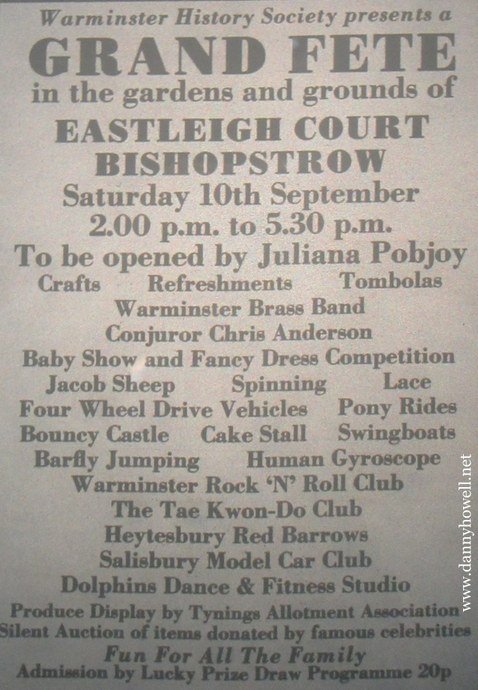
Warminster History Society’s Grand Fete At Eastleigh Court, Bishopstrow

Advertisement for Warminster History
Society’s Grand Fete in the gardens and
grounds of Eastleigh Court, Bishopstrow,
on Saturday 10th September 1994.
2.00 p.m. to 5.30 p.m.

To be opened by Juliana Pobjoy.

Crafts, Refreshments, Tombolas,
Warminster Brass Band,
Conjuror Chris Anderson.
Baby Show and Fancy Dress Competition.
Jacob Sheep, Spinning, Lace.

Four Wheel Drive Vehicles. Pony Rides.
Bouncy Castle. Cake Stall. Swingboats.
Barfly Jumping. Human Gyroscope.
Warminster Rock ‘n’ Roll Club.
The Tae Kwon-Do Club.

Heytesbury Red Barrows.
Salisbury Model Car Club.

Dolphins Dance And Fitness Studio.

Produce Display by
Tynings Allotments Association.

Silent Auction of items donated
by famous celebrities.

Fun for all the family.

Admission by Lucky Prize Draw Programme 20p.

Warminster Dewey Museum Shop

December 1993

The weeks before Christmas 1993 at the Dewey Museum shop inside Warminster Library were very rewarding. Over £600 of goods were sold during December, bringing the total sales to date to £1,701 (since 1 March). The Warminster History Society will make good use of the money, funding projects at the Museum.

Thanks go to everyone who gave freely of their time to run the shop, particularly Margaret Durham, Jack Field, Alwyn Hardy, Glenn Head, Terry Hibbs, Danny Howell, Celia Lane, Joyce Pearce, Ruth Smith, Eleanor Treasure, Joy West and Hazel Yate.

The shop was the idea of Danny Howell, and the cabinet for displaying the sale goods was built by Danny’s father, Ben Howell.

Thanks are also given to everyone who supported the shop with their purchases.

Warminster History Society Programme Secretary Resigns

December 1993

Danny Howell writes:

The Warminster History Society’s programme secretary Kim Phelps has tendered her resignation from the Committee owing to personal commitments.

The Society hopes to elect a new programme secretary at the AGM on 7 March 1994.

Rest assured though, Kim has arranged an interesting and varied programme for the year ending February 1995.

We offer our thanks to Kim and wish her well with her future plans.

Recent Enquiries At Warminster Dewey Museum

Autumn 1993

Danny Howell writes:

The Museum’s role in handling local history enquiries continues unabated. Here are just a few of the topics we’ve had to deal with since September (you will see that we not only answer enquiries from Warminster residents but also from far and wide):

The Willis family of Warminster in the 17th century (for a descendant of the family who now lives in California).

The role of the military in Warminster and its effect on the population during the last 50 years (for a student at St. Augustine’s R.C. School, Trowbridge).

The Colderick family, gentlemen’s outfitters, of Warminster (for a gentleman in Yelverton, Devon).

Photographs of Boyton Farm in the Wylye Valley (for a gentleman in Southampton).

Henry Thomas Garner who died in Warminster in 1951 (for a descendant now living at Victoria, Australia).

The history of Warminster Gardening Club (for the Chairman of the Gardening Club).

The Brodribb family of Warminster during the 1820s and 1830s (for a researcher based at Sunbury On Thames, Middlesex).

Weights and measures in the Dewey Museum collection (for an historical study being made by the Trading Standards Officer).

Harry Slater who lived at Codford and Chitterne, 1922 – 1954 (for his grandson now living at Wilmorton, Derby).

Recent Acquisitions To Warminster Dewey Museum

Autumn 1993

Danny Howell writes –

A list of items recently donated to Warminster Dewey Museum include:

P.D. Crawford: Two agricultural chains with hooks.

M.J. Ednay: Cutting shears for opening tins, 1921.

C.G.R. Gibson: Electricity fuse box from 8 High Street, Warminster.

Ted Gillingham: Piece of Goss china with a Warminster crest.

Terry Hibbs: Brass pole head of West Country Friendly Society.

G.A. Jones: Nameplate featuring John Wallis Titt & Co., Warminster.

Sian Jones: Two pencils advertising John Hall & Co., Warminster.

Colin Markes: Shield advertising the agency of the General Accident Fire and Life Assurance Corporation for the Warminster Motor Company.

Lorna Marvell: One pair of cotton clothes made by Dents of Warminster.

Robert Millett-Dew: Four old photographs by Warminster photographers.

F. Moody: Christmas and New Year cards with photographs of Scouts Tattoo, 1933.

L.W. Moody: Gift tin of the Colonies to His Majesty’s Forces, World War One.

Mary Rogers: Reproduction of 1787 Wiltshire map.

Mrs. J. Rothe: Two irons.

Mary Ryall: Paisley shawl, c.1900; a smock, c.1850; and a bedspread, c.1830.

Mrs. L.P. Samson: Five photographs of the Avenue School and King George V Silver Jubilee.

Sam Smart: Two photographs and three newspaper cuttings.

Graham Zebedee: Catalogue of sale of goods of R. Butcher & Son, Warminster.

Conservator’s Visit To Warminster Dewey Museum

Tuesday 30th November 1993

Following the departure of Kathy Laws from the Conservation Centre at Salisbury for pastures new at Bournemouth University, responsibility for overseeing conservation at Warminster Dewey Museum has passed to Anne Wright.

Anne made her first visit to the Dewey Museum on Tuesday 30 November 1993 and began her programme of conservation for the period 1994 – 1995. The volunteers at the Dewey Museum welcome Anne and look forward to a good working relationship with her.

error: Content is protected !!