
Friday 14th March 2014
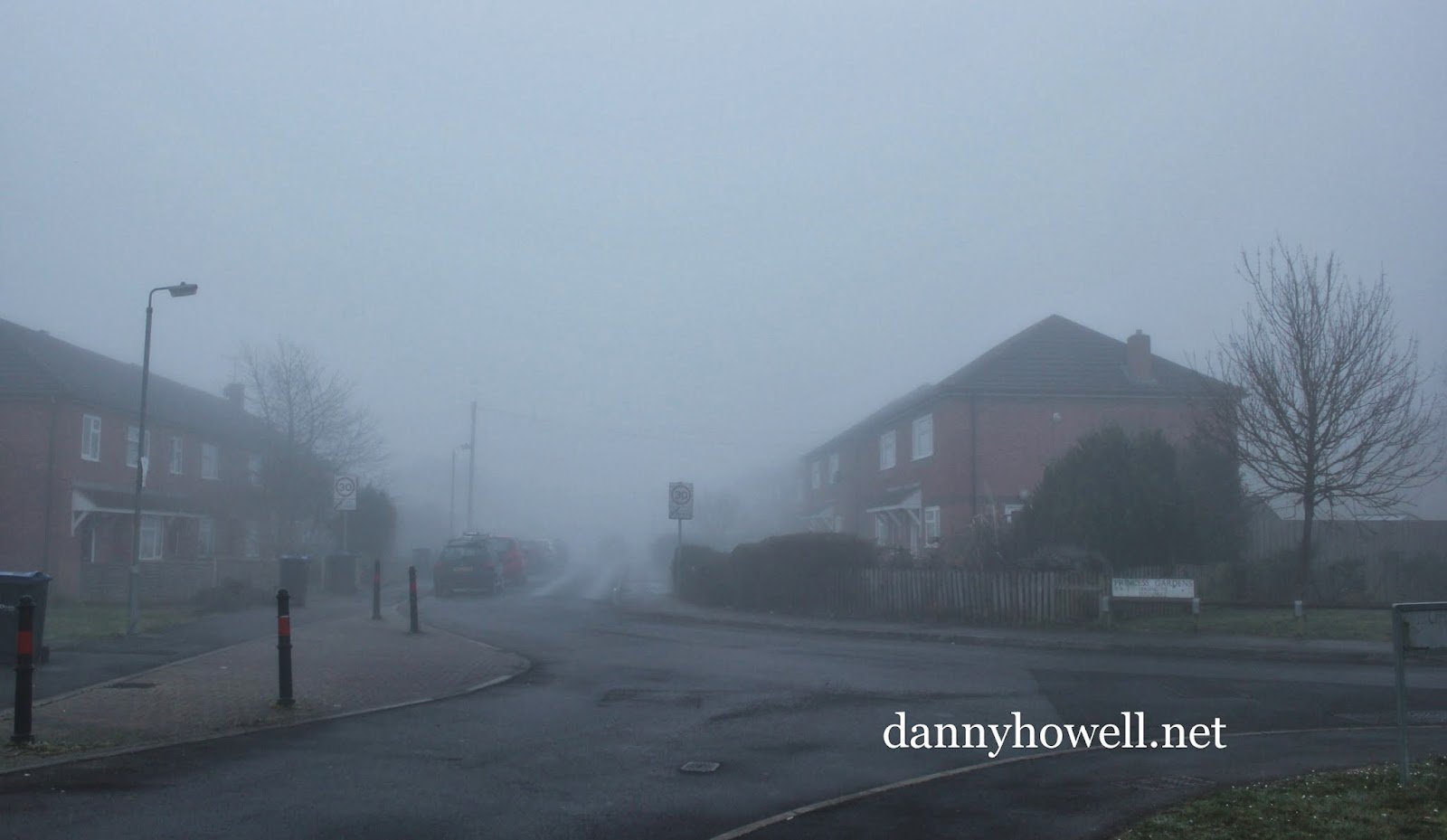
A foggy scene at Boreham Field, Warminster, before 6.30 a.m. on Friday 14th March 2014.

Photographs taken by Danny Howell.
Information and pictures for climate and weather in and around Warminster.
Friday 14th March 2014
A foggy scene at Boreham Field, Warminster, before 6.30 a.m. on Friday 14th March 2014.
Photographs taken by Danny Howell.
Tuesday 11th February 2014
The relentless rain has prompted Richard Dombkowski, of Warminster, to compose the lyrics to a song which he would like to share with dannyhowell.net readers:
Rain Rain Rain (It Keeps On Falling)
Down onto my head
Down onto the ground
Down into the rivers
Everywhere it’s all around
Saturation completed
Communities defeated
The lakes have swallowed up
The hedgerows and green land
And as the water continues to flow
With such force
The barriers have failed to protect us
And withstand
The power and glory of nature
So unpredictable and irritatingly grand
Rain rain rain
It keeps on falling
Rain rain rain
Will it ever end?
Rain rain rain
The sun ain’t calling
Rain rain rain
Again and again!
Down onto my head
Down onto the ground
Down into the rivers
Everywhere it’s all around
Rain rain rain
Don’t worry ‘about polishing
Your fancy cars at the weekend
Rain rain rain
If it carries on
We’ll be all dead
Rain rain rain
Set your tools out
The wood and the workbench
Rain rain rain
Build yourselves an ark instead!
Tuesday 21st April 2009
A brief description of the weather in Warminster today, as noted by Danny Howell:
“Sunny day.”
Wednesday 11th August 1999
A cloudy sky over Warminster, today (Wednesday 11th August 1999), obscured the eclipse of the sun.
From The Wiltshire Times, Saturday 8th January 1938:
Christmas At Warminster. Unseasonable Weather.
The most unseasonable weather consisting mainly of fog, tended to keep most residents indoors over the holiday and the streets, especially on Christmas Day, presented a strangely deserted appearance. Parcels dealt with at the Post Office were 10 per cent up on last year, and letters 20 per cent up.
1932 – 1934
The prevailing winds of this district come from the south-west, although in the winter months north-easterly winds are frequent and make the valleys very cold. The south-westerly rain-bearing winds are far more pleasant than those from the north-east, which sweep bitingly through the valley and rage unheeded across the downlands. They are too chilly to be pleasantly bracing except in summer when they are not frequent.
Possibly, Wylye situated as it is on the southern side of the river valley, with half a mile or more of low lying water meadows between it and the downlands on the northern side, which would afford some shelter from the cold winds of the north and north-east feels these winds more than do Codford and Steeple Langford. These two villages are on the northern side of the valley and more exposed to the pleasanter effects of the south-westerly winds. Wylye is sheltered from these winds by the downlands lying south of the village, and in the summer months when a south-westerly wind is blowing across the downlands it is stiflingly hot in the village, with scarcely a breath of air to cool the hot and tired inhabitants.
Sudden weather changes are frequent in the district. Generally in summer one day might be very hot and the next of a wintry character, this all depending on prevailing weather over Britain, which in turn is dependent on the low pressure centres so often situated over Ireland, and the high pressure areas in Southern Europe in the winter months and over the Atlantic Ocean in the summer.
Sometimes there are long periods of drought, which are generally experienced when England as a whole is having hot, rainless days. Such a drought season occurred in 1921, when numerous wells in this district were dry and the river was very low. Nothing has since been done to provide a more adequate water supply for the villages, and again in 1933 (summer) the water shortage caused anxiety. The winter 1933-34 has been an extraordinarily dry one, and following on a summer drought period, it seems likely that should this coming summer be as hot as the previous one, the shortage of water will be a very acute problem indeed. In these chalk regions the water supply is entirely dependent on the rainfall.
Usually the yearly rainfall total for this district varies from 30.25 inches to 32.37 inches. On the 4th of August 1931 an extraordinarily heavy downfall was recorded. The day’s rainfall was 5.18 inches, and of this amount 5.10 inches fell in two hours during a thunderstorm. This was the heaviest day’s downpour experienced for many years, and caused the pond at the west end of the village to overflow and made the streets like rivers, whilst the ploughed fields on the downland slopes were cut in many places by miniature river valleys.
On the whole there is no very high daily or seasonal range of temperature. In the winter months it is not generally below 40 degrees Fahrenheit, although on March 18th 1930 18 degrees of frost was recorded. This was a very unusual temperature however. The usual temperatures experienced in July are between 60 and 70 degrees Fahrenheit but in August, if the weather is fine and the sky cloudless, temperatures are often higher, being sometimes more than 80 degrees Fahrenheit. In 1933, during August, a temperature of 89.6 degrees Fahrenheit was recorded.
The watermeadows contribute to the general humidity of the air and very often heavy mists arise from them in the mornings.
Snow is seldom seen here in December – when January comes the inhabitants expect to see snow, but not generally before then. Heavy falls have been known, and drifts are frequent in the lanes and along the road sides. More than once Wylye and other villages in this district have been isolated from each other by heavy falls of snow, occurring in the latter half of the winter or the early spring months.
Occasional thunderstorms disturb the serenity of the Wylye Valley during the summer and early autumn. When they come they are generally bad storms, for the thunder clouds seem to gather and stay over the valley, as if hemmed in by the downlands. Heavy downpours of rain sometimes accompany these storms and can cause havoc in the corn fields, especially before the harvest.
From The Parish Magazine, October 1902.
Upton Scudamore. Rainfall At Biss
April, May, June, July & August 1902
April, 2.24 inches;
May, 1.91 inches;
June, 2.72 inches;
July, 1.84 inches;
August, 4.23 inches.
From The Wiltshire Times, Saturday 1st September 1888:
Warminster. Bad Weather For The Harvest.
During the past week farmers have experienced very unfortunate weather, especially on Tuesday, when a gale in the town and neighbourhood did considerable damage to standing crops.
An account concerning Mere, in South West Wiltshire, penned by a member of the Women’s Institute, published in Moonrakings, A Little Book Of Wiltshire Stories, reprinted in 1979:
The Great Snowstorm Of 1881. This unforgettable storm, which began on January 18th, and lasted over forty-eight hours, blocked all the roads out of Mere, and not only from bank to bank, but from hedge-top to hedge-top, and in many places it was impossible to tell where the road ran. The snow froze hard, so that you could walk over the banks and hedges.
In the Workhouse, all the old people had to be kept in bed, for the fresh supply of coal that was due could not be brought, and the stores were running out.
At Ashfield Water, on the right hand, was a little old thatched cottage, half of it below the level of the road. It was entered from the other side, down a steep path, which sloped still more steeply down to the stream, at the point where it emerges from under the bridge which spans the road. The cottage was inhabited by fowls, ducks and other live stock, as well as by old Shadrach Blank and his wife. His brother Meshach lived near Gillingham, but Abednego has already parted this life, I believe.
On the second or third day after the storm began, we thought of the old couple, who lived from hand to mouth, as the saying is. Two of our men, accompanied by my brother, set out on their journey, laden with food, coal, and spades. The cottage was only a quarter of a mile away, but it took them two hours to fight their way through the storm and the drifts. They got round to the front of the cottage, to find that the snow had drifted up to the eaves, and they had a hard job to dig through to the door. The old people had lain down to die, for they had scarcely any food in the house when the storm began, and it had been impossible to get out to fetch more. Their gratitude was very great, and when a fire was lighted, and the kettle filled with snow and hung over the fire, and they saw the food laid out on the table, tears of joy flowed down the furrows of their aged cheeks, as they thanked God for their deliverance from starvation.
It was certainly not a “fiery furnace” from which they had escaped, but a trial the very antithesis of that endured by their Hebrew namesakes; but they seem to have taken it with a courage and resignation which most of us would find hard to imitate.
From The Warminster Parish Magazine And Church Register, April 1867:
The oldest of our inhabitants cannot, we suppose, remember so severe weather in the month of March as that which we have lately been experiencing. The heavy fall of snow has not a little thinned our Lenten congregations. On Wednesday, the twentieth, the usual morning service at St. John’s had to be given up on account of the snow.