A chapter from the book The Deverill Valley, The Story Of An Upland Valley In South-West Wiltshire. Published by The Deverill Valley History Group, 1982. Re-published here by kind permission of John Peddie.
The Deverill Valley. The Landlords by John Peddie.
. . . Horner and Thynne;
when the monks went out, they went in.
Contemporary Jingle (16th century).
But now the sounds of population fail,
No cheerful murmurs fluctuate in the gale,
No busy steps the grass-grown footway tread,
For all the bloomy flush of life is fled.
‘The Deserted Village’ by Oliver Goldsmith.
Feudalism was a product of the Dark Ages and had already in part been introduced into England by the Saxons, and in particular by Alfred with his plans for ‘burghal’ defence, before the arrival of the Normans. William the Conqueror brought with him a more developed variety of it which he used as a means of subjugating the country, providing himself with an army for its defence, and rewarding those who had come with him. William’s successors, involved as they were in lengthy continental wars with the French, soon found the feudal levy to be a cumbersome and impactical way of funding their fighting forces and turned to a system of Parliamentary subsidies levied throughout the country, one of the most fruitful being a tax on wool.
Feudalism, however, remained the basis of English land law, and in theory land was not owned but held directly from the crown by tenants-in-chief. The passage of time slowly changed this, with the result that by the end of the thirteenth century a tenant-in-chief has nearly as absolute title to his land and property as any modern landowner. The authority of the crown was still felt, nevertheless, and although a tenant-in-chief could dispose of his land as he saw fit, he first had to purchase a royal licence to do so. When he died, if his heir was over twenty-one years of age, then the heir did homage to the king and paid a tax which enabled him to enter upon his inheritance: if on the other hand the heir was still a minor, the property was held by the king until the heir came of age. It was for this reason that Humphrey, Earl of Arundel, the three year old son and heir of John and Eleanor Maltravers, became ward of the king upon the death of his parents. The boy died almost immediately and the estates to which he was the successor reverted to the crown, thus enabling Henry VI to make a grant of the manor of Hill Deverill to the Ludlows.
William Ludlow of Ludgershall, the first of that family to hold the lordship of the manor of Hill Deverill, was an important and influential man who had held the honour of Butler to three kings: the unlucky Henry IV, the heroic Henry V and the tragic Henry VI. He was in all probability a descendant of Lawrence de Ludlow, a successful Shropshire wool merchant who owned a house in that town and who died about 1291. Lawrence bought Stokesay Castle from the de Vernon family between the years 1274 to 1281, when he was granted royal permission to fortify it. The name William appears several times in the pedigree of the Shropshire Ludlows and it is probable that William Ludlow of Ludgershall sprang from a junior branch of the family. There is, however, no evident record of when the Ludgershall Ludlows were established in that town but there can be little doubt that William was granted Hill Deverill when he was then a man of considerable wealth. It is significant that in 1439 he held the rank of a marshal of Calais, a port which within a few years was to be the only English possession across the Channel. All England’s export trade in wool was required to pass through the port to facilitate the collection of dues for the king, and a privileged company – the Company of the Staples – was formed for this purpose. William Ludlow was doubtless one of its members.
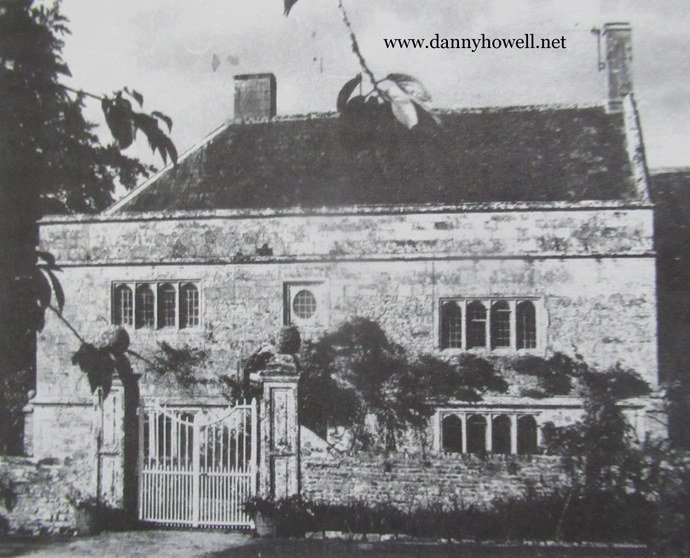
Hill Deverill Manor House.
The Victoria County History for Wiltshire records that the Ludlows were among the top 28 families who had each supplied at various times two members of Parliament for the County. William Ludlow was not only a member of Parliament for Ludgershall borough for five years, on the last occasion in 1437, but was also a royal officer representing the City of Salisbury. (1) Lay persons at this time held 80% of the property of Salisbury and by 1455 he held the biggest portion of this. He paid ‘quit rents’ for well over forty tenements which he was subletting. There is no evidence that he took an active part in local affairs, although he was especially interested in the church of St. Thomas a Beckett, where he and his family were buried. Sadly it is recorded (2) that ‘the altar tomb of William Ludlow was taken some years since from the situation it had long occupied on the north side of the chancel, and broken to pieces; and the remains of himself, his wife and child were thrown into some unknown corner . . . ‘
In 1444, William Ludlow built for himself a house in Blue Boar Row in Salisbury and he seems to have found the main timbers for the purpose from his own estates, probably from his property at Hill Deverill. He employed a carpenter from Bishopstrow, named Fayrebow, to do much of the construction work. His main residence, therefore was in Salisbury and not in Hill Deverill, if he lived there at all. In his will the manor of Hill Deverill is described as consisting of ‘two tofts (i.e. house and farm buildings), two and a half carucates of land, six acres of meadow, fifteen acres of woodland and three shillings rent in Hill Deverill and Longbridge Deverill’. (3) William died in 1478: his heir was his son, John, who was to outlive his father by ten years and who seems to have continued to live in the family home in Salisbury.
John Ludlow’s son and heir, also named John, was the first member of the family to reside in the manor. He married Phillipa, daughter of William Bulstrode of Erlestoke, and their coat of arms may be deciphered today in the coeval niche over the old porchway at the north end of the barn in the manor house farmyard. It is very possible that this porchway was originally part of the Chapel of the Holy Trinity founded as a Chantry by Robert le Boor in 1319 and was later embraced as part of the original manor house occupied by John and Phillipa. The fact that a large dwelling house stood upon this site in medieval times is confirmed by the large quantities of broken crockery, oyster shell and other artifacts recovered from the rear of the barn in recent years. John died in 1519 and he was buried in the church at Hill Deverill. He was succeeded by his son, William, who seems to have lived an unremarkable life but who nevertheless provides an important landmark in the family history, for by his marriage to a coheiress of Nicholas Moore of Tadley, the mansion and park there, held of the Bishop of Winchester, came into the family possession.
An interesting relic of John and Phillipa, and their son William, found its way from Hill Deverill to Tadley, and later was in possession of Miss Eleanor Ludlow-Bruges at Rodney House, Trowbridge. This was a fine piece of heraldic stained glass, depicting a shield enclosed within a circle, a foot in diameter, upon which were emblazoned, the arms of Ludlow, impaling Bulstrode, described by the College of Arms as:
Argent, a chevron between three martens’ heads erased sable – Ludlow: impaling ‘Sable, a stag’s head cabossed Argent, between the attires Or, a cross of the last, and pierced above the nostrils by an arrow in fess, point to the sinister, also Or, feathered of the second, the nostrils dripped blood proper. (4)
According to the note recorded of this window, the circle surrounding the shield bears the following inscription:
I. Ludlow, son & heir of I Ludlow & phellyp hys wife, dowghter of W bulstrode.
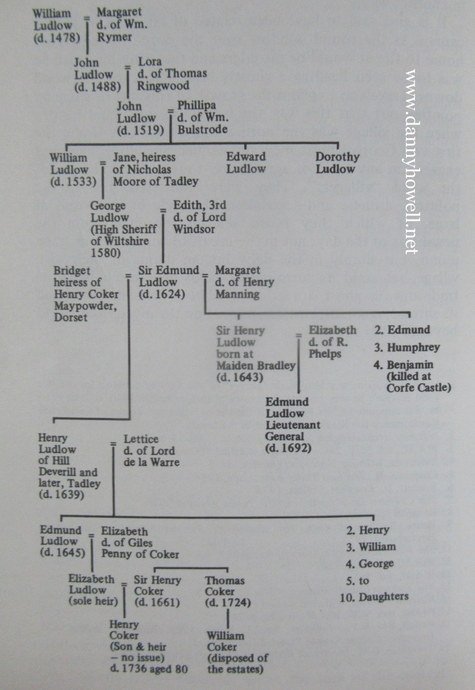
At first glance this would seem to indicate that John & Phillipa had a son and heir also named John: this, however, is not so (see family pedigree at Appendix A) as the name of their heir was William. It is apparent, therefore, that a comma after the words ‘son & heir of I. Ludlow’ has been omitted in transcript. If this is a correct assumption then it is likely that the window provides us with a clue as to the age of the existing manor house, which was probably built by John and Phillipa soon after the former inherited his father’s estates in 1488.
William Ludlow was buried in the Church of the White Friars in London; in his will he required his executors to cause a ‘remembrance’ of him to be made at Hill Deverill Church – or as he also described it, ‘a picture of me’. It is presumed that by these words he meant an effigy to be placed upon the altar tomb, which is still to be seen there with its splendid heraldic carvings, very similar in style to those in the church at Erlestoke. There is no trace of the tomb ever having supported such an effigy and one must assume that his executors either failed in their task or that it was displaced during the rebuilding of the church in 1841.
William’s son, George Ludlow, was appointed High Sheriff of Wiltshire in 1567 and it was within a year or two of this date that Roger de Stanter, whose family had held the manor of Kingston Deverill for some 250 years, sold this to him – together with the manor of Horningsham – and thus commenced a chain of property acquisitions by the Ludlow family over the next two generations which must have been in part motivated in the first instance by the actions of their land-hungry neighbour, Sir John Thynne.
John Thynne was born in 1515, the son of a Shropshire farmer from Church Stretton, three or four miles from Stokesay Castle, the family home, by strange coincidence, of both the Ludlows and the de Vernons. He purchased Longleat, which included sixty acres of land, a water mill and an old priory, from Sir John Horsey in the spring of 1540 for the sum of £53. He left home at an early age and was introduced to the Court of Henry VIII by his uncle, William Thynne, who was Clerk to the Royal Kitchens and said to be held in much favour by the king. John’s qualities immediately caught the eye of Edward Seymour, Earl of Hertford and brother-in-law of the king, and he entered the household. With the increasing age of Henry VIII much of the task of running the country fell into Seymour’s hands, particularly the sale and disposal of the lands and possessions of the dissolved monasteries. Amongst these, as we shall see below, were the manors of Longbridge Deverill and Monkton Deverill which, with the manor of Brixton Deverill held by King’s College, Cambridge, flanked the Ludlow holding of Hill Deverill.
Thynne was arrogant, ruthless and naturally acquisitive: he was also a keen administrator and within a few years he was lord of the manor of some 6,000 acres and he could boast his independence. In 1547 he accompanied his master, now Duke of Somerset and Protector of the Realm, to a Scottish war aimed at bringing about a marriage union between the four year old Mary, Queen of Scots, and the boy King, Edward VI. Thynne so distinguished himself upon the battlefield that he is said to have been knighted by Somerset whilst still bleeding of his wounds.
Somerset was a first class soldier and an honest and sincere man, whose sympathies – at a time of the many changes inevitably brought about by the Reformation of the Church – lay with the common man rather than with the nobility. He therefore made many powerful enemies. On June 1st 1549 (5), whilst not being opposed to the need for enclosures (he appreciated England’s economic dependence on the wool trade and the consequent importance of increasing the sheep population) he issued a proclamation aimed at restricting the robber-baron behaviour of landowners. His authority was ignored both by the gentry and the peasants and there were risings of the latter, both in the West Country and in East Anglia. Somerset was ousted from power and Sir John Thynne, suffering from the reflection of his master’s disgrace, was exiled to his country estate; but not for long. In 1553 he was appointed Comptroller to the young Princess Elizabeth, who succeeded to the throne three years later; within a few years, Sir John Thynne was a member of Parliament for Wiltshire, High Sheriff of the County, and High Captain of the County Levy.
In being granted these appointments he was pursuing a course to be followed both by George Ludlow and his son, Edmund. Since both these influential and neighbouring families had so many ambitions in common, and since the abrasive Thynne moved so quickly to the top of the county tree, it would not be surprising if they held no fondness for each other. An indication of this is perhaps given by the fact that Sir John gave the name Ludlow to one of the two dogs which always closely followed him on his perambulations of his estate. (6) By a strange coincidence both men, George Ludlow and John Thynne, died in the same year, 1580. If Sir John Thynne’s son – also called John – lacked his father’s character and enthusiasm, the same could not be said of George’s son, Edmund, who became member of Parliament for Hindon in 1604. Before then, in 1593, he was successful in enclosing much of the land of the manor of Hill Deverill despite a vigorous protest by his tenants, many of whom were reduced to beggary, and a consequent but unsuccessful Star Chamber enquiry. (7)
It is not surprising that a lot of bad feeling was engendered locally by the acquisition of land in this manner; poaching became commonplace by villagers who went out to snare or kill game on land which they considered to be theirs by right. It is recorded that one year (8) a pitched battle took place on the Longleat estate between eight gamekeepers and a local gang, two of whom were seriously wounded and placed in the stocks on Crockerton Green. Such were the times in which they lived that nobody offered any help to them and in two days both were dead.
In 1606, the third year of the reign of James I, Edmund Ludlow continued with his land acquisition by purchasing Hussey Deverill which in early days had been an integral part of Longbridge Deverill. It is interesting to examine the historical background to its creation as a separate manor.
Longbridge Deverill was granted circa 924 AD by king Athelstan to Wulfhelm, Saxon Archbishop of Canterbury. When Wulfhelm died, some ten years later, the holding of the manor was granted by royal charter to the Abbey of Glastonbury and the manor in their hands enjoyed the disciplines of a Hundred and of being styled a Free Manor. It comprised, with Monkton Deverill, part of the holdings of the Abbey which went to make up the Hundred of South Damerham, the remainder lying in South Wiltshire around the villages of Damerham and Martin. Longbridge Deverill also included the hamlet of Crockerton within its boundaries.
The Abbots held the manors of Longbridge and Monkton until the dissolution of the religious houses by Henry VIII and the execution of Abbot Whiting in 1539 when, along with other possessions of the Abbey it ‘escheated’ to the Crown. The holding of Longbridge then formed part of the dower of Catherine Parr until the death of the king in 1547 when it was purchased of the Court of Augmentation by Sir John Thynne, together with the manor of Monkton Deverill, which he was already sensibly holding of the Abbot at a rental of £39.17.2d. The land in Longbridge, which many years previously the Abbey had granted as an ancient feoffment to the Hussey (Huse) family to perform military service for the Abbot, was not included in the transaction. This land lay in the southern area of the parish, roughly from the Marsh up to Cow Down and eastwards to the boundary of Sutton Veny. The first record of this feoffment is 1168, when Radulphus Huse is shewn as providing this service for a ‘knight’s fee’ but it is very probable that the family were in possession some years before that date. The Entitlement descended from the Husseys to Philip, son of John de la Mere of Nunney Castle, and from thence through several hands until the land was sold in 1605, by Christopher Hinton to Sir Edmund Ludlow. The Ludlows, in turn, at a later date in about 1641, sold it to Sir James Thynne and it again merged in the superior manor of Longbridge Deverill from which it had been so long separated. (See Appendix A.)
It is also of interest to note in passing that in 1391 the Abbot of Glastonbury, with the royal assent of Richard II, (9) annexed the churches of Monkton and Longbridge. The effect of this was to be that on the dissolution of the monasteries, the two churches were sold as part of the estates of the manors concerned, and the Thynnes received the privilege of becoming lay Rectors of the parishes. For this reason the ancient manor house of Longbridge Deverill, which was situated in the walled area to the north of the church, was often used by the family as a residence, particularly so after the great fire at Longleat in 1567, when the Thynnes moved into their house at Corsley. The manor house at Longbridge continued in use by them up to 1600. In a survey of estates in 1639 it is described as ‘a very faire new built house, wherein the said Sir Thomas Thynne sometimes lived, with out-houses, a dove house and water myll adjoining.’ The latter were still in existence in the early 19th century. (10)
Sir Edmund Ludlow married twice; his first wife was Bridget, daughter and sole heiress of Henry Coker of Maypowder in Dorset, by whom he had ten children; she died in September 1587, and is buried at Hill Deverill. Edmund then married Margaret, daughter of Henry Manning of Down in Kent, by whom he had a further four children, and by each marriage confusingly called the eldest son by the forename Henry. Indeed it must be said that the custom which persuaded all branches of the Ludlow family to persist with the use of the forenames Henry and Edmund does nothing to make life easy for present day researchers of the family history.
On 20th April 1625, in the year following Edmund’s death, an Inquisition was taken at Salisbury which showed him ‘seised’ of the manors of Withford, Sherborne, Kennet and Wallop and ‘all of that capital mansion house within the park of Withford alias Tadley Park . . . and all those manors of Hill Deverill, Kingston Deverill . . . and the woodlands called Sowley and Elye in the parishes of Heytsburie and Sutton . . . (and) of the manors of Fifield alias Fiffit and Deverill Hussey co Wilts, and land, meadows and pasture in Longbridge, co Wilts called Burleis Farm.’
Upon succeeding to his father Edmund’s estates, it was not long before Henry Ludlow of Hill Deverill, Bridget’s son, vacated the manor in favour of his son Edmund, and took up residence in Tadley, where he appears to have made no effort to gain popularity. The Hampshire Victoria County History (11) records that ‘he seems to have oppressed the tenants in . . . various ways, pulling down their houses, failing to give them their wages and utterly refusing to pay all rates and taxes. In 1639 he was ordered to redress the grievances of his tenants but he died a month or two afterwards, being succeeded by his son and heir, Edmund, who conveyed the manor to Joseph Blagrave in 1641.’
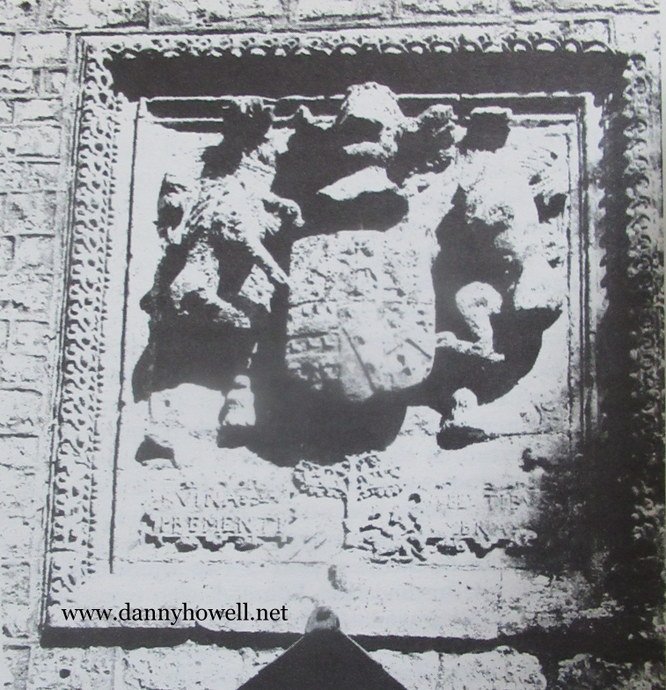
The Ludlow coat of arms over the door at 86 Monkton Deverill.
As we have already seen, when Henry vacated Hill Deverill he took with him to Tadley a heraldic stained glass window, emblazoned with the arms of the Ludlows. It is very probable that Edmund replaced this window externally with the carved stone replica of the Ludlow coat of arms which today may be seen on the village house at Monkton Deverill and which was later to be occupied by his Coker heirs. In the words of Colt Hoare, he added to the device ‘three dogs running to a tree for shelter, which might allude to the hard usage which he met with from his family . . . the three dogs may be figured his three brothers, the authors of the persecution.’ Whatever form this persecution may have taken, there can be little doubt that it had financial origins and the family was falling into increasingly straitended circumstances, a conjecture perhaps strengthened by the fact that Edmund disposed of both Hussey Deverill and the Tadley property in the same year, 1641.
After the death of his wife Bridget, Edmund’s grandfather, also named Edmund as will be recalled, went to live at Maiden Bradley in a house which he leased from the Duke of Somerset for a period of three lives. It was here that his son, Henry, by his second wife Margaret, was born. Henry was a man of strong political convictions; he represented Wiltshire in the Long Parliament, and in 1642 was rebuked by the Speaker of the House for expressing the view that the king was unworthy to be king of England. In view of the strong political opinions of his father, it is not surprising to find that his son, later Lieutenant-General Edmund Ludlow, followed the political convictions of his parents and joined the Parliamentary forces at the outbreak of the Civil War. After the battle of Edgehill, in October 1642, he became a captain of a troop of horse in Sir Edward Hungerford’s regiment. He was not present for the main part of the siege of Wardour Castle, when Lady Arundell, with a party of some twenty-five persons, many of whom were women, gallantly defended it against the rebels for a period of several days, until she was compelled to surrender by the explosion of the second of two mines laid by Hungerford under the building.
Parliament, having resolved that Wardour Castle should be maintained as a garrison, appointed Ludlow as its governor; but after the Royalist victory at Roundway Down outside Devizes, his position was rendered precarious. The nearest garrisons from which he might expect help were hardpressed Gloucester, Portsmouth and, to a lesser degree, Poole. Despite the advice of his father and friends, and despite the fact that the position was of little military value, he defended the castle against Royalist attack for four months, until March 1644, when according to the Royalist newspaper Mercurius Aulicus:
Master Ludlow left off preaching within four or five days, for when he saw the mine deprive him of his fortifications he delivered up himself and all the garrison (of 75 persons) without so much as a promise of quarter, with all the cannon, arms, ammunition, baggage and the lord Arundell’s plate, which it seems had not yet found the way home . . .
After a short imprisonment he was released and exchanged, and in July he was appointed Colonel of a Regiment of Horse in the pay of the Wiltshire Committee.
In the summer of 1647, General Ludlow took the part of the Army in their quarrel with Parliament. Although in his Memoirs he states he had a preference for the monarchy, and was alienated from Cromwell by these views, in 1648 he was nevertheless appointed one of the judges at the trial of King Charles I. Moreover, on 30th January 1649, when the monarch was beheaded as a public enemy, to the revulsion of the great majority of Englishmen, the name of Edmund Ludlow appeared as fortieth on the list of those signing the death warrant. Upon the Restoration of the Monarchy, Ludlow was branded a regicide and, having already fled the country, he died at Vevey, in Switzerland, in 1692.
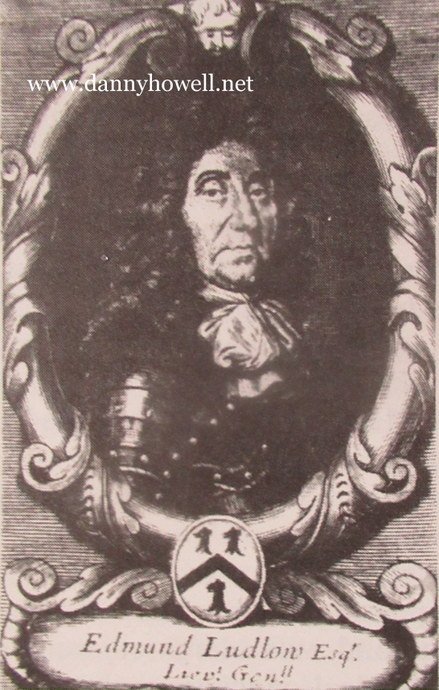
Lieutenant General Edmund Ludlow (1617 – 1692) of Maiden Bradley, grandson of Edmund Ludlow of Hill Deverill. He was one of the signatories of the death warrant of Charles I.
The part which the Deverills played in the Civil War is uncertain. Brocklebank, reflecting on the remains of the old British Village which today are to be found on the opposite side of the road to Hill Deverill manor house, considers (12) it may have been a medieval village ‘destroyed in the Parliamentary Wars by being burnt, together with the Rectory and Tithe Barn.’ The well known Wiltshire historian Rev. J.U. Powell, writes (13) ‘it is said that the mounds and ditches facing the church are the remains of houses in the village which were battered down by the Royalist cannon mounted upon Burnbake, between the Manor House and the Shaftesbury Road.’ There is, however, no documentary proof of any such incident having taken place and it would not be unreasonable to expect that some record would have been made of a major action of this nature. On the other hand, when Greentiles, the bungalow standing on the left of the approach road to the Manor House, was being built, a substantial chalk and stone foundation was uncovered, together with three stout timber supports. These latter appeared to have been burnt and were conjectured to have come from a Tithe Barn which originally stood upon that place. Additionally, Mr. & Mrs. Wood, the present occupants, state that they have occasionally discovered old musket balls when working in the garden of their bungalow.
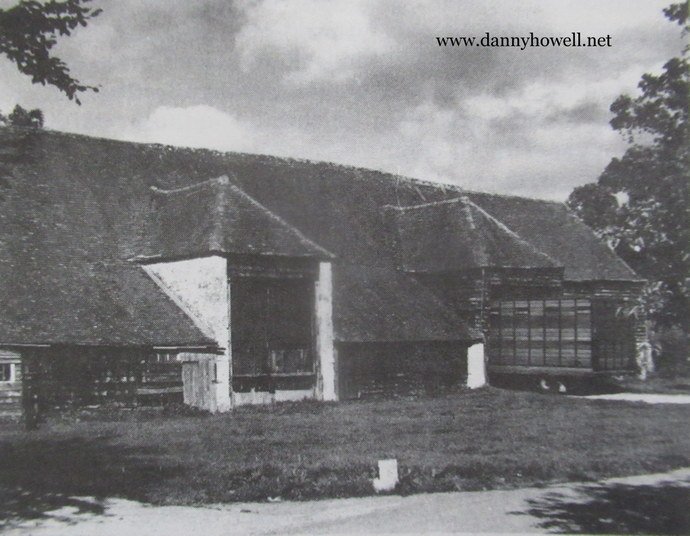
The tithe barn at Hill Deverill, built circa 1550.
It is said to have housed a troop of Roundhead
cavalry during the Civil War of 1642-1646.
There is also a tradition at Hill Deverill that Cromwell stabled his horses in the old Manor House barn during the Civil War. Again there is no evidence that Cromwell ever visited the village, although it is known that he went to Devizes. There was, however, a cavalry patrol encounter on the Heath, above Warminster Common, adjoining the Deverill Road. (14) It is not unlikely, therefore, that some of Hungerford’s regiment, which took part in the sieges of Wardour Castle and Woodhouse Castle at Horningsham, stabled and watered their horses in the Manor House barn when operating in the area. Ludlow’s Memoirs record:
Out of Wiltshire they write that Sir Edward Hungerford is returned with Colonel Stroud to Mear, whither they have brought with them 700 horse and foot, and also that they were there joyfully entertained, and had free quarters given to them; and that during their abode at Mear their soldiers seized upon Master Arundell’s catell and killed almost all his goats on Horningsham Common, and they also got into the parke at Longleat and killed some of Sir James Thinne’s fallow deer . . .
Behaviour of this nature did not endear the troops of either side to the local population, and in the years 1643 and 1644 (15) there were some popular disturbances in the Selwood area, arising from the burden which was being imposed upon the country people by the military presence.
The loyalties of the landlords were varied. Sir James Thynne, a soldier who had distinguished himself in continental wars, was probably a Royalist: he took no part in the uprising but concerned himself with the administration of his estates and the safeguarding of his livestock, although apparently even these suffered. There was no doubt about the political sympathies of the Ludlows at Maiden Bradley: they were fervently Roundhead. Kingston Deverill, with its close association with the Arundells of Woodhouse Castle and Horningsham, was probably Royalist in its outlook. Edmund Ludlow of Hill Deverill was an old man and may be expected to have maintained a reasonably neutral attitude, probably concealing Parliamentary sympathies. He died in 1645 about four years before the king’s death upon the scaffold.
Edmund, who was the son of Henry Ludlow of Tadley, was succeeded by his daughter and heiress, Elizabeth, (16) wife of Sir Henry Coker of Maypowder. If an illustration were required as to how cruelly families were divided by their loyalties in those momentous days, Sir Henry Coker and his wife are prime examples; for he was an ardent Royalist who fought for the King at the battle of Worcester and a rare portrait of him held by the Powell family (17) displayed the following inscription:
The Honble Sir Henry Coker of the County of Wilts, Knight, High Sheriffe, Ano 63, Coll: of Horse and Foot to King Charles the First; Coll: to the King of Spayne, and Coll: to his Ma: that now is for the servis of Worcester, now Gent: of the Privy Chamber, aetat 48. 1669.
There is some uncertainty about the true date of his death but he is thought to have predeceased his wife in 1693 when 72 years of age. Elizabeth bore him several children but her son and heir, also Henry Coker, died without issue in 1736 at the age of eighty; he was therefore succeeded by his nephew William Coker, who ‘burthened with a debt contracted by his ancestors and increased by a long and expensive law suit’, first sold Hill Deverill in 1737, and later the Somerset estates of the Cokers, to the family of the Duke of Marlborough. It must have been whilst these events were taking place that the Cokers moved to the village house at Monkton Deverill, which to this day bears the Ludlow arms, albeit so badly weathered as to be almost illegible.
In an age when the gap between the aristocracy and the working people was considerable but class consciousness was minimal. Henry Coker was not popular with the country people amongst whom he lived; but many of the tales which were generated about him derived probably from the fact that he lived alone to a considerable age. More than 150 years after his death it was still being related that he was a robber and that ‘many went into the house that never came out’; (18) there was also said to be blood marks on one bedroom floor and the farm was described as a ‘den of thieves’, associated with smugglers. It is very possible that smuggling was prevalent in the district and that some of these stories were circulated to frighten villagers off the roads at night time. Powell records that, at Longbridge Deverill, local people were afraid to go up Church Lane in the dark lest ‘woolpacks should roll down from the thicket upon them’: and kegs of brandy were said to have rolled out of the hedgerows. Whatever the reasons, and these probably included the straitened circumstances in which the family found itself, the name of old ‘Henry Coker’ provided a lively contribution to the folklore of the Deverills up to the turn of the century when, for example, some farm labourers saw his ghost ‘sitting on the dreshol (threshold) of the barn, so that they had to go in another way.’
It is also said to have been related of him that he kept a cannon at the round window over the porch of the manor house to fire at would-be intruders and that after his death he was to be seen heading a ghostly hunt across the Pertwood downs. Trevelyan explains the growth of this sort of story by pointing out that this was ‘the last era in our island history when the village was the normal unit of society. Under the first two Georges most men and women, including many not engaged in any form of agriculture, were in the full sense of the word “villagers”. They were interested, not in the political, athletic and scandalous chronicle of the world at large, of which they heard seldom and little from the newsheets of the day, nor in the life of town, factory or trade union, but simply in the daily human drama of their own village, set amid its surrounding fields and woods, with its traditions, its ghost stories, its neighbourliness, its feuds, and its shrewd, ignorant, rustic comment on the mysterious world beyond.’ (19)
Notes
1. In 1437 William was also made ‘gauger’ of the City of London for life ‘for good service’; he was granted the manor of Ludgershall in 1440. In later years he was appointed Chief Forester of the Isle of Wight and keeper of Carisbrook Castle: hence the Ringwood interest in the family.
2. Wiltshire Archaeological Magazine [W.A.M.], vol.15, p.332.
3. W.A.M., vol. 28, p.246. A carucate equalled 100 acres.
4. Bulstrode, Wiltshire Notes and Queries, vol.7.
5. Chapman, H., The Last Tudor King, Cape, 1958.
6. Burnett, D., Longleat, Collins, 1978.
7. Star Chamber Documents 5/A/11/8, Public Records Office.
8. Longleat Records, vol.2, f.221.
9. Hoare, Sir Richard Colt, The History of Ancient Wiltshire (Hundred Of Heytesbury), 1812.
10. Ibid.
11. The Victoria County History of Hampshire, vol.4, p.220.
12. W.A.M., vol.42, p.252.
13. W.A.M., vol.28.
14. Ibid.
15. The Victoria County History Of Wiltshire, vol.5.
16. Hutchin’s Dorset, Wiltshire Record Office.
17. Powell, Rev. V.V., W.A.M., vol.28, p.249.
18. Powell, Rev. V.V., Folklore, vol.12, March 1901, Folklore Society, c/o University College, Gower Street, London, W.C.1.
19. Trevelyan, G.M., Illustrated History of England, Longman, 1964.
Appendix A
The Ludlows Of Hill Deverill
Appendix B
Table to Illustrate the Succession of Owners of Hussey Deverill
1168 Radulphus Huse is shown as providing military service to the Abbot of Glastonbury for a ‘knight’s fee’. Possession might have been earlier.
1390 The entitlement descended from the Hussey family to Philip, son of John de la Mere of Nunney Castle.
1415 Elias de la Mere died and his sister and heir married William Paulet, second son of Sir John Paulet, ancestor of the Marquis of Winchester.
1572 William Paulet, Marquis of Winchester, sold to William Mullens.
1575 William Mullens sold to William Burley.
1588 William Burley sold to Richard Hinton.
1604 Christopher Hinton sold to Sir Edmund Ludlow of Hill Deverill Manor.
1641 Sir Edmund Ludlow, grandson of the Ludlow mentioned above, sold to Sir James Thynne and thus completed the circle. It is interesting to note that the Civil War was to break out in the following year, and Sir Edmund was to die in London within four years, whilst the troubles were still continuing.