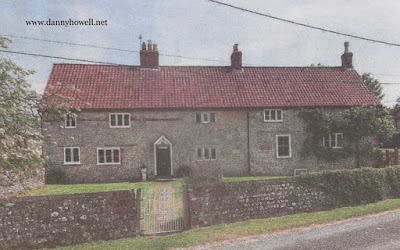
Sturgess Farmhouse Is For Sale With A Guide Price Of £925,000

Friday 29th June 2018

Savills are the selling agents for
Sturgess Farmhouse at The Marsh,
Longbridge Deverill, BA12 7EA.

It is described as having versatile accommodation
(over 4,000 sq., feet),
annex potential, gardens, orchard and parking.

EPC exempt. Under new instructions.

Guide price is £925,000. 

With its origins dating back to the mid sixteenth
century Sturgess Farmhouse is a stunning detached
country property offering a wealth of character and
charm and is being offered to the market for the
first time in more than forty years.

The living room offers lovely proportions,
double aspect windows, a large inglenook
fireplace with a fitted wood-burning stove and
flagstone flooring; there is a formal dining room
beyond and a further sitting room. 

The kitchen/breakfast room offers a range of
wooden kitchen units with wooden worktops
and double stainless steel sink, there is a gas
Rayburn and Range master cooker with 
extractor and space for fridge/freezer;
furthermore there is a large inglenook with
old bread oven and flagstone flooring. 

Beyond the kitchen is a useful and large utility
room, a cloakroom and a large pantry.

On the first floor the master bedroom features
large original elm floor boards, a striking feature
fireplace and a step down leads in to a 
large en suite bathroom; there are two further 
bedrooms on the first floor, a family bathroom
and an additional cloakroom. On the second floor
 there is a further bedroom and two attic rooms
that could be used as bedrooms or an office,
there is also the space to create an additional
bath or shower room.

The property offers excellent annexe potential if
required, the sitting room on the ground floor 
has an external door allowing it to be completely
self-contained, there is a separate staircase
leading up to a first floor bedroom and then
a second floor attic room which could be a
bedroom or an office. This part of the house
also links directly into the main house on 
the ground and second floors.

Outside
The property has a wonderful and large walled
garden to the rear of the house which features
areas of lawn, large patio, vegetable garden, 
attractive terraces including a barbeque area
and an orchard. There is a useful outside 
store with an old “copper’ which at one time
would have been used primarily for laundry 
but also for specific culinary activities. 

To the front of the property there is a further 
walled garden and there is a driveway 
to one side providing ample parking.

search.savills.com/property-detail/gbsarssas180069

Telephone 01722 426820

Longbridge Deverill Parish Council Meetings 2015

The Annual Parish Meeting for Longbridge Deverill will be held on Monday 18th May 2015, commencing at 7:30 p.m. (This is a Meeting of Electorate, not a Full Council meeting).

Dates of Full Parish Council Meetings for Longbridge Deverill 2015 are as follows:

Monday 2nd February 2015, 7.30 p.m.

Monday 2nd March 2015, 7.30 p.m.

Monday 13th April 2015, 7:30 p.m.

Monday 11th May 2015, 7.30 p.m.

Monday 8th June 2015 7.30 p.m.

Monday 6th July 2015, 7.30 p.m.

Monday 7th September 2015, 7:30 p.m.

Monday 5th October 2015, 7.30 p.m.

Monday 2nd November 2015, 7.30 p.m.

Monday 7th December 2015, 7:30 p.m.

Longbridge Deverill Parish Council meetings are held at Longbridge Deverill Village Hall. All Parish Council meetings will have an opportunity at the start for parishioners to ask questions or make comments on any matter. 

Parish Councillors Contact Details:

Richard Baxter (Chairman), telephone 212918 
email: rgabaxter@hotmail.co.uk

Graham Read (Vice Chairman),telephone 840296 
email: grahamread@live.co.uk

Ian Belltelephone840514  
email: ijb079@me.com

Kelvin Graytelephone 841363 
email: cllr.kevin12321@yahoo.co.uk

Brian Marshalltelephone 214789 
email: brian@berkeleyhallmarshall.co.uk

Caroline Sawyertelephone 840585 
email: caroline.sawyer585@btinternet.com

Nigel Spreadbury-Clews, telephone 216660 
email: nsclews@hotmail.com

Graham Connellan (Clerk)telephone 218622 
Mobile 0794 1000861
email: graham.connellan@me.com

Open Get-Together To Arrange Longbridge Deverill Flower Show 2015

Monday 19th January 2015

Longbridge Deverill Flower Show 2015

A group of residents in Longbridge Deverill have decided it is about time the parish Flower Show was reinstated. So plans are underway and a date has been set for Saturday 8th August 2015.

The organisers say: “As you can imagine it is a fairly large task beforehand and on the day. So we are having an Open Get Together for anyone who would like to come along and maybe offer their help on flower show day, running stalls, setting up, etc., or maybe you have a local business that would be willing to be a sponsor. Maybe you can remember the original flower shows and are able to provide us with some memories of them. The Open Get Together will be held at the George Inn, Longbridge Deverill, on Monday 19th January 2015, commencing at 7.00 p.m.  Come along and have a coffee and a chat. Everyone welcome.”

For further details, please contact: Claire Gray, telephone 01985 841363.

No.3 Battalion Overseas Training Brigade At Sandhill Camp, Longbridge Deverill – AIF War Diaries Digitised – Jo Caminiti Research

Wednesday 2nd July 2014

Jo Caminiti writes ~

SANDHILL CAMP, LONGBRIDGE DEVERILL

“Hi Danny,

My name is Jo Caminiti, from Victoria, Australia. I saw you were interested in this subject on your website.  The Australian War Memorial had digitised official AIF war diaries and in doing research on my grandfather’s service in 1918/19 I found the records of the No 3 Battalion, Overseas Training Brigade located at Sandhill Camp, Longbridge Deverill. Records are available from late 1917 to end 1918 at http://www.awm.gov.au/collection/AWM4/23/98/

My grandfather arrived in England on 13 November 1918 and his diary refers to arriving at Tidworth station on 15 November 1918 and marching 2 miles to camp at Parkhouse No. 2.  I am still trying to work out what the official name of the camp was so that I can gather information from the AIF war diaries. He remained there until 5 December when he went on leave to visit London and friends in Edinburgh before returning to No. 6 camp 14 Hurdcott for 6 weeks training before going over to France.  

I am in the research phase for a book based around my grandfather’s diaries and letters about his time in the Graves Registration Detachment exhuming fallen soldiers from the battlefields and smaller cemeteries and re-interring them in the larger concentration cemeteries around Villers Bretonneux on the Western Front.

I hope you find the link to the AIF war diaries of interest and that they fill in some gaps.”

Danny Howell writes ~

Jo didn’t mention grandfather’s name, so I got in touch and asked, and this is Jo’s reply:

“My Grandfather was Private William Frampton McBeath AIF 58th Division who then joined the Australian Graves Registration Detachment from March – August 1919. My Mother, Norma Harrision (nee McBeath) self published his diaries and letters in the 1990s which are now digitised in the State Library of Victoria.  The link is http://cedric.slv.vic.gov.au/R/GM2LAJNNMC2KGD48RBY61UU2MAVKJ1CB1M69BLQS9JPIVJRQD4-03934?func=results-jump-full&set_entry=000006&set_number=000601&base=GEN01.  If the link doesn’t work, go to the State Library of Victoria website and search for World War 1 unit histories and you can find it in the infantry section.  There is a great letter that describes his time over Christmas & New Year on the Salisbury Plains, particularly traipsing around in the snow at night trying to find escaped prisoners from camp. 

I am now researching material to write a book based on my grandfather’s diaries and letters and am finding all sorts of fascinating information in digitised records, photos, diaries and newspaper articles on websites and blogs.  The challenge will be pulling it all into a coherent story.”

A Farm Worker’s Cottage With An Orangery!

Wednesday 28th August 2013

John Robins, of Manor Farm, Longbridge Deverill, is seeking planning permission for an agricultural worker’s cottage with an orangery!

Vision For Warminster, in their Hot Topics pages (27th August 2013), have commented:

Former Wiltshire councillor John Robins has raised hackles at the local AONB caucus by asking for a new agricultural worker’s cottage at his farm in Longbridge Deverill.

Mr Robins, who was the member for Upper Wylye Valley electoral division between 1989 and 1997, has caused annoyance because of the scale of the proposed property and because it includes an orangery.

Planners have recommended refusal of the scheme because of its scale in the area of outstanding natural beauty.

Steve Dancey, said: “I dislike the stupid rules in AONBs which preserve the look of rural areas but sap their lifeblood by restricting commerce and the rural economy.

“Usually I would be all for development in these dried up rural communities but I think farmer Robins has gone too far by applying for such a big development at Manor Farm.

“The only person who could possibly get away with an orangery is Lord Bath – oh I think he has already done that!!!”

Sandhill Camp, Longbridge Deverill

Danny Howell writes:

Among the Longbridge Deverill archives in the Wiltshire And Swindon Record Office, there is a scrap of paper featuring a handwritten list of “The Divisions Which Occupied Sandhill Camp During The Great War.’ The list is as follows:

June 1915. 26th Division.

Oct 1915. 34th Division.

March 1916. 60th Division.

Sept 1916. R.A.M.C.

Nov 1916. 58th Division.

June 1917. Training RW Brigade.

Oct 1917 to Aug 1919. Australian Imperial Forces.

This tells us nothing really of the activity and events that must have been witnessed by Longbridge Deverill villagers during the First World War years. We now know that 5,000 men, serving King and Country, were stationed (though not all at the same time), at Sandhill Camp.

Finding out more about the camp and what went on there is not easy. As Terry Crawford says in his book, Wiltshire And The Great War, published by DPF in 1999, “Frustratingly the Warminster Journal, having regularly featured the tented camps established in the Wylye Valley within weeks of the war’s beginning, barely mentions the hutted one at Sand Hill. By the time construction had started, press censorship was restricting references to military works and activities.”

Mrs B. M. White in A History Of Longbridge Deverill, Hill Deverill And Crockerton 914 – 1960, written in 1960, refers to a farmyard called Cowley’s, in Sand Street, Longbridge Deverill, which she could remember seeing when she was a child. She says “It was quite a picturesque farmyard, filled entirely with thatched buildings. In 1914 most of these buildings were pulled down to make room for a big Military Post Office, for the use of the military who had built a large camp to accommodate about 5000 men at Sandhill.”

Waldron Court, Longbridge Deverill

From a press release issued in 1987:

Waldron Court

Situated 3 miles south of the attractive and lively town of Warminster in Wiltshire, lies the village of Longbridge Deverill in the beautiful Wylye Valley. The present village probably had its origins in Saxon times; the Domesday survey of 1086 lists a watermill by the Church in Longbridge. Certainly when the Domesday Book was compiled the Free Manor of Longbridge Deverill had been in the possession of the Abbot of Glastonbury for more than 150 years, having been granted by Wulfhelm, Saxon Archbishop of Canterbury in 926. The land was retained by the Abbot until the dissolution of the monasteries in 1539. Longbridge Deverill was established as a forest village in a boundary review of Selwood Forest in 1257. In the 1377 poll tax return, the population was recorded as about 500.

The most well-known of the village’s past inhabitants was probably Sir John Thynne. Born in Shropshire in 1515, he lived in the old Manor House, whilst supervising the building of Longleat – just four miles away as the crow flies – on the site of the dissolved Augustinian Priory of Black Canons. The Manor House was used by the Thynnes up until 1660. A ruined wall at the north western corner of the churchyard is the only remaining evidence of this building. The parish church, dedicated to St. Peter and St. Paul, is very ancient and is supposed to have been consecrated by Thomas a’Beckett. The many alterations over the centuries (in particular 12th, 14th and 16th) were followed by extensive restoration by the Marquess of Bath in 1851. It is the burial place of the Thynne family. Other notable buildings in the village include the Almshouses, built by Sir James Thynne in 1665, which have been restored and modernised recently and continue to be lived in, and the George Inn, an 18th century building sited at the crossing of two former turnpike roads.

The largest building in Longbridge Deverill has always been the Rectory or Vicarage now known as Longbridge Deverill House (or formerly just Longbridge House). The present building was erected by the Reverend Lord Charles Thynne, one of the eight sons of the second Marquess of Bath, in 1837, in the Gothic or Tudor Revival style, on the site of “20 cottages which had to be demolished”, as his Rectory. Coming as he did from the aristocracy, Lord Charles was in a position to build himself a splendidly large house, with well laid out and planted gardens, coach house, stables, etc. He had a household staff of at least nine people. In 1883, the several cottages to the north of the Rectory were built for servants, including gardeners. The clergy who followed Lord Charles as Incumbents of Longbridge Deverill also had private means in order to be able to maintain this extensive property.

The house remained as a Church hereditament until 1923 when the then Rector, Canon J.W.R. Brocklebank, bought it from the Church; the particular conveyance bears not only the signatures but the Seals of the Bishop of Salisbury and the Archbishop of Canterbury. The house remained in use as a rectory until the late 1920s, after which it was used as a private country house by a number of families until 1979, when the present owners acquired the property. Longbridge Deverill House has been described as “a most attractive country house with period origins”, it has mellow brick elevations with stone quoins and dressings with stone copings to parapets and gables under a tiled roof. The house is listed as being of Architectural and Historic interest Grade II. Above the front entrance a crest holding the plaque of the Bath family contained in a garter with the motto “J’ai Bonne Cause” is seen. The long entrance hall and main reception rooms have graceful Georgian arches, Tudor ceilings and fine fireplaces.

The house was converted into a “country residence for the retired and elderly’, in 1979, since when further conversions and extensions (all in the original architectural style) have been carried out. The original layout of the early 19th century garden has been largely maintained. Apart from the usual herbaceous and rose beds and shrubberies of rhododendrons and azaleas, the gardens include a stone lined lily pond, long terraces with magnificent Yew topiary, a wild flower garden and a Laburnum Tunnel. In spring, several thousand bulbs break into flower; in summer there is a fine collection of old-fashioned roses. The arboretum includes a 150 year old Mulberry, a Noble fir, an enormous Cedar of Lebanon, a Tulip tree, three species of Magnolia and a giant Monkey Puzzle tree. The present owners have planted an extensive collection of flowering trees, including Japanese Cherries, over the past eight years. There is also a Japanese Garden with its traditional Maples, Azaleas and Wisteria, rocks, stones and ponds, designed as a forest garden to evoke a quiet environment.

This then, is the historical and topographical setting for Waldron Court, which is now being built adjacent to and in architectural harmony with Longbridge Deverill House. This unique development of only ten apartments in a gracefully designed building is a new approach to sheltered housing for those professional people who prefer to be in the country in their years of retirement.

In the first place, the setting of a lovely country house estate has been described in detail already. This is in contrast to the majority of sheltered housing schemes which comprise multi-storied blocks in built-up areas. The location of Waldron Court – in a village in rural England, yet close to towns like Warminster, Bath and Salisbury – offers the benefits of country living as well as the nearby facilities of pleasant towns, but without the disadvantages of actually living in an urban area. Residents of Waldron Court will have the use of the gardens of Longbridge Deverill House, including the large heated swimming pool and croquet lawn; a nine hole putting green is to be laid out. A private sitting room in Longbridge Deverill House, known as the Library, will also be available for their use.

Secondly, the apartments in Waldron Court have been designed and are being built to the highest standards, as is appropriate for people of discernment used to living in attractive surroundings. Externally, the building will have high quality brick elevations, with stone window mullions, door openings, quoins and gable details, and a traditional tiled roof. Each of the ten apartments will be finished to the highest standards. All windows will be double glazed with frames in bronzed aluminium finish for minimum maintenance and maximum insulation value. All the panelled doors will be fitted with heavy brass door furniture. The skirting and cornice details have been carefully selected. Decorating finishes and carpeting will be of high quality. Kitchens and bathrooms will be fitted and equipped only with best quality units and appliances. Although there will be only one floor above ground level, a four-person lift capable of taking a wheelchair is being installed in addition to the wide central staircase. The needs of older people have been foremost in the architect’s design, from the provision of power points positioned at waist level on walls, to bathroom suites suitable for ease of access.

Thirdly, the whole management and staff of Longbridge Deverill House, which totals 40 people including professional nurses, will be on hand to cope with any emergency that may arise, as well as providing many useful services to residents, rather than just one duty warden being responsible for perhaps up to 60 flats, as is usually the case. Each apartment will be equipped with a call facility from the principal bedroom enabling direct contact between the resident and the manager or duty warden at Longbridge Deverill House. In addition, emergency call buttons will be located in the sitting room and bathroom of each apartment which will also alert the duty staff in case of sudden need.

During their active years, the main house and grounds, the countryside, the village and the nearby towns of Warminster, Bath and Salisbury, will offer ample scope for recreation and interest to the residents of Waldron Court. Some residents may eventually wish to move into Longbridge Deverill House when they become older and frailer but, with the support envisaged, many can expect to spend the rest of their lives in their own apartments. Over the past eight years, Longbridge Deverill House has established a sound reputation for providing accommodation and care to a very high standard and it is intended that, in the near future, the house will be registered both as a retirement home and a nursing home.

As can be seen from this article, this new approach to providing for the retired and elderly could well be described as permanently sheltered care. L. A. Ash Limited and Longbridge Deverill House Limited are combining their considerable experience and resources to fulfil this new concept in housing the retired. Waldron Court is scheduled for completion in the Autumn of 1987.

In contrast to other very sheltered retirement schemes, where occupation is based on a high weekly rental figure, or the down payment of a substantial capital lump sum without interest or capital appreciation, the apartments at Waldron Court are being sold on a long leasehold basis. Thus, as the owner of 100% of the equity in the property, the purchase benefits from the increase in the apartments value as time gos by, and is of course free to sell it in the open market at any time.

Captain Heard And “The Duchess Of Argyle”

The Warminster And West Wilts Herald, Saturday 19 March 1887, reported:

LONGBRIDGE DEVERILL

To readers of Coleridge’s “Ancient Mariner,” the following incident may possibly afford a good deal of interest.

It is reported by the Hiogo News, having been communicated by Captain Heard, of the British ship “Duchess of Argyle”:-

“When rounding Cape Horn an immense albatross was noticed following the ship. One day as it hovered over the poop it was noticed that an object about the size of a dollar was hanging around the bird’s neck, and an attempt was at once made to catch it by means of a large hook, baited with a piece of pork, and allowed to drift astern. Several other albatrosses were caught, but it was not until the third day that the one in question took the hook, which fixed itself firmly in the beak. On the bird being dragged on board it was found that the object hanging from its neck was a pocket compass-case of brass, fastened with three strands of stout copper wire. Two of the wires had worn through, and the box was thickly covered with verdigris. On its being opened there was found written on a piece of paper, and in faded ink, the following:-

“Caught on May 8th, 1848, in latitude 38.6 S., longtitude 14.14 W., by Ambrose Cochran, of the American ship Columbus.”

A fresh label, with the old and new dates of capture, was fastened upon the bird’s neck, and the creature was again released. It measured twelve feet two inches between the tips of its wings; and, as the bird was probably four or five years old when first captured, the interesting fact is provided that the natural life of an albatross extends to at least fifty years.”

Captain Heard, who figures in this statement, is the brother of Mrs. Hicks, of this village [Longbridge Deverill], and his narrative may be regarded as trustworthy.

Longbridge Deverill Sparrow Club Mdeeting At The King’s Head Inn, Crockerton

The Warminster Herald, Saturday 4 December 1858, reported:

LONGBRIDGE DEVERILL

The thirteenth Annual Meeting of the Longbridge Deverill Sparrow Club was commemorated on Wednesday evening last, at the King’s Head Inn, Crockerton.

The number of Birds killed during the past year, and the prizes awarded, were as follows:-

John Butcher, 3,690 Birds, £1 10s.;

Mr. Gad Wilton, 3,392 Birds, £1.;

Mr. John Randall, jun., 2,251 Birds, 10s.

Mr. J.H. Clifford’s extra prize of 10s. for the greatest number of hen Sparrows killed in the month of April, was won by Mr. G. Wilton, there being no less than 189 killed in the month of April, which if allowed to have lived would have made a vast increase in the feathered tribe, and supposing that each bird had three nests of young during the year, which is known to have been the case in many instances, and supposing each nest to contain 4 or 5 birds, but putting the average at 10 young birds per hen for the year, which would not be too great, would have made in that case the number to be 1,890.

The above numbers show an almost incredible increase of birds destroyed on any former year; so that the exertions of the destroyers must have been great to attain such numbers when it is taken into consideration the length of time the Club has existed.

An excellent supper was provided by Mr. Gad Wilton and gave general satisfaction, and the old English fare was done ample justice to; after which the evening was spent in a very pleasant and harmonious manner.

Longbridge Deverill – Kelly’s Directory 1848

Longbridge Deverill, Kelly’s Directory 1848

Longbridge Deverill with Crockerton, a parish in South Damerham Hundred and Warminster Union, 3 miles south from Warminster, 4 miles west from from Heytesbury, and 8 south-east from Frome. The living is a vicarage, in the archdeaconry and diocese of Salisbury, and the patronage of the Marquis of Bath, to whom the manor belongs; the Hon. And Rev. Lord Charles Thynne, M.A., is the present incumbent. The church, dedicated to St. Peter and St. Paul, is very ancient, and consists of nave, aisles, and chancel; in it is a mausoleum, the burial-place of the Bath family. Here are also National schools for boys and girls, a place of worship for Primitive Methodists, and almshouses for six men and two women.

Longleat House, in this parish, was erected on the site of a priory of Black Canons, by Sir John Thynne; the foundation was laid in January, 1567, and 12 years were spent before it was completed; it is traditionally asserted that the model was obtained from Italy, and that John of Padua was the architect. The house is spacious and magnificent, standing in a park 12 miles in circumference, watered by a branch of the river Frome, well-stocked with timber, amidst pleasant woods and scenery, with wide prospects over the adjacent country. Sir John Thynne, the founder, died in 1580, and was buried in the church of this parish, where a monument was erected to his memory in the chancel; at the time of his decease part of the interior was left unfinished, and his son did not live to complete the works; his descendant, Thomas Thynne, who was shot in his coach in Pall Mall in 1682, formed the road to Frome, which is planted with elms, and the whole was completed by the first Viscount Weymouth. Alterations were made in the disposition of the grounds by Thomas, third Viscount Weymouth, when the gardens were remodelled by Brown. The late Marquis of Bath built the northern front, from designs by Sir Jeffery Wyatville, and the mansion now forms a parallelogram, 220 feet by 180 in dimension, built entirely of freestone, and with a principal entrance on the southern front; the hall is grand and imposing in appearance, rising to the height of two stories; the ceiling is flat, with spandrel brackets and pendants, and at the lower end is a richly-carved screen; the staircase contains a central flight of oaken steps, ten feet wide, with two returns, and is adapted to the style and magnitude of the building; it is lighted by an octagonal lantern, 15 feet in diameter, rising from a covered ceiling, enriched with arabesque foliage. The height of the ground floor is 15 feet, the next 18, and the third storey 12 feet. A fine collection of family portraits adorns the principal apartments.

Population of Longbridge Deverill, with Crockerton, in 1841, 1,352; area in acres 4,142. Crockerton shear water lake 40 acres in extent, is on the domain of the Marquis of Bath.

GENTRY:

The Most Hon., the Marquis of Bath, Longleat House.

Rev. T. Carey (Curate).

The Hon. and Rev. Lord Charles Thynne, M.A. (Vicar).

TRADERS:

John Charlton, farmer and shopkeeper.

Thomas Charlton, farmer.

William Charlton, “George’.

George Dyer, butter dealer and carrier.

George Lampard, farmer.

Thomas Maxfield, farmer.

Thomas Millard, farmer.

George Mitchell, farmer and shopkeeper and post office.

William Noakes, tailor.

Mrs. Susannah Parker, blacksmith.

Thomas Payne, shopkeeper.

Andrew Pearce, farmer.

John Pitman, boot and shoe maker.

John Randall, farmer.

Egbert Smith, blacksmith.

Henry Smith, builder and carpenter.

George Snelgrove, farmer.

Stephen Snelgrove, farmer and shopkeeper.

Philip Stride, farmer.

John Turner, tailor and beer retailer.

Post Office – George Mitchell, receiver. Letters arrive by messenger from Warminster at 9 a.m., are dispatched at 5 p.m.

National School, Samuel Mifflin, master; Miss Susan Dunford, mistress.

Carrier – Dyer’s cart to Trowbridge, through Warminster and Westbury, Monday and Friday; Wincanton Wednesday; Shaftesbury, Saturday.

error: Content is protected !!