Monday 29th September 2014

Illustrations on a glazed jug, seen in a bathroom
at St. George’s Close, Warminster.
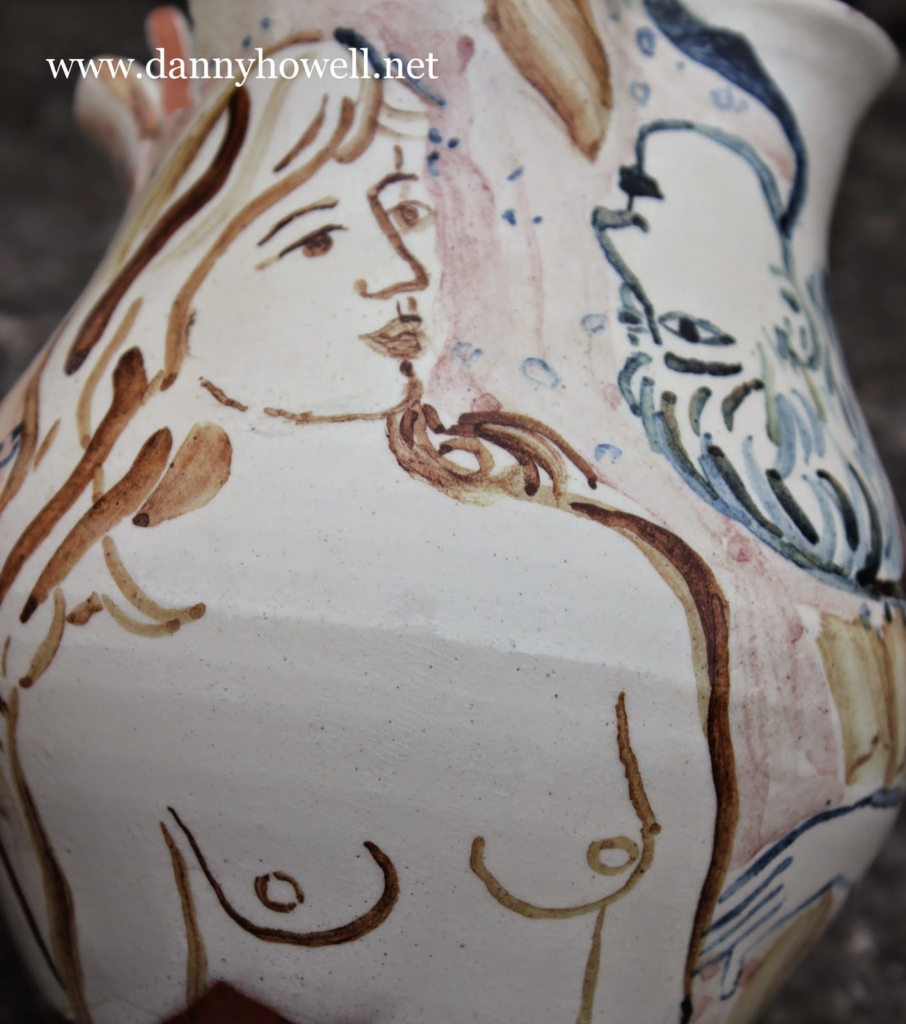
Photographs taken by Danny Howell
on Monday 29th September 2014.
Information and topics which do not match the criteria of the main categories of this blog, or which does not relate to Warminster and district.
Monday 29th September 2014
Illustrations on a glazed jug, seen in a bathroom
at St. George’s Close, Warminster.
Photographs taken by Danny Howell
on Monday 29th September 2014.
Wednesday 9th October 2013
Uproot
Fence posts, hedge roots and tree stumps
up to 10 inches in diameter uprooted by
hydraulic equipment which can be
wheeled through a 30 inch wide gate.
Quick and very cost-effective service.
Never dig a root out again!
For a free quote call John
Telephone 01985 300194 or 07758 790301
Wednesday 23rd January 2013
At last ~ the promise of something more than good to watch on the box ~ because Salisbury-born Jonathan Meades – one of our great favourites at dannyhowell.net ~ is back on tv next Tuesday – BBC Four, 9.00 p.m., 29th January 2013, with The Joy Of Essex.
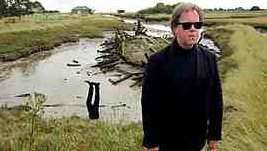
Here’s a preview courtesy of the BBC ~
The Joy Of Essex, Jonathan Meades
Duration: 1 hour.
Jonathan Meades is unleashed on the county of Essex. Contrary to its caricature as a bling-filled land of breast-enhanced footballer’s wives and self-made millionaires, Meades argues that this is a county that defies definition – at once the home of picturesque villages, pre-war modernism and 19th-century social experiments.
Shaped by its closeness to London, Meades points out that this is where 19th-century do-gooders attempted to reform London’s outcasts with manual labour and fresh air, from brewing magnate Frederick Charrington’s Temperance Colony on Osea Island to the Christian socialist programmes run by Salvation Army founder William Booth.
Meades also discovers a land which abounds in all strains of architecture, from the modernist village created by paternalistic shoe giant Thomas Bata to Oliver Hill’s masterplan to re-imagine Frinton-on-Sea and the bizarre but prescient work of Arthur Mackmurdo, whose exceptionally odd buildings were conceived in the full blown language of the 1930s some fifty years earlier.
In a visually impressive and typically idiosyncratic programme, Meades provides a historical and architectural tour of a county that typically challenges everything you thought you knew and offers so much you didn’t.
The programme will be repeated, again on BBC 4, on Wednesday 30th January 2013, at 3.00 a.m. (and, of course, it’ll be on BBC iplayer for seven days).
Monday 11th June 2012

“A few years ago when John Forbat and his wife, who live in Weybridge, were researching their family trees, they came to Warminster, having discovered details of ancestors who lived here (and at Frome). I have just received an email from John Forbat, who has kept in touch with me, to say he has had a book published. Here are the details.”
Evacuee Boys, Letters Of A Family Separated By War by John E. Forbat, is published by The History Press. Paperback. £8.99. ISBN: 978-0-7524-7123-5
Brothers John and Andrew Forbat had been happily living in England as patriotic British boys since 1936. When the Second World War broke out, however, the brothers found themselves evacuated to a disadvantaged part of Melksham in Wiltshire, cut off from home and family, and in austere circumstances. Added to this, on Pearl Harbor Day 1941, Hungary, along with other countries, joined the Axis and the Hungarian Forbat family became Enemy Aliens.
Their many letters home throughout the war, with details of their schooling, bullying, friendships and constant pursuit of more pocket money, form a humorous and at times tragic testament to the hardships of war. Interspersed with diary entries made by the boys’ father back home in Blitz-ravaged London and letters from Andrew when he was interned on the Isle of Man, Evacuee Boys is as full a record of war-torn Britain as one family could provide.
Available from all good Bookshops or directly from The History Press, telephone: 01235 465577 and www.thehistorypress.co.uk
To see the book’s details on its own page: click on
www.thehistorypress.co.uk/publication/evacuee-boys/9780752471235/
The book is also available from Amazon. Click on
www.amazon.co.uk/Evacuee-Boys-Letters-Family-Separated/dp/0752471236/ref=sr_1_7?s=books&ie=UTF8&qid=1339427440&sr=1-7
About the Author: John E. Forbat was born in Hungary but emigrated to England in 1936 with his family. In 1939, along with thousands of other children, he and his older brother Andrew were evacuated away from London to a deprived part of Melksham, Wiltshire. Returning to London later in war, John went on to become the youngest Fireguard in the London Blitz. He later completed a BSc (Eng) in Aeronautical Engineering, married and raised five children. He now lives in Weybridge, Surrey.
Friday 16th March 2012
The One Show wants to hear from you if you’ve got a wildlife mystery that needs solving, be it in your home or garden. The production team are asking: “Is something digging up your lawn, leaving mysterious footprints in the soil? Are you hearing animal sounds at night that you can’t identify? Has something moved in under your shed? Or you might have captured some footage of wildlife on video that is baffling you?”
The One Show wants to solve these wildlife mysteries on television. They will bring their cameras and expertise to film you and members of your family.
If you have a wildlife mystery to solve and want to take part in the tv programme, please telephone 01179 335601 or email: wildlife@tigressproductions.co.uk
Wednesday 14th March is No Smoking Day.
The No Smoking Day charity are encouraging smokers to Take the Leap and make a quit attempt. The charity does this by raising awareness of the Day, which takes place on the second Wednesday in March every year, and by highlighting the many sources of help available for quitters. In 2011 No Smoking Day merged with the British Heart Foundation with the aim of securing the future of the campaign and building on its success. The new 2012 campaign theme is positive, energetic and persuasive. The charity says: “Delve into our ‘get involved’ section on our website and find out how together we can help millions of quitters to Take the Leap on 14th March.”Further details:
Monday 2nd January 2012
John Lloyd Warden Page in An Exploration Of Dartmoor And Its Antiquities, second edition published in 1889, noted “Shortly before the opening of the railway from Okehampton to Lydford, the coach was crossing in the twilight hour a part of the Moor near the latter village. Suddenly the driver exclaimed in accents of unmistakable terror, “There! there! do you see that?’ pointing to an animal keeping up with his vehicle; “it is the black dog that hunts the Moor!’ To escape the phantom hound he lashed his horses into a gallop, and the creature, whatever it may have been, for in the gathering gloom its form was ill-defined, was soon left in the rear. [J.F. Wilkey, Report of Committee on Devonshire Folklore, Trans. Dev. Assoc., vol. xii.] That so cosmopolitan a being as the driver of a stage-coach should be affected by such an ordinary incident as the appearance of a dog by the side of his team may well be wondered at.”
Danny Howell writes: “Thanks to film and television, there can be only a few people today who haven’t heard of The Hound Of The Baskervilles, a Dartmoor-located story penned by Arthur Conan Doyle in 1902, involving his celebrated fictional sleuth Sherlock Holmes. The dog with huge jaws and small, deep-set cruel eyes, which ‘plagued the family’ is described as ‘a foul thing, a great, black beast, shaped like a hound, yet larger than any hound that ever mortal eye has rested upon,’ and ‘not a pure bloodhound and . . . not a pure mastiff; but . . . a combination of the two – gaunt, savage and as large as a small lioness.’ ”
Arthur Conan Doyle (1859-1930), writing in June 1929 and referring to his novel The Hound Of The Baskervilles, stated “It arose from a remark by that fine fellow, whose premature death was a loss to the world, Fletcher Robinson, that there was a spectral dog near his home on Dartmoor. That remark was the inception of the book, but I should add that the plot and every word of the actual narrative was my own.”
Friday 4th February 2011
West Wiltshire Crematorium,
Devizes Road, Semington, Wiltshire.
Telephone 01380 871101.
Friday 30th October 2009
Dennis Chedgy, of the Radstock Mining Museum, was the guest speaker at the October 2009 meeting of Warminster U3A. He spoke about the deep coal mines of Coleford and Radstock in Somerset.
He said that surface coal had long been known in the area at the foot of the Mendips. Archaeologists had confirmed its association with Roman activities in the region. Mr. Chedgy expressed his opinion that surface coal had not been used widely because the area was so well wooded.
The earliest indication that coal was actually being dug for is on a map of the late 1600s, where the word “Pits’ is denoted. These are what are called “Bell Pits’. These pits were technically simple: a hole was dug down to a seam laying fairly close to the surface. Digging was then extended sideways along as as far as possible and then another hole was dug further along the seam. The coal was hauled to the surface by hand, using a rope and a basket.
Serious deep mining did not occur until two men were granted a lease on the estate of the family of Earl Waldegrave in 1759. They spent four years digging and lining a shaft to the seam at a depth of 1,000 feet. This started to produce coal in 1763.
The only way to move the coal out to the consumer was by horse and cart, about one ton at a time; a task that was difficult in summer, but given the country lanes in the area, almost impossible in winter. To overcome this problem, a canal was dug through to Coleford. The output from Radstock was brought to the canal by means of a tramway some eight miles long.
By 1847 the canal had become very expensive to maintain. The use of the canal was abandoned, and a tramway was laid on the towpath; this was used until the railway reached Coleford in 1870.
When the mines were nationalised in 1947 there were 12 pits producing in the area, all were by then under the ownership of Somerset Colleries. In 1973 the last of these closed; the seams, some of which were only 16 inches in depth, were considered uneconomic to continue mining.
Information from Best Value And Council Tax Summary, How Your Money Will Be Spent 2003/04, published by West Wiltshire District Council:
Wiltshire County Council maintains 1,830 bridges – 830 road bridges and 1,000 footbridges – and 70,000 gullies across the county.