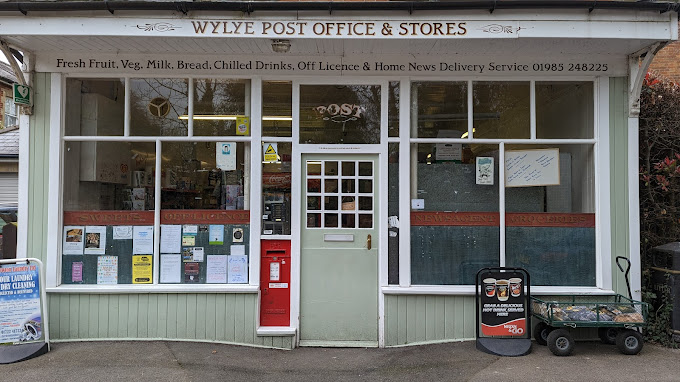
Please complete this survey to help shape the future of our village shop. Your input is essential in assessing community interest in the Future Wylye Shop – the more responses we are able to gather, the better. Thank you!
Wylye Parish Council has announced that improvements have been made to the footpath which connects Wylye and Fisherton Delamere. “This has provided a much easier access for families with children in buggies, and opens up the whole circuit (Wylye-Fisherton Delamere-Bapton) to motor scooters. Thanks to Wiltshire Council for the Grant Aid and the generous help of the Collins family. The gates were erected very professionally by Tom Thornton.”
SECTION 14(1) OF THE ROAD TRAFFIC REGULATION ACT 1984
Notice is hereby given that the Wiltshire Council intends to make an Order to close temporarily to all traffic:
C64 (Part), Wylye;Â for a distance of approximately 30m either side of level crossing to enable Network Rail Infrastructure Ltd to carry out level crossing scheme and associated works. Alternative route via C64 (unaffected length) – C10 – A303 – C276 – C277 – B3089 – C64 (unaffected length) and vice versa. The closure and diversion route will be clearly indicated by traffic signs.
This Order will come into operation on 24 February 2023 and the closure will be required as follows; 24 February 2023 between the hours of 21:00 and 06:00 until 27 February 2023; 03 March 2023 between the hours of 21:00 and 06:00 until 06 March 2023.
It is anticipated that the works will take the stated duration to complete depending upon weather conditions. Access will be maintained for residents and businesses where possible, although delays are likely due to the nature of the works. The Order will have a maximum duration of 18 months.
For further information please contact Centurion Traffic Management on 0113 2775360. Wiltshire Council
The Reverend Bryan Thomas, former Rector of the Yarnbury Group of Churches in the Wylye Valley, and former Vicar of Gorslas with Crosshands in Carmarthenshire, passed peacefully away at his home on 3rd May 2018. A service of thanksgiving will be held at the Church of St. Mary The Virgin, Wylye, on Wednesday 16th May 2018, at 2.30 p.m. All enquiries to Chris White, Funeral Directors, telephone 01722 744691.
The record of Listed Buildings refers to the statue of the post boy, in the river at Wylye, as “The Wylye Hornblower.” Grade II listed, its location is given as “north of Mill House.” The notes read: “Statue. Probably C18. Lead sculpture, about life-size, depicting a young male, almost nude, figure blowing a horn and draped and festooned around the waist; representing the Horn of Plenty. It stands on a rock on a small island in the River Wylye. The left knee is supported on a later metal bar and the statue is said to have been re-set on the rock base in living memory. Reputedly it was installed in the late C18 by the Earl of Pembroke to commemorate the post horn man, who was drowned saving one of the Earl’s relatives from drowning when a coach overturned at the old ford over the River Wylye when it was in flood. Also, it is said to be of Roman origin and collected by the Earl of Pembroke on his Grand Tour of Europe, but it would seem to be of C18, possibly Italian, origin. SOURCE: Buildings of England, page 601.”
When Knight Frank were the selling agents for the Mill House, Wylye, in 2014, their sale brochure included the following historical notes (dated May 2024):
The Mill House has an interesting history. There has certainly been a dwelling on this site from Saxon and Norman times at least, as the Mill is recorded in the Domesday Book as rendering 10 shillings. The London to Exeter road forded the river beside the Mill until the first bridge was built in the late 18th Century.
In the middle of the river stands a statue of a sea sprite blowing a shell-like trumpet. This statue, known as “The Wylye Boy†and mentioned in Pevsner, was collected by the Earl of Pembroke on the Grand Tour in the early 18th Century. It was later given by him to stand in the river in perpetuity as a memorial to a young postilion rider who drowned after saving a relation of the Earl from a coach which had overturned in a flood.
The place is also mentioned in William Cobbett’s “Rural Rides†published in 1830: “… I remembered Wylye very well, and thought it a gay place when I was a boy. I remembered a very beautiful garden belonging to a rich farmer and miller. I went to see it; but, alas! Though the statues in the water and on the grass platt were still remaining, everything seemed to be in a state of perfect carelessness and neglect…â€
Dear Danny, We are looking into buying The Old Swan in Wylye, and wondered if you knew much about it, and had any photographs? It was converted from a pub to a house some time in the 1970s, and is now known as Old Swan Cottage. Kind regards.
Danny Howell replies ~
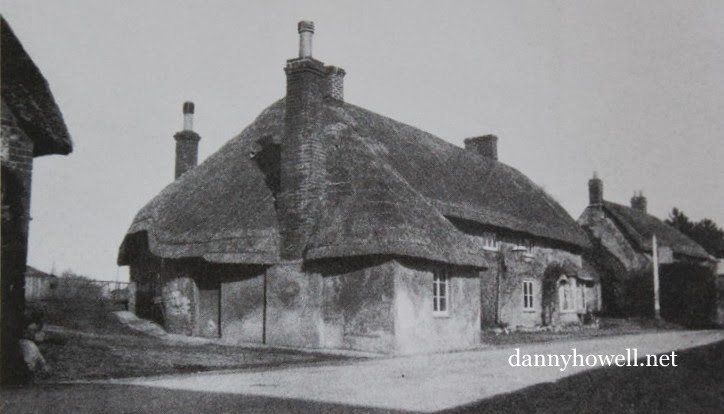
It seems the Swan Inn at Wylye was in business from about 1840 (according to the Tithe Award for Wylye) and certainly appears in trade directories with a succession of landlords from that period onwards. The first reference I have to it in a trade directory is in Kelly’s 1848, when Giles Cornelius is listed as the landlord. Later landlords included: James Mead (1867); George Hayter (1875); George William Snook (1889); Samuel Herring (1899); and William Herring (1907). It was sometimes referred to by locals as The White Swan. It was originally a thatched building, as this photograph, taken in or before 1920 shows:
At about 8.40 p.m. on Thursday 6th December 1923, while the landlord Frederick Johnson and his customers were discussing an election that had been held that day, a fire broke out in a spare bedroom above the kitchen of the pub. Salisbury Fire Brigade were delayed by thick fog and didn’t arrive in Wylye until 10.35 p.m., by which time it was too late. The building was burnt almost to the ground, although the wooden sign outside was not even singed. The building was the property of Messrs. Mathews, brewers of Gillingham, and was valued at £3,000.
It was rebuilt and continued as a pub. The property was extended in 1936. I think the plans for the extension are in the Wiltshire and Swindon Record Office (History Centre) at Cocklebury Road, Chippenham (document reference W.R.O. G11/760/240.) The landlord of the Swan Inn, Wylye, in 1939, was Frederick Still. It seems the Swan closed circa 1975, when the construction of the Wylye Bypass would have undoubtedly led to a diminishment in passing trade.
If you want to purchase some pictures of the Swan, Julian Frost of Wylye Valley Postcards has five different views reproduced from old postcards in various sizes: 6″x4″ £1.50 each or four for £5, 7″x5″ £2.50 each or three for £7, 9″x6″ £3.50 each or three for £10, or 12″x8″ for £10 each.
From Wylye, Fisherton Delamere And Deptford Parish Plan, January 2014:
During the 1980s the memories of several residents who had lived in Wylye during the 1920s and 30s were collected and preserved. At that time there were still farmers, a baker, a grocer and two butchers. A local man also ran a fish round. His fish was sent down to Wylye by train from Grimsby every Tuesday and Friday. Wylye also had a successful motor engineers and haulage contractors business called Smith Brothers. This firm started by supplying coal, coke and firewood, later opening a petrol station and car repair garage. It also charged wireless batteries, and in the 1930s it progressed to wiring houses for electricity although for quite a few years there was little demand for electricity or water to be supplied because of the cost involved. The villagers did not want to pay extra rates when they were happy drawing water from their wells. They felt the same about electricity; the Bull family was one of only six houses that had electricity installed ¢.1933. Mr Bull was very keen for his wife to have an electric iron. He paid £3 each year for three lights, one plug and the use of 120 units of electricity.
From The Wylye, Fisherton Delamere And Deptford Parish Plan, January 2014:
POLICE We are fortunate in that 85% see Wylye as a secure and low-crime village. Nevertheless, 70% percent would want there to be a greater police presence.