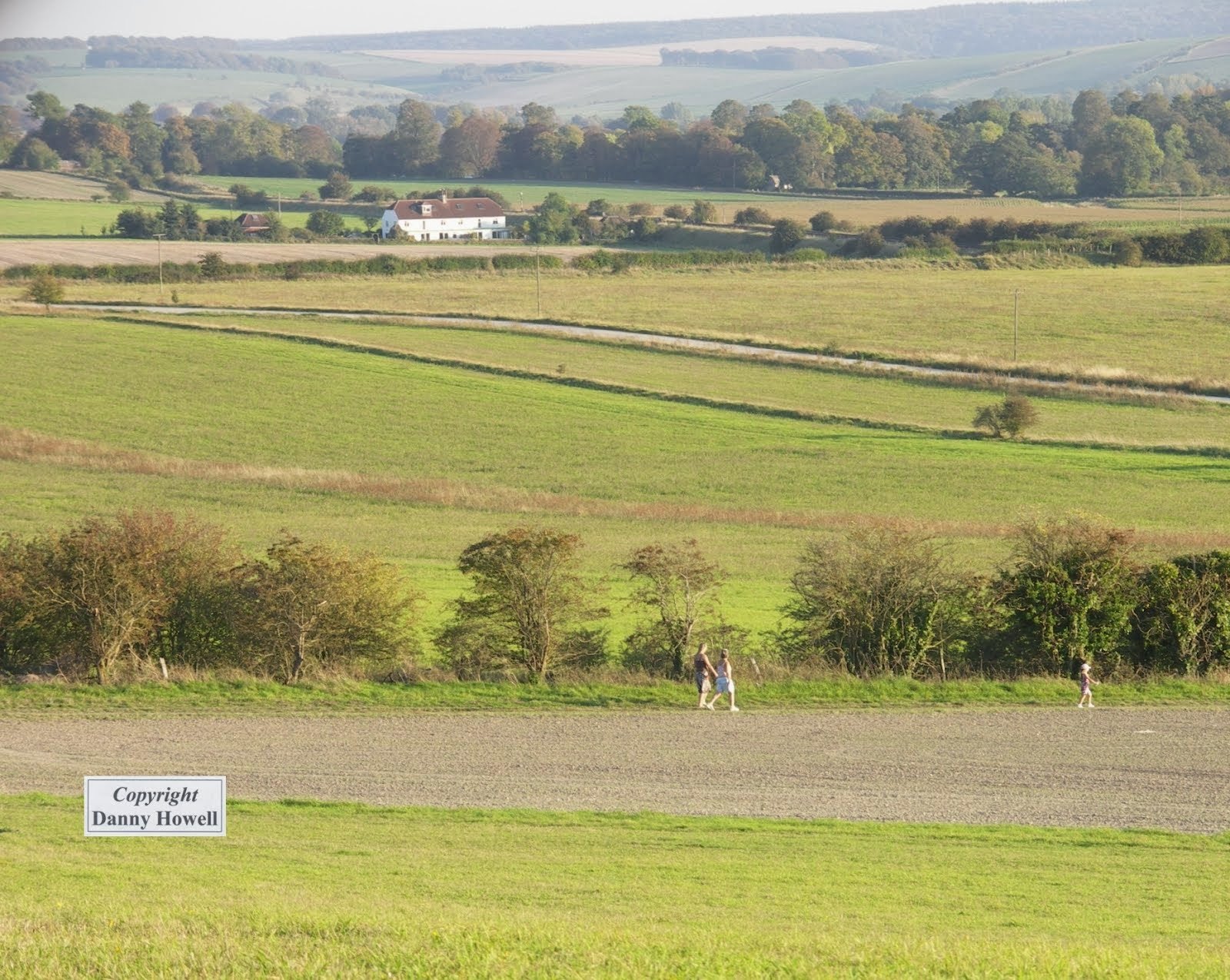
On location in the Wylye Valley with HTV West.
Danny Howell, writing in Warminster & District Archive magazine, No.1, Winter 1988, reported:
Many Archive readers, particularly those who live in Warminster and the Wylye Valley, will have seen a HTV West film crew filming in the area last summer. So, what was it all about? Why were the cameras focusing on our part of the world? Was it the return of unidentified flying objects? Was something out of the ordinary happening in our midst? As one who was partly involved in the media activity, allow me to satisfy your curiosity.
HTV were filming a series of half-hour documentaries for screening in 1989. Clive Gunnell, who needs no introduction, having walked many miles for television in recent years, including Along The Cotswold Way and Through The Forest Of Dean, has now completed a stroll through the Wylye Valley from Salisbury to Warminster, following as closely as possible the route taken by the great William Cobbett in 1826.
Cobbett (1763-1835), who made his journey on horseback, wrote a series of evocative essays about this and other travels for his book Rural Rides. He has recently been described as “the most powerful and eloquent political writer of his day.” Born a farmer’s son, at Farnham in Surrey, he began work for his father after leaving school but aspiring to better things he left when he was 20 and became a solicitor’s clerk. He wasn’t really suited to this and in 1784 he enlisted in the army, where he soon became a sergeant-major, travelling with the 54th Regiment to New Brunswick. In 1791 he was discharged, and set about exposing the corruption he had seen amongst the officers. He soon found himself in trouble and was forced to flee to France for a while and later to the USA. Here, he put his talents to good use, writing and publishing pamphlets defending the British Monarchy. His publications included Observations on Priestly’s Emigration (1794), and the Porcupine Gazette (1797-99). He became well-known for this and his fame spread back to England where the pamphlets were re-printed.
His criticism of the pro-French party in the USA got him “into hot water” and, with his career apparently ruined, he returned to England in 1800 after losing a libel suit to Dr. Benjamin Rush. He was immediately taken under the wing of the Tory leaders, who provided him with the funds to start the Political Register in 1802 (this was published on a weekly basis until his death). In 1804 he also began an unofficial record of parliamentary debates – this was later taken on by Hansard, the printing firm, and became the official record of Parliament. Cobbett, always on the side of the oppressed and moved by the suffering of the poor, reverted to radicalism and he was prosecuted in 1804 for an article he wrote on Ireland. He constantly criticised those in charge of the administration and they too prosecuted him for his remarks in 1810. He was sent to Newgate Prison for two years. In trouble again in 1817, he absconded to America, not wanting to go behind bars again. Although he was an active politician and was elected to Parliament in 1832, leading the agitation for parliamentary reform, he never really achieved any marked success. He did find time to write several books: Cottage Economy (1822), The English Gardener (1829), and Advice To Young Men (1830). Rural Rides was also published in 1830.
Some of you will be familiar with what Cobbett said in Rural Rides about Warminster – “I must once more observe that Warminster is a very nice town: everything belonging to it is solid and good. There are no villainous gingerbread houses running up, and no nasty shabby-genteel people, no women trapseing around with showy gowns and dirty necks; no Jew-looking fellows with dandy coats, dirty shirts and half-heels to their shoes. A really nice and good town.”
Cobbett was also impressed with the upper reaches of the Wylye Valley – “From Heytesbury to Warminster is a part of the country singularly bright and beautiful. From Salisbury up to very near Heytesbury, you have the valley . . . Meadows next the water; then arable land; then the downs; but, when you come to Heytesbury, and indeed, a little before, in looking forward you see the vale stretch out, from about three miles wide to ten miles wide, from high land to high land. From a hill before you come down to Heytesbury, you see through this wide opening into Somersetshire. You see a round hill rising in the middle of the opening; but all the rest a flat enclosed country, and apparently full of wood . . . all the way from Salisbury to Warminster . . . the country is the most pleasant that can be imagined. Here is water, here are meadows; plenty of fresh-water fish; hares and partridges in abundance, and it is next to impossible to destroy them. Here are shooting, coursing, hunting; hills of every height, size and form; valleys, the same; lofty trees and rookeries in every mile; roads always solid and good; always pleasant for exercise; and the air must be of the best in the world . . . It is impossible for the eyes of man to be fixed on a finer country than that between the village of Codford and the town of Warminster . . . There are two villages, one called Norton Bavant, and the other Bishopstrow, which I think firm, together, one of the prettiest spots that my eyes ever beheld.”
I think we can take this as quite a compliment – for Cobbett, as I mentioned earlier, had travelled both in this country and abroad, seeing many forms of landscape, and he was certainly not a man to mince his words. Most of his remarks were critical and scathing – yet he said these wonderful things about our patch. What better reason could there be for making some films about the Wylye Valley?
And so to Clive Gunnell. I think that he, like Cobbett, having seen many varying types of landscape and panoramas, was also suitably impressed with the Wylye Valley. Not only that, the film crew commented, more than once, either on location or over lunch, how they had not realised before how outstanding the countryside round Warminster is. In conversation between takes I came to know Clive and his way of thinking and I found him instantly likeable and easy to talk to. He does not describe himself as a journalist or a writer (even though he has contributed articles to magazines), nor does he like the tag “historian” and he shudders at the thought of being “a television star” despite his TV walks and appearances on West Country Farming and The Weekend Starts Here. When confronted with all this, he told me he considered himself “an entertainer” right from his youth when he appeared with his father as a music-hall duo. His programmes do entertain, and he does have the knack of putting his interviewees at ease – what’s more he appears to know what they’re talking about!
It was my pleasure to help Clive plan his route between Wylye and Warminster, and I introduced him to some of the Valley’s characters who soon found themselves talking in front of the cameras. Among them were Roy Bryant of the Stores at Bapton; Mrs. Beagley, who keeps the Ram Park flock of Jacob sheep at Sherrington, spinning the wool into attractive garments; Mr. Green, whose ducks and trout in the old watercress beds at Sherrington have until recently attracted tourists for miles around; Mr. and Mrs. Bill Robbins at Heytesbury; and Fred Stickland, a resident of St. John’s Hospital, also at Heytesbury. The rapport was simple, logical, no-nonsense stuff – concentrating on how things had changed in the villages, over the years, for better or for worse. I’m pleased to say that the interviewees were the ordinary folk (and I don’t mean that insultingly) who live and work in the Valley. I even found myself casting modesty aside to wax lyrical for the small screen!
Between interviews Clive drew attention to much of the area’s historical past, including Seigfried Sassoon’s association with Heytesbury; St. James’ Church at Tytherington; Cobbett’s generosity to nut-gatherers in the Angel Inn, Heytesbury; the impressive Iron Age hill fort of Scratchbury; and the deserted village of Middleton, to name but a few examples. In Warminster, once a great corn market and trade centre for malt and cloth, Clive had some outspoken things to say about the more recent street architecture (will his comments, true as they are, survive the cutting room?) and he visited Carson’s Yard, for a chat about the demise of the Wiltshire Foundry. Also on his schedule was a chin-wag with David Pollard who maintains many of Warminster’s clocks. Television viewers will be able to see at close quarters the faceless clock of St. Laurence’s Church striking 3 pm. Before leaving Warminster Clive had time for a windswept natter on Arn Hill with Mr. Jack Field, Chairman of the Warminster History Society and Honorary Curator of the Dewey Museum. Mr. Field extolled the virtues of living in Warminster, and the lofty summit of Arn Hill allowed the cameraman to record some views of the busy town below.
All of this will be transmitted in the coming year. If possible, Archive will give you advance notification herein of the dates and times when the films are to be shown. Meanwhile, we will all have to wait patiently to see some of our friends and surroundings immortalised on celluloid, or should I say video? William Cobbett (for the past) and Clive Gunnell (for the present) equally promote the Wylye Valley as a pleasant and attractive place – let’s hope the makers of these documentaries, combing the words of both these commentators with the thoughts and recollections of some of the locals, have been successful in capturing something of the essence of the beautiful Wylye Valley.