A Short Account Of The Parish Of Steeple Langford In The Hundred Of Branch And Dole In The County Of Wiltshire
K.D.D. Henderson. 1973.
Foreword
This paper is condensed from a longer survey intended for Salisbury Museum. A still more detailed version will be offered to the Wiltshire Archaeological Society at Devizes.
Documents and source material, collected over the years with the aid of Mr. O. Devereux Price of Hanging Langford, will be preserved in a suitable container and lodged at the school or in the vestry.
Information which is already included in the Guide to Steeple Langford Church has been omitted from this account.
A Short Account Of Langford Parish In The County Of Wilts.
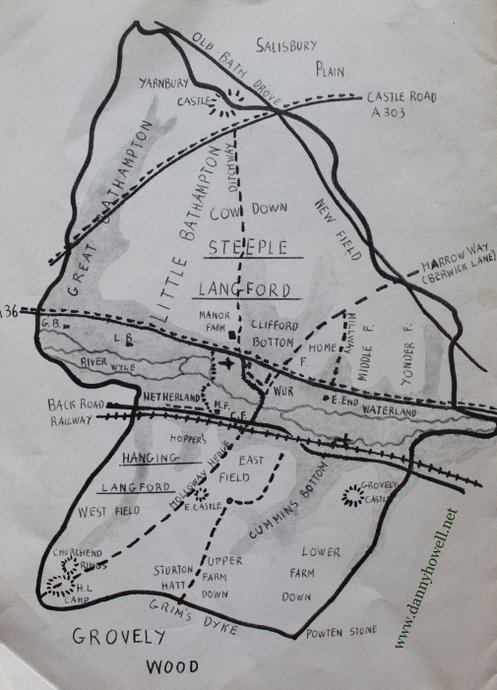
An eighteenth century traveller like William Cobbett, who brought down a horse from Farnham in the summer of 1773 for the use of the rector, the Rev. John Forde, would have followed the Harroway through Stonehenge, climbing up from the Till valley at Berwick St. James and crossing the old Bath Drove, Sarum Way, on top of the down. On the left the ground falls away from here through the high furlongs of Steeple Langford into Yonder Field Bottom. On the right was a New Field, carved out of Tenantry Down some time in the sixteenth century. These were all the common fields until the enclosure of 1866.
As the ancient road, perhaps, the second oldest in England, begins its descent to the Wylye Valley, the ground starts to drop away on the right into Clifford Bottom, the easternmost extremity of the demesne land. Opposite, after the passage of the furlongs called Great and Little Upright, a road called the Millway or Melloway took off down the slopes of the Home field to the hamlet of Tucking Langford, with its thirteenth century fulling mill.
The Home field was bordered on the west by a rugged piece of hillside , “the Rudges”, from which a strip of allotments called the Cotelands stretched up over Berwick Lane just above the point where it dips below the Clifford escarpment to the chalk pit.
The sexton’s Bell Acre, which originally abutted on the lower Millway, was moved to the Rudges by the enclosure award. Its site is now shared by the parish allotments and the Bell Inn, which stands on the corner where the lane comes out onto the high road (A36).
This high road was built in 1762 by the Wilton Turnpike Trust to link up with a Warminster road-head at Heytesbury. Previously there seems only to have been a bridle path across the tract called Waterland between Serrington Mill and Tucking Langford. Tucking Langford, or East End as it was later called, dwindled away during the 19th century until now only one house remains, apart from the comparitively modern East End Inn.
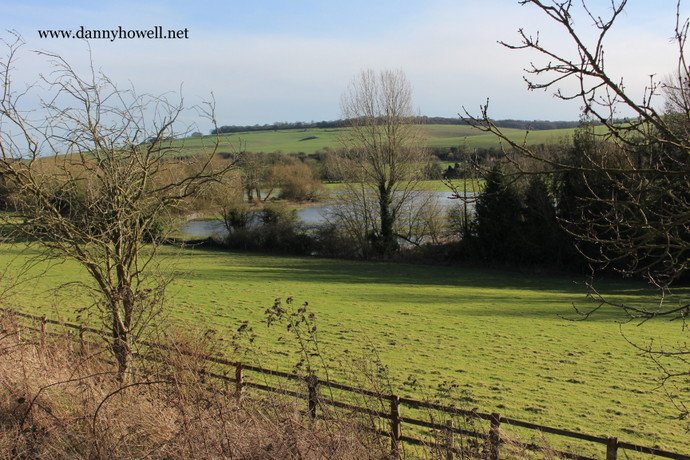
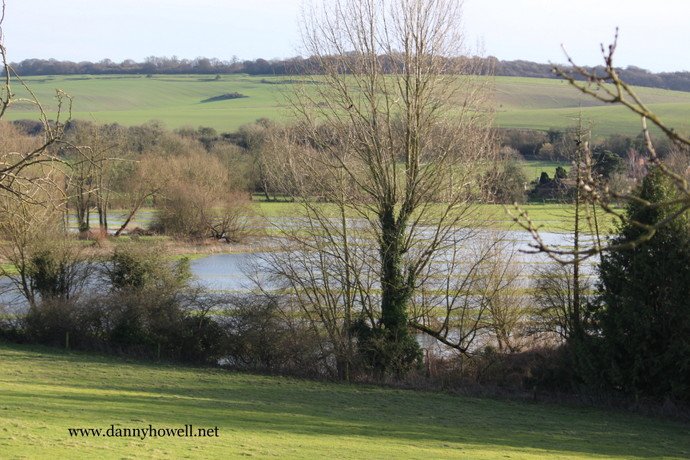
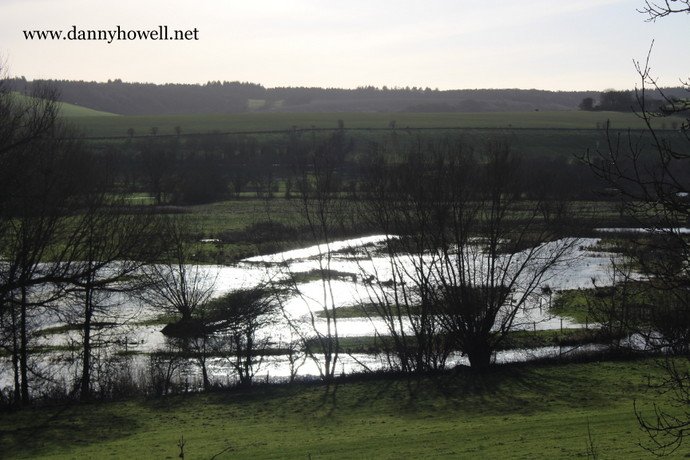
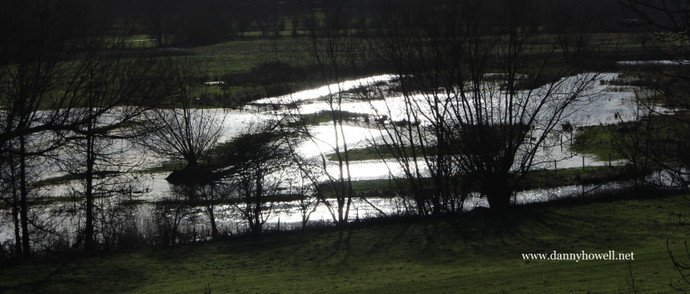
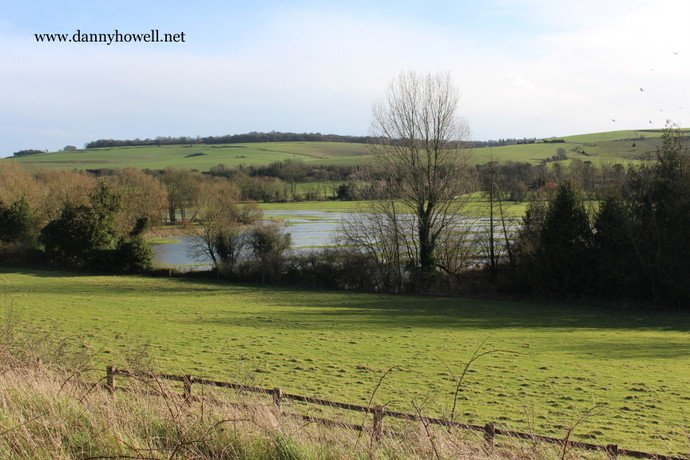
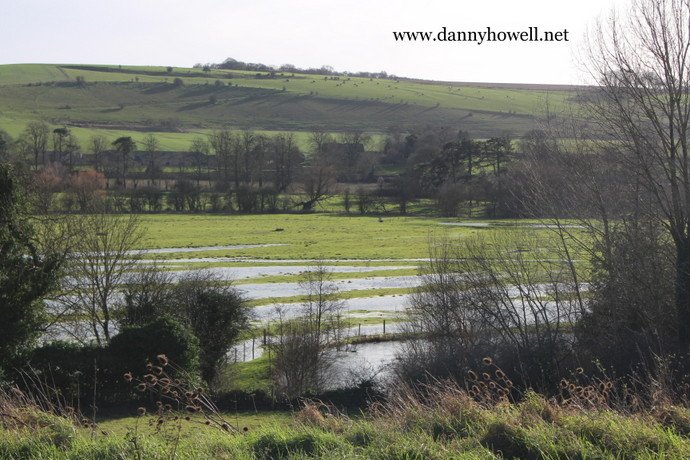
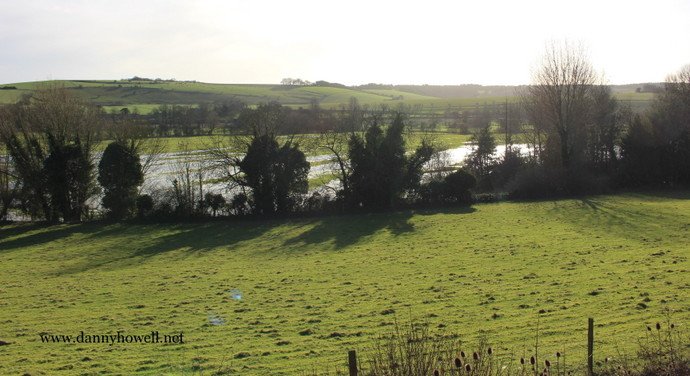
In pre-enclosure days the Harroway continued south of the Bell as Bounds Lane. This was then reduced to the status of a footpath but is now a metalled road for most of its length. It has been re-named the Wirr, after an adjacent piece of land marked Wur on the old maps. Most of the Wur is occupied by the recreation ground, from which it is possible to get a good view southwards across the river.
Hanging Langford
Directly opposite are the steep slopes which comprised the old East Field of Hanging Langford, now part of Hill Top Farm, but under strip cultivation till 1833. The strips were known as acres regardless of size and were grouped into copyhold tenancies, known as Yardlands in Hanging Langford and Livings in Steeple Langford. They were scattered among the various furlongs to ensure an even distribution of good and bad land and fair shares in the rotation, and though sometimes where conditions were suitable a strip would abut or “shoot” upon another strip belonging to the same living in an adjacent furlong.
West of this field a confused triangle of hedgerows marks the junction, above the site of the old limepit, of two Holloways. One is the Harroway, climbing from Black Hollow under the railway line on its way to Hindon, and the other, known today simply as The Hollow, giving access from it to the village of Hanging Langford. The lanes are separated by Limepit Linch and Holloway Hedge from the great West Field, part of which was common land and part demesne.
The ‘henge’ or ‘hanging’, the steep rise from which the village takes its name, continues westward across this field behind the village , where it is intersected by two deep combes or bottoms running back into the downs. The first of these embraced a field called Hopper’s after one Edward Hopper, who got into trouble with his landlord in 1573 for cutting down timber, Three hundred and fifty years later, when the two Hanging Langford manor farms were broken up after the 1914-18 war, this field gave its name to a new farm.
Above the west field Farm Down and Tenantry Down were brought partly under cultivation during the 18th and 19th centuries through marginal clearances known as Beaks or Bakes.
According to John Aubrey, writing at the end of the 17th century, the custom of Burn Beaking, or firing the stubble, was introduced into this part of Wiltshire in 1639. “They say it is good for the father but naught for the son, by reason it does so wear out the heart of the land.” Similar doubts were expressed in a Government Survey dated 1794 and by the Salisbury Journal in 1972. The former regarded the undesirability of the innovation as a matter for serious consideration. The latter remarked that its desirability was “by no means generally accepted”.
The 1794 report gives a detailed description of local agricultural methods, including the irrigation of the water meadows, known as drowning. This practice, according to Aubrey, was inaugurated at Wylye in 1635, and is not apparently altogether extinct in Wiltshire, though the last drowners’ supper in Langford was held in 1915. The general system of farming and folding remained very much the same from 1794 to 1914. Mr. Stanley Matthews, who had carried out most of the functions in his time and died in 1972, could find only two obvious changes. The immigrant harvesters from Somerset were no longer called Taskers when he started his working life, but Strappers, and they were paid five shillings an acre instead of six.
Hanging Langford village lies along the Back Road, the original Saxon highway from Wilton to Warminster, traffic on which is visible from the recreation ground beyond the gravel pits which occupy the site of the village common. The road entered the parish from Little Langford at Sturton Gate and left it at Scotland Corner* after traversing the Netherlands or Netherway strips west of Townsend Gate.
* Scot-land paid a special tax or Scot towards the cost of irrigating the meadows.
In the 1760s the Amesbury Trust converted part of the back road into a turnpike to link up at Wylye with their new road from Stonehenge to Willoughby Hedge, (A303), which crossed the Wilton turnpike at Deptford. There was a famous coaching inn at the crossroads which failed to survive the railway era but is presumably responsible for the retention of the name Deptford on modern road maps.
The railway produced an inn of its own just west of Hanging Langford village and opposite the halt on the Wiltshire, Somerset and Weymouth line, constructed in the 1860s beside the back road. The Railway Tavern was closed down in 1966 on the death of the licensee, Mrs. Annie Witt, who had never slept a night outside the house since she entered it as a bride on August 3rd, 1914. It was famous for the skill of its dart-throwers.
The platform of the old Halt is still visible south of White Cottage, with a blackthorn hedge on top, but the station was closed soon after it was opened, for lack of custom. Langford people preferred to travel by road, visiting the inns en route. In later days passengers from Salisbury used to throw their parcels out of the train window and collect them on the way home from Wylye. It was still possible early this century to get a ride on the carrier’s cart for a shilling, but the Castle Road from Deptford to Stonehenge was deserted and local men were employed to keep it clear of grass. At that period too girls could earn money picking stones off the fields for cobbling the steep streets of Bath.
The usual route from the station to Steeple Langford was the Church Way, known on the other side of the valley as the Upper. This took off opposite Hicks Lane Gate (the old name for the entrance to the Hollow. Richard Hicks leased the College Farm in 1452) at the Manor Farm and crossed the river at Mascall’s bridge. The origin of this bridge and the identity of Mascall are wrapped in mystery. There is a story that he was a stranger who tried to ford the river at this point and was found in the morning standing upright in the water frozen stiff. Hence perhaps the nickname “Die Upright” still applied to natives of Langford up till 1914, but usually derived from a rector who died in his pulpit. This was the Reverend Samuel Weller, who expired after giving out his text on Easter Sunday, 1795, but is popularly supposed to have been Joseph Collier, an earlier incumbent whose effigy looks out of a niche on the chancel wall.
For animals there was a driftway further downstream and finally the ford itself, sometimes a quarter of a mile wide, until the bridges were built in the 1880s, after Thomas Davis Powell of the Manor Farm had stuck there in his carriage on his way to get married. Travellers on foot could negotiate the difficult places on stepping stones and there was a footbridge of sorts in 1866 near the present bathing pool. On the south side of the ford was the smithy, still distinguished by the figure of a horse as weather cock, cut for the smith by Mr. Walter Haines in 1902. There was once a mill hereabouts, but it fell to pieces by the 17th century. The forge is described in 1833 as “late Noah Diaper’s cottage”. The Diapers are an old Langford family who came over from Flanders about 500 years ago to teach the English how to weave. The name, which is also found in the Suffolk wool towns, does not derive from the town of Ypres but from a linen cloth of Byzantine origin called diasporos.
Eton College Farm is situated south of the road about a hundred yards west of the forge. It used to belong to the County of Mortain, the Norman equivalent of the Duchy of Cornwall. One of the less reputable Counts was the future King Stephen, who devastated this part of Wiltshire during his wars with the Empress Matilda. According to his chronicler, Richard of Hexham, he not only set fire to houses and churches but, “a still more cruel and brutal sight”, to the crops in the fields. This was in 1149 A.D. and it is to be hoped that he spared his own manor, which Richard Coeur de Lion later removed from the possession of his brother, John Lackland, and bestowed on Mortain Abbey. After the loss of Normandy in 1442 the Abbey lands formed part of the endowment of Henry VI’s new College of Eton, which retained possession till 1924.
The other farm was one of the many manors in the neighbourhood, including that of Steeple Langford, bestowed by the Conqueror on his huntsman and verderer Waleran, warden of Groveley Wood. From his heirs it passed to the Abbess of Wilton and was leased by her to Thomas Bonham of Wishford who held at his death in 1420 “the manor of Hanging Langford with appurtenances, with Alice his wife, the manor being held of the Abbess as of her Manor of Wylye, by service of 100/-, worth beyond 40/-.” This property and Alice’s other inheritance at Bathampton passed subsequently to Robert Mompesson with whose heirs both manors were associated for more than 300 years.
In the 18th century at some stage the two Hanging Langford farms were leased to the same tenant and by the time William Moody, a Wilton clothier, took them over in the 1760s they had been farmed together for so long that the boundaries were no longer distinguishable.
Moody’s son and namesake, writing to the Provost of Eton in 1789, warned him of a proposal to build a canal from Warminster to Salisbury, which would, he felt, ruin the watermeadows and so eliminate the sheep whose presence was essential to the fertility of the thin soil. In 1970 the threat came from Warminster’s increasing intake of water and output of effluent, encouraging the growth of flannel weed and generally bad for the fish. In Aubrey’s day it was “the late improvement of drowning the meadows” which was supposed to have decreased the supply of grayling or “umbers” as he called them.
Neither farmhouse is visible from the recreation ground, which, as has been remarked, faces the East Field. At the other end of this field is a very ancient hedge. For the last 200 years it has been called Cunnekar, after a Coney Gree or rabbit warren installed on the far side of it by some Norman lord of Little Langford. In the 17th century it was called Dangers’ Hedge after the D’Angers family who were lords there 1323 till 1440. But the hedge was old before the Angers arrived. “Winehouse Lane” which ran down the side of it, was a “newly broken path” in 943 A.D. when Edmund, King of the West Saxons, granted the upper farm to a vassal. The boundary is also described in a charter of King Eadwig dated 956 and is not difficult to identify. You can see it from the recreation ground running south westerly up the hill to a clump of trees called French Bush in the inventories. There it bears westerly, parallel with the path to Hindon from Little Langford, skirts a strip of glebe called Parsons Piece or the Shoulder of Mutton, and turns left across the herepath (Hindon Way) to a broken barrow crowned with bushes.
From the barrow the boundary continues southward across the western fork of Cummins Bottom (“Bottescombe”) to Stourton Corner on the edge of Grovely Wood and turns eastward along Grim’s Dyke to an ancient landmark called the Powten Stone where four parish boundaries meet.
Groveley Wood
The outlying coppices of Groveley are visible on the hills to the south east. It was the only Wiltshire forest to be mentioned in Domesday and, as has been said, William installed his verderer Waleran in these parts to look after it. Waleran held the lordship of Grimstead, which also included two other Langfords – now known Longford and Landford. Subsequent developments at Clarendon and the New Forest reduced the importance of Groveley and in 1300 the western boundary was moved back from Wylye Cross to Wylysford, on the boundary between the lands of Alan de Langford and those of Alan de la Ford at Wishford. From Wylysford it ran up “the Red Way Valley” east of Groveley Castle and then via the “Meneway” to the Powten Stone. From the Powten stone it went south to Ashwell Lake on the Nadder near Baverstock.
Disforesting, as Aubrey pointed out, deprived the peasant of grazing rights, which consisted in his time of free pasture for swine and 4d a year for a cow. As a result of recent examples in the area he reported that the highways were encumbered with cottages “and the traveller with beggars who dwell in them.”
About the only right which was left to them seems to have been the right to gather nuts. Langford men and women used to rise before dawn in October in order to get back by early afternoon, when the dealer from Wilton arrived and rang his bell. He used to pay sixpence a gallon for hazel nuts in the early years of the 20th century.
Aubrey has quite a lot to say about Groveley. Its fallow deer were the largest in England, save for a record buck killed at Verneditch in the parish of Broad Chalk in 1650. But the skins were inferior and the Tisbury glovers would pay sixpence more for a buckskin from Cranborne Chase.
“Excellent fire flints,” he remarks elsewhere, “are digged up at Dun’s Pit in Groveley, and fitted for guns by Mr. Thomas Sadler of Steeple Langford.”
Reference has been made to “Stourton Gate” where the back road crosses the old parish boundary, and to Stourton Corner on the edge of Groveley. The name derives from the Stourtons, the oldest baronial family in England, who succeeded the Dangers as lords of Little Langford. The stone at Stourton Corner stood at the head of a coppice called Sturton Hatch, but marked as Sturton Hatt on the old maps. Aubrey explains the origin of the name in a passage commenting on the death of beech trees in Wiltshire. “About the middle of Groveley Forest was a fair wood of oakes, which was called Sturton’s Hatt. It appeared a good deal higher than the rest of the forest (which was mostly coppiced wood) and was seen all over Salisbury Plain. In the middle of this hatt of trees (it resembled a hatt) there was a tall beech which outtopped the rest.” The Hatt was cut down by Philip Earl of Pembroke in 1654 and disforested by his successor Thomas in 1684.
In addition to the ancient earthwork called Grim’s Dyke by the Saxons (Grim was a name for Woden, who was god of boundaries amongst other things) there was a Roman road which ran alongside it on its way to the Mendips. All along the ridge are iron-age forts and entrenchments from Ebsbury Copse to Bilbury Rings. Of these only East Castle with its crown of trees is conspicuous from the recreation ground, just east of Holloway Hedge Barn. Hanging Langford Camp, with Church End Rings below it, lies further west along the Harroway.
Most of these works probably date from the period between the two Roman invasions of 55 B.C. and 43 A.D., when Groveley formed a boundary between two tribal confederacies, immigrants respectively from the low countries into Hampshire and from Brittany into Dorset. According to Caesar the Belgians specialised in entrenchments on the edge of forests. Neither these defences however, some of which were never completed, nor Yarnbury Castle above Steeple Langford nor Maiden Castle itself availed against the siege-train of the Second Augustan Legion under the future Emperor Vespasian, who reduced them all in one campaign in 43/44 A.D.
During the Roman occupation the Groveley ridge was quite closely settled, probably producing wool and hides rather than grain, which the Romans could import economically from Gaul.
Three collections of Roman coins have been found in the area. The Groveley Hoard, now in Salisbury Museum, was unearthed by Mr. S.H. Doughty in 1906 while digging for flints in Groveley Castle, above Little Langford. It included 300 silver coins of 383-408 A.D. and about 1,000 4th Century coppers. These were probably buried during an invasion by Irish pirates from the Bristol Channel. In 1961 Mr. H.F. Ford of Hanging Langford turned up some earlier specimens when ploughing beside the driftway below Scotland Corner – believed to be part of an old road from Hanging Langford Camp to Yarnbury Castle. These included specimens struck by the Emperors Gallienus (252-268) and Claudius Gothicus (268-70) and the pretenders Victorinus (265-7) and Tetricus (268-70).
A coin dug up in his garden near Black Hollow by Mr. H.E. Down about twenty years ago dates from the reign of Lucius Verus, co-Emperor with Marcus Aurelius from 161 to 169 A.D.
With the Saxon invasion the ridge reverted to forest. Unlike the Britons and the Danes, the Saxons preferred to settle in the valleys, and their ploughs were capable of dealing with the heavier soils they found there. It was not until the 19th century that a new settlement grew up east of the Powtenstone near the Rails, the Earl of Pembroke’s hunting lodge in Groveley. It centred around a well as deep as Salisbury spire (covered over in 1969) and had a chapel built by the Earl in 1861, and a population of 61 in 1911. Classes were held in the chapel, and there were still 32 residents in 1932, but afterwards they dwindled away.
Little Langford
It may be significant that the earliest family of which we have record as lords of Little Langford took their names from it. Before the Alan de Langford mentioned above we hear in the 12th and 13th centuries of Stephen, John, Walter and other de Langfords usually connected in some way with the forest. Alan or his executors sold out to the D’Angers, but in 1325 his son John built a chantry onto the church in his memory, with an endowment to enable the Hospital of St. John at Wilton to provide a chaplain to look after it. The Chantry Bridge over the river to Steeple Langford Great Meadow survived in a dilapidated condition till Colt Hoare’s day.
Under the Dangers, the two farms were known as Langford Dangers and Alton Dangers, later corrupted into Dony’s, Dunys, Dounes, and even Domus. The Stourtons had acquired the Upper Farm and the presentation to the living by 1443 but not apparently the Lower or Alton Farm until 1462. Thomas Giffard, the Rector appointed in 1443, was attacked forty years later by a yeoman of Little Langford called Edward Bays, who “on the Monday before the feast of St. Margaret, on the night of February 18th in the second year of Richard III, with swords, sticks, bows and arrows” broke into his house and inflicted such injuries that his life was despaired of. The processes of law were unaffected by the occurence of the Battle of Bosworth Field between crime and punishment and Bays was duly hanged in Salisbury under Henry Tudor.
The Stourtons had been Yorkists, but retained their holdings until the reign of Mary, when one of them murdered his mother’s steward and was also hanged in Salisbury. Aubrey relates that it had been his custom to instruct his henchman to blow raspberries on their hunting horns when riding past Wilton House on their way to Sarum. Ironically it was to the Herberts of Wilton that his sequestered property was entrusted. The heir had to live for a time under their tutelage at Stoford. He was re-instated in 1575 and compelled 12 years later, being a Catholic, to sit on the court which condemned Mary Queen of Scots.
The Stourtons never recovered possession of Little Langford from the Herberts, who had already nominated Thomas Hayter to the living in 1573 and have retained possession ever since. The distinguished modern family of Heyter descends from a contemporary, Robert Hayter, of Wishford. Hayters continued to farm at Little Langford till Commonwealth times. There is a tomb with an effigy in the church which carries the initials I.H. and presumably contained one of them, unless it was a Herbert.
Cromwell’s Commissioners recommended in 1651 that Hanging Langford be transferred to this parish, but nothing came of it.
The Rector appointed at the Restoration, Lancelot Moorhouse, gained some notoriety, according to Aubrey, by “writing against Francis Potter’s book on the Number 666” and “falling upon him for that 25 is not the true Root but the Propinque Root”. Francis Potter, who answered this attack “with some sharpness”, was born at Mere in 1594 and elected a Fellow of the Royal Society in 1663 for his work on hydraulics. He wrote a paper on blood transfusion in 1640.
The only other tomb in the church, which was restored in 1864 by T.H. Wyatt (the third) is that of Tristram Biggs of Stockton, who rented the Upper Farm in the 18th century. His daughter married John Swayne in 1744 and the Swaynes became the leading family in both the Langfords for over a century. They claim descent from the Swegn who had the manor of Stapleford under Edward The Confessor. They provided Salisbury with a famous 15th century Mayor. They held the Manor of Netton in the parish of Durnford from 1630 till 1919. They were succeeded in Langford by the Andrews from Somerset.
The original rectory and both farmhouses at Little Langford were demolished when the railway came through in 1866, but the church survived and parts of it are very old. The famous tympanum above the south door is believed to represent the miracle of St. Aldhelm, whose staff burgeoned while he was preaching at Bishopstrow. It may date from the Bishopric of St. Osmund (1078-1099).
There is a mural tablet in the chancel to the 6th Earl of Lauderdale, killed by lightning in Berwickshire in 1884. His father, the Rev. Charles Maitland, was rector from 1828-1844 and is buried, with his widow and two daughters, in the churchyard.
Steeple Langford
Mention has been made of a stock-road or driftway crossing the Wylye above the ford. This was closed in 1866 and the road now known as Duck Street diverted eastwards round the Glebe. Duck Street is the southern extremity of an ancient track called the Ditchway which comes down from Yarnbury Castle (pronounced Yarnborough). This was the site of a famous fair, held in the Castle Rings at the beginning of October from time immemorial till that end of all things, the first Great War. It was first and foremost a sheepmarket – Hampshire Downs mostly, after the hardiness had been bred out of the horned Wiltshire breed in response to a craze for size. But there was also a sale for heavy draught colts from Somerset and a hiring fair on the second day. Carters wore hanks of whipcord in their hats, grooms a twist of horsehair, shepherds a tuft of wool. More recently this second day was devoted to amusements – pony riding, shooting galleries and the like, most of which are still features of the annual summer fete, a combined effort by the church, the clubs and the parish hall committee which has been blessed with fine weather for eighteen consecutive years.
Below the castle the Ditchway crosses the Cow Down as a bridlepath. The Langford Cow Down is well known to archaeologists because of a series of unexplained artificial mounds. General Pitt Rivers supposed them to be Norman rabbit warrens, but O.G.S. Crawford, who liked them in his “Wessex from the Air” to a handful of mixed biscuits, preferred to leave them as “unique and inexplicable”. There was a settlement here in Roman times, probably founded by evacuees from the Castle.
Nearly at the bottom of the Ditchway lies the Manor Farm, a chequer board building contemporary with and not dissimilar to the old rectory. It seems doubtful if any of Waleran’s heirs actually lived there.
The name “Stupelangford” appears for the first time in 1310 in an inquisition into the estate of one of them, John de Ingham. In it are mentioned three free tenants, Ralph of the Mill, John the Smith, and John Free. The manor also included two freehold properties, one of which was later associated with the tithing of Bathampton. The other belonged in 1323 to Nicholas de Kyngston, who left his name to it. “Kingston’s Lands” were still paying, in 1807, the annual service of four shillings for which they were originally assessed.
Possession of the Manor passed by inheritance till 1567 when it was sold to a member of the new Wiltshire middle class, whose prosperity was founded on the wool industry. This was John Mussell, presumably a relation of William Mussell, who had been Rector from 1548-1551.
There was a bad in trade at Sarum in 1567 and investment in land was probably a prudent move. By his acquisition of the Manor and the mills Mussell was able to combine the functions of grazier, fuller and clothier and to fix his own prices to the cottagers. By 1580 his son Nicholas had acquired, in addition to various livings, the lease of Kingston’s Lands. In 1608 Nicholas appears as Lord of the Manor and Churchwarden. His fellow churchwarden that year, Thomas Merriott of Hanging Langford, was another product of the time. He had sent his son and namesake to Wykham’s School, whence he achieved a Fellowship at New College in 1610, and died in 1662 as Rector of Swalcliff, near Banbury, leaving numerous compositions in verse and prose, including two widely read school books.
In 1626 another Nicholas Mussell erected to the memory of his father Tristram the earliest surviving memorial in All Saints, Steeple Langford. The inscription is worth quoting:-
Reader, behold thyself and know
He was good lies here, and be thou so.
How old he was in goodness grown
Without our sense our loss makes known.
But his example hath trod forth
A nearer way to virtuous worth,
For virtue dies not, but ‘s supprest
And finds in tombs not end but rest.
Thus once to die is twice to live
When fame and worth a new life give.
This year, 1626, seems to have marked the peak of the family fortunes. In 1627, with 2,600 unemployed weavers in Wiltshire and 130 idle looms, there was an outbreak of plague which put almost all the local clothiers out of business, except the Potecaries of Stockton, who weathered through to the revival of the industry under Charles II.
Nicholas Mussell had to sell the Manor and most of his other lands in 1628 to Sir Edward Grobham of Wishford, with whose heirs it remained until 1807, when the executors of John Howe, fifth Baron Chedworth, sold it to Alexander Baring the banker.
The women of Langford were still busy carding and spinning at their cottage doors in 1773 when William Cobbett brought his horse down from Farnham, but they were no longer under contract to a Mussell. Christopher and Charles, sons to Nicholas, leased Kingston’s Lands in the 1630s. Jerome was a witness before the Parliamentary Commission of 1650. Nicholas joined the Penruddock Rising in 1656. Henry and Christopher are mentioned in a Glebe Survey of 1698. Another Henry was churchwarden in 1726 and 1729. A Nicholas was tenant to Francis Perkins at Hanging Langford in 1764 and another to William Moody in 1790. After that the name drops out but there is doubtless plenty of Mussell blood still in the village today.
It was due to Cobbett’s childish memories that the legend arose of a steeple on the tower of the parish church. The present broach spire is accurately sketched in the margin of an Elizabethan map of Groveley. The name could still derive from the church, if Little Langford had not also had a church just as early, if not earlier. On the whole “staple” is a more likely origin than steeple. Staples were used to mark boundaries and fords as well as markets, and although Aubrey says the association with markets only began in the reign of Henry VII the Latin variant, stapula, goes back in English usage to the beginning of the 14th century. Our first mention of “Stupellangford” dates from 1310.
I do not myself believe that the fragment of a Saxon cross, found in 1931 built into the wall of Pear Tree Cottage in Hanging Langford and now in the church, has any connection with the name.
At the time of the Chedworth sale (1807) the Manor covered 1660 acres, 580 let at rack rent, 470 copyhold, and upwards of 500 acres of meadows, commons and downland. The remainder was glebe and freehold (mainly Kingston’s Lands). Baring bought it for £17,500 and discussed enclosure with the Rector, Mr. Coates, who explained that the tenants were anxious to avoid having the old enclosures meddled with. Baring replied that he didn’t understand what they meant by this, but in any case he was perfectly willing to omit Steeple Langford from his proposed enclosure bill. This he did, and the common fields survived until 1866. In the interval all the copyhold livings were bought by Thomas Swayne, whose brother John was Baring’s tenant at Manor. Lord Ashburton, son of the original Baring, had already acquired the small freehold called Patient’s Living from the Duke of Somerset and after the enclosures he bought out the owners of Kingston’s Lands, John Marshall of Langford and William Blake of South Newton. The acquisition of their compensation area, a block of 67 acres in the old Home Field, enabled Ashburton to form a new farm, East Cliffe, approximately the same size as the demesne farm attached to the Manor.
The Ashburton estates in Wiltshire were sold in 1896 to a Mr. Ernest Hooley, who spent so much money on “the villages, cottages, inns, schools, reading rooms and buildings generally” that he wenk bankrupt in 1898. Most of the property was bought by Sir Christopher Furness, a Yorkshire landowner, who resold through the Cavendish Land Company in 1909. Thereafter the two farms were freehold.
The centre of village life in Victorian and Edwardian times seems to have been the triangular patch of ground opposite the junction of the Ditchway and the turnpike. Here was the old churchwardens’ malthouse, converted into a post office, and the colymaker’s shop, later used as a “reading room”. People came from all over Wiltshire to buy Henry Polden’s horse collars. A large chestnut tree overhung the crossing.
Trade in general had shifted across to Hanging Langford during the railway era until all the shops in Steeple Langford had closed down except for Thring’s Stores. There is a stone-built cottage further down Duck Street which is associated with this family. It bears the date 1635 and the initials of Nicholas Thring, one of the three sons of John Thring who moved here from Quidhampton in the reign of James I and died in 1631. Another son, Joel, or possibly a grandson of the same name, was tenant of Kingston’s Lands in 1665, having married Frances Brounker of Erlestoke, a family of some eminence north of the Plain. Their third son, Brounker Thring, was brought up by his mother’s family and founded (in Codford) a long and distinguished line which included two rectors of Sutton Veny, a number of eminent officers in the navy, and three famous brothers, Edward, headmaster of Uppingham; Godfrey, the hymn writer, author of “Fierce Raged The Tempest”; and that Baron Thring of Alderhurst who in 1893 piloted through Parliament the bill which finally abolished enclosures in England.
From Joel’s other sons descended a succession of Langford farmers down to the Crosiers of Hill Top Farm whose new buildings are adjacent to Duck Street below Nicholas’ cottage.
Opposite the cottage is the tithe barn, raftered by timbers from an Elizabethan ship, reputedly economised after the defeat of the Armada. It was later reconstructed under the direction, we are told, of young Christopher Wren, whose father had been friendly with the Colliers when he was Rector of East Knoyle. The Rectory itself, now Corpus Christi House, was rebuilt in 1576. You can see it from the recreation ground looming in Chilmark chequerboard above the houses in the Wirr. In its grounds stands a very ancient acacia tree, used as a gallows by Cromwell’s men after they had turned the rector out into the snow in December 1645.
This was Henry Collier, son to that Joseph whose effigy is in the church. Joseph’s father, Giles, a Bristol clothier, had bought a half share in the living in 1602. He had already provided Joseph with two Somerset livings at Nunney and Ilchester and when Steeple Langford fell vacant in 1607 Ilchester was made over to John Ravens, Rector of Stapleford, who married Joseph’s daughter Blandina. Henry Collier’s younger brother George succeeded his father as Rector of Nunney. They were both members of the Royalist garrison of Nunney Castle which surrendered to Fairfax on September 18th 1645.
After his expulsion, Henry Collier found shelter with his wife and seven children in a barn in Hanging Langford. They finally got accommodation in a cottage where, their grandson Arthur Collier later recorded “they lived as poorly as any in the village, the children going daily to Groveley for dry wood . . . . This lasted until they went into service or the army, or to mean trades in London. Of all my father was the only one who met with friends (being the youngest) who placed him to Winchester School.”
Two of them, Henry and Joseph, with Nicholas Mussell, joined the Penruddocke rising, presumably as members of the troop of forty horse led by Mr. John “Mountparsons” of Bathampton. This also included a Mr. William Whatley of Fisherton de la Mere, a name not unknown in Langford. The Collier brothers and two unnamed Langford men defended themselves so desperately in the rebels’ last stand at South Molton that they were allowed to surrender on terms, and sold into slavery in Jamaica.
Penruddocke’s son later stood godfather to Arthur Collier’s brother William. He was responsible for planting two Sedgemoor refugees on the aged Dame Alice Lisle, whose husband had sentenced his father to death.
During Henry Collier’s sequestration the living was held by one Nathaniel Giles, who “supplied the cure and received the profits”, preaching twice every Lord’s Day, with a pistol hung round his neck, according to village tradition. His name appears rather surprisingly with that of Charles Rowden* the churchwarden, on two of the church bells, which were re-cast in 1656.
*The Rowdens are Langford’s oldest surviving family. One of the coppices in Groveley bore their name and they have provided a long series of farmers and churchwardens down the centuries.
When, on September 18th 1660, the fifteenth anniversary of the surrender of Nunney Castle, Henry Collier rode triumphantly back to his rectory, Mrs. Collier wore in her bonnet a little glass drinking cup which she had snatched up on her way out into the snow.
Henry died in 1670 and his son Arthur in 1696. The grandsons, Arthur and William, had studied under a Mr. Delacourt at Chitterne and at Edward Hardwick’s Free School in The Close. Arthur’s biographer, Robert Benson, laments the decline, in 1838, of a school which had numbered Addison among its pupils and where “country squire and shopkeeper were brought up together in easy intimacy, which laid the foundation of friendly feeling for the rest of their lives.”
Arthur was at Oxford when his father died and was unable to take over the living (from Hardwick) till 1704. Although not so good a preacher as his brother (who was Rector of Baverstock and Compton Chamberlayne) Arthur earned a national reputation as a philosopher. He was a close friend of John Norris, the famous rector of Bemerton, and published his “Clavis Universalis” in 1713, 12 years after Norris’s “Essay towards the theory of an Ideal or Intelligible World”, and three years after Bishop Berkeley’s “Principles of Human Knowledge”. His daughters, Jane and Margaret, were friendly with the novelists Richardson and Fielding. Jane was responsible for a satirical work called “The Art of Ingeniously Tormenting” which went into four editions between 1753 and 1806.
Arthur Collier has left recorded on the flyleaf of one of the parish registers a fascinating account of an extraordinary incident at Stapleford on July 31st 1703 when the home of a widow called Lucy Randall was struck by lightning with all kinds of bizarre results.
He sold the living in 1726 for £1,585 to a consortium of Fellows of Corpus Christi College, Oxford, which has retained the Advowson ever since. Their first presentation, John Ballard, a Salisbury man, was appointed in 1732 and is commemorated by a quaint Latin inscription in the Chancel. He was very keen on his tithes, and sought unsuccessfully to collect these on pigeons and bees, and on the sale of sheep and faggots. After Ballard came John Forde of Farnham (1763) and then Samuel Weller (1779). Weller was also Vicar of St. Clements at Oxford. The name may have caught the eye of Charles Dickens when he was visiting Salisbury as a young reporter.
Weller was succeeded by Thomas Barnard, late Bishop of Killaloe, a friend of Dr. Johnson, who wrote to him that “the Irish are a fair people. They never speak well of one another.”
The next incumbent, Robert Trotman Coates, held the living from 1802 till 1853 but mostly resided at his other living of Sopworth in Gloucestershire, where he was Chaplain to the Duke of Beaufort. His first curate, John Seagram of Warminster, was father-in-law to young Henry Moody and through this marriage possession of Bathampton was to pass in 1908 to his descendant Colonel J.A.S. Seagram. Seagram’s successor as curate, William Mayo, was anxious to found a church school in Steeple Langford, partly as a counter to the Nonconformists, as is evident from Coates’ correspondence with his college. The project however failed “owing to the opposition of the local farmers”. This was in 1834. The Methodist Chapel in Hanging Langford was built soon after. Mayo, who left in 1841 to take up the chaplaincy of St. Nicholas in the Close, was an expert gardener and woodcarver. Specimens of his craft were exhibited at the Salisbury Exhibition of Local Industry in October 1852. He was also a man of considerable energy who thought nothing of walking over to Sopworth in a day to visit Coates, a distance of 40 miles.
Memorials to the Moody family are to be found in the north aisle of the church, above the tomb slabs of their predecessors at Bathampton, the Mompessons, who are supposed to have built the aisle, and whose chequered history enlivened the parish for several centuries.
Bathampton And The Mompessons
The tithing of Bathampton was part of the barony of Castle Combe, bestowed on the Scropes by Richard II but filched from them for fifty years in the 15th century by Sir John Fastolfe, who married the baron’s widow in 1408. Fastolfe got one of his reeves, Thomas Pirys, installed as curate-in-charge at Langford for the absentee Rector, John Gooding, who resided at Beckington in Somerset. Papers have survived in which Pirys took oath in the parish church from certain tenants that they had duly paid their rents to Fastolfe’s agent, and the latter instructed his bailiff to find him a new tenant for Bathampton, having heard that “a thrifty man about Salisbury will buy the said place and give as much rent and land in London as is worth twelve marks yearly”.
There are two manors at Batham/Wyly, as it was usually called to distinguish it from Bathampton near Bradford on Avon. The farm Fastolfe talked of selling (in 1440) belonged to a minor, John, son of that Robert Mompesson who was heir to Thomas Bonham in 1420 and died in 1434. John appears in 1454 as holding (under Fastolfe) “the whole vill of Wily with its appurtenances called Bathampton Wily alias Batington Wily”. A note dated 1476 describes him as holding “a hide of land in the vill of Wily on which he has a messuage or manor distant from the barony in the direction of Salisbury 26 miles and from Salisbury itself 8 miles. The same John holds the entire vill of Wily otherwise called Batynton Wily in fee of £8 per annum.”
The Mompessons were an East Anglian family (from Monte Pincernon in Normandy) who had fallen on evil days in the reign of Edward I (1272-1307) but were now to re-emerge both here and in Derbyshire, the home of the famous Rev. William Mompesson, Rector of Eyam during the great plague. John died in 1501 and may have been the original occupant of the altar tomb in the north aisle of the church. He expressed in his will a wish to be buried “in my new chapel at Bathhampton”, and refers to “the parson at Langford that hath envye at my building my mortuary.” His eldest son, Drewe, who predeceased him, also expressed the wish to be buried at Batyngton. There is no trace of any chapel or mortuary there now and one can only assume that it was pulled down later and the tombs removed to the parish church.
John’s grandson, Edward, Sheriff of Salisbury in 1540, died without male heir in 1553, seized of the manors of Bathampton, Deptford, and Hanging Langford. His elder daughter Elizabeth was then the wife of Richard Perkins. Her unmarried sister Susan lived at the adjoining farm house called Little Bathampton, where she endowed a charity for the poor of Langford in 1574. This remained a charge upon the farm until redeemed in 1969. The house was rebuilt in 1580 and the initials SM cut beside the date at the west end.
A cousin, John, son to Richard Mompesson of Maiden Bradley, occupied Great Bathampton and was buried in 1576 in the 15th century altar tomb referred to above. Elizabeth, now twice widowed, then returned as Dame Elizabeth Marvin to take up residence and she in her turn endowed a charity for the poor of Langford and Wylye in the year of her death, 1581. She left everything to Francis Perkins, kinsman of her first husband, with a reversion to Thomas Mompesson, John’s son.
Perkins got immediate possession of Hanging Langford but Bathampton was entailed and Thomas moved in. His son, Giles, born in 1584, was notorious for his rapacity in a hardened generation and only the interest of the Villiers family saved him from disaster. As Commissioner for the licensing of inns (1616) and for the manufacture of gold and silver thread (1618) and as surveyor of the profits of the New River Company (1619) his exactions were so appalling, that he was impeached, deprived of his parliamentary seat at Great Bedwyn, and sentenced in abstentia to be degraded, dragged on a hurdle, fined £10,000, and imprisoned for life. This was later commuted to perpetual banishment, but he was none the less allowed to return in 1623 to “settle his affairs”. He remained undisturbed in Lydiard Tregoz till his death in 1663, having been lampooned, as Sir Giles Overreach, in “A New Way To Pay Old Debts”, produced in 1624 by the Salisbury dramatist Philip Massinger. (Overreach ended up in Bedlam, Mompesson in a splendid tomb in Lydiard Tregoz).
Owing to these setbacks, however, he had been compelled to make over Bathampton to his brother Thomas, who cut the entail in 1626, after which Great Bathampton passed at last into possession of Francis Perkins.
Little Bathampton remained in Mompesson hands until 1783 when it was acquired by the Duke of Somerset.
The Perkinses were Catholics and do not appear ever to have resided at Bathampton, though they rebuilt the great house in 1694. There was no separate farmhouse at this period and a suite of rooms was reserved for them when visiting. When William Moody took over he was in much more frequent residence and his tenant William Roles, of Stockton, whose family had become almost permanent tenants of both farms for a century, objected to being “spied upon” and removed to Maddington in the 1780s. Little Bathampton was at this time leased to one of the Rowdens, who was succeeded in 1805 by Alfred Powell of Knook. The history of Langford farming during the next 150 years is mainly a story of three families, the Swaynes, the Powells and the Andrews.
There is a field south of the road adjoining the entrance to Little Bathampton, or Yarnbury Grange as it is now called, with the name of Tratton or Troy Town. This derives from one of the village mazes “made in the fields to entertain children” in Roman times and used by adults in England for the game of Troy, a mixture of hopscotch and country dancing.
The tradition died hard in Langford, whose dancers in 1929 were judged to have achieved by their performance of the Rigs of Marlowe the best men’s Morris of the evening at the All England Festival at the Albert Hall. For eleven successive years the team competed, meeting dancers from all over Europe and attracting to Langford any local aspirant for training.
The romance between John Seagram’s daughter Felicia and Henry Moody was turned to tragedy by a quarrel between their fathers. They were finally married as soon as the mourning period for William Moody was over but within a few months Felicia was a widow. Neither she nor her daughter Henrietta lived at Bathampton, which was latterly left without a tenant. In her old age Henrietta, who presented a new bell to the church, still called after her “Miss Moody”, lived in Salisbury, at the Cathedral Hotel, employing the Langford parish clerk, Ambrose Carter, to keep the house aired and the garden in order. The remarkable livery which he wore when performing this office was a great source of delight to the local children.
Miss Moody’s heir was her cousin John Seagram, late Lt. Colonel in the 95th Foot (Sherwood Foresters). After the death of his son, Brigadier Tom Seagram, R.F.A., in 1958, the property was purchased by Lord Hugh Russell.
Little Bathampton, after changing hands several times, was divided in 1962, the upper fields going to Lord Hugh and the lower, with the house, to Mr. David McCormick of Manor Farm, Steeple Langford.
Similar changes took place south of the river when the Wyndham Estate was broken up after 1918. A series of sales and resales resulted in Eton Farm, which had been allotted the western portion of the west field under the enclosure act of 1833, emerging with increased acreage and a new farmhouse near Scotland Corner.
Hill Top Farm, the Thring holding, was based largely on the East Field.
The rest of the land south of the river, including Hungerford Lodge Farm in the parish of Wishford, the 200 acres of the “West Bakes”, and Hopper’s, are farmed today by the Helyer brothers of Little Langford.
The main thing which emerges from this account of Langford is continuity. The various boundaries have altered little since Wilton was capital of Wessex (and England) and the electoral roll still includes names which were in the parish records when records began. There must be plenty of Wiltshiremen here whose ancestors fought for Alfred against the Danes or for Arthur against the Saxons. Mr. Lloyd of Great Bedwyn says his men learned their craft building Stonehenge, and without some such tradition how did Geoffrey of Monmouth’s 12th century informants know that Blue-stone Henge had been brought up to Bristol by sea?