Down On The Farm At Christmas

February 2018

Kit Pottow of East Farm, Knook, penned the following notes which were published in the February 2018 issue of The Upper Wylye Parish News:

For those intrigued, lunch was served at 1.30 prompt! All cattle clean, well fed and milked (well, for the first shift).

Without wanting to harp back too much on the festive period, I must highlight one rather fun evening spent with local friends. Naturally, conversation covered many subjects but there was an emphasis on my husband’s work on the farm (he is rarely seen out in public). I think they were surprised by how technical, scientific and forward thinking our industry is. In their defence why should they be any the wiser? After all, we no longer live in an environment where a high number of the community work, live or have a connection to the local farms. In the past, the day to day running of the farms would be part of conversations, visibly more evident and people maybe had empathy sadly this no longer exists on all counts.

It is obvious that machinery and technology have put paid to a degree of man power, but we must accept times are changing. However, certain areas do not change, and one is the history behind our herd of cows. Since the 1960s we have had a pedigree herd of Holstein-Friesians, originally bred in Holland and Northern Germany. My father-in-law had the good business sense and knowledge to appreciate that this breed was the way forward for milk production, rather than the Short Horn which is a dual-purpose breed (beef and dairy). We have always been committed dairy farmers, so it was natural to move in that direction.

If you are regular walkers in the area, you may have seen cattle with ear tags which have the name of the sire (bull) and family name which is inherited from the mother, hence you have a continuing strain of families. Our first was Gem, Gem had a heifer (girl) who was also called Gem and, so it continues, and we have now bred 583 Gems. We can track their entire pedigree back to day one! As is the case with all our cows.

We cover a variety of names from Raquel, Pamela, Trixie, Ruby, Primrose, Angel, Peggy, Tulip, Debbie, Rosie and the list just keeps going. Folk find it highly amusing locating their name amongst the herd and, without wishing to sound like Farming Today (Radio 4, 5.45am every day) or The Archers which I hazard a guess is where most folk’s farming knowledge comes from, the process of caring for a pedigree herd is not straight forward or an easy one so I hope you will accept this as a simplified explanation on how our herd of black and whites is bred and named ‘Down on the Farm’.

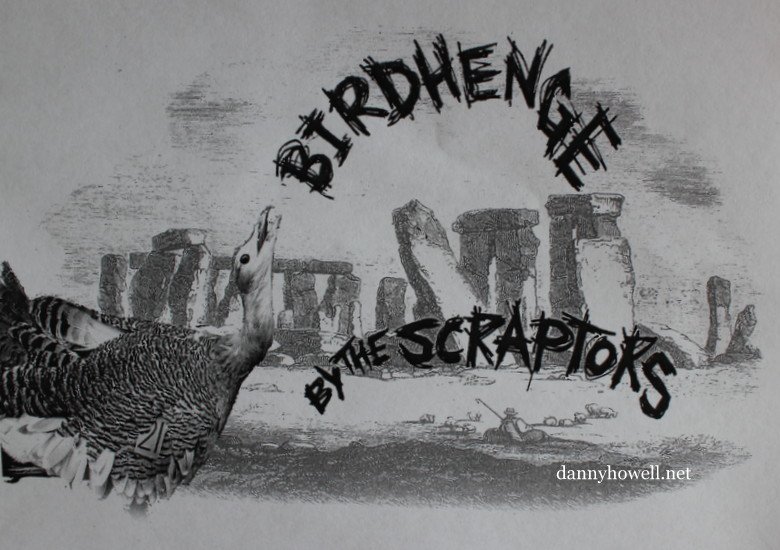
Bird Henge Completed By Scraptors Sculptors At Heytesbury

Tuesday 19th August 2014

Scraptors Sculptors have now completed their Bird Henge installation at Bunters, Heytesbury (albeit for a few tweaks). They are now about to create and publish online their accompanying Bird Henge Ramblers’ Trail, a walk in the upper Wylye Valley taking in nature and history. This will be uploaded to the website of the Cranborne Chase and West Wiltshire Downs Area of Outstanding Natural Beauty. The AONB generously gave a grant towards the cost of the project. To discover more, click here. To follow the Scraptors on Twitter, click here.

Poppies Raised £2,571

31st January 2013

Mary Phillips, Poppy Appeal Organiser, writes:

I would like to thank all of you within Heytesbury, Knook, and Tytherington, who so kindly volunteered to collect for last year’s Poppy Appeal. I am pleased to reveal that the final total for the 2012 collection for Heytesbury, Knook and Tytherington was £2,571.73 which was an increase of £304.03 on last year! As you are all aware this money does a lot of good for our Servicemen and Women and their families, so thank you all once again.

Around Quebec Barn And Knook Castle ~ “Where It Was At In Roman Times”

Monday 26th September 1994

Danny Howell writes ~

Where It Was At In Roman Times

In quest of Roman times, Quebec Farm, north of Ansty Hill, on the road between Heytesbury and Chitterne, was the destination for an afternoon trip by 15 members of the Warminster History Society.

They were in pursuit of Andrew Houghton, the Society’s Honorary Secretary and a teacher at Kingdown School, who is particularly interested in Roman archaeology.

Around Quebec Barn, near the earthwork known as Knook Castle, are banks, ditches, circular platforms, lynchets and the edges of fields which date from the late Bronze Age (the time when Stonehenge was falling into disuse).

Andrew pointed out the sites of two Romano-British settlements, each with its own village street running north to south. People once lived either side of these streets, hence the discovery by William Cunnington and Richard Colt Hoare in the early 1800s of coal, a latchlifter, plaster, and pottery from France.

Strips of nettles in the ditches reveal signs of human activity from hundreds of years ago.

Around the settlements can be seen the remains of field systems. Ridges denoting the edges of early fields and lynchets where ploughing has created steps were visible from different angles.

The edges of the old fields are prominent features at regular intervals in a shelter belt of beech trees straddling the downs. These field edges can also be seen where they cross the track which runs from Quebec to Breakheart Hill.

Several circular flat areas, dug into the slope of the downs, measuring twenty to thirty feet across, are the remains of hut bases. These huts would have been made of timber, mud and plaster. The people who lived in them, between 200 A.D. and 350 A.D. kept cattle and grew grain.

The bleakness of the area and the cold weather made for difficult living conditions. So, why did people live here? It certainly wasn’t for safety, because the country was at peace during the time of the Roman occupation.

There are three possible answers:

1. A large population generally meant that every piece of land, even bleak downland, had to be used.

2. The Roman Government ran the plain as a cattle ranch (there are no stone buildings used by the Romans on the plain; the nearest were at Pitmeads).

3. The tribe who lived here were so nasty to the Romans they were subject to extra taxation, and had to eke out a living by scrabbling in a marginal area.

It really is a case of ‘we don’t know.’ 

Andrew offered another suggestion. Perhaps the area was only used for summer habitation. “This is where it was at for the ordinary person in Britain,” said Andrew. “Their lives are not recorded. These humps and bumps in the landscape and strips of nettles are the visible reminders of their existence. This is far more important to me, the lives of ordinary people, than those of the more noble who lived at Chedworth and other Roman villas.”

A unanimous vote of thanks for an interesting afternoon jaunt was given to Andrew. Next month, in the comfort of the Dewey Museum, Martyn Whittock will give a lecture about King Arthur.

Return Of The Heytesbury-Knook Parish Boundary Marker

September 1993

Danny Howell writes:

The Heytesbury/Knook parish boundary marker which was given to the Warminster Dewey Museum in 1993 by the Highways Department of Wiltshire County Council has been returned to them.

The Warminster History Society, which oversees the Warminster Dewey Museum, had not accessioned it but Graham Zebedee had given it an undercoat as the first stage of conservation.

It transpired that the marker is a Grade II listed monument and should have remained in situ.

Danny Howell had received phone calls about it from the County Council and the Department of the Environment requesting its return.

The Highways Department have reinstated the marker, where it was before, adjacent the road outside Bunter’s Cottage, on the brow of Unicorn Hill at Heytesbury.

Knook

From The West Wiltshire District Guide 1978:

Knook, about a mile east of Heytesbury, is, like Tytherington, probably smaller now than it has been for centuries. The population today is approximately 60, but many years ago there were 300 people in Knook, when many of the weavers and clothworkers of Heytesbury lived there. There are still two weavers’ cottages standing, restored and modernized.

The ancient manor was about 1,250 acres in extent, and its history is confused. Three lords are mentioned as having manorial rights – the Earls of Gloucester, the Lords Bedlesmere of Heytesbury, and the St. Martins, Lords of Wardour. After these names, many others appear as owners or part owners.

Knook now consists of two farms, the Manor House and about 25 houses and cottages. The Manor House, on the banks of the river Wylye, between the river and the church, is a Tudor building of stone with gabled ends, gabled porch and stone mullioned windows, and, since its restoration, is a very attractive house. The range overlooking the river is buttressed and is pre-Reformation; the range with the porch is dated 1637. The house has never been part of a monastery as some have said, but it was for a time divided into cottages.

Bizarre Incidents At East Farm, Knook; Quebec Farm At Chitterne; And Parsonage Farm, Warminster

Arthur Shuttlewood, in one of his books – Warnings From Flying Friends – Flying Saucer Revelations, published by Portway Press in 1968, noted:

It was on Boxing Day of 1967, when farm worker Michael Coleman set off to feed a herd of cows on the hill overlooking Heytesbury, three miles from Warminster, that another example of the bizarre and unworldly sounds erupted without warning, scaring the beasts of the field as well as causing the phlegmatic employee concern.

He had distributed the food to the cattle and, turning his tractor round to face the wind and rain so that his seat would not get too wet, he dismounted from the machine and started to count the animals. Immediately his feet touched the earth, however, he heard a tremendous clatter of noise that shook the sides of the hill and almost made his topple off balance.

It was so unexpected and savage that he clung to the side of his tractor until it subsided. The weird buffeting of soundwaves he termed ‘much like giant hands shaking loads of galvanized sheeting all around. The cattle fled from their piles of food with feet flying and tails in the air. They were terrified.’

Michael pointed out that it was a rarity for cows to run from food, especially in bad weather. After the thunderclaps of noise abated, they were still reluctant to return, taking ten minutes or more to settle back to former equanimity and content.

‘It was funny, though,’ he told me sombrely. ‘Some cattle in the next field, no more than a couple of hundred yards from us, never even flinched.’ This surprised him considerably. They chewed the cud quite happily, unconcerned at blasting sounds nearby. Why?

Perhaps this was an earth tremor, I suggested, but Mr. Coleman was insistent that – although its effects made the ground tremble at its height – the loud sounds originated in the atmosphere. ‘It made my head and ears sing, it was so fierce,’ he told me. The geography of the hill fields supplied the answer.

The sounds were localized in one section; the adjoining field was around a curving slope of the hill. Mr. Coleman then recalled another unaccountable incident back in December of 1961, when he worked for farmer Harry Wales [Henry Wales]. [Quebec Farm]. The employees erected a new fence, digging in sleepers three feet into the ground to act as strainers.

Going to the field the next morning, they found that all the cattle had strayed from their pasture during night hours. The fence had been violently uprooted, the sleepers torn out and littering the area in jumbled confusion. Yet not one of the beasts was hurt and there were no tracks of any vehicle visible around the soil disturbance mounds.

In February of 1962, working for his present boss, Stanley B. Pottow [East Farm, Knook], by the same field only over the boundary, Michael found that a similar phenomenon had again struck one night. The employer thought the fence had been smashed by the impact of a vehicle driving through it.

No tracks of any transport were discovered, however; and no cattle were anywhere near the scene of devastation, so their footprints could not have obscured wheel marks. The tractor driver from Knook thought no more of these incidents, apart from their constituting unsolved minor mysteries, until he read a newspaper report that Geoffrey Gale, of Parsonage Farm (near Cradle Hill at Warminster) had suffered fencing damage in January and February of 1966.

An account of the latter appeared in The Warminster Mystery, precludes to sightings of UFOs with clockwork regularity over Cradle Hill itself, a few hundred yards from the farmhouse lying in the dip before the steep approach.

These happenings all took place in the same area, Michael revealed, practically on a direct line between Chitterne and Warminster. He saw nothing overhead at the material time. Nevertheless, he did experience a nasty electric shock on one occasion, while travelling on a tractor early one morning.

He attributed it to a shorting fault on the machine. Strange climax to this true story is: When the tractor and its engine was thoroughly examined by a specialist, its electrical wiring system was faultless.