Heytesbury – Recollections Of An Old ‘Un

Recollections Of An Old ‘Un
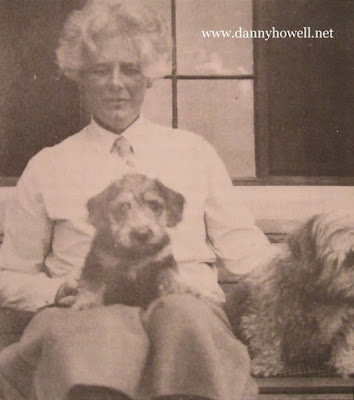
Nancy Bouverie, pictured circa 1930,
with two of her dogs, Whisky and Soda

Miss Nancy Pleydell Bouverie, who died on 30th October 1972, aged 87, and is buried near the north-east corner of Heytesbury Churchyard, left the following written memories, which she called Recollections Of An Old ‘Un. They provide a picture of Heytesbury from 1911 to 1950, a period interrupted by two World Wars, and portray the way life was in the village. This is what Nancy recalled:

“In 1911 we came to Heytesbury, three sisters and a brother and all the furniture. It was carted up from the Station by Mr Pike and his merry men who were such a help that I shall be eternally grateful. Everyone was kind to us young things and when we found that we had everything necessary in the house except matches to light the lamps we went down to Miss Daly’s (now Mr Davis’ shop) who not only provided the matches but offered to light the lamps for us.”

“The first excitement was the arrival of the mail cart from Bath, an old gentleman and his little white dog sitting on the box. In those days Her Majesty’s mail was too precious to be trusted to those new-fangled railways and was transported by horse and coach. The postman came from Bath in the morning, as far as Wylye, and collected the letters on his return in the evening; and the letters were delivered in London the next day without fail and all for a penny.”

“The village in those days was, of course, much quieter, with only the occasional cars going through. We had to amuse ourselves more and there were lots of activities. One activity was polo. Heytesbury had quite a good polo team which played in Mr Osborne’s field. People brought their own ponies and a good time was had by all.”

“There were some funny habits in the village, as there still are; Margaret Lady Heytesbury was a bit of a character and disapproved of the draught in the church, well known to all of us. When it was particularly bad she sat under an umbrella.”

“The declaration of war, in 1914, stands out in my memory. There was only one telephone in the village, at the Estate Office. There was always a large crowd there on August 3rd and 4th, waiting for news. They included an old man called Twabeard, who was so called because he had a two-pronged beard. He became a great friend though I never discovered his real name.” 

“Then the war broke out and we all worked hard in the Red Cross detachment tent in the village; every afternoon we all gathered and weaved straw mattresses for the sick and injured recruits encamped at Sherrington. Otherwise they had to sleep on the ground. We went in rota to wash the sick before they were sent to the base hospital. They appreciated that because the Sergeant-Major only allowed hot water when the ladies came. For the next few years the detachment was dispersed all over the country.” 

“The next great event was the declaration of peace and the joyful celebrations. The highlight was the cricket-match between the ladies and gentlemen. The star of the match was Miss Dolly Maslin (later Mrs Frank Whitfield) who, wearing a very long fashionable hobbled skirt and high heels, ran with a floppy hat in one hand and the bat in the other. She made ten runs (top score) and carried her bat. There was a large bonfire as near the top of Cotley Hill as we had the energy to carry the wood. From the top we could see bonfires on the top of every hill above every village as far as the horizon.”

“The first year that women had the vote was memorable though not at all appreciated by the men folk. Before this they had a great time having magnificent fights protecting their candidates. Old Mr Bill Field told me that he and Mr White, the blacksmith, were escorting the Conservative candidate, Mr Challoner, down the High Street one night and Mr White hit several people whom he could not even recognise in the dark. There were many black eyes the next morning but nobody bore any grudges.” 

“After the War one of my sisters married and we had to move from the Vicarage and we built Bunters and moved there. Bunters was on the site of an old Army camp used during the War and was a jungle of nettles, barbed wire and rubbish. Even now an occasional 1914-18 bottle or bullet is found when ploughing the field next door. We moved, carrying our effects in a horse and cart, assisted by the donkey and cart for carrying odds and ends like chickens, and with a baby donkey running behind.”

“Time passed happily and we came to the Second World War. At the tender age of 55 I was made the head of the Defence Committee, set up to defend the village, composed mostly of old men and useless women. Every able-bodied man had been taken for the army or the Home Guard. We were told that any holes in the road were to be filled immediately. The only labour available was the old men in St. John’s Hospital and the women – willing but weak.”

“There were other precautions. I moved my beehives, under order, near the road so that if the German tanks came I was to tip them over to sting the Germans and hold up their advance. Of more use was the cave dug in the bank and filled with incendiary bombs which were to be thrown into the road when the enemy came.” 

“Heytesbury House was full of revolting biscuits and valuable books from London. There were other large food piles.” 

“In those days Queen Mary was a frequent traveller through the village as she was living at Badminton and I remember that she was once held up in the village street by George Rendell’s cows coming home to be milked. She smiled and bowed to all of us who were waving to her.”

“We had three bombs in the Park which did no damage but the blast behaved in a peculiar way as Bunters, some way from the village, was shaken to the foundations and the walls cracked; but down in the village, Miss Joyce Bartlett thought that a reel of cotton had fallen off the dresser. Three bombs fell by Knook Camp, of  which I still have several bits (quite harmless).”

“I have less dangerous recollections of the war. Some German soldiers walked up and down Warminster Market Place and nobody took the slightest notice; in fact they were Englishmen from the Ministry testing out the alertness of the population.”  

“We were having a Civil Defence exercise once and some joker told the pensioners of St. John’s Hospital that they would not be safe without their gas masks and so they all went down to church wearing top hats, red cloaks and gas masks.”

“Peace came again and life reverted to normal except for more cars and more houses. Great changes have come to the village, some good, some bad. The post takes two days to get to London for four pence but Heytesbury is still Heytesbury.”

Chinn Bros. Ltd., 1922

1922

Advertisement:

Chinn Bros. Ltd.
Warminster & Heytesbury.
Butchers and Fishmongers.
Prime English Beef, Mutton, Lamb, Veal, Pork.
Wholesale and Retail dealers in
Game, Poultry and Eggs.
Best quality only.
Daily supplies of high class fresh and dried fish.
Game of all kinds in season.
Poultry and new laid eggs.
Imported meat of first grades always on sale.
Telephone Warminster 45.
Telegrams: Chinn Bros., Warminster.

Heytesbury – Notes By Edward Hutton

Edward Hutton, in his book Highways And Byways In Wiltshire, written before the outbreak of the First World War, first published in 1917, reprinted 1919, noted:

” . . . Heytesbury. This old town stretched all along the road is a pleasant and quiet place of very great antiquity. The Saxons called it Hegtredesbyri, and the Normans, according to Domesday Book, Hestrebe. For long it played a not inconsiderable part in the history of the county, and sent a member to Parliament; but in 1832 it was disfranchised.”

“In the time of Henry II, Heytesbury was divided into four parts, which belonged to the four families of Dunstanville, Montfort, Badlesmere and Burghersh, but in the time of Richard II the four were united in the hands of the elder Hungerfords, who took their title from the place in the time of Henry VIII. It was as lords of Heytesbury they bought Farleigh Castle in Somerset; but in the troublesome times of the Dissolution they lost the place, and never recovered it. Their old house has disappeared, but the almshouse they founded in 1449 remains, and still bears their arms. It is a charming building of red brick, forming three sides about a court.”

. . . . 

“Heytesbury is a place to linger in, a good centre too for exploring all these downs strewn with barrows and camps, and for visiting these churches and villages of the upper Wylye valley.”

Mr. G. Smith Of Sutton Veny To Fill Vacancy At St. John’s Hospital, Heytesbury

From The Parish Magazine, January 1903:

Sutton Veny. Mr. G. Smith
By the kindness of Lord Heytesbury, Mr. G. Smith, an aged parishioner in the Deverill road, has been selected to fill a vacancy which has occurred by death in the St. John’s Hospital, Heytesbury.

Art In The Mansion At Heytesbury Park

Monday 1st May 1899

Art In The Mansion At Heytesbury Park

John Murray’s Handbook For Residents And Travellers In Wilts And Dorset included the following details for the paintings at Heytesbury House:

On the north side of the town [Heytesbury] is Heytesbury Park, the seat of Lord Heytesbury. Its woods clothe the base of Cotley Hill and sweep in dark plantations of fir to the neighbouring heights. The mansion [Heytesbury House] is modern and perfectly plain, but it contains some fine pictures of the Italian, Spanish, French and Flemish schools, particularly of the Spanish.

In the drawing-room: Guercino: Genius of Painting. Raphael: Holy Family (belonged to Cardinal Mazarin), “an early and careful copy, somewhat hard in form and dark in  colour.” – Waagen. Parmegiano: Christ and St. John Baptist (belonged to Madame Murat). Albano: Cupid bending his bow, a copy from Correggio. Teniers: several. Paul Veronese: Moses in the Bulrushes; the Baptism, elevated in sentiment and powerful in colour. Luca Giordano: Philip II, examining the plan of the Escurial, rich composition, conceived as a          landscape. J. Juannes: good copy of the Ecce Homo by Roger Van der Weyden the younger; (2) Mater Dolorosa, “of portrait-like but noble character, of pale tone and intensely moving of expression, not a copy, one of the best specimens of the early Spanish school I have ever seen.” – Waagen (companion picture). B. Luini: the Baptism. “Among the few pictures on a small scale by the master, this is the most beautiful I know.” – Waagen. B. Schidone: Virgin and Child, with St. John and Joseph. Murillo: St. John and the Lamb. Zurbaran: two masterly pictures of SS. Jerome and Benedict, saints, life-size. Guercino: the Magdalen, “of unusual nobility of form and expression.”

In the ante-room: G. Poussin: a grand mountainous landscape. Zurbaran: St. Francis; (2) a saint.

In the dining-room: A. Cano: the Magdalen. Van Helmont: May Day; Condemnation of a Deserter. Ribera: St. Jerome. G. Romano: Marriage of St. Catherine. Murillo: Virgin and Child, with SS. Joseph and John. N. Poussin: View of Ponte Molle; (2) Herminia seeking refuge with the Shepherds. Claude: two small landscapes, “delicate and clearly coloured works of his best time. ” S. Rosa: portrait of  a man. Zurbaran: the Infant Christ on an ass, with Joseph and St. John, “coarsely realistic in conception, but the heads animated and of masterly treatment.” C. Cignani: Charity. Domenichino: a landscape, with St. John preaching. Vanni: Flight into Egypt.

In the drawing-room is preserved Charles I.’s cap, given by him to Henry Vernon, Esq., of Farnham, at whose house he passed the night on his way to Carisbrooke.

The library contains family portraits of the Ashes and A’Courts; on the staircase are portraits of the Worsleys and Holmes from Appuldurcombe, in the Isle of Wight.

The Shire Stallion Pantaloon

From The Warminster Herald, Saturday 27th May 1893:

[Advertisement] Season 1893. The Shire Stallion, Pantaloon.

Pantaloon, 13430 Vol.13, the property of Right Honorable Lord Heytesbury, will travel the Warminster, Frome, Gillingham, Shaftesbury, Tisbury, Wilton and Salisbury districts this season. Pantaloon has a certificate of Freedom from hereditary unsoundness. Pantaloon has been shown twice and placed 1st and Champion on each occasion. Fees £3 3s. and 2s. 6d. groom. 10s. discount if paid by July 1st. For cards and particulars apply, R.H.H. Eden, Estate Office, Heytesbury, Wilts.

Heytesbury: The Water Works

Tuesday 12th July 1892

From the Warminster Herald, Saturday 16th July 1892:

Heytesbury. The Water Works.

On Tuesday, the 12th inst., [July 1892] Lady Heytesbury turned the first sod on Heytesbury Knoll in connection with the projected Heytesbury waterworks, Amongst those who were present at the ceremony were Lord Heytesbury, Messrs. A’Court, Eden, Charlton, Parker, W.E. Gillard, and Mr. John Wallis Titt, in whose hands the scheme had been placed. The spade used for the occasion was of solid brass, with box wood handle, with the following inscription: “Presented to the Lady Heytesbury, on the occasion of turning the first sod of the Heytesbury Water Works, July 12th, 1892. JOHN WALLIS TITT, Engineer.”

Her Ladyship was evidently highly pleased with the spade, and said she should treasure it all the more because it had been designed and made in the locality, at the Woodcock Iron Works. Lady Heytesbury then cut out the first sod, expressing a wish that “great results might follow from so small a beginning.”

Mr. Titt has fortunately secured the services of Mr. Hobbs, a well-sinker of great experience. In course of conversation the latter said he did not expect to reach water under 250 feet, and that he hoped to have the well sunk in about 3 months.

Mr. Titt’s idea in selecting Heytesbury Knoll is that it is the highest point on the Heytesbury estate. He purposes, when water is found, to sink pumps and erect a wind engine. The high elevation will then serve a double purpose. It will afford the most advantageous site for the reservoir, from which the water will be distributed through pipes by gravitation, and at the same time will tend to relieve the wind engine of purely local inflences, giving it a full and uninterrupted current of wind. It is proposed at first to lay a 3-in. main to Heytesbury House and East and West Hill Farms. It will then be seen that the initiatory ceremony here recorded is the beginning of what promises to be a most beneficent scheme for the adjoining village. It will confer a great boon on the inhabitants of Heytesbury and increase materially the value of the holdings on the estate. We trust the same success may attend Mr. Titt in his efforts here that has earned him so high a reputation for similar undertakings elsewhere.

Trap Accident At Heytesbury

The Warminster And West Wilts Herald, Saturday 11 June 1887, reported:

HEYTESBURY. TRAP ACCIDENT. – Mrs. Gatteral, with whom was Mr. John Pierson, was driving her horse and trap up the High Street, on Tuesday evening, when the animal fell down, throwing the occupants on to the road. Both, however, escaped with only a few bruises, but one of the shafts of the trap was broken off.

error: Content is protected !!