The funeral of Peter Carter was held at Boyton on Wednesday 9th August 2017.
Category: Boyton: People
Painting The View To The West Of Old Tin Shed, Tytherington
Wednesday 1st May 2013Â
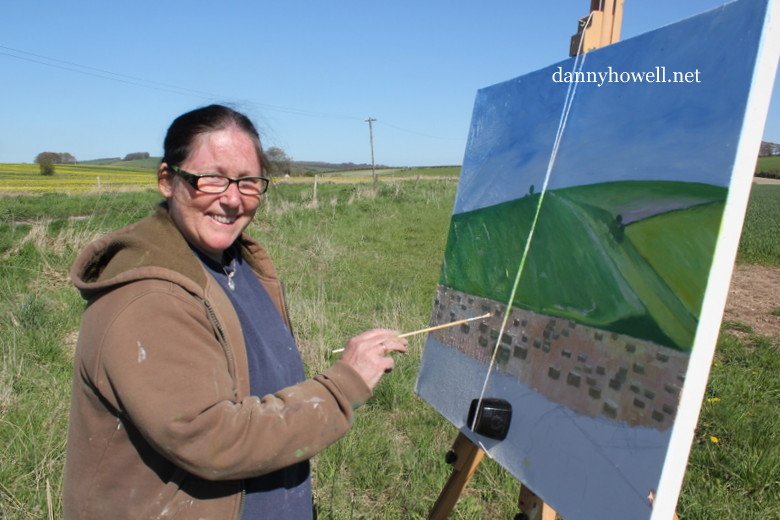
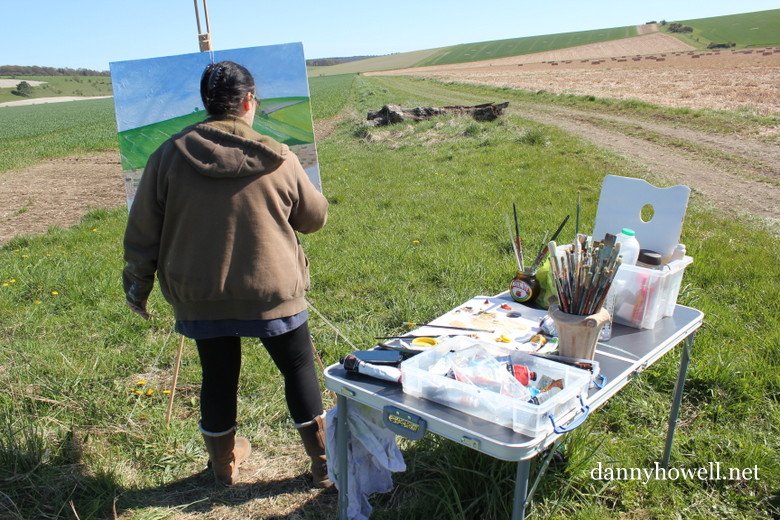
Artist Karen Welsh, from Boyton,
is painting a view of
the landscape near Tytherington.
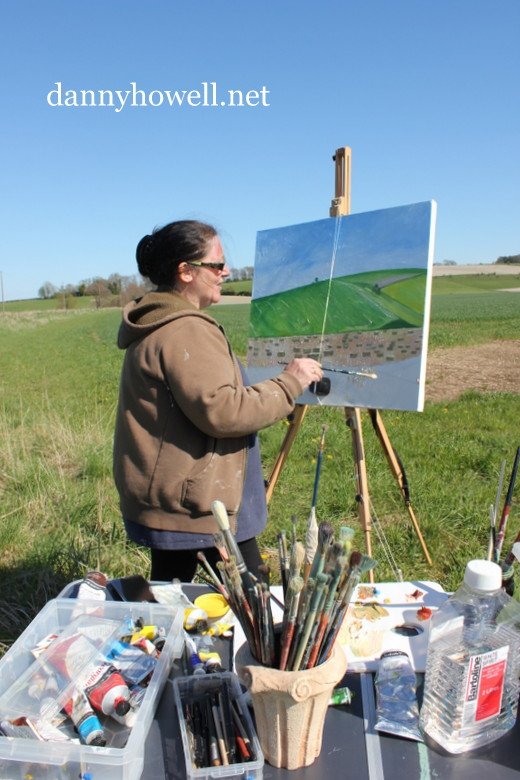
Photographs taken by Danny Howell
on Wednesday 1st May 2013.
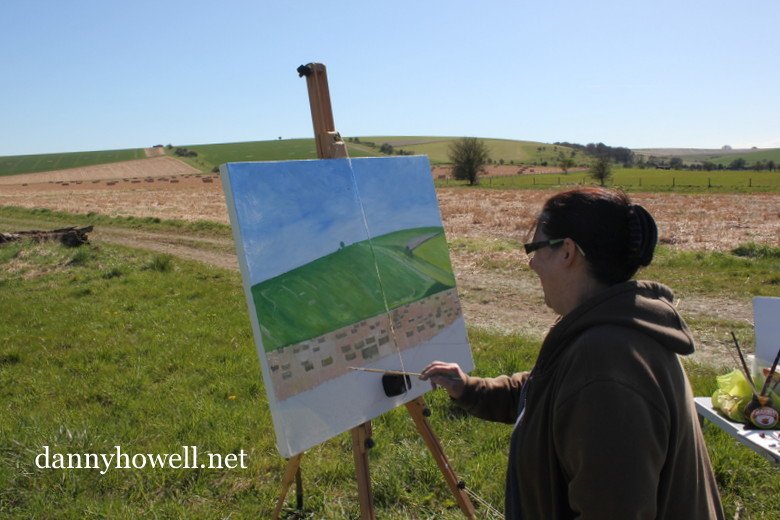
Her chosen subject here is the landscape
across Windmill Piece to the downland,
west of Old Tin Shed, Tytherington.
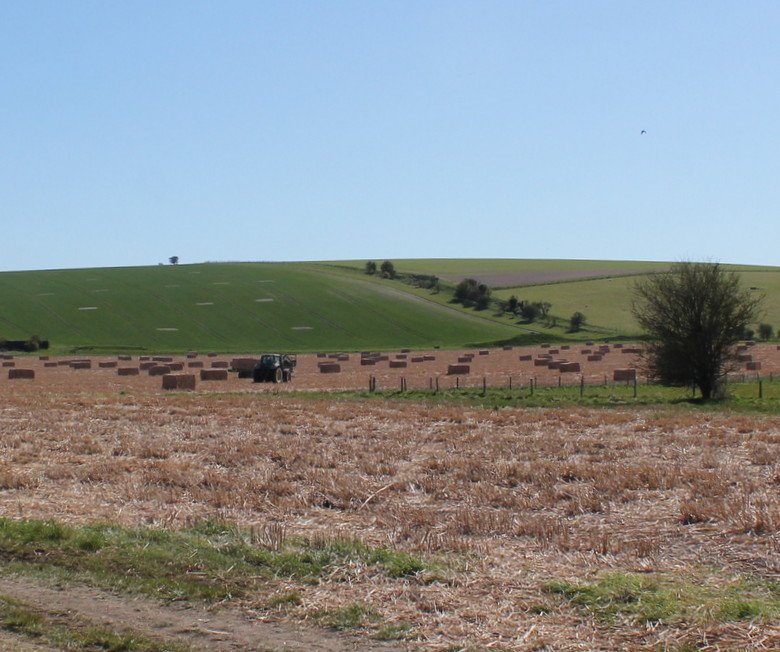
The scene, with bales of elephant grass
below the downland.
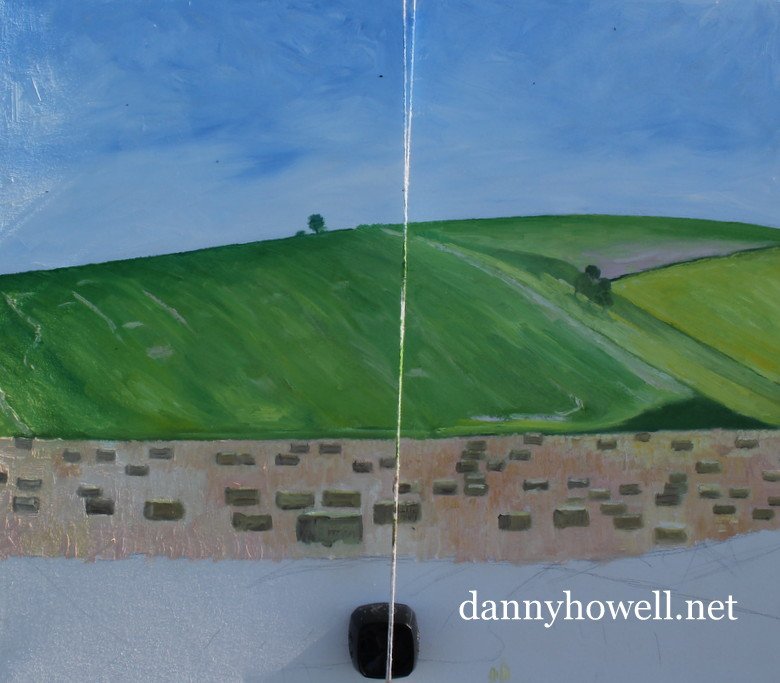
Work in progress.
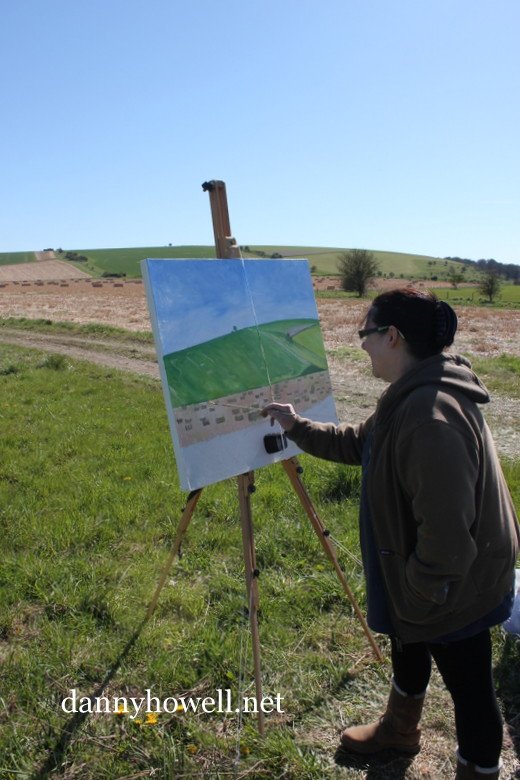
Karen says she moved here from Surrey
two years ago, when she first visited
the bi-annual Wylye Valley Art Trail.
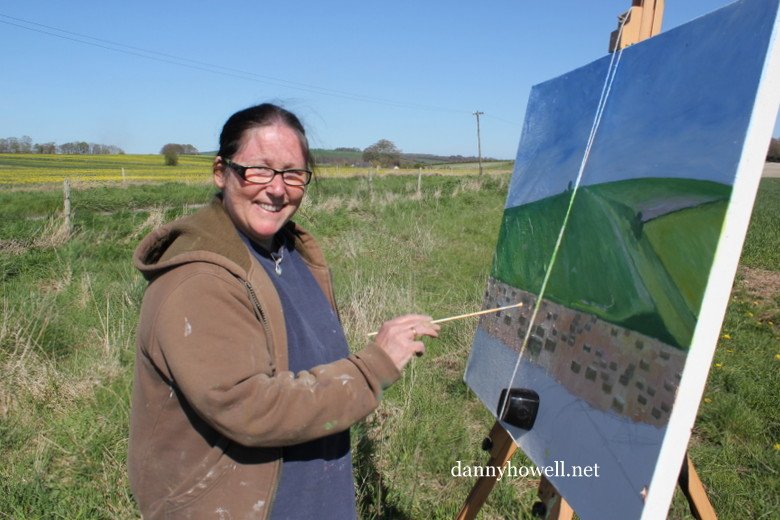
Karen will be participating in this year’s
Wylye Valley Art Trail
(Saturday 25th May to Sunday 2nd June 2013).
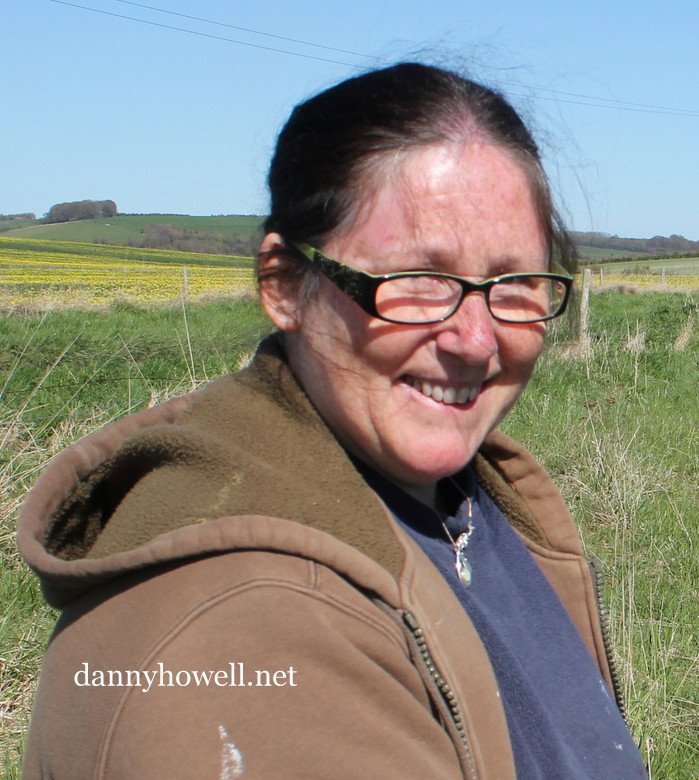
Karen Welsh.
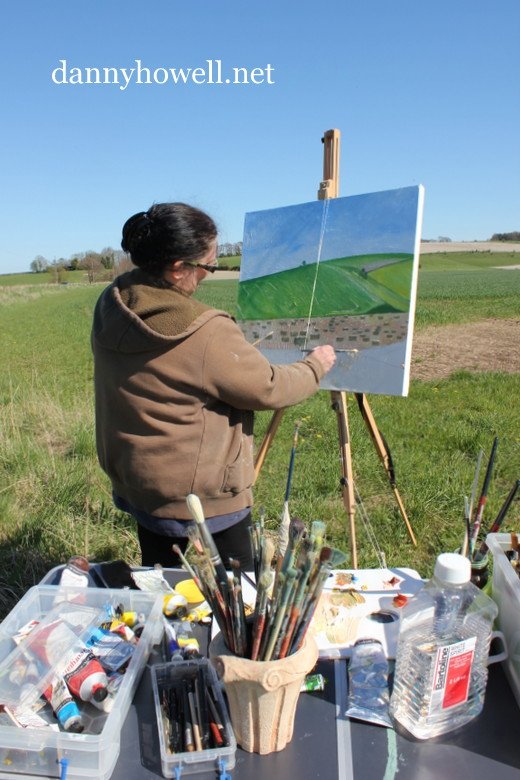
This painting, and others,
including one from Lord’s Hill
(also currently a work in progress)
will be exhibited and for sale
at this year’s Wylye Valley Art Trail.
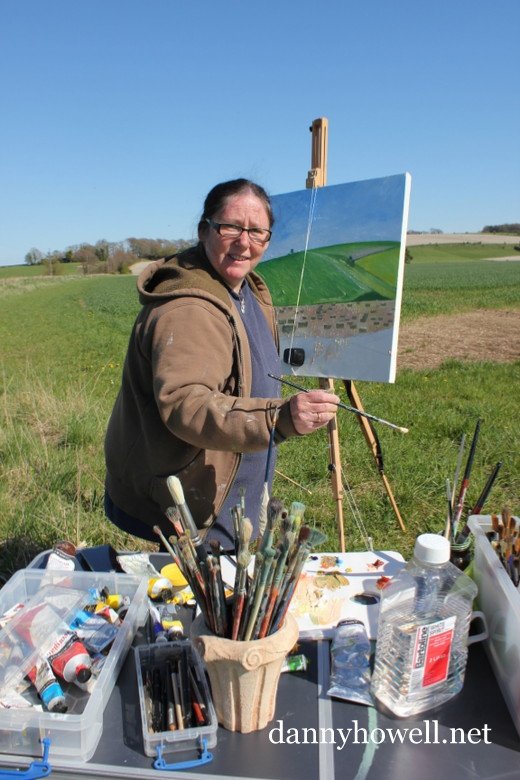
Karen says this particular picture
at Tytherington, being on a large canvas,
will probably sell for about £600.
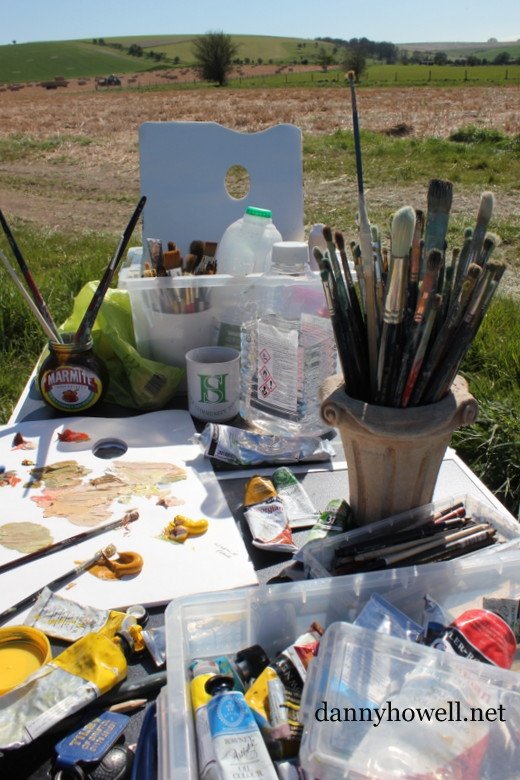
Karen is working here with oil and acrylics.
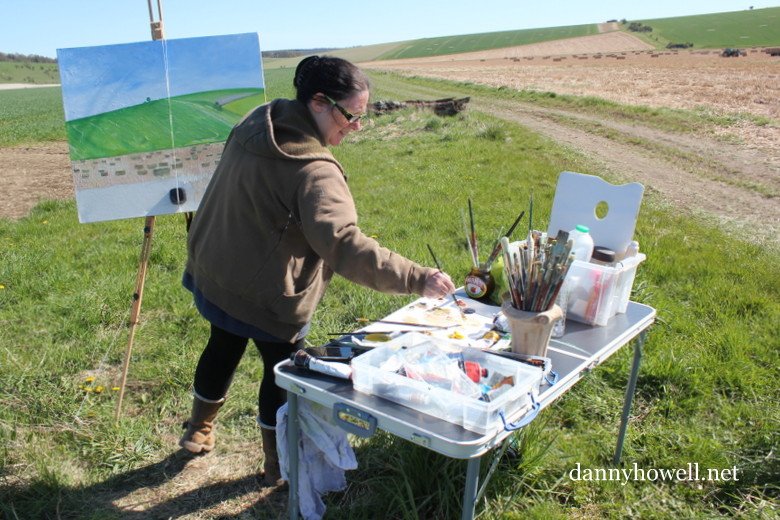
Karen says she is impressed
by “the big sky” over Tytherington.

To find out more about Karen and her work,
visit her website:
www.karenwelshcreativearts.co.uk
Karen may be contacted by email:
karen@karenwelshcreativearts.co.uk
or by telephone: 01985 851058
The Last Lambert Of Boyton
From The Upper Wylye Parish News, March 2006:
Local And Notable – Past And Present
The Last Lambert Of Boyton
Aylmer Bourke Lambert (1761-1842) was born in Bath, the only son of Edmund Lambert by his first wife, the Hon. Bridget Bourke, heiress of John, Viscount Mayo. He was the eighth Lambert to own Boyton Manor since its acquisition by Richard Lambert, sheriff of London in 1572.
He started his natural history collections at Boyton before being sent to Mr. Newcome’s school in Hackney at the age of 12. Many holidays were spent with his stepmother’s brother, Henry Seymer, at Hanford in Dorset. Here he met the botanist Dr. Richard Pulteney, and the Dowager Duchess of Portland, whose herbarium he later purchased.
In 1779 Lambert matriculated at St. Mary Hall, Oxford. He never graduated, but while at university he was introduced to the topographer Daniel Lyons, and shortly afterwards met Sir Joseph Banks and Sir James Edward Smith.
On the foundation of the Linnaean Society in 1788, Lambert became a fellow, and served as vice-president from 1796 until his death. In 1791 he was elected a fellow of the Royal Society and also joined the Society of Antiquaries.
On his father’s death in 1802 Lambert moved from Salisbury to Boyton. He also inherited land in Ireland and Jamaica. At Boyton he amassed a herbarium of c. 30,000 specimens which was freely available for his fellow botanists to study. His own major work, “A Description of the Genus Pinus”, published in seven parts between 1803 and 1807, with engraved plates by Ferdinand Bauer, was one of the most lavish botanical books ever produced. A second volume, largely the work of his curator and librarian, David Don, was published in 1824. The gardens at Boyton were celebrated for the variety of their species of Pinus. He collected specimens from around the world, including material gathered during the Ruiz and Pavon expedition to Chile and Peru 1778-1785. In 1789-1790 he went to Connaught and met the Irish botanist Patrick Browne who gave him a list of the plants of Mayo and Galway. Amongst his own botanical discoveries was Salix Lambertian, or the Boyton willow.
In 1814 Lambert was corresponding with the Empress Josephine’s gardener, M. Bonplan, about a visit to England to collect plants. The latter wrote: “Je vois avec peine que votre maison est a 100 milles de Londres . . . . .”. The Empress took calomel one morning before showing Napoleon the grounds of Malmaison. She died of a violent chill within 48 hours of Bonplan’s letter. Bonplan told Lambert that the Empress had been planning to move to England.
Among Lambert’s many friends was Sir Richard Colt Hoare of Stourhead, who mentions him in his “History of Wiltshire”, and gives an abbreviated catalogue of his collections. Lambert allowed Colt Hoare’s excavator, Mr. William Cunnington of Heytesbury, to open the barrows on his land, including the long barrow at Corton.
Towards the end of his life Lambert moved from Boyton to Kew Green for the sake of his health. Here he was looked after by his servants, Mary Evans and Elizabeth Richards, for whom he endeavoured to make provision in his will. His wife, Catherine, daughter of Richard Bowater of Allesley, Warwickshire, predeceased him. They had no children. In his will he offered his herbarium to the British Museum provided that they paid his debts. The offer was declined, and, sadly, his collection was auctioned and widely dispersed. He died a bankrupt. Boyton passed to his sister, the wife of John Bennett of Pyt House. Their daughter, Lucy, married Arthur, son of General Sir Henry Fane. Barbara, Comtesse de Brye, the mother of the present owner, was previously married to Captain Edmund Fane.
Aylmer Bourke Lambert died on 10th January 1842 at Kew. He is buried at Boyton, allegedly in the ancient crouched position. His memorial stone lies in the Giffard chapel in front of the altar. Sir Richard Colt Hoare described his friend as: “A gentleman well known in all our learned societies, and justly celebrated for his researches in botany and Natural History, and for his liberality in communicating knowledge and information.
(A more detailed article on Aylmer Bourke Lambert, F.L.S., F.R.S., F.A.S., by Dr. Michael J. Allen and Maria Mayall is in preparation for the Linnaean Society and Wiltshire Archaeology Magazine).
Death Of Maria Aldrich
Wednesday 1st July 1857
Death notice in the Warminster Miscellany (a monthly publication).
July 1857
On the 12th ult., at the Rectory, Boyton, Maria, wife of the Rev. Pelham Stanhope Aldrich, Curate of the above parish.