Will Carling Baptised At Bishopstrow

On a wall, in the corner near the font in St. Aldhelm’s Church, Bishopstrow, there is a framed and glazed Baptism Roll. Handwritten on the roll, which features a coloured illustration, are over 160 names and baptism dates. Among them for the month of March is ‘William David Charles Carling, 13th ’66. (13th March 1966, which was a Sunday).

We all came to hear a lot about Will Carling later on when he was involved in rugby union, particularly including when he was Captain of the England rugby union team (he was England’s youngest captain, aged 22). He won 72 caps from 1988 to 1996, captaining England 59 times. Under his captaincy, England won the Five Nations Grand Slam in 1991, 1992 and 1995, and reached the 1991 World Cup final.

According to Wikipedia and other online sources, Will Carling was born at Bradford on Avon (presumably in the maternity hospital there) on Sunday 12th December 1965. Will’s mother is Pamela J. Carling (nee North). Will’s father was Lieutenant Colonel Bill Carling (William Derrick John Carling), an officer in the Welch Regiment (which later became the Royal Regiment of Wales).

The Welch Regiment was stationed at Brooke Barracks, Spandau – Berlin, Germany from April 1961 where their duties included guarding the prisoner Rudolf Hess. The battalion on its return to the United Kingdom in 1963 became the Demonstration Battalion at the School of Infantry, Warminster, stationed first at Netheravon and then at Knook Camp, before becoming the first occupants of the newly re-built Battlesbury Barracks, Warminster in 1965. For its final overseas posting the battalion moved to Stanley Fort on Hong Kong Island in June 1966. It then amalgamated with the South Wales Borderers to form the 1st Battalion the Royal Regiment of Wales in June 1969.

Many Warminster residents will recall the Welch Regiment when it was stationed here – and remember its mascot: a goat called Taffy.

Annual Fete At Drayton’s School, Bishopstrow, 1960

The Annual Fete at Drayton’s School, Bishopstrow, on Wednesday 6th July 1960, was opened by Mr J.F.C. Brown, the Headmaster of Lord Weymouth’s School, Warminster. He was introduced to the children and parents by Mrs Rosser-Rees, the Headmistress of Drayton’s School. Her Grace, the Duchess of Somerset, presented the prizes to the children who won the various competitions.

Fancy Dress Competition
(under 7 years old):
David Hall-Tipping and Paul Dunstan.
Judges: Mrs Peter Wakefield and Mrs Luce.

Fancy Dress Competition
(over 7 years old):
Juliet Anley and Susan Arter;
Jane Carpenter and Verena Maguire
(as a jockey and horse).
Judges: Mrs Peter Wakefield and Mrs Luce.

Painting and Handwriting:
Janice Alford;
Richard Main;
Virginia Greville;
Susan Everidge;
Angela Marks;
Jane Carpenter;
Sarah Underwood.
Judges: Lady Nicolson, 
Mrs Bennett-Shaw and Mrs V.J. Robinson.

Cake Competition:
Vanda Sergison;
Margaret Banbury,
Jane Carpenter;
Penny Day.
Judge: Mrs White of Corsley.

Collection of Wild Flowers:
1st, Anthony Kenney Herbert;
2nd, Michael Brake;
3rd, Christina Burridge.
Judge: Mrs Hopcroft.

Essay Competition:
Susannah Read.
Cordelia Mayall.
Judge: Miss Morris, Headmistress
of Trowbridge High School for Girls.

The fete was a success and raised £145. No expenses were taken out by the organisers. A cheque for £100 was sent to The League Of Pity, and the remaining £45 was sent to The Relief Fund of the Monmouthshire Colliery Disaster (the disaster occurred the day before the fete).

A Princess At Sweetland Cottage, Bishopstrow

Valerie Keun married the Italian artistocrat Prince Don Livio Guiseppe Borghese in Smyrna 31 August 1901 but they had divorced by 1912. Don Livio Borghese died in Athens on 26th Nov 1939. During WW1 Don Livio was in exile in the UK and worked as a radio operator and after the war became an attache for Italy. Pr Valerie Borghese [nee Keun] died in Catania 31 Jan 1956.

Bishopstrow: Account book, Including List Of Those Qualified To Vote In The County Elections, 1830-1936

The Wiltshire And Swindon History Centre, at Cocklebury Road, Chippenham, Wiltshire, SN15 3QN, holds the following document(s):

Bishopstrow. Account book, including list of those qualified to vote in the county elections. 1830-1936. Reference PR/Bishopstrow: St. Aldhelm/621/14.

Notebook Containing A Record Of The Inscriptions Of Memorial Tablets And Brasses In The Church, Bishopstrow

The Wiltshire And Swindon History Centre, at Cocklebury Road, Chippenham, Wiltshire, SN15 3QN, holds the following document(s):

Notebook containing a record of the inscriptions of memorial tablets and brasses in the church, Bishopstrow. Compiled by the Rev. G.H.S. Atwood in 1903, and supplemented by the Rev. H. Johnson in 1927-1929. Reference PR/Bishopstrow: St. Aldhelm/1705/7.

The Bishopstrow Alphabet

Friday 25th February 1927

The Bishopstrow Alphabet

A successful entertainment was held at the Parish Room (the former school), in Bishopstrow, on the evening of Friday 25th February 1927.

It was a fundraiser for the Parish Room and was organised by Miss Alice Heath (the Secretary of the Parish Room Committee). Not only did Miss Heath organise the event, she also wrote a poem The Bishopstrow Alphabet which she recited as part of the programme. The poem mentions the surnames of many Bishopstrow residents and hints at some of their occupations, traits and  appearances. The poem is reproduced at the end of this article.

It was reported that great interest was taken in every one of the items featured in the programme and that all the performers “belonged to the village” and “acquitted themselves in a most creditable manner.” Mrs Erskine and Mrs Arnold played the  musical accompaniments.

At the end of the evening, Miss Heath thanked all who had so wholeheartedly helped to make the entertainment so successful and enjoyable.

THE PROGRAMME
Mouth Organ Duets: Mr Garrett and Mr Payne.
Song: The Airman: Mr. F. Garrett.
Sketch: The Unwilling Witness: Mr Long and Mr Payne.
Song: When You And I Were Seventeen: Mrs Rogers.
Recitation: The Scout’s Death: Mr Everley.
Song: The Egg: Mr Roberts.
Sketch: Women’s Rights And Men’s Wrongs: Mrs Long, Mrs Stevens and Miss Maslin.
Song: I Want To See The Old Home: Mrs Willis and Miss Snelgrove.
Reading: Mrs Wiggs Of The Cabbage Patch: Mr Earle.
Song: The Bluebird: Miss Fitz, Miss Mills and Miss Whatley.
Sketch: Kitchen Rebellion: Mrs Garrett, Mrs Millard, Miss Pearce and Mr Roberts.
Reading: The Bishopstrow Alphabet: Miss Heath.
Mandolin Solo: Killarney: Mr A. Long.
Monologue: Defective Memory: Mrs Erskine.
Songs by members of Bishopstrow and Boreham Women’s Institute.
Sketch: Impossible Perkins: Mrs Francis, Miss Bush and Miss Parham.
Conclusion: God Bless The King.

The Bishopstrow Alphabet
A is for Arnold, with tall famil-y;
that they’ll have luck with their poultry I’m sure you’ll agree.
B’s for Bush, Barber, Butcher, Bazley, whom we now  miss;
but for reasons of health she cannot help this.
C is for Club, where the men love to go,
they say they don’t gossip, but don’t they? Ho ho!
D is for Doughty, whose brother is Tim,
he sits on his doorstep and plays his mel-o-din.
E is for Erskine, Earle and Everley;
put the thatch on the barrow and take to Eastleigh.
F is for Francis, and also for Fitz;
one’s rather reserved, t’other sends you in fits.
G is for Grist and for Garrett, one tall and one short;
he keeps the Room’s yard clean, and’s a jolly good sport.
H is for Heath, whom on Sundays you meet;
she’ll be begging for funds soon for her Sunday School treat.
H is also for Haskell, and Hiscock as well;
living close, oh! how oft they must hear the Church Bell.
I is for Institute, in which members take pride;
it’s genial Secretary lives at Hillside.
J is for Johnson, with wife slim and tall;
I’m sure that he has the good wishes of all.
K is for Kimber, the postman you know;
he takes letters to Deverill, and not Bishopstrow.
L is for Legg, who comes round in his float;
he’s merry and jovial, and has always a joke.
L is also for Long, but it’s nothing of the sort;
there’s some mistake here, for the family’s short!
M’s for the Moore’s, Maidments, Maslin and Millard;
four of the five are jolly good diggers.
N is also for neighbour; so let you and me;
always show a good spirit and be neighbourly.
O is for Olphert – the Major you know;
he scans you, on parade, right from head down to toe.
P is for Payne, but contrary to papers;
they don’t need a back ache – they all cut such capers!
P’s for Pearce too, and Parham, both stalwart and tall;
one’s family has done very much for this hall.
Q’s for quiet, which men say the ladies can’t keep;
they can as well as men, any day of the week!
R’s for Rogers and Roberts’es one two and three;
two are quite good serving afternoon tea.
S is for Stevens, one tall and one short;
one tends to the horses, the other seals corks.
S is also for Snelgrove, you quite seldom meet;
that’s easily explained – he’s on t’hills with his sheep.
T is for Temple, the Lord of the Manor;
if you ride without lights, he’ll fine you ten tanners!
U is the uniform of Nurse of the Association;
if you don’t all join it you are surely mistaken.
V is the Vanity which both sexes possess;
men are quite full of it – women much less!
W’s for Willis, who doesn’t live far;
he may well be quite proud of his horses and car.
X is for (e) Xpenses we all try to meet; in Home,
Parish Room, Church, and for poor in the Street.
Y is for You who are present tonight;
it’s a pleasure to see you all so happy and bright.
Z stands for Zebra, with coat black and white    . . . . . . . . .
My alphabet’s finished; so I wish you “Goodnight”
A.H.

Footnote: Alice Heath’s copy of The Bishopstrow Alphabet is now in the possession of Danny Howell.
A Plaque In St. Aldhelm’s Church, Bishopstrow ~ In Memory Of Henry Raymond Wansey, M.A.

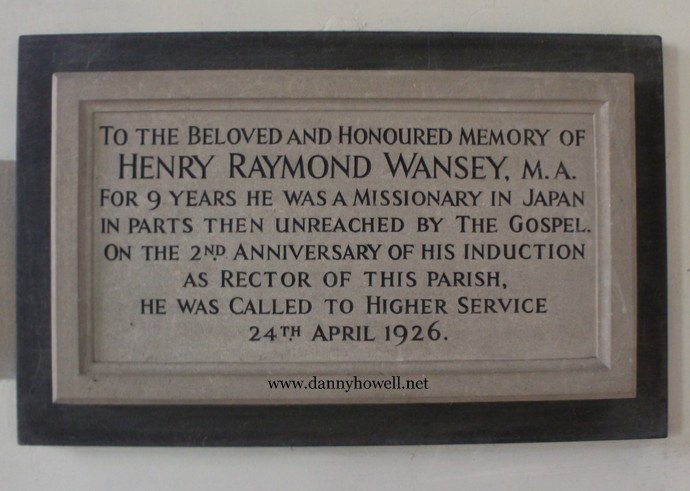
A plaque in St. Aldhelm’s Church, Bishopstrow:

“To the beloved and honoured memory of
Henry Raymond Wansey, M.A.
For 9 years he was a missionary in Japan
in parts then unreached by the Gospel.
On the 2nd anniversary of his induction
as rector of this parish,
he was called to higher service
24th April 1926.”

Photograph taken by Danny Howell
on Saturday 25th June 2016.