
Monday 6th October 2025
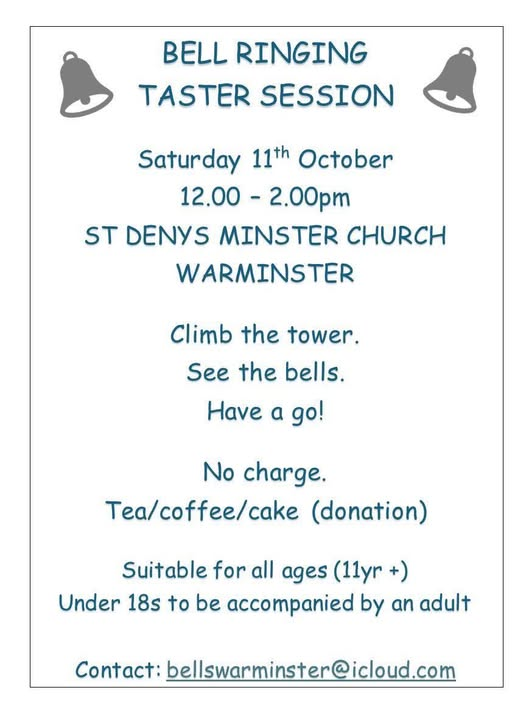
Bell Ringing Taster Session at the Parish Church of St. Denys, The Minster, Warminster, on Saturday 11th October 2025, 12 noon to 2.00 p.m.
email: bellswarminster@icloud.com
Monday 6th October 2025
Bell Ringing Taster Session at the Parish Church of St. Denys, The Minster, Warminster, on Saturday 11th October 2025, 12 noon to 2.00 p.m.
email: bellswarminster@icloud.com
Some notes gleaned from the Warminster Herald:
There was formerly in Warminster a bell foundry of considerable repute. During the greater part of the eventful 17th century – probably from about 1610 to 1710 – this bell foundry carried on somewhat extensive operations in what was then known as the Common Close, but is now simply known as The Close.
From about 1620 to 1686, the name of the proprietor of this foundry is mentioned as John Lott. Whether there were two John Lotts we have no means of knowing, but it seems improbable that the foundry was managed by one man for over sixty years. In 1707 we hear of a Richard Lott, under whom, however, the foundry does not seem to have flourished. He recast the great bell of Warminster Church in 1707 for £46, but it appears not to have lasted long, for thirty years later the present Tenor was supplied by Abel Rudhall of Gloucester, for £190.
John Lott cast or recast the old bells hanging in Warminster Tower in the 17th century. He also cast the great bells at Chippenham and Frome, besides many other bells great and small in the county and neighbourhood of Wiltshire.
The following entries are in the Church books of Churchwardens’ payments (which commenced in 1567), at Frome Church. Amongst these items are the following entries relating to Warminster:-
“1621. Payd Richard Cockey of Warminster, the Pewterer, for casting of 8 Braces of the Bells which was 86 lbs of brass – 43/-.â€
(In 1621 it appears that the Frome Churchwardens went to Warminster, to a Mr. Richard Cockey, for bell casting. About a century later the Warminster Churchwardens went to Frome to a Mr. Wm. Cockey, and paid him fourteen guineas for casting a bell. Later on he cast two other bells for the Warminster Church. Probably these individuals were related).
“1633. Payd John Lott for casting two Bells £22 1s. 0d.â€
(As will be seen by the price, and by the agreement below, these bells were only recast. The Tenor did not last long, but, as will be noted, had to be recast in 1662. It featured upon it a coat of arms, and the inscription, “1662 I Lâ€, between the I and the L was John Lott’s trade mark, a curious representation of a very primitive-looking bell. The other bell [the Fourth Bell] featured upon it the original date of its first casting, for it noted the following inscription in large uncouth letters: “I AM HEE FOR IOTH LOTT MADE MEE ANNO DOMINI 1624.†This second bell featured an elaborate embossed design, containing the Prince of Wales’ Plume, and the motto “Ich Dien.â€).
“Payd for expenses at Warminster and at Frome when the Bells were cast £1 9s. 0d.â€
“Payd Rogers and John Biss for carriage of the Bells from Warminster, £2.â€
“Payd for hanging the Great Bell and mending the Stocks and Brasses, £2 12s. 8d.â€
All the bell metal appears not to have been used, as the following entry occurs in the same year:-
“And the said Churchwardens, R. Whitechurch and W. Hackett, doe acknowledge that they have in their hands, belonging to the parishioners of Froome, fowre hundred and 16 pounds of Bell mettle, which mettle they doe promise to give up into the hands of the parishioners of Froome upon demande, or the uttermost value thereof.â€
The contract for casting these Bells is entered in a wrong page of the Church book, and among the charges for 1648, but is dated 1632, as follows:-
“The Parishioners of the Psh. Of Frome bargaineth with John Lott of Warminster, Bellfounder, for the new casting of their tenor and the fourth Bells now in the Tower there. He is to cast them ruleable and tuneable, to go with and sounde in perfect and tuneable manner with other three bells there. He is to have twenty pounds of lawful money of England for casting the said Bell as foresaid. He is to be allowed two pounds and a half for waste of each hundred of mettle that he doth cast. He is to take down the said Bells out of the said Tower; to hang them up again out of his owne charge; for performance hereof to give security to the said Parishioners when he doth take downe the said Bells out of the said Tower. In witness the said John Lott hath hereunto sett his hand this 27 day of May of the Raine of our Sovereign Lord Charles that is now King of England. Anno Do. 1632. Witness hereunto:- S. WHITECHURCH. JOHN LOTT. R. STYLES.â€
As mentioned before, these Bells were paid for in 1633, but the Tenor cracked again in 1662, and at this date are the following entries:-
“To Mr. Avery for drawing a bond and articles about the grete Bell, 8/8.â€
“Spent at waiting the grete Bell, 10d.â€
“Spent in beare the daie that the Bell was hanged, 1/-.â€
“Paid John Lott the fourth qr. for the new casting of the grete Bell, and new mettall, as appears by his resaite, £19 3s. 4d.â€
This sum being almost as much now for one bell as he had in 1633 for casting two bells, when the contract was for £20. In 1882 it was recorded that the bell in Frome Tower was in good condition, was signed John Lott, and weighed 36 hundredweight.
In 1633 the new bell appears to have been brought into requisition upon the important occasion of Charles the Second’s visit to Longleat:-
“Paid the Ringers when his Majestie came through the Towne of Longleate, 20/-.â€
Later on is the following entry:-
“Paid for Ringing the grete Bell at Christmas, 2/6.â€