1922
Advertisement:
Marshman & Son,
Corn, Seed, Cake and Forage Merchants.
Warminster, Heytesbury and Frome.
Telephone: Warminster 10. Frome 52.
Established over half a century.
Information and pictures for trade, industry, and occupations in Warminster.
1922
Advertisement:
Marshman & Son,
Corn, Seed, Cake and Forage Merchants.
Warminster, Heytesbury and Frome.
Telephone: Warminster 10. Frome 52.
Established over half a century.
1922
Advertisement:
Miles & Son,
Wholesale Butter, Margarine, and Egg Merchants.
English Butter a speciality.
Phone: 118 Frome. Send P.C. for Price List.
Frome & Maiden Bradley.
1922
Advertisement:
Chas. Harding,
Coal and Wood Merchant.
Best Household and Steam Coals supplied at Market Prices.
General hauling.
20 West Street, Warminster.
1922
Advertisement:
Corsley Wagon Works
(White and Whitmarsh).
Builders, Wheelwrights, Smiths, &c.
Carts, Drays, Floats, Vans, Wagons, Lorries,
built to order with good materials and workmanship.
All repairs at moderate prices.
Funerals furnished.
From The Warminster & District Directory And Local & Village Guide For 1922:
Boot and Shoe Factors –
Alfred Beaven, 5 Silver Street, Warminster.
Co-operative Society, 32 Market Place, Warminster.
Walter Henry Dodge, 6 George Street, Warminster.
Frisbys Ltd. (M.E. Sane, manager), 40 Market Place, Warminster.
Mills & Son, 28 and 29 East Street, Warminster.
From The Warminster & District Directory And Local & Village Guide For 1922:
Bakers and Confectioners –
Edwin John Butcher, 21 Silver Street, Warminster.
Co-operative Society (M. Bush, manager), 32 Market Place, Warminster.
Oliver Charles Cundick, 33 Bread Street, Warminster.
Ernest Thomas Dodge, 1 and 2 Fore Street, Warminster.
Charles James Holloway, 3 Chapel Street, Warminster.
John Frederick Lines, 27 Boreham, Warminster.
Payne & Son, 9 George Street, Warminster.
Ethelbert Phillips, 33 High Street, Warminster.
Albert Edward Sharp, 8 East Street, Warminster.
Charles William Turner, 17 Brook Street, Warminster.
John Henry White, 43 East Street, Warminster.
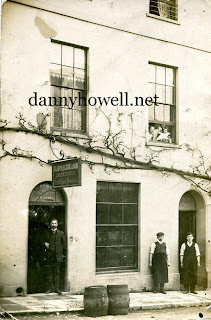
Ed Brooks has very kindly contributed the above photograph
to dannyhowellnet.
It shows Applegate’s, who ran an off-licence and
sold beer at Weymouth Street, Warminster.
The photo could have been taken between 1905 and 1925.
Applegates of Trowbridge purchased this Warminster business
from W.P.T. Wyld during March 1905.
In 1919, the owners of the building, the Longleat Estate,
put the property up for sale (it was still let on a yearly tenancy
to Applegates) and in 1929 Mr. J. Ethell took it over.
The premises became the Bunch of Grapes public house.
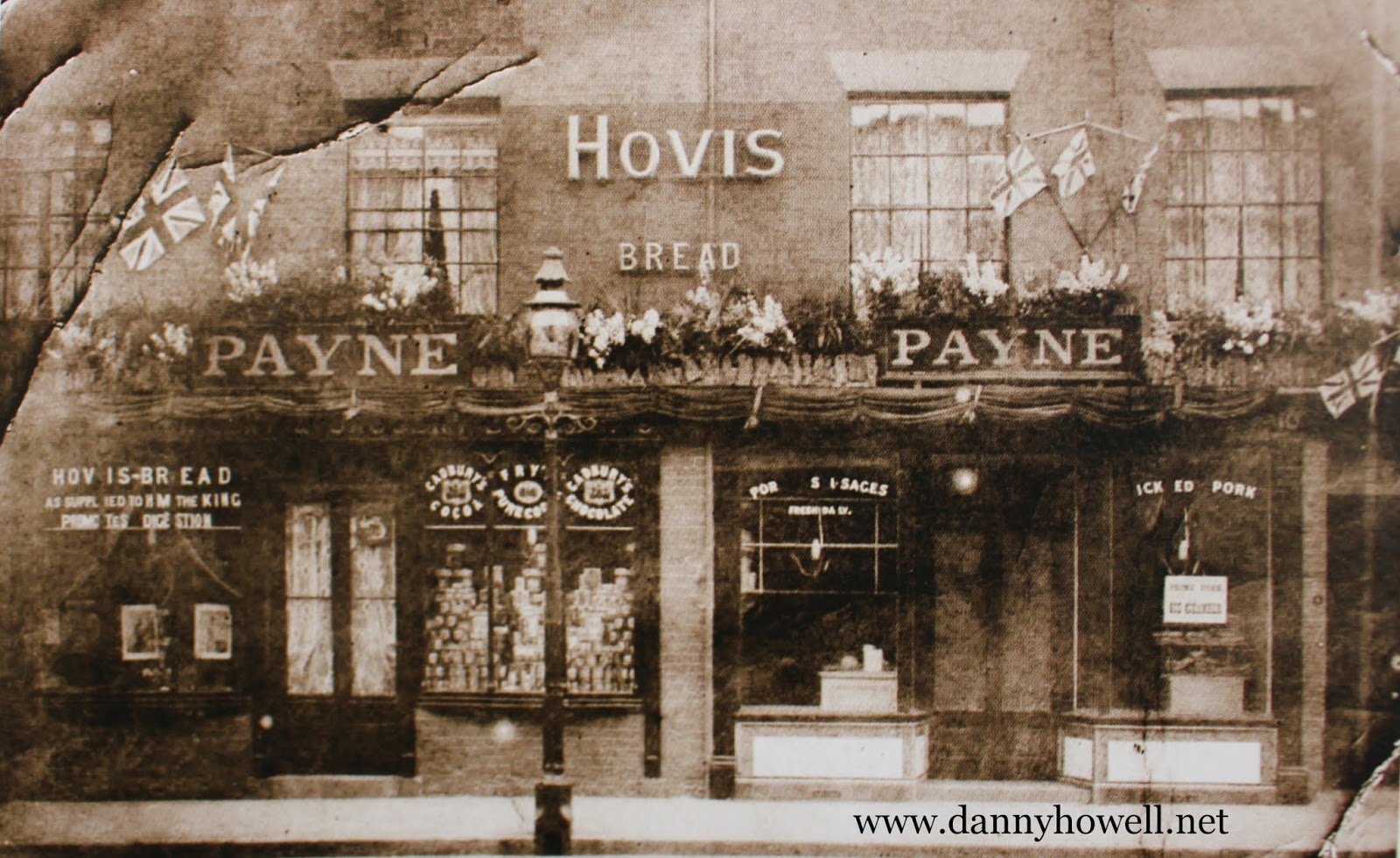
Photograph taken in June 1911 showing
William H. Payne’s
bakery, confectionery, grocery,
pork butchery and bacon curing premises at
9, 10 and 11 George Street, Warminster.
(No.11 was later demolished to give greater
access to the rear of the property).
Signs include: “Hovis Bread, as supplied to
the King, promotes digestion” “Cadbury’s Cocoa”
“Fry’s Cocoa” and “Cadbury’s Chocolate”.
“Pork Sausages Fresh Daily” “Pickled Pork” and
“During Summer Months all meats
stored in Ice Chambers”.
The Payne family lived on the two floors
above the shop. Their steam bakery was in a
building in the yard at the rear.
The family also had another shop at
Chapel Street, Warminster Common.
Flags are flying above the shop windows,
celebrating the Coronation of King George V
(Thursday 22nd June 1911).
It was announced during the early part of June 1910 that “Mr. David Waddington, the popular and esteemed auctioneer, whose offices are in the Market Place, Warminster, has owing to the continued development of his business taken his son, Mr. D.H. Waddington into partnership.”
Written by Danny Howell and first published in Warminster And District Archive magazine, No.3., Summer 1989.
The Boreham Road Foundry, Warminster, was established during the 18th century by the Dutch family. It was situated within a triangular piece of land, between Boreham Road and Smallbrook Road. The latter, which connects the western end of Boreham Road with Chain Lane and Gipsy Lane, was once known as Dutch’s Lane because it ran alongside the southern boundary of Dutch’s Foundry. In the late 1880s it was referred to as Foundry Lane but is recorded as Smallbrook Road on an 1887 Ordnance Survey Map.
Benjamin Dutch is the only smith and mill-founder listed in the Warminster entries of Barfoot & Wilkes Directory, 1793-98. Although the information is unconfirmed, some local people believe that the Dutch family were responsible for the manufacture of the iron parts used in water-meadow hatches in the Wylye Valley.
A recent trip by the Warminster History Society to Manor Farmhouse, Codford, led to the discovery by Society member Danny Howell of a piece of Dutch’s work. A huge fireplace in the western part of the house (believed to be the oldest part) features a bread oven – the door of the oven is inscribed “B. Dutch, War”, obviously for Benjamin Dutch of Warminster.
Among the more unusual items Benjamin Dutch produced were iron coffin-shaped grave covers; examples of these can be still be seen in local churchyards. Indeed, Benjamin Dutch’s own grave in the south churchyard at Christ Church, Warminster, is marked in this way. He died in October 1852, aged 70 years. Following Benjamin’s death, the Foundry was run successfully for the next twenty years by his wife, Mary, and son, William.
William Dutch died on 1st April 1872, but is not to be confused with another William Dutch buried at St. Leonard’s Churchyard, Sutton Veny. The latter’s grave is marked by an iron coffin-shaped tomb cover and this was probably made at the Boreham Road Foundry.
On William’s death, the Foundry business was purchased by Edmund Collins, who publicised his acquisition by placing a notice in the Warminster Herald, dated 20th April 1872. It reads: “DUTCH’S IRON AND BRASS FOUNDRY, BOREHAM ROAD, WARMINSTER. E. COLLINS BEGS respectfully to inform the Nobility, Gentry, Agriculturalists, and General Public of Warminster and the surrounding neighbourhood, that he has succeeded to the above old-established business, carried on for many years past by the late Mr. Wm. Dutch, and for three-quarters of a century previously by members of the same family. The foundry has always been celebrated for its productions in Agricultural Implements, its Machine Fittings, and for general Jobbing Work. E. Collins has had large experience in the above branches of the trade, and especially in the repairing of Fixed and Portable Engines, Thrashing and other Machines; in all kinds of Boilers, Kitchen Ranges, Stoves, Hot and Cold Water Apparatus, Palisading, Pumps, Cisterns, and general Plumbing Work. The business will be opened on WEDNESDAY, the 1st of MAY. Moderate Charges and strict Punctuality.”
Edmund Collins ran the Foundry for 20 years, during which time he moved to a new site, further east, on the same side (south) of the Boreham Road, nearly opposite the Non-Conformist Cemetery. His yard and outbuildings are currently occupied by the transport/haulage business of F.S. Gibbs. The old Foundry site was redeveloped – a terrace of red brick houses (Nos.8 to 14 Boreham Road) were built there in 1887. Another house, on part of the site, number 16, is named Jubilee Cottage (1887 was Queen Victoria’s Golden Jubilee year).
Collins’ staff, were no doubt hard workers, but they knew how to enjoy themselves too, as the following item from the Warminster Herald, dated Saturday 21st July 1883, shows: “EMPLOYEES’ OUTING TO WEYMOUTH – On Monday last Mr. Collins’ workmen at the foundry, Boreham Road, proceeded to Weymouth by the excursion train, in company with the members of the Young Men’s Society and Mr. W.F. Morgan’s Bible Class, on the occasion of their annual outing. After doing the sights of that pleasant watering-place, and enjoying a good dinner, the party took the steamer for Portland, where they visited the convict establishment. Tea was provided at Portland, and the return to Weymouth made, where boating in the Bay was indulged in. After spending a very pleasant and enjoyable day, Warminster was eventually reached at 9 pm.”
Alfred J. Pope, who lived at Hillside, Imber Road, Warminster, purchased the Foundry from Collins in 1892. He considerably developed and increased its resources. By the turn of the century the Foundry specialised in repairs to traction engines and agricultural machinery; the work being carried out either on the premises or where necessary on the farms. Pope was responsible for the manufacture of hundreds of agricultural implements, particularly ploughs, harrows and rollers; and he also acted as agent for the sale of farm machinery made elsewhere. General engineering plus brass and iron founding were carried out; a speciality being the casting of heavy metal parts for large turret clocks. Among this work, which was done to fulfil orders both in this country and abroad, was the making in 1900 of four clock faces, each four feet six inches in diameter, with figures cast in, for export to South Africa. Another speciality undertaken during Pope’s time at the Boreham Road Foundry was the casting of iron plates, about four feet by three feet, and half an inch thick, for colliery floors. A consignment of these, weighing four tons, was despatched from the works to the coal mines at Clutton in 1900.
The September 1900 issue of the Pictorial Record featured an article on Mr. Pope’s Boreham Road Ironworks. It included “Warminster contains several businesses that would be by no means unimportant in their several spheres even were they situated in the largest centres of industry, and it is a well known fact that work can often be done more economically in smaller places than in large ones, while the quantity of so-called “country’ craftsmanship is often far above that of large manufacturing towns. At any rate we feel that we are making no mistake in describing the Boreham Road Ironworks, now conducted by Mr. Alfred J. Pope, as a good representative of its class of trade. The works are of good size and a considerable number of men find constant employment here, but what principally strikes the visitor is the complete manner in which the place is equipped with machine tools and foundry plant. Everything necessary to the production of the best work is at hand, and the equipment is constantly being brought up to date to render it more effective.”
Alfred Pope’s name was, at the turn of the century, visible on many of the manhole covers and drainage grids in the streets of Warminster; Pope having secured the contract to supply the Urban District Council. Two of Pope’s manhole covers/drains can still be seen today – both to the south of 3 Emwell Street, one in the pavement and one in the road, near the junction with Vicarage Street.
Other work by Pope originating from the Boreham Road Foundry was the making, supply and installation of heating apparatus. The Foundry’s proud boast was “copper pipes supplied instead of galvanised iron”, and Pope became well-known for the radiators he installed in the greenhouses and homes of some of Warminster’s wealthy residents. The churches at Stockton and Brixton Deverill were two of the many places Pope supplied with heating equipment.
Pope remained in business until c.1899 (listed in Kelly’s Directory of Wiltshire for that year but not in the subsequent Kelly’s, 1903). Pope’s successor at the Boreham Road Foundry was Herbert W. T. Roberts. He also specialised in drain covers and several of these still survive in Warminster – at least three are visible at North Row, one outside the front door of number 24, one in front of V. Preller’s Dental Surgery at number 30, and another in the road near the northern end of the rank of new houses known as the Stables. All feature the wording “H.W.T. ROBERTS, WARMINSTER.”
Herbert Roberts joined forces with a Dorset engineer called Hole in January 1903. They announced their partnership with an advertisement in the Warminster & Westbury Journal, Saturday 3rd January 1903: “BUSINESS ANNOUNCEMENT – We wish to announce that the business of Mr. H.J.G. Hole, Water and General Engineer, of Poyntnigton [sic – Poyntington], Sherborne, Dorset, has been amalgamated with that of Mr. Herbert W.T. Roberts, General Engineer and Iron Founder, etc., of Boreham-road Ironworks, Warminster, at which address the combined businesses will be carried on. The firm will be known as Messrs. Hole and Roberts, and they trust that customers will continue their kind patronage in the future as in the past, which they will use every endeavour to deserve by careful and prompt attention to any orders received. Advt.”
Hole and Roberts’ work continued to include manhole covers and drains, and there are also examples of these surviving in Warminster. Unfortunately, the Hole and Roberts’ drains at Pound Street have just been replaced (April 1989) following remarks by the prospective (and later successful) Liberal Candidate, Steve Dancey, that they were dangerous to cyclists. The new replacement drains are functional and no doubt safer, but of little interest to the local historian, compared to their predecessors.
The range of Hole and Roberts’ work was quite extensive, if their entry in Kelly’s Directory for Wiltshire, 1903, is to be believed. It lists them as “iron and brass founders, wind engine manufacturers, waterwork engineers, agricultural implement and cycle and motor manufacturers.” Work was certainly undertaken for some of the water-boards in London but Hole and Roberts possibly put “all their eggs in one basket” because when these contracts expired they had to put their workforce on short time and rumours began. The Warminster Journal, having heard the rumours, on 8th July 1905, reported: “TRADE IN THE TOWN. There was a rumour in the town last week that Messrs. Hole and Roberts, Boreham Road, were closing their premises and suspending their workmen for a month; but on inquiry of the firm we find that the rumour was like the Westbury reservoir – there was nothing in it. It appears that in the foundry department a good deal of work was done for some of the old London water boards. These boards having been taken over by the central organisation formed under the new Act, this particular work has for the moment ceased, and there is some slackness in the foundry, which will result for the present in short time being worked.”
As the old saying goes, “there’s no smoke without fire” and just over a year later the rumours became fact. The Warminster Journal, 6th October 1906, regretted to announce “owing to slackness of business, the firm of Hole and Roberts have closed their works, in Boreham Road, and discharged their hands, of whom a dozen were employed.” A fortnight later the Journal was asked by Mr. Roberts, with reference to the closure of his business, to state “that it was not through lack of work but through Mr. Stratton leaving the neighbourhood, and withdrawing his interest in the firm.” Mr. Stratton, presumably was involved with the business and was no doubt the only one with the wherewithal or the finance to keep it going through a bad patch, which he was not prepared to do. We can only speculate on that but the iron-founding trade at the time, like so much of Warminster’s former prosperity was in decline. One of the town’s other foundries, the Wiltshire Foundry, at Carson’s Yard, which had been extremely successful for 87 years, in the hands of Carson & Toone, had passed to Messrs. Turner & Gray in 1903 but they too had to close down in 1909. Another Warminster iron foundry, that of Thomas Petherbridge, behind the Rose & Crown Inn at East Street, also met its demise. Warminster’s involvement in commercial iron founding was totally extinct by 1910.