Living In The Same House – At Woodcock, Warminster – For 75 Years

Saturday 1st October 2011

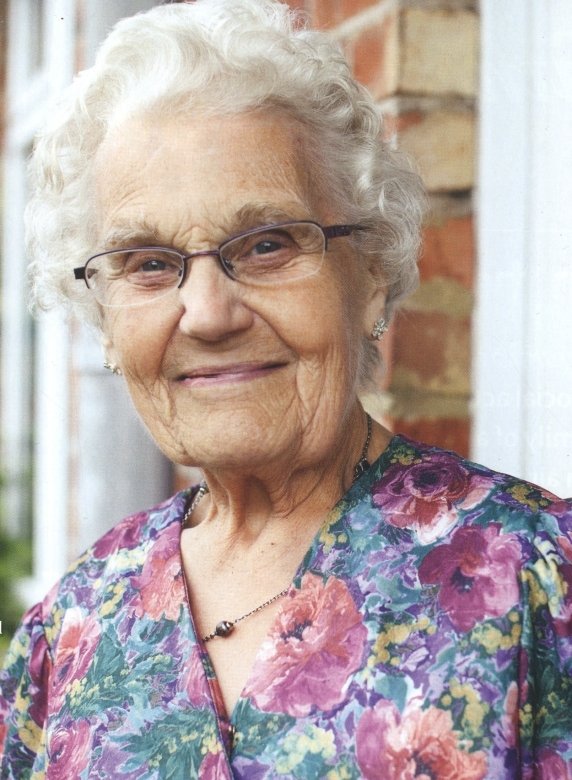
Gwen Taylor, nee Curtis, has lived at Woodcock Road, Warminster, for seven decades – reason enough for her to be featured in the Autumn/Winter 2011 issue of Working Together, the magazine for tenants and residents of the Selwood Housing Association (Gwen’s landlords since 2001). The following words and photographs are reproduced from that magazine ~

Gwen outside the home she has lived in 75 years.

Home Sweet Home
They say home is where the heart is and that’s certainly the case for Gwendoline Taylor. She’s still living in the same house after 75 years!

When Gwen was born in 1928 things were very different to how they are now. Of course there weren’t any televisions, mobile phones or computers but you might be surprised to hear that for the first few years of her life she didn’t even have a bathroom!

“Our old house was very small,” says Gwen. “Just a bedroom and a landing. My brother Jesse had the landing, and mum, dad and I slept in the bedroom. We had to share toilets and wash-houses with the other families,” she continues. “One Christmas my brother caught scarlet fever from the drains and had to go to hospital. But we were happy – you get used to these things.”

A new beginning
At the age of eight Gwen was excited to hear that the council were building the family a new home in Warminster – with a bedroom each for her and Jesse and an indoor bathroom all of their own! “We often came down to see how they were getting on,” Gwen recalls. “We couldn’t wait to move in.”

The new house was a massive improvement, but things were still pretty basic back then. “We never had a washing machine, so on a Monday mum would fill the bath with water, light the copper up and do the washing,” says Gwen, who was 32 when the family bought their first black and white television. “But we did have a radio. We listened to Mrs Dale’s Diary and Children’s Hour with Uncle Mac.”

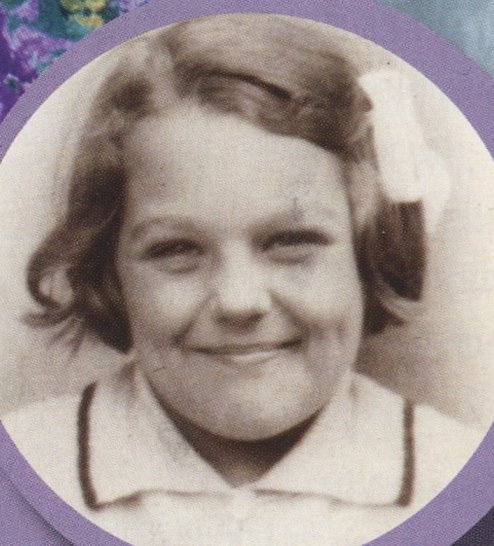
Gwen, aged eight, at St. John’s School, Warminster.

Times may have been tough but Gwen has very fond memories of her childhood – especially the new family home. “The house was really lovely. We had Michaelmas daisies and dahlias at the front and the back garden was all vegetables.”

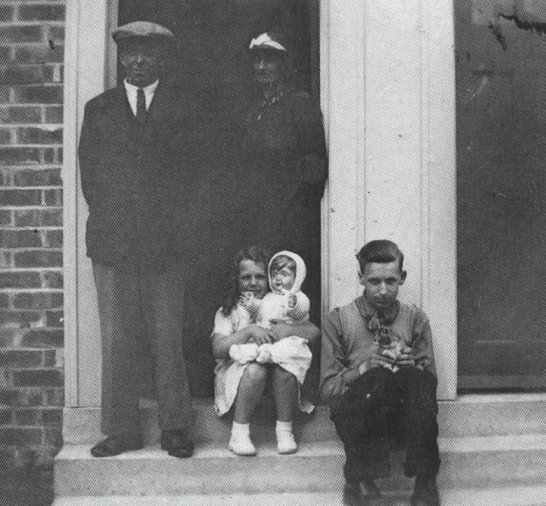
Gwen sitting on her front doorstep with her parents and brother Jesse.

And she couldn’t have wished for a better neighbourhood. “There were nearly 50 children in the 12 houses here but we never quarrelled – we were like one big happy family. We’d play out back – chucking balls in an old tin bath, skipping, and sometimes on a Saturday morning we’d go to the pictures – if mum could spare the sixpence.” 

Holidays were unheard of. “Our only outings were Sunday School trips, once a year – usually to Weymouth or Weston-Super-Mare. We looked forward to them very much,” Gwen says with a smile.

“And, of course, every Sunday we went to Chapel and then for a family walk round Southleigh Woods.”

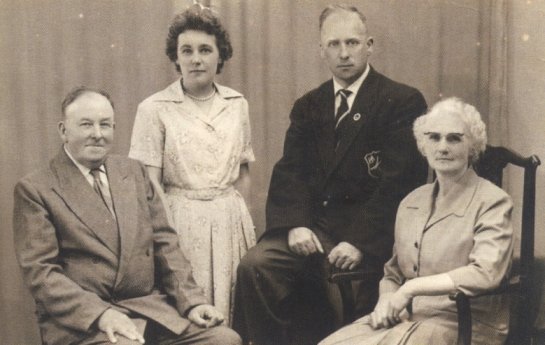
The Curtis family in 1960.

Passed down from generation to generation
Growing up, Gwen would never have guessed she”d still be living in the same house nearly 80 years down the line. But after her father sadly died in 1975, his wife Mary took over the tenancy and her daughter stayed in the house and became her carer. Gwen met her husband Wilf in 1982 and after marrying he too moved into the family home. “When mum passed away in 1988 my husband and I took over the tenancy, and when he died in 1995 I took it over,” Gwen explains.

This was the first time Gwen had ever lived alone – but she says she’s never felt lonely in the house she shared for so many years. “I’ve had a happy life – I couldn’t wish it any different.”

“There’s been lots of changes over the years,” Gwen adds. “Shops disappearing, people in and out of houses. But I don’t think I could settle anywhere else now – not after all this time.”

There’s no place like home
Indeed, Gwen’s house is bursting at the seams with memories, from her parents’ furniture and family photos, to nik naks and keepsakes from her past. “I like it like that,” she says. “In fact, I wouldn’t change anything about my home.” Although the house itself has had a few major alterations over the years.

“In 1973 they knocked down the downstairs bathroom, made the kitchen bigger and put a bath, toilet and washbasin upstairs,” Gwen recalls. Since becoming her landlord in 2001 Selwood has also installed central heating and a new gas fire. Not forgetting other adaptations throughout the property to help Gwen maintain her independence, and enable her to live in her home for hopefully many more years to come.

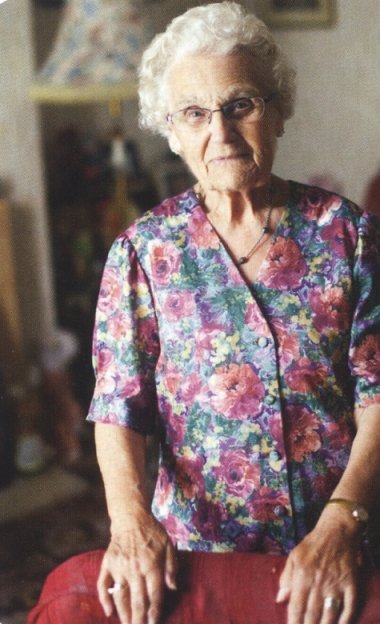
Gwen inside her home at Woodcock Road, Warminster.

“Someone said to me recently: ‘Gwen – once you give up your house you won’t be here long.” She pauses. “I think they’re probably right. There’s so many happy memories here – I’d like to stay here as long as I can.”

Captain Arthur Austin Taylor

From The Illustrated Warminster And District Miscellany, May 1996. Compiled by Danny Howell:

Captain Arthur Austin Taylor
One of Warminster’s best known personalities, living in the town for over 50 years, was Captain Arthur Austin Taylor. He was known by many local men because they served with him in the Old Volunteers and the Territorial Army. His life was devoted to the Army and it was his boast that he had enjoyed every minute of it.

A native of Chippenham, Arthur Taylor ran away from home when he was 16 to join the Army. His parents were greatly upset because the Army in those days was not always looked upon as an honorable career. His long years of service were spent entirely with the Wiltshire Regiment, first with the Regulars and later, as before mentioned, with the Old Volunteers and the Territorials.

As a boy he had never heard of Warminster and eventually learned of it through his growing interest in county affairs. It was, therefore, coincidence when he was appointed Regimental Sergeant Major in the Old Volunteers and was posted to the town. He had been greatly interested in a law case relating to the building of the house where he finally lived – Berry Villa at West Street – and from what he could ascertain there had been a dispute between a builder called Gaisford and another Warminster resident called Lucas. The latter had been responsible for building Berry Villa by direct labour (Lucas had also built the rank of houses on the opposite side of West Street: Jubilee Terrace, commemorating the Diamond Jubilee of Queen Victoria) and the case had gone to court. A Mr. Tanswell was called as a witness and his evidence weighed strongly in favour of his employer, Mr. Gaisford.

At the outbreak of the Boer War in 1898 Arthur Taylor went to South Africa as R.Q.M.S. It was there that he first met the Earl of Radnor, who was later to command the 4th Battalion the Wiltshire Regiment during the First World War. It was after returning from South Africa that Taylor came to Warminster, to carry out his duties as Regimental Sergeant Major to the Old Volunteers.

He lived at Crockerton for a short while but then moved to 7 Market Place, Warminster. When Berry Villa at West Street came on the market he bought it from James Bartlett, the Sambourne School Headmaster. Bartlett had been a sergeant in the Old Volunteers and a close association had been formed between the two men.

Patriotism ran high among the Old Volunteers, no more so than with the Feltham family of Chitterne. Captain Taylor proudly recollected the sterling work of Jimmy Feltham, who had a record of volunteer service which was second to none in the whole of the country. Jimmy’s two sons followed him. Ev was one of the first volunteers to go to the Persian Gulf in 1915 and he eventually gained the D.C.M. Geoff remained with the Regiment and rose to the rank of R.S.M.

Captain Taylor, recalling the old Volunteer camps, said that at one at Aldershot they were all thrilled by a visit from Lord Roberts, who was then the Commander in Chief of the Army. He was a Boer War hero and the visit was marked with great celebrations. Many of the camps were held on the downs near Warminster.

When Taylor retired from the Regular Army in November 1911, the occasion was marked with the presentation of a clock and an address to him from the Sergeants’ Mess. The following day he was gazetted as Lieutenant Quartermaster to the 4th Wiltshire Regiment and with that rank he went to India in October 1914. He was promoted to Captain Quartermaster in 1917, during his service in Palestine, and he was the last of the officers to leave that country at the end of the First World War. He retained his interest in the Territorials until the age limit necessitated his retirement.

Of the olden days in Warminster Captain Taylor said West Street was much noisier before the First World War. Saturday nights were always rowdy and there always seemed to be family quarrels for people to sort out. The big event in the neighbourhood was the Whitsuntide festivities at the Cock Inn. The Cock emblem, which was known as the ‘bird’ was taken from its ‘perch’ and carried in a procession through the town and afterwards there were sports held in a field where the houses at Princecroft now stand. On Guy Fawkes Night there were always torchlight processions to the old Fair Field at Station Road, where it was the usual custom to burn an effigy of whoever was the most unpopular person in Warminster at the time!

Freemasonry was Captain Taylor’s chief interest in his civilian days. In 1952 he was the oldest, by age, of Warminster’s freemasons. He was primarily responsible for the establishment of the Royal Thynne Chapter and carried out its secretarial duties in the office of Scribe E for over 20 years. Ill health forced his retirement from the Longleat Lodge. Captain Taylor was also a prominent member of the Athenaeum Club and he also enjoyed gardening. A Nonconformist he attended the Congregational Church in the Close for many years.

Captain Taylor’s wife, Mary Louisa, was formerly a Miss Hailstone of Devizes. She was the eldest daughter of Issachar and Martha Hailstone, who lived at 35 and 36 The Butts (the Crown Grocery Stores), Devizes. Issachar Hailstone was a cooper, born at Woodborough, Wiltshire; and Martha was born at Stanton, Wiltshire.

Arthur Taylor and Mary Hailstone were married by the Rev. J.E. Doubleday at the Wesleyan Chapel, Devizes, on 23 May 1890. The Rev. Doubleday was obviously very neglectful in his duties because he didn’t bother making an entry in the Wesleyan Chapel’s marriage register for Arthur and Mary. The register also shows that he didn’t always fill in all the necessary details for other couples he married. The registrar didn’t fare much better either. He should have been present at weddings to sign the register, but his name is also missing from several entries!

Mrs. Taylor took no part in public affairs in Warminster, preferring to look after her home and family. She eventually suffered a long illness and in August 1943 she moved to Yeovil, to be cared for by her eldest daughter, Mrs. Millicent Steadman. An operation in September 1943 left her bedridden for the rest of her life. She returned to Berry Villa and was nursed by her sister Mrs. Fruen and Nurse Spiers. Mrs. Taylor died at Berry Villa on Thursday 30 December 1943. She had asked for no mourning and no flowers and was cremated privately at Arnos Vale, Bristol. The service was conducted by the Rev. J. Stacey, the Methodist Minister of Warminster.

Captain and Mrs. Taylor had seven children: Mrs. Millicent Steadman, as previously mentioned, was the eldest of the family and lived at Yeovil. Her husband was Captain Steadman and they had three children; Arthur Taylor, was born at the Curragh Camp and lived at Trowbridge; Harvey Taylor, who was a school teacher, moved to Swansea (he married a local girl, Miss Binden, who was also a school teacher); Stanley Taylor, who lived at Trowbridge, was a Relief Stationmaster with the Great Western Railway; Mrs. Winifred Carter, was born in the Wynberg district of South Africa and lived at Swindon. Her husband had served with Captain Taylor throughout the First World War, was mentioned in despatches and awarded the M.B.E.; Mrs. Gladys Dicks, who lived at Crockerton (and whose children were born at Berry Villa), was the wife of Mr. J. Dicks, the engineer at the Waterworks at Crockerton; and Ethel, who died in Australia, had three children who survived her there

Captain Taylor employed a housekeeper, Miss Gilbert, after his wife’s death and he described her as “an angel.” After indifferent health for some years Captain Taylor died in March 1956. He was 86. His funeral was held at the Methodist Church, George Street, Warminster, and was followed by cremation at Bristol. The service was taken by the Reverend F. May, who was assisted by Captain Taylor’s grandson, the Reverend John Taylor. Jesu, Lover Of My Soul, a favourite of Captain Taylor’s, was one of two hymns sung at the funeral. At Captain Taylor’s request there was no mourning and no flowers. In an interview made in February 1952 he said he hoped there would be “No moaning at the bar when he put out to sea.”

The Toones In Canada

From Warminster And District Archive magazine, No.2, Spring 1989:

In November 1987 Archive Editor Danny Howell published in book form his researches into the Wiltshire Foundry, which was situated during the 19th century at Carson’s Yard, on the south side of East Street, Warminster. The Foundry, which had been in the hands of Hugh Carson since 1816, passed into the sole-ownership of his son-in-law John Vidler Toone in 1880. The Toone family continued to run the Wiltshire Foundry until January 1903, having emigrated to Canada the previous autumn to take up wheat farming. The change was prompted by William Carson Toone’s health.

At the time of the book’s publication, Danny Howell knew little of how the Toones fared with their new life in Canada. He knew they took up residence at Maryfield, Saskatchewan, but was not sure whether any of descendants were still alive. Needless to say, news of the book soon spread to Canada and Danny received letters, photographs and documents with regard the Toone family from William Carson Toone’s descendants. He also received information from a Maryfield family who remembered the circumstances that the Toones experienced on first arriving on the prairies. A lady living in Basingstoke, who was a cousin of the Toones, also responded.

So much so, that Mr. Howell could probably write a sequel to his book. A follow-up about the Toones does not seem imminent, so Archive now features, by permission, some of the post-publication information received. The following articles are, therefore, intended as a postscript to the book (which should ideally be read first).

Mrs Freda Page, nee Smith, of Box 354, Maryfield, Saskatchewan, SOG 3KO, wrote to say that her brother, William Smith, and his wife, live in Maryfield; and that the Smiths and the Toones were neighbours for many years.

William Smith, who is now 88 years old, told Mrs. Page: “I remember Mrs. W.C. Toone, her son W.H.C. Toone, and Ellen Toone. They were left by the man who had brought them from Elkhorn, Manitoba, at an old deserted house, if you could call it a house. This was 22 miles south-west of Elkhorn, into Saskatchewan. One day my father was combining by this old house and saw that people were living there. He called in to see who they were, as there were very few people in this area then. The house was just a shelter overhead, no doors or windows in place, just openings. My father invited them to come home with him and stay at our place till they could get something better.”

“My dad and mother’s place was very small, a kitchen and living room in one, and a bedroom with a curtain across the center to make two rooms. It was very crowded with five adults and two children; anyway they made do as those first settlers did. Toones stayed until fall or October. My dad sent Bill (William Toone) out to harrow, when he finished he asked what he could do, so my father sent him out to harrow it over again.”

“The Toones finally found a house that two bachelors used to have, they fixed this up and lived there all the winter. Bill made a sleigh that he pulled by hand and used it to haul willows. The willows grew around the sloughs. He cut them by hand and used them for wood to help keep them warm. Next Spring the Toones built a small house, and a few years later they built a bigger and better house. In the meantime they had broken up some land and were growing a small crop. Conditions today are a far cry from 85 years ago (1903).”

Mrs. Page and her husband, George, took some photographs of the Toone cemetery in Maryfield, noting that Mrs. W.C. Toone is not buried there. Nor was Mrs. W.H.C. Toone. Mr. Reg Toone, they say, was buried there but they could find no marker. Mr. and Mrs. Page also sent Danny Howell some photographs of the Toones that Mr. Page’s parents, Mr. and Mrs. M. Page, had. Some of these photographs are reproduced here, accompanying this article.

Reginald John Toone’s second wife, Mrs. Lily Holland, of 1006-575 St. Anne’s Road, Winnipeg, Manitoba, corresponded with Danny Howell in December 1987. She wrote “I am enclosing pages from the Maryfield History Book, that’s in Saskatchewan where the Toones and the Holland family lived. We were friends for years. Reg’s wife died in 1963 and my husband died in 1966. Reg was living on the farm, a quarter section of land, at the end of the road. No one passed by and the only sound of civilisation was the trains which passed by about a quarter of a mile away. In later years Reg was not able to work the farm, so he paid a neighbor to prepare the land for crops, plant and harvest, haul the grain to elevator for sale, then plow ready for next year’s crop. You will realise by the time this was done there was very little left for the owner. Two and a half years after we were married we sold the farm to the neighbor.”

“In the winter time Reg was with one of his family – his son Jack one winter and daughter Olive Morton the next. In gthe meantime I lived in Kelowna, British Columbia, but drove back to the prairies to my cottage at Carlyle Lake, Saskatchewan, which is 45miles from Maryfield and 1,000 miles from Kelowna. While visiting Maryfield I heard that Reg wasn’t too well. I visited him during the summer and we talked of marriage but hesitated.”

“My daughter lived in Winnipeg and I visited there for Christmas. Reg and I met again and we decided to tell the family. All agreed that it was a good idea. To make a long story short we were married on 4th January 1973 and left for Kelowna by train that night. Reg loved Kelowna with its mild winter, better if any snow, beautiful summer, all kinds of fruit, and on the edge of a 70-mile lake.”

“We made one trip by car back to the cottage, the farm, and Winnipeg, but the travelling was too much for Reg. He was 85 years old and using a cane. We had two and a half very happy years. He was a very fine man. He played the organ and sang in the choir in his earlier years. Reg and I had much in common. Then he had a slight stroke and some memory loss which gradually got worse, and he spent the last six months in intensive care in hospital. I was only five minutes away, so was with him every day, and for the last week all the time. He was in a coma but still would tighten his fingers on my hand when I tried to take it away. He died on 27th May 1975. Cremation followed and the service was at Maryfield on the 15th June.”

“When the railway went through it cut into Reg’s land – so they allowed him another few acres. This is where the Toone family cemetery is. There wasn’t a cemetery there when the Toone’s first daughter died. The cemetery is a huge oval surrounded by huge evergreens. William Toone St., son William, Helen their baby daughter, Emma, and Reg are all buried there. It is a lovely peaceful spot.”

“I visited Stratford when we were in England in 1961. I have a picture of the house in Stratford where Emma (Reg Toone’s first wife) lived. We didn’t get to Warminster. We got a car and spent six months from John O’Groats to Land’s End, Ireland, Wales, and a tour of Europe. We had intended to spend the year but my husband, shall I say, got homesick!”

The following information about the Toone family is taken from the Maryfield History Book, as sent to Danny Howell by Lily Holland:

TOONE, William Hugh Carson and Merton Ann (Pilbeam). William Hugh Carson Toone, who was born February 19, 1880, in Warminster, England, the son of William Carson and Ellen Louise Toone, came to Canada in the fall of 1902 with his mother plus their belongings. The other members of the family, William Carson Toone, Reginald and Ellen came later.

They rode from Elkhorn with the mailman to their homesteads, E 2-10-30. It was in October. There was no house so they were taken farther down the road to an old shack which had no windows and only an opening for a door, where they were left with their belongings. The weather was beautiful, Canada was lovely and they thought they could live in this place until they built something better on the homestead.

They had been there only a few days when Mr. Fred Smith, who was returning from Elkhorn with his winter supplies, saw smoke coming from the chimney and called to see who was there. He took them to his home where they stayed until another deserted shack in the district could be made liveable for them. They remained there until a dwelling could be erected on NE 2-10-30, and they moved to the homestead in the spring of 1903.

Hugh Toone and Merton Ann (Nancy) Pilbeam were married in February, 1915, and lived at Inglebury Farm, as the homestead was named, until his death in September, 1939. They had one daughter, Jean, whom they adopted in 1927.

Mr. and Mrs. Toone were members of the United Church and he was an Elder for many years. In the early years Mr. Toone took services at Hillcrest School and from time to time at Heron School. Mrs. Toone, who taught school prior to their marriage, served on the Hillcrest School Board for a number of years.

In the fall of 1940 Mrs. Toone rented the farm to Ian Will and moved to Winnipeg. Prior to going to Kenora to live she taught in the Indian Residential School in Elkhorn. Mrs. Toone died at Kenora in December, 1960, at the age of 76 years. The farm was sold to Roy and Marie Burman and is presently owned by Henry Klassen.

Jean and George Robinson. Jean (Hart) Toone, the chosen daughter of Mr. and Mrs. Toone was born in Northern Ireland. She attended Hillcrest School and lived on the farm until she moved to Winnipeg with her mother in 1940.

Jean was married in 1942 to George William Robinson, then serving in the RCAF. In 1945 they moved to Kenora where they lived for 25 years before returning to Winnipeg. George worked for the CP Rail.

Jean and George have two children, William, a carman welder with CP Rail, and Heather, who is a Major in the Canadian Forces, stationed at the CF Base in Camp Borden.

TOONE, John Reginald and Emma (Acock) – submitted by Olive (Toone) Morton. Reginald, the second son of William Carson and Ellen Louise Toone, was born June 6, 1884, at Warminster, Wiltshire, England. He attended Lord Weymouth Grammar School and won several scholastic awards. His father owned an iron foundry in Warminster and he worked there for a short time before coming to Canada.

Mother, Emma Acock, was born at Stratford-on-Avon, England, on July 20, 1876. She was a saleslady in a dry goods shop after completing school and a course in elocution. Her mother died when she was 12 years old, and she lived at home taking care of her father until he died, before coming to Canada to marry Dad in 1906.

Mother and Dad were married at the home of Dad’s sister, Ellen MacPherson and her husband Stuart in Souris, on October 17, 1906, shortly after Mother’s arrival in Canada. Dad had come from England previously with his father and sister to join his mother and brother.

While living with his parents and brother, William Hugh, Dad built a small house in the same yard at Inglebury Farm; my parents began their marriage there until Dad built a larger home on his newly acquired section, NW 2-10-30 of the Toone home section which they titled West View Farm.

Their first child, Helen Mabel, died in 1910 at the age of seven months. When the CPR came through the area, about an acre of the farm was separated from the farm by the railroad, and the company granted Dad corresponding land on the north side of the railroad tracks. There being no cemetery in the area when my sister died, Dad received government permission to use an acre as a family cemetery, and Helen Mabel was buried there. It remains in the Toone name and the tall evergreens surrounding it are a real landmark today. My paternal grandfather, William Carson Toone, my parents, and Uncle Will Toone are also buried there. My maternal grandparents died some years before Mother came to Canada, and Dad’s mother, Ellen Louise Toone, died in Brandon and was buried there shortly after I (Olive) was born.

Grandpa, William Carson Toone, moved into Maryfield some years later. He had an insurance business and was the village secretary for several years. He enjoyed spending time visiting with the families at West View and Inglebury Farms several times each year, and was indeed, a welcome guest, and a very special Grandpa to Jack and me.

The coming of the railroad to the community brought benefits to the early settlers and the sounds of the trains’ whistles during the long, cold winter days must have assuaged many a lonely night for them. Prairie fires in the dry summer seasons were often a dreaded threat, and some of these were started by stray coals and sparks from the coal-fired train engines. However, with true community spirit, everyone banded together to protect homes, crops, etc., from the ravages of these fires.

With the arrival of more settlers each year more social gatherings were enjoyed, and when Hillcrest School was built it became a community centre as well as a place of learning for all residents.

Dad’s love of trees was evident, not only at West View but also in the rows of trees surrounding the school yard which he was instrumental in planting and nurturing.

Both of my parents were musical, and they shared these talents in the social programs and events in the district held during the early years. They were always active in the church and community life. Mother was one of the first presidents of the Homemaker’s Club and later held offices in both the Ladies’ Aid and Women’s Missionary Society groups of the church. She enjoyed sewing and knitting and contributed many pairs of knitted sox and other articles to the Red Cross Society for shipment overseas to the soldiers on active duty during World Wars I and II. In the years following, her knitting needles were kept busy making various articles for families and friends. Despite the pain and immobility of her later years, Mother continued to be a source of inspiration, faith and strength to members of the family and many close friends.

Dad’s health improved considerably after coming to Canada; he had suffered frequent bouts of bronchial infection during his youth in England, and doctors there had advised a move to a drier climate which prompted the Toone family coming to Canada. He enjoyed an active life on the farm and was a long-time member of the church choir, as well as serving on the church and school boards. During his last years on the farm he was the only homesteader of the district still residing on his farm.

Among fond recollections of my early childhood are very happy Christmas family gatherings first held at “Inglebury” farm, when after a sumptuous Christmas dinner we were ushered into the parlor where we were greeted with a huge Christmas tree laden with gifts for everyone. Of course we young ones had earlier been visited by a generous Santa Claus overnight and found our stockings well filled when we wakened at home.

In later years after the Gooderham family arrived from England to settle on the adjacent quarter section our Christmas Day festivities were held in turn at each of the three farm homes. My brother Jack and I were happy to have the Gooderham children, Connie and Douglas, as nearby playmates, and of course our parents enjoyed having Mr. and Mrs. Gooderham as neighbors, newly arrived from the “Old Country”.

During Christmas holidays one year I recall our family visit at the Dick Johns’ farm in the district, when their daughter Doreen and I decided we would enjoy a little more of the delicious hard sauce which we had eaten with the Christmas pudding at dinner. So while the grown-ups chatted we invaded the pantry and helped ourselves to the delicacy, a little too generously for our digestive systems however, and the escapade was soon revealed! Strangely enough I still prefer hard sauce with Christmas pudding.

On March 23, 1920, a violent blizzard came up about noon and was so severe that it was necessary for the school pupils and a teacher at Hillcrest to remain overnight in the school building. One of the closest farmers was Clifford Gooderham who undertook to walk to the school to bring extra coal oil for the lamp and more food. As he followed the barb wire fence along the roadside between his home and the school, Mr. Gooderham suffered frost-bitten fingers and lacerated hands, but his foresight in following this route gave a safe arrival and needless to say how thankful and welcome we were to have him with us during that stormy night. Next morning the weather had cleared enough for parents to arrive and take all of us safely home for the day. Truly those early days on the prairies had many “unsung heroes” among the pioneers in all walks of life.

Winter holidays then were of longer duration than present vacations, as it seemed better to avoid school attendance in the cold days of January. During some of these winter vacations I was invited to visit my Aunt Ellie and Uncle Stuart at Souris. It was a highlight of my young days, especially the trip to and from Souris on the CPR “Peanut” when I was in the care of a very genial conductor whose name was Mr. McDonald. Visiting with Uncle Stuart and Aunt Ellie was always a happy time, as well as enjoying my cousins Lindsay and Moray who were quite unaccustomed to having a girl in their home! Aunt Ellie was a talented musician and gave me much help and encouragement with piano lessons. She taught piano and gave vocal lessons while living at Souris, and continued to do so after the family moved to San Francisco, as well as playing the organ in a large church there until shortly before her death. I had not seen either of my cousins, both living in the USA, for many years until Lindsay and his wife Mary visited with us here in Fort Qu’Appelle during the summer of 1980 – indeed a very pleasant surprise.

Many happy recollections come to mind of childhood days on the farm; and I would like to add that Mother and Dad never indicated any regret in having come to live in Canada, and were proud to be citizens of a new country and happy here. To the best of their abilities they contributed to church and community life as well as being truly good parents to Jack and myself, and in later years equally good grandparents who were very proud of all five grandchildren.

Mother died in Winnipeg on December 7, 1963, after a lengthy illness and Dad died in Kelowna on May 27, 1975.

OLIVE AND ERNEST MORTON – submitted by Olive (Toone) Morton. “I was born at Maryfield on May 25, 1912. I attended public school at Hillcrest and took high school at Maryfield, after which I attended Brandon College for one year, finished a couple of high school subjects and took piano theory and vocal lessons. I went in training at Brandon General Hospital in 1930, graduated in 1933 and did private nursing for a while. I was on staff at Manitoba School at Portage la Prairie, after which I took a post graduate course at Fort San in TB nursing. I remained at Fort San until I went to Minnesota where I was night supervisor at the State Sanitorium at Walker. Then I went to Chicago . . . “

Reginald John Toone’s son, Mr. R.J.C. Toone (Jack), wrote to Danny Howell on 21st December 1987. In a very friendly letter he said “Perhaps you would like to hear about my family. Alice and I were married in Winnipeg in 1944. I had been on the farm up until 1942. Alice has always lived in Winnipeg. We have three children – John, Gail and Mavis. John is married to Pat and they have one boy and two girls. John is a senior partner in the law firm Pitblade Hoskin. His oldest daughter is in last year at University. Gail is married to Guy and they have two boys and one girl. Guy has his own construction business. Mavis is married to Craig and they have three boys, two are twins four years old and the youngest is 14 months. Craig is with London Life Insurance. All our family live in Winnipeg. My own sister, Olive, lives in Fort Qu’Appelle and she has a boy and a girl. Barry has his own store businesses in Barff, Alta, and Lynda with her son lives in Fort Qu’Appelle. Olive’s surname is Morton and her husband passed on about a year ago. Regarding myself, I was in the Automobile and Industrial parts aftermarket until 1983 when I retired at age of 68. I could go on with more information but will wait until I hear from you again. Incidentally, when we were in California last winter I found there were 27 Toones listed in the Utah phone book. They all live in the Ogden area. Utah is chiefly Mormon religion. My folks were Baptist. Dad (John Reginald Toone) died in 1975 at age of 91. He re-married at age of 85 to a Lily Holland. Mother (Emma Toone) died in 1963 at age of 87.”

Jack Toone’s cousin, Dorothy Acock, who lives at the Greenbank Retirement Home, 16 Cliddesden Road, Basingstoke, Hampshire, RG21 3DU, contacted Danny Howell by letter on 27th October 1987. She wrote:

“I can verify the later facts you give about the Toones as correct but I don’t know the earlier ones. I can’t tell you much more than you already know as my mother’s family (the Churchills of Silver Street) never seem to have had anything to do with the Toones. The Toones were Baptists and the Churchills were Congregationalists. I’m nearly sure that Reginald John Toone lived in a mobile home in a caravan park at Kelowna but died in a sort of big nursing home. Also, I’m nearly sure he was buried in the private cemetery on the farm at Maryfield, Saskatchewan. I’m very hazy about this but think it was West View Farm. Reginald John Toone married my dad’s youngest sister Emmie Acock. We kept up a correspondence with her, then R.J.T. and I now keep a sporadic correspondence with Reg’s second wife Mrs. Lily Holland, the son Jack and Jack’s sister Mrs. Olive Morton. Jack and his wife spent two weeks with me in June 1969. We had a day in Warminster and visited the building where the old foundry had been. The proprietor kindly left off work, showed us round and had a long talk with Jack. I spent very many happy holidays in Warminster before the Second World War and always felt it was like coming home, though it was only my mother’s home. That was why I was able to Jack around without waste of time. Here are some addresses: Jack Toone lives at 132 Handyside Avenue, Winnipeg, Manitoba, R2MOM9, Canada. I’m sure Jack will be very interested to hear from you. Jack’s sister, Mrs. Olive Morton, is at P.O. Box 177, Fort Qu’Appelle, Saskatchewan, SOGISO, Canada. Reginald John Toone’s second wife (Jack and Olive’s stepmother) is Mrs. Lily Holland, and her address is 1006, 575 St. Anne’s Road, Winnipeg, Manitoba, R2M5B2, Canada.”

Mrs. Olive Morton, granddaughter of William Carson Toone, got in touch with Danny Howell on 25th November 1987. She wrote:

“My grandfather was a very important person to me during my childhood, as he was the town secretary for some years. My grandmother died during my early infancy. My dad’s sister and brother were also a good part of childhood days, although Aunt Ellen did not live nearby. I used to spend some winter school holidays visiting with her and the family, and she gave me piano lessons then, which I kept up with able assistance from my dad for some years. Uncle Will lived on a farm next to ours, so we often visited back and forth with them. Never having had an opportunity to meet any of my mother’s family I am glad that Dorothy Acock and myself have enjoyed a good correspondence over many years. Her father was my mother’s only brother. Photos of my dad are quite scarce as he did not enjoy having any taken. It is truly regrettable that so many of the old photos and snapshots were not marked for easy identification when they were taken, especially that the present generation has no way of doing so with any accuracy. I have always wished that during my younger days I had asked more questions and even been able to write up some family history while my parents and grandparents were living. There seems to be a present trend that this generation is more interested in learning of their ancestry, or that we (of the older generation) are more willing to establish family ties with whatever information is available. I am delighted to learn that you have researched and published a book about the foundry once owned by my dad’s family and relations. My sincere thanks for your interest and endeavours in producing it.
Benny Lantern ~ William Tucker of Warminster

Wednesday 22nd April 1987

From Yesterday’s Warminster by Danny Howell, 1987:

Another of the inmates [at Warminster Union Workhouse, Sambourne], who spent the last year of his life at the Workhouse, was William Tucker who formerly lived at Brook Street. He earned a great deal of notoriety for himself and he had two nicknames. ‘The Workhouse Terror’ was a reflection on his behaviour at the establishment, where he assaulted a fellow inmate called Allard, for which he was sentenced to gaol. Not long after that, in August 1902, he found himself in trouble again for assaulting a porter and the Master of the Workhouse, Jesse White. Tucker was taken into custody, during which time he broke the windows of a cell at the Police Station. He was sent to gaol again – two months for assaulting the Master, one month for assaulting the porter, and one month for breaking the windows.

Tucker’s other nickname was ‘Benny Lantern’ which probably stemmed from his time as a supernumerary porter at Warminster Railway Station, where he met with an accident on the evening of 23 December 1903. While attempting to cross the tracks at the pedestrian crossing place, with a trolley loaded with goods for the platform on the other side, a light engine which had banked the 6.45 p.m., came out of a yard. The engine and its tender struck the trolley, smashing it to bits and dragged Tucker down the line for about 20 yards. He was taken to the Cottage Hospital, where he was attended to by Dr Partridge and Dr Willcox, and although severely cut  and bruised about the scalp and body, he fully recovered. However, ‘Benny Lantern’, aged 44, died at the Workhouse, eleven months later in November 1904.

A Tribute To Percy Trollope

Friday 27th September 1985

A Tribute To Percy Trollope
There was a special service of tribute at the Old Meeting House, Horningsham, on Wednesday 25th September 1985, for the late Percy Trollope, whose name between 1973 and the opening of the new Warminster Library [at Three Horseshoes Mall] in 1982, was synonymous with the study of Warminster history.

During those years, when a museum for Warminster was housed at the old Sexton’s Cottage behind St. Laurence’s Chapel [at High Street], it was to him that all notes and queries about the past of the town and district were directed.

As anyone who had ever cornered him in his “consulting rooms” on a Saturday morning will surely testify, if he was not always able to supply the information one sought from him, he rarely failed to answer a series of far more interesting questions one never thought to ask.

A glorious untidy mine of information was Percy Trollope’s mind, and a five minute glimpse of the workings frequently turned into a full morning’s exploration.

A farmer all his working life, he was born at Horningsham, and began his career as a pupil of Mr Pope at Rye Hill Farm, Longbridge Deverill.

In 1923 he emigrated to Canada, but after only a year (his son Clive says he couldn’t stand the weather) he came home, soon going into farming on his own account at Blackford, near Wincanton. 

That same year, 1928, he married Laura Dewey, whose father was the Warminster blacksmith Albert Dewey, and (more significantly in the light of later enthusiasms) whose uncle was Harold Dewey – headmaster, scholar and town benefactor.

In 1935 Percy and his wife moved to Broomclose Farm, Longbridge Deverill, as tenants, and there with their sons, Clive and Earl, they remained until he retired in 1970.

Percy’s love of local history made him a “public figure” two years later, when a letter was published in the Warminster Journal recruiting support for a local history group. The intention then was to begin to piece together a town archive, but in Mr Trollope, the founder chairman of the History Society discovered someone who had already gathered together the nucleus of a collection. In particular, Percy had managed to salvage many of Harold Dewey’s papers, the latter having died not long before, and that precious hoard was to form the major part of the Dewey Museum’s assets when it opened in 1973.

Meanwhile, Mr Trollope’s own researches concentrated on the history of the Pope family with whom he had spent his early farming years. Percy inherited John Pope’s mother’s diaries, a painstaking record covering the years from 1873 to 1913, and the deciphering of her handwriting became almost an obsession with him. That work he is thought to have completed before his death last week at the age of 83. Still continuing was his exploration of the history of Broomclose Farm, since Percy’s retirement in the hands of his son Clive.

Nicholas Thompson Accepted For Training

The Warminster & District Church magazine, December 1981, included:

St. John The Baptist, Horningsham

It is good news to report that Mr. Nicholas Thompson of Forest House has been accepted for training as a Reader by the Diocese of Salisbury. This means that he will be increasingly involved in our worship during his time of training and we hope it will not be too long before he becomes an official Reader in the parish.

Prime Minister Margaret Thatcher Visited Warminster

June 1981

Prime Minister Margaret Thatcher visited Warminster to officially open the Airfoil Development Company factory at Beech Avenue during June 1981.

Afterwards she attended a reception of the Westbury Conservative Association at the Assembly Hall, Warminster.

Viscount Weymouth Eccentric? His Butler Doesn’t Think So

From The Radio Times, Thursday 8th July 1971

VISCOUNT WEYMOUTH ECCENTRIC?
HIS BUTLER DOESN’T THINK SO

Timeri Murari visited the Marquis of Bath’s Longleat Estate and met its unconventional heir, Viscount Weymouth (Alexander Thynne) – writer, philosopher and painter of huge murals, ahead of the broadcast of a BBC tv documentary The Thynne Blue Line, on BBC2, Sunday 11th July 1971. Timeri Murari wrote:

Viscount Weymouth’s butler, a man gentled by years of service in great households, hesitantly voices an opinion on his master’s murals. “They’re okay,’ he says. “Except sometimes he does get a bit . . . . er . . . . over enthusiastic. Especially with those sex ones.’

The faint disapproval lingers on as we drive through the vast estate of the Viscount’s father, the Marquis of Bath. The car tops a rise. Down in the valley, looking almost like a mirage that has been conjured up to fit one’s idea of a Lord’s manor, is Weymouth’s home. To add somewhat to the fantasy there is a pride of lions to the right and charabancs to the left.

The private entrance to the manor is through a discreet side door which is well hidden by a forest of signs directing tourists to the kitchens and the game parks. Once inside, your eyes are bombarded by huge, brightly coloured       murals. The butler pauses and then points out a small silvered-framed photograph of a beautiful woman holding a child. “That’s Lady Weymouth, sir,’ he explains; not adding that she is also the French actress Anna Gael.

After leading me through a labyrinth of rooms to the study he retires discreetly. The Viscount sits at a desk,  writing letters. The room, in contrast with the rest of the manor, is distinctly homely; toys and newspapers scattered around him on the floor. He is a tall, slim man, bearded, and with hair that is long enough to be plaited into a pony-tail. To add to this unconventionality, he is wearing Levi’s and a short Afghan jacket.

His pride and joy is not the manor but his murals. They average about ten to twenty feet in height and width, and cover every conceivable space on the walls. They range from the abstract to the erotic. His latest work, and they normally take two years to complete, is to be created in three consecutive rooms. The furniture and fittings have been removed and the walls and ceilings are covered with charcoal sketches. The theme is ‘Day, Night and Heaven.’ The conflict between the modern murals and the old manor is somewhat disturbing. Moving from a dim gallery crowded with a collection of 16th-century Dutch masters into a room of dazzling murals is a slightly hallucinatory experience.

‘Every one of us has contributed in some way to this place,’ the Viscount says. ‘My contribution is the murals. My son will do something different to the interior of the place.’ He hesitates a moment and looks around casually. ‘This must sound terrible, but I have no interest in any of the things in the house. I haven’t bothered to have them evaluated.’ The ‘things,’ apart from the Dutch masters are priceless-looking objets d’art. 

Back in the study, the Viscount admits he had a conventional upbringing. Governesses, private school,  public school, the Guards and Oxford. What made him different was his father’s liberalism. The Viscount’s own contribution to eccentricity, apart from the murals, was his much-publicised anti-marriage to a model a few years back.

‘I consider myself mainly a painter and a writer,’ he says. ‘I learnt art in Paris at one of those schools where you pay a pound an hour and everybody is welcome. My writings revolve mainly around my philosophy which I’ve been revising since I was 14. At first, people used to call me a  dilettante when I said I paint and write. But I don’t think it will happen once they’ve seen my works and know how much time and trouble I’ve taken. I haven’t sold any but I intend to open the house when I’ve completed the murals. I suppose I’ll earn my living from the takings.’

Apart from his writing and painting, the Viscount helps his father run Longleat.

From somewhere deep in the building a gong is struck and the Viscount leads me into the dining room where the butler is waiting. As I was warned, he eats his breakfast at lunch-time and the meal consists of kippers and poached egg washed down with red wine.

On the way back to the station the butler considers my question. ‘Well, sir, it depends on what you call eccentric. I wouldn’t think Lord Weymouth is. Why, once I was in service with a gentleman who hadn’t left his house in 30 years, Had no idea what was happening in the world.’

John Wallis Titt & Co. Ltd.

Wilfred Middlebrook in The Changing Face Of Warminster, first written in 1960, updated 1971, noted:

A really long-established business is represented by the Woodcock Engineering Works of John Wallis Titt And Co. Ltd. John Wallis Titt started the business in Portway, in a building that is still used as a workshop by Curtis And Son, the builders, funeral contractors and monumental masons. Titt moved to Woodcock in 1877, buying Woodcock House and the row of cottages that still adjoins the works. In those days Woodcock Road was mainly a mud track, and old-time employees of the firm recall how they used to hop from one hedgerow to the other in an effort to avoid the deep mud as one went to work at six in the morning. If the bell went before the works’ entrance had been reached, the unlucky workman had to cool his heels in the lane until nine o’clock. A similar practice was in force at the Crockerton Silk Factory in those days, when factory girls were locked out for several hours if they failed to enter the works before the bell went at six.

It was John Wallis Titt who finally made a proper road as far as the works, and it has fallen to the military authorities to carry it through to Boreham Crossroads. Titt was in charge at Woodcock from 1877 to 1903, in which time he built up the works and made a name in this country and abroad as a pioneer of wind engines. One of his earliest wind engines was erected at Boyle Hall, West Ardley, in Yorkshire, for generating electricity for lighting the mansion. Another large windmill and pumping plant was erected for the Italian Government at Margherita di Savoia, and was used for raising sea water for distribution in vapourising beds for the production of salt. With a wind velocity of around eighteen miles per hour, this installation could supply nearly 284,000 gallons of water per hour.

It is also interesting to recall that the firm of John Wallis Titt sunk the wells for the Heytesbury Waterworks in 1892. Lady Heytesbury turned the first sod on Bowlesbury Knoll with a solid brass spade with a boxwood handle inscribed ‘Presented to Lady Heytesbury on the occasion of turning the first sod of the Heytesbury Waterworks, July 12th, 1892. John Wallis Titt, Engineer.’ The sources of this ambitious scheme were detected and marked by a water diviner carrying a forked hazel rod.

error: Content is protected !!