Loitering With Intent?

Sybil Fuller, writing in November 1998, recalled:

I remember going into St. George’s Church [at Boreham Road, Warminster] one day in the 1950s and seeing a shabbily-dressed man wandering around, seemingly inspecting everything. My father, thinking he was a tramp loitering with intent, waited until he went out and then followed him into Boreham Road and bade him ‘Good night’. The man replied in a cultured voice, and my father asked him whether he was just passing through the town, or was a new resident. “Oh no,” said the man. “I live in Heytesbury, my name is Sassoon.” After that, we got quite used to seeing Siegfried Sassoon worshipping in St. George’s – driving up in his equally shabby old high back car.

Gloria Sloper’s Family Background Included Titled Connections

Wednesday 17th January 1996

Danny Howell writes ~

Bill Sloper: Taxi Owner And Driver Was At One Time Lord Bath’s Chauffeur

Gloria Sloper’s father, William James Sloper, was a descendant of an old Warminster family, the Slopers, who once owned land which reached from Boreham (in the area where Battlesbury Barracks now stands) to parts of Norridge Woods.

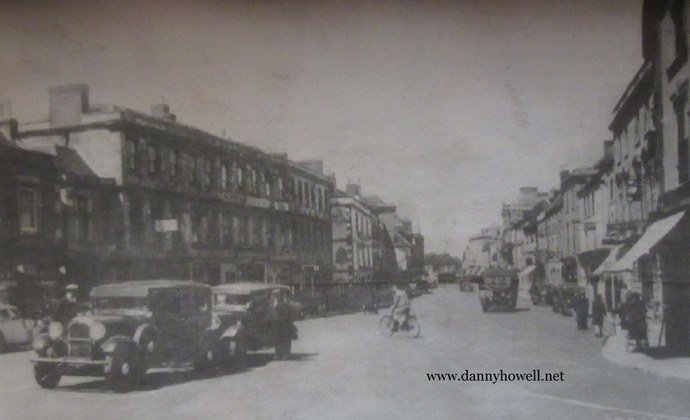
 Taxis, including William Sloper’s, parked in the middle of the road at the eastern end of the Market Place, Warminster, during the 1930s.

William Sloper, or Bill Sloper as he was referred to, was best known as a local taxi man for over 40 years.  The photograph above shows where Mr Sloper (and others) parked their taxis in the Market Place, Warminster, during the 1930s. At one time William Sloper was Lord Bath’s chaffeur.

Born at Steeple Ashton, Mr Sloper’s first love was trains, and he worked in Trowbridge railway engine sheds on leaving school. He left when he was 16 and began what eventually became his driving career, working at a Trowbridge garage owned by a Mr Bodman.

Mr Sloper, who was well respected and liked over a wide area, was one of Lord Long’s first volunteers the night the First World War was declared in 1914, joining the 2nd Wiltshire Regiment. Early in the war he was groom to the then Lord Heytesbury. Mr Sloper was wounded at the Battle of the Somme, and was sent to recuperate at a convalescent home at Crystal Palace on the Jordan family estate at Sutton Coldfield, where he met Eva Jordan. (It took seven years for pieces of shrapnel to work their way out of Mr Sloper’s body).

William Sloper married Eva Jordan. He then decided to return to Warminster with his new wife, and they resided with Eva’s mother, Lady Florence Jordan, at East Street, Warminster, before moving to Boreham Road in the 1930s.

Mr Sloper rented Folly Farm, Warminster, for a year, before working for 15 months as a chauffeur to the 5th Marquess Of Bath at Longleat. Daughter Gloria worked for a period at the Longleat Nurseries for the 6th Marquess, Henry Thynne. Mr Sloper described Lord Bath’s family as “the finest people I’ve ever worked for.”

Mr Sloper, who was nicknamed Ally Sloper, after a comic book character, was a keen coin collector and also owned many leaden ‘bull’ seals which he had dug up locally. Among his other souvenirs were a number of early German helmets, which were spiked and made of tough leather.

After leaving Longleat, Mr Sloper started his own car-hire business which he ran for over 40 years. His car was a regular sight outside Warminster Railway Station where Mr Sloper had preference over the other taxi drivers, Mr Cuff and Mr Garrett.

In those days the taxis also waited for customers by the Morgan Memorial Fountain outside the head Post Office at the junction of Station Road, East Street and Market Place. Mr Sloper is remembered by many people as an ever-helpful and obliging driver.

William James Sloper died, aged 81, on 13th August 1972, having held a clean driving licence for over 60 years. He was buried at the Minster Churchyard, Warminster.

Family Fortune Lost
Both Gloria Sloper and her father William Sloper worked at Longleat for the Thynne family – but they had some titled connections themselves. Local historian Danny Howell, who knew Gloria, has retraced various branches of the family tree.

Gloria’s grandmother was Lady Florence Jordan, who lived in Warminster for many years – after the family fortunes were lost in a mysterious fraud.

Gloria’s mother, Eva Winifred Jordan, was a direct descendant of the famous Dr Jenner, whose patient medical research and study made possible the discovery of vaccine. She was also related to Lord Penrhyn, Lady Poynter and Lord Culrain.

The marriage of Eva Winifred Jordan and William James Sloper was registered during the quarter April, May, June, 1918, at Warminster. Gloria was born on 31st July 1922. She was christened Gloria Penryhn Sloper – her middle name was a reference to one of her mother’s ancestors: Lord Penrhyn.

Eva’s mother (Gloria’s grandmother) was Lady Florence Jordan, of Sutton Coldfield Park, Birmingham. Lady Florence Jordan (1861 – 1932) is buried at the Minster Churchyard, Warminster.

Gloria’s grandfather was Thomas Jenner Jordan, a well-known silversmith in the Midlands, who lost his considerable fortunes when the trustee of his affairs absconded abroad with all his wordly wealth and was never traced.

A memorial to Thomas Jenner Jordan was enshrined in the impressive Crystal Palace at Sutton Coldfield, for he freely gave all the glass used in its construction.

On Thomas Jenner Jordan’s large estate were seven lakes, a polo ground, a miniature railway, and a portion allotted to donkey rides for children. It was here, also, that the BBC erected their first television station and transmitter to broadcast outside London and the Home Counties (1949).

This was the childhood environment of Gloria’s mother, surrounded by beautiful parkland and living in one of the finest houses in the Midlands.

When Thomas Jenner Jordan died, having lost the estate, Gloria’s mother became a member of the working class, joining the staff of Jones and Willis, of Birmingham, who fashioned robes, surplices and cassocks, for ecclesiastical customers. Gloria’s mother became a staunch worker for the church, and as chief seamstress and machinist for Jones and Willis she helped to make and fit robes for the then Bishop of Salisbury. An artistic person, she embroidered silken book-markers for Bibles used in churches throughout Britain, usually in the shape of a cross and superbly patterned.

In her younger days, Eva Jordan acted in church plays. Of a courageous nature, she was one of the few females who dared act in St. Gabriel’s Church at Sutton Coldfield during that period – for this was a rough, tough slum area, where the safety of a woman was imperilled unless she was escorted. Eva Jordan bravely ventured alone through the dismal streets to rehearsals and the actual performance, the bullies leaving her alone and respecting her courage.

Eva Winifred Sloper died at her home Penrhyn, at Boreham Road, Warminster (the house was named after her ancestor Lord Penrhyn), on Friday 14th December 1962, and was interred at the Minster Churchyard, Warminster.

Uncle In The Blitz
Eva Jordan’s brother (Gloria’s uncle) was Albert Ernest Jordan, a painter and decorator by trade, who came to Warminster from the Midlands after the First World War. He lived at 27 East Street, Warminster, above what was Mills’ shop, and worked for local builders R. Butcher And Son. He also worked at one time for Messrs. Culverhouse And Son, and went to London during the Second World War, helping to clear and rebuild the blitzed areas. A life-long bachelor, Albert Jordan died, aged 72, on Wednesday 2nd December 1964, and was buried at the Minster Churchyard, Warminster.
Gloria Sloper, Who Taught Hundreds Of Warminster People To Dance, Has Died

Wednesday 17th January 1996

Danny Howell writes ~

Miss Sloper Taught Hundreds Of People To Dance

Miss Gloria Sloper, the well-known professional dancing teacher, of Boreham Road, Warminster, has died. Over the years she taught hundreds of local residents to dance, from tap to ballet to ballroom. Her pupils regularly appeared at fetes and church bazaars, and were much in demand.

Gloria, herself, when a young girl, used to dance at local functions too, and often appeared during the early 1930s on the same stage as Warminster’s boy film star Freddie Bartholomew (he went on to a glittering Hollywood career).

Gloria, who was a great lover of cats, rarely spoke of her ancestral connections, even though her family background was exceptionally interesting.

It is thought that Miss Sloper, who passed away two days before Christmas 1995, died intestate, and the Treasury Solicitor is currently trying to trace surviving family members. 

Gloria’s father, William Sloper, also had a son, Mr. L. Sloper, and another daughter, Mrs Ida Scott, and grandchildren and great-grandchildren.

Miss Sloper’s funeral is delayed until the Treasury Solicitor has contacted everyone.

John Strawson

Tuesday 12th November 1991

Major General John Strawson served in the 4th Hussars, Winston Churchill’s Regiment, during the Second World War in the Middle East and Italy.

After the war he took part in various internal security campaigns, including the one in Borneo when he commanded his Regiment, by this time The Queen’s Royal Irish Hussars. He was Colonel of The Regiment from 1975-85. During the Borneo campaign he helped to direct SAS operations.

Later he commanded an infantry brigade, and retired in 1976 as Chief of Staff, United Kingdom Land Forces. He is married with two daughters and lives in Wiltshire.

His ninth book, on military history, titled Beggars In Red, The British Army 1789-1889, was published in 1991.

His previous books are:

The Battle for North Africa.

Hitler as Military Commander.

The Battle for the Ardennes.

The Battle for Berlin.

El Alamein.

A History of the SAS Regiment.

The Italian Campaign.

Gentlemen in Khaki.

Co-author of The Third World War.

Ninth Book By John Strawson

John Strawson, of Chitterne, had his ninth book, on military history, titled Beggars In Red, The British Army 1789-1889, published in 1991.

Major General John Strawson served in the 4th Hussars, Winston Churchill’s Regiment, during the Second World War in the Middle East and Italy.

After the war he took part in various internal security campaigns, including the one in Borneo when he commanded his Regiment, by this time The Queen’s Royal Irish Hussars. He was Colonel of The Regiment from 1975-85. During the Borneo campaign he helped to direct SAS operations.

Later he commanded an infantry brigade, and retired in 1976 as Chief of Staff, United Kingdom Land Forces. He is married with two daughters and lives in Wiltshire.

John Strawson’s previous books are:
The Battle for North Africa.
Hitler as Military Commander.
The Battle for the Ardennes.
The Battle for Berlin.
El Alamein.
A History of the SAS Regiment.
The Italian Campaign.
Gentlemen in Khaki.
Co-author of The Third World War.

Albert Brazier Saywell, MBE

1st January 1988

Albert Brazier Saywell, born 1904, who grew up in Warminster, but now lives in Congleton, Cheshire, has been awarded the MBE in the New Year Honours 1988, for his military service in the Royal Navy.

Supplement To The London Gazette, 31st December 1987:

M.B.E.
To be Ordinary Members of the Military Division of the
said Most Excellent Order:

Warrant Officer (Steward) Albert Brazier Saywell.

Gerald Stratton 1879 – 1969

From A History Of The Wiltshire Strattons, updated and edited by Richard Flower Stratton, 1987:

Gerald Stratton 1879-1969
Gerald was educated at Dean Close School where he won the Victor Ludorum for athletics. Then briefly he was despatched to his Aunt Charlotte’s at Sutton Veny to dissuade his cousin Dorothy from marrying “that awful garage man”. He failed.

At 18, he enlisted as a trooper in the Glamorgan Yeomanry and served in the Boer War in the Imperial Yeomanry 8th Division (The starving 8th). On the 26th of September 1900 he earned the D.C.M. for staying with and guarding, a wounded colleague whilst the rest went off for help – or ran away! Invalided home with a near-fatal attack of enteric fever, he was later commissioned in the Highland Light Infantry with whom he returned to Africa. In 1906, with the Natal Mounted Police he survived many narrow escapes in the Zulu war.

Back in England in 1908, he joined the Glamorgan Mounted Police. He was in command during and after the coal-field riots. He was reserve for the Welsh Hockey Team.

During the Great War he spent two years commanding the 2nd Battalion The Welch Horse, a holding unit for reinforcements. Impatient for action, he dropped rank to Lieutenant in order to join the Royal Artillery in France. During the German attack in 1918 he was found in the snow having fallen from his horse through dysentry and general exhaustion. The price he paid was almost total deafness, for which he got a pension from the Army till the day he died. In spite of this he served as Lance Corporal in the Home Guard throughout the Second World War.

In 1920 he had married Gwladys Davies and their unmarried and only son Brian was killed in a tank landing craft off Normandy in 1944.

Gerald and Gwladys were a devoted couple and both died in the winter of 1969/1970.

What a warrior!

Jack Stratton 1879-1970

From A History Of The Wiltshire Strattons, updated and edited by Richard Flower Stratton, 1987:

Jack Stratton 1879-1970

Born 30th June 1879, John Maurice, but always known as Jack. He was a very sensitive man, but his childhood was so traumatic that emotionally he retreated into himself and never came out. I was probably closer to him for longer than anyone else in his life, but I never ever got an emotional spark out of him on any occasion. When I tried to introduce him into an emotional crisis in my own life, he would immediately change the subject.

“Uncle Jack” as everyone knew him, was a remarkable horseman. He gave a horse immediate confidence and horses would do anything for him. As a young man he had a wonderful mare called ‘Marmaid’; he won many point-to-points on her and then went on to steeplechasing at Wincanton and looked all set to become one of the leading steeplechase riders in the country. He once took three horses down to Sparkford Vale point-to-point and won four races with them – the first and the last with the same horse. With a groom he rode down and back from Kingston Deverill in the day, as his father would only give him one day off.

He kept the ‘Marmaid’ line going at Codford until after the Second World War. There was an exceptional mare called ‘Lonely’, a marvellous hunter and point-to-pointer in the thirties and just at the end of the Second World War, ‘Golden Plover’. To my infinite chagrin, he sold him to a Major Armitage who won the Grand Military on him. The last of the line was ‘Star Turn’, a beautiful mare; she was not “got up” and in no way fit, but a specious rascal (to whom my uncle was always prey), asked for a ride in the last South and West Wilts point-to-point at Kingston Deverill. ‘Star Turn’ led all the way round, but dropped dead of a heart attack just before the finish. Uncle Jack showed no emotion and expressed no regret.

Uncle Jack was a passionate hunter; up till Christmas he hunted with the South and West Wilts. The horses were stabled at Codford and it was a long ride down to the Semley Vale and back. He kept a cake at Willoughby Hedge petrol station and would call in on his way back, bang on the tin roof with his crop and dear Mrs. Harper would run out with the cake. After Christmas the horses were taken down to Sherborne and he hunted with the Blackmore Vale. He rode with tremendous courage.

In about 1905, when he was 26, Uncle Jack was tightening barbed wire round the cricket pitch at Monkton Deverill (in a field opposite what used to be the pub), when the wire snapped and went back across his face and damaged one eye. He went to Bristol for treatment and they decided not to take the eye out, because it was his best one, but to try to repair it. A year later his perfectly good eye decayed with sympathetic opthalmia and had to be removed. For the rest of his life he was left with the very minimum of sight.

He made absolutely no adjustment whatsoever to his loss of sight; he made no attempt to change his life style, he carried on regardless. Horses seemed to understand and would always bring him home somehow. He landed in the most appalling predicaments – he never complained, or felt sorry for himself or lost his nerve. He used to say that everyone should be blind for a day and then they would never complain again. The Fates must have been at their most cruel to have selected Uncle Jack, of all people. to deprive of sight, but because of his marvellous courage, they relented enough to detail off a squad of guardian angels to hover over him for the rest of his life.

When hunting, he would have a pair of horses and another rider (originally Harry Dufosee) with a big white patch sewn on the back of his coat. Uncle Jack would follow the white patch.

After a year or two, a cataract began to form over the remains of his one eye. The surgeons said that it was impossible to operate and he must resign himself to going quite blind. Of course he carried on hunting and one day over-rode his guide and jumped a fence into a quarry. It was a frightful crash and he was terribly damaged about the head. After weeks in hospital, the bandages were removed and they found that the cataract had completely disappeared. It never recurred.

Uncle Jack’s father was a highly educated man, but, because of the agricultural depression, he decided that Jack (and his elder brother Dick), should leave school in their middle teens and work on the farm. About 1905 they took over Kingston farm from their father. When Dick got married in 1914 Jack took over Pertwood from their partnership and took a tenancy on Codford Farm. He went to live at Warminster with his father, step-mother and half-sister Jessie. Harry Dufosee lived at Codford as his manager. When the war broke out, the military descended on Codford immediately and it became one vast camp and eventually Anzac Headquarters. Farming activities more or less ended.

After the war his nephew Jack Houghton Brown, after a spell at Reading University, came to join him as Farm Manager and a large and successful business was built up. He bought Codford farm from the Yeatman-Biggs in 1921 for £7000 and Monkton Deverill from Lord Bath in the same year. He sold off the bottom half to Mr. Hinton and added the top half to Pertwood which at the same time he bought from Kings College, Cambridge. In 1930 he took a lease of Manor Farm, Stockton, for three years rent free, his landlord putting up ten miles of fencing and laying on water in the fields. In 1932 he bought Clump Farm, Chitterne, for £3 per acre from the Bankruptcy Commissioners. He rented all the land to the north of Great Ridge from Fonthill Estate to join Stockton to Pertwood. It was thirteen miles from one end at Chitterne to the other end at Pertwood. In addition, great tracts of the Imber Ranges were taken for winter grass keep, fenced with a single strand of barbed wire and stocked with cattle.

The business was a huge ranch. With the collapse of cereal farming, farmers were going in for dairying everywhere and, while JMS/JHB ran two dairies at Codford and Stockton, their main business was supplying downcalving heifers to the dairy industry. Great numbers of Shorthorn stirks were bought in Ireland, shipped across the Irish Channel and arrived by train at Warminster and Codford Stations. Every autumn they held special sales of heifers with calves at Chippenham, Warminster and Salisbury markets.

Sheep were also brought down in trainloads from Scotland and a big poultry egg-laying unit was set up in the “arks” on the downs which had to be moved every day – an awful job in bad weather.

The business was managed off horses and two sets were kept in the stable – one for the morning – one for the afternoon.

In the desperate economic conditions of the twenties and thirties, this was a highly successful business. It was almost entirely due to the drive, energy and business acumen of Jack Houghton Brown. Uncle Jack was not interested in the business side of farming, he was quite incapable of working out a cropping programme or forward planning of any sort. He loved the sidelines of farming – driving cattle, picking up stones, etc. – not the mainstream. As I have said, he was a very sensitive man, but never showed it. Jack H.B. was either unaware of this or took no notice of it. Uncle Jack became more and more disenchanted with the way J.H.B. ran his highly successful business, but gave no outward indication of his feelings.

One morning in 1937, J.H.B. received a letter through the post giving him the sack! There was a major explosion! When the dust settled, Pertwood and Hill Deverill were made over to J.H.B. and Uncle Jack retained Chitterne, Codford and Stockton, with another nephew, myself, bespoken as heir apparent. Uncle Jack then moved from Warminster to live for the first time at Codford.

With the outbreak of the Second World War his properties were again immediately requisitioned by the Army and he spent this war surrounded first by the Guards Armoured Division and then a series of American Divisions. He didn’t bat an eyelid at this and when in 1943 Codford farm house was burnt down he delighted in taking his meals with the Americans. Most of the land was swept into military training areas, but with the little he had left he got into quite a mess and was losing money by 1945. He was an embarrassing problem to his brother who was Chairman of the War Agricultural Committee.

I came back from the war and took over management of the business in 1946. Uncle Jack was able to devote himself to his ploys – he usually had a farm pupil – a long-suffering young man who was woken at dawn, trundled round all day with a horse and cart picking up stones, dead sheep and odds and ends. Uncle Jack always took out his lunch – consisting of 2ozs cheese, 2ozs bread and a small bottle of home brewed raw cider. On such rations the wretched young man starved. At night the pupil either had to play bridge or read aloud, at least till midnight. Bridge to Uncle Jack was entirely a game of chance, not of skill, and was torture to a partner who played well. As he had difficulty in seeing the cards, he constantly revoked by mistake, and, if he found it annoyed his partner, would start doing it on purpose.

I spent two years in this role before the war. I remember the hunger and lack of sleep and lack of money. Money meant nothing to Uncle Jack – one way or the other. He spent nothing on himself – bought secondhand clothes if he could – and couldn’t see why anyone else wanted money. He wasn’t mean – he didn’t think that money mattered. I worked twelve hours a day for him seven days a week and wasn’t paid a penny. They were the happiest days of my life.

Until his ninetieth year Uncle Jack walked about six miles a day and rode as well. He liked walking in sunny weather in the early morning or late evening. With the rays of the sun almost horizontal behind him he could see along the rays a surprising distance. When he was ninety he finally lost his last vestige of sight. Life had nothing left for him and he just sat in his chair and set about dying. He died on 10-11-1970, aged 91.

William Stratton 1834-1919

From A History Of The Wiltshire Strattons, updated and edited by Richard Flower Stratton, 1987:

William Stratton 1834-1919

William Stratton, the eldest child of Richard and Eliza, was born at Calcut, near Cricklade, on 17th November 1834. Two years later the family moved to Manor House, Wroughton, and in 1842 to Salthrop where he spent a happy childhood with his ten brothers and sisters. When William was sixteen the Strattons moved to Broadhinton, leased additionally from the Duke of Wellington. He went to Shaw House school, leaving in 1848 for a school at Calne; but the following year he was taken, aged 15, from this school at Easter because of heart disease. At 18, he and his sister Charlotte were sent back to Salthrop to manage the farm and neighbouring Bupton Farm.

In his memoirs, William’s younger brother Dick writes “About this time I must record what I look upon as plucky a performance as any I have heard of on the part of brother William. Some people had come to see the cattle and two big, high-mettled bulls were being let out for inspection at Salthrop Dairy; one being led by the big old dairyman, Mr. Sly; the bulls began challenging each other when one jumped forward, knocked Mr. Sly down and knelt down over him, beginning to work his horns on him. The leading-stick had become detached from the ring, so the bull was absolutely at large and very excited. William, who was sitting on his horse close by, jumped off, rushed to the bull’s head, caught hold of the ring and pulled the mad brute off the man with his bare hands and so held him until properly secured, thus undoubtedly saving the old man’s life. Greater courage than this there can hardly be.”

William’s mettle must surely have been further tested when in 1855 his father sent him in charge of a bull and a cow to the Great Exhibition in Paris, whence he returned with two first prizes of 700 franks (sic) each.

In 1857, Inglesham Farm near the Thames, between Highworth and Lechlade, was rented from Lord Radnor for William. This was an excellent dairy farm of 200 acres. Young William was fond of horses and hunting. Once when he was ill, he loaned his good horse ‘Friar Tuck’ for a day with the Heythrop to his brother from whom we read of an alarming trip straight across country. William was still farming Bupton which he rented from his father. Though busy, he was gaining experience of both heavy and light land farming. His 1859 diary records 43 acres of wheat averaging over 11 sacks (2¼cwt) per acre and return of £12-14-0 per acre. Perhaps it was this that triggered off a trip to Paris and the Rhine with his brother Dick the following summer. The Strattons had never lacked for farm pupils and it must have been at this time that William saw three of his sisters marry neighbours or pupils. Alice, Emily and Eliza to Messrs. Walker, Blyth and Rawlins respectively.

In 1865 on his marriage to Elizabeth Harris, and undoubtedly backed financially by both families, William was looking for fresh worlds to conquer. His opportunity came when Lord Bath at the 1864 meeting of the Bath and West Show Council was recommended the Stratton family by a Mr. G.H. Andrews of Rimpton near Sherborne, probably a fellow shorthorn breeder and exhibitor. Mr. Jones, the Longleat agent, then sought a written reference from Mr. Andrews. Before the usual queries as to farming competence, assurances were sought as to whether the Strattons were regular churchgoers and whether their politics would be in accord with those of the Marquess, Conservative. Mr. Andrews replied that all was well and that he could recommend all of Richard Stratton’s sons equally, so well had they been brought up. On a day in January 1865 father came over from Walls Court and son took train from Swindon to Warminster, announcing that he would then spend the night in Maiden Bradley. Inspection of Kingston Deverill followed next day. There followed correspondence over the rent, but on the 25th March 1865, William wrote to confirm a rent of £1300 per annum for 1682 acres, the tenancy to be for “three years certain”. (This rent was steadily increased but in 1871 William negotiated a permanent reduction of £174 to £1724 because his wheat crop was ruined by blight.) William moved to Kingston in April 1866 and his new bride took over the pleasant farm house which had recently been tastefully enlarged from the old, but modest, dwelling house. They must have been relieved to have missed the great blizzard in January which buried all the sheep on the neighbouring Pertwood.

The Longleat Estate had invested substantially in their Kingston Deverill estates in the shape of cottages and buildings. The small farms set up following Enclosure had not proved viable. The estate was now looking to throw these in together and was seeking a man to weld the whole into a business that would justify their investment.

With his background, experience and financial backing, they certainly found the right man in thirty year old William Stratton. His landlord, the 4th Marquess, had taken over the administration of Longleat from his mother on attaining his majority in 1852 and in 1865 obviously found it congenial to work with a man only four years his junior. It was to prove a rewarding partnership and the two men achieved a mutual respect, culminating in William being invited to propose the toast to the 5th Marquess at the coming of age celebrations in 1883.

The agreed strategy at Kingston Deverill was to reduce dependence on corn; the soil was too poor and the climate too wet. Unlike his new neighbours, William understood cattle and a cheesemaking dairy of fifty cows was soon established in the Maiden Bradley valley. All this difficult working heavy land was laid to permanent grass for these cows and other cattle. The Downs were enclosed for the first time, a mammoth task since oak posts five inches square were dug in at three yard intervals and were to last a century. The Downs carried maybe 20% of gorse and were suitable only for sheep and rabbits. William imported literally train loads of lambs from Scotland every autumn; they paid well for their twelve month stay until worm infestation, for which there was then no cure, enforced caution and more cattle.

In 1882 Kings College, Cambridge, could not find a tenant for Pertwood. William Stratton took it on, and installed a shepherd in the big house surrounded by sheep and rabbits.

Kingston had an abundance of cheap labour and the requirements of a largely self-supporting society kept many off the Poor Rate – pond making, road making, thatch making, haulage in and out of Warminster, horse and hand hoeing, stone picking, cutting crops, remind us of a myriad of activities. Even so, many people emigrated. As time went on, much farm machinery was loaned and hired out from Kingston Deverill, culminating in the purchase in 1869 at Manchester Show of a set of steam tackle to rip into the land, to be replaced in 1894 by a pair of 14 H.P. Fowlers costing £450 the set.

Marketing the farm produce was then a personal activity and William had his hands full getting round the markets for his cheese, corn, beef, mutton and lamb. On one occasion he rode on to Bristol with the proceeds of a sale at Devizes Market to invest in the forming of the Ashton Gate Brewery; the share register shows the blotting by his wet sleeve. This investment was emulated by his brothers and was to underpin the Stratton family for a century.

By the turn of the century, the lack of a proper water supply for stock had become acute and in 1900 Mr. J.W. Titt of Warminster was commissioned by Longleat to sink a well surmounted by a wind engine, build a reservoir and install pipes for the whole estate, including Keysley Farm. The cost totalled £2406-17-2. In 1987, the pipes are still as new. It occurred to no one to bring the marvellous supply into the village.

It was well that William had plenty to occupy his mind for his personal life was dogged with tragedy. Elizabeth died in her second childbirth and the baby survived her by only six months. In 1873, when 38, William married Amy Flower, the lovely eighteen year old daughter of his friend at Chilmark. They were marvellously happy until after only fourteen years she was finally struck down with pneumonia, having been delicate for four years with congestion of the lungs. Before this, three of her seven children had died; her eldest, Walter Flower, was killed in an accident involving a water barrel; he was nine years old. Norah died aged four and a half and Edmund Herbert died when he was eight months, both from scarlet fever. It was Amy who caused the ornamental trees opposite the farmhouse to be planted. They have given pleasure for a century.

These personal sorrows and the increasing farming depression turned William into a hard and withdrawn character. He enjoyed fox hunting regularly with the South and West Wilts, hare coursing and horse racing. We read of a trip in 1894 to the sale of the Chilcombe Estate, then on to Bognor and Goodwood Races. In 1900 a fall from a runaway horse strained his legs so badly that he was obliged to give up hunting. He used his enforced six weeks confinement to have an operation on his eyelids and to give up shaving for good. But he was a man who inspired respect, even fear, rather than affection. He was a rabid Tory. His public work must have been a real solace, and he certainly made his mark.

William started the South Wilts Chamber of Agriculture in 1871 and seven years later was elected Chairman. From the start he was its representative on the Central Chamber of Agriculture in London and after two years a Cattle Diseases Committee, which he was to chair for most of his life, was formed at his suggestion. It is hard for us in 1987 to appreciate the scourge of human and animal diseases a century ago. In January 1882 William had to take his family to Clifton for part of the winter while the whole house was disinfected following infectious disease.

His stock “first had foot and mouth disease” in 1859 and it was often repeated. In 1901 he records heavy losses in hill lambs due to worms in stomach and bowels. It is recorded of William Stratton that “he took the leading part in the long struggle to secure the flocks and herds of this country from the ravages of infectious diseases.”

This was followed in 1879 by a letter, in Lord Beaconsfield’s own hand, inviting him to serve on a Royal Commission under the Duke of Richmond to enquire into the depressed state of the agricultural interest. William was one of the only two tenant farmers so appointed and we learn “in the examinations of witnesses he always inquired their view as to tenant rights”; he claimed that he had a large part in inducing the Commission to report in favour of a fair measure of compensation for tenant improvements on leaving their farms, which ultimately led to such a measure being passed by Parliament. The Duke of Richmond himself was entertained at Kingston Deverill, young Dick being on hand to attend the great man’s boot-laces.

William Stratton was a founder-member of the Wiltshire Archaeological Society, and himself financed the excavation of the Roman site on Bidcombe Hill, whence he sent artifacts to Devizes Museum.

William moved to St. Andrews, Boreham Road, Warminster when Dick married in 1914 having handed tenancies of the Kingston and Pertwood farms to Dick and Jack together in 1905. He died in the post-war flu epidemic of 1919, aged 84 years.