More About Bill Symes Please

Friday 20th April 2012

Jo Reed writes:

“Hi Danny. I love your website and I really liked your eulogy for Bill Symes. Can you do mine for me at my funeral? Just joking. I never knew Mr. Symes but after reading what you wrote I really wish I had known him. You said he knew all about the old characters in Bishopstrow, it sounds like Mr. Symes was quite a character himself. Will you be putting more about him on your website please? I’m sure lots of people (me included) would like to hear more about his life and read more of his stories.”

Danny Howell replies:

Thank you Jo for your kind words. Yes, Bill Symes was indeed a character in his own right. Several people have emailed me about the tribute and I have said to all of them that there were many many things I could have said about Bill. Although he was not a mover and a shaker in the big wide world, and although his name will never be mentioned in anything to do with academia, he was a lovely, pleasant, down-to-earth, man who had got all his priorities right. He was the least materialistic man you could ever meet. He used to say “I began with nothing and I’ve still got most of it left!” Wonderful!

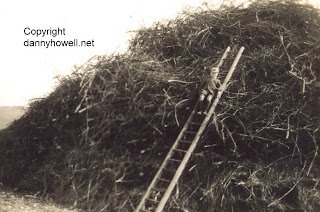
I think I managed to portray a flavour of Bill and his life. With regard more about him, I tape-recorded a lot of the things Bill said over the years and his family asked me at the wake after the funeral if I could put together a book about him and I think we probably can. To that end, members of Bill’s family are looking out photos for inclusion. As a taster of what’s to come, here is a photo that Bill’s sister, Jean Whelan, has already let me have:

The photo shows the bonfire built on Middle Hill, Bishopstrow, in 1935. It was lit as part of the local celebrations to mark the Silver Jubilee of King George V and Queen Mary. The boy up the ladder is Bill Symes. He would have been 8 years old at the time. It looks like Bill is wearing his school blazer and cap. To the left of the picture, behind the bonfire, is a glimpse of neighbouring Scratchbury Hill.

Bill Symes Was “Mr. Bishopstrow And Boreham”

Yesterday, Tuesday 17th April 2012, the funeral of Bill Symes was held at St. Aldhelm’s Church, Bishopstrow. At the request of Bill’s family, Danny Howell, who spent a lot of time in Bill’s pleasant company, was asked to write and read out a tribute to Bill. After the service, Danny was asked by several of the mourners if they could have a printed copy of what he had said in the church. Which now prompts him to share the tribute with an even wider audience. What follows is the slightly longer, unedited version of the tribute, as originally wrote by Danny, from which the excerpts he spoke at the funeral were taken:

Bill Symes: a tribute by Danny Howell.

They say the past is another country, and if you know anything of Bill’s past, you will be in no doubt that his life was one he made something uniquely special.

I am pleased to say I spent many happy hours in Bill’s pleasant company listening to his recollections. Sat indoors, with his cap on, he would talk about Cox’s Drove, Millard’s Hole, Spilsbury Pond, Penny’s Park, and other places. If you didn’t know these places yourself, you wouldn’t know where on earth he was talking about. But they all existed and still do within less than a mile of where we are now.

And he had a treasure chest of tales for every place, like the grass snakes at Horsepools, the secret tunnel at Eastleigh Court, the deep well at Bigbury Wood, the largest of elm trees that stood between Mill Lane and Watery Lane, the Junkers 88 plane that came down near Ladywell Barn, and more.

He knew all of this because he spent a lot of time wandering around the lanes and woods and over the hills, observing things first hand. He would go for walks every evening and at weekends. Later on, he took his children with him and their friends would tag along too for the great adventure it all was. Bill was a familiar sight round here, especially on his beloved bike. He was very much part and parcel of this locality. To me, Bill’s intimate knowledge of this parish was so vast I always thought of him as “Mister Bishopstrow And Boreham.”

That’s not to say he was a know-all or bigheaded about it. In fact he was quite the contrary. Bill’s favourite saying about himself was “I started at the bottom and worked my way down to where I am now.” He even contemplated having that on his gravestone. He said “If Spike Milligan can have “I told them I was ill’ on his, then why can’t I have “I started at the bottom and worked my way down.’ That’s an indication of Bill’s sense of humour. I hasten to add he’s not having those words on his gravestone, he later thought of something more in keeping.

Bill certainly had a very curious, inquiring intellect, because he gathered in his head all sorts of information and anecdotes concerning Bishopstrow and Boreham. This penchant for discovering more things about his locality, remained with him all his life. Just recently, some turntables and a massive saw pit were uncovered in Blackett’s Wood, not far from here, just the other side of the Bypass; they are remnants surviving from the military railway that connected Heytesbury Station with Sutton Veny Camp during the First World War. When I told Bill, he immediately said to me: “I suppose you are going to go and have a look at they. If you do, take me with you, I want to go with you, I want to see they, I’d love to see they.”

He did have a passion for steam locomotives and vintage vehicles. Before he was six years old he could tell, by the noise alone, whether a steam lorry making its way up Boreham Hill, was a Foden or a Sentinel.

Not only did Bill have a world of almost mythical places, he had a cast of characters to populate it – not fictional characters, but real larger-than-life people.

His favourite story concerned this very church. He would tell you of the time when the incumbent here in the 1920s and 1930s, the Reverend George Atwood, arranged to go shooting on the downs for a day with Mad Jack Bennett, one of the areas’s most notorious characters. Mad Jack arrived at the church at the hour agreed, as indicated by the hands on the dial of the church clock. Mad Jack waited outside. The Rector was inside, attending to someone or something else. Bill said Atwood was being “a touch tad tardy.” Mad Jack soon lost his patience and got out his gun. He fired at the weathercock, blasting away the initials N E W S which indicated the four main points of the compass. The Rev. Atwood rushed out of the church, wanting to know what was going on. Bill loved to tell that story. And as always, with Bill, he added his own riposte to it: “Ah”, said Bill, referring to Mad Jack, “He had he out of there, alright.”

The character who gave Bill his biggest store of stories was Squire Grenville Newton Temple, the Lord of the Manor. Bill’s favourite story about him concerned the time that Squire Temple, who had been out for the day, was brought home to Bishopstrow House by car hire and taxi proprietor William Sloper. When Temple got out of the car, Mr. Sloper asked him for the half-a-crown fare. Temple raged it was too much and only handed over two shillings before striding off into his mansion. Mr. Sloper, determined not to kowtow to the Squire, sat in the car and refused to move. One hour later, Temple bounded back out of the house and hurled a sixpenny bit at the car!

That was the world that Bill rejoiced in, the world he had entered on 20th July 1927, when he was born at 14 Boreham, the house next to the Yew Tree pub. His parents were in temporary lodgings at that house with the Moore family. Bill’s father soon afterwards bought a property on Boreham Hill, where they lived for about ten years, and then they moved into one of Park Cottages, renting from Miss Bradfield.

Bill told me many things about his childhood. He summed it up by saying “I was as well off as any schoolboy at Boreham who came from a working class family. If I could get myself a penny a day, which I did, to buy some sweets from Mrs. Fitz at Boreham Post Office and Shop, well I was doing alright.”

Bill attended St. John’s School and the Avenue School. I say attended but he soon realised school wasn’t really for him. He would skive off. He’d set off for St. John’s but would take a right turn down Rock Lane, and he’d spend all day, without anything to eat, curled up under a bush in the old Ballast Hole Quarry, where part of the Boreham Field housing estate now is. His friends, Vera Sheppard, Grace Norris and Joey Howell, covered for him for a while but eventually persuaded him to return to school.

He hated school and didn’t pay much attention during lessons. His school report would be so uncomplimentary that he would push it down a drain in the side of Boreham Road as he walked home at the end of term. And he had no interest in sports. He said he was no good at it. While the other boys played football on the school field he was told to help out in the school garden. He spent his time digging the shrubbery and pushing compost in a wheelbarrow to the plots for potatoes and beans. By all accounts the compost had quite a potent “aroma” which permeated his clothes. Bill said when he went into Mrs. Watkins’ class after gardening, she would push her nose up, flutter her nostrils and say “Did you have to bring that in here!”

Bill said the only thing good about school was the school holidays. He would run up to Bishopstrow Farm, where farmer Mark Gauntlet had two traction engines for steam threshing and ploughing. Bill would ride on the cultivator that was hauled by a long steel cable between the engines, either side of that big 70 Acres field between Battlesbury and Middle Hill. There’s a couple of photographs of young Bill in one of my books (The Wylye Valley In Old Photographs) – in one photo he is stood on the traction engine, in the other he is on the cultivator – he’s wearing short trousers and what looks like his school blazer and cap.

Battlesbury was one of Bill’s favourite places. He would climb up the ramparts to the very top of the hill, where one of his Boreham neighbours, Georgie Love, had the job of raising or lowering the red flag on the pole by the old reservoir, warning that the military were live-firing. Bill also liked to visit the keeper in the hut in Battlesbury Wood, and Bill would go looking for linnets’ nests in the box bushes. It was an idyllic time.

Somehow he managed to play truant from the Avenue School for 16 weeks continuously. He would spend the school hours loitering at places where he thought grown-ups wouldn’t know who he was, places like Roly Poly Lane and Sandy Hollow. Then questions started to be asked, not at home but at the school, so Bill devised a master plan. He instructed one of his mates to tell the teacher that he had died. Well, of course, that ruse didn’t last long. It must have been the next day that the schoolteacher just happened to meet Bill’s mother in the street and expressed condolences at the unexpected news of young William Symes’ passing away. Young Bill was in very serious trouble when he got home that afternoon! The School Attendance Officer, Mr. Noyce, called on Bill’s father at Bishopstrow Mill. Bill’s father went to the Avenue School and saw the Headmaster, Harold Dewey. Bill’s father pleaded for leniency for his son. It worked! Bill, the lucky so-and-so that he was, didn’t even get so much as the cane for his absenteeism.

There were some consolations among the drudgery of school life for Bill. As soon as the Second World War started, Warminster, like other places took in evacuee children from London. Bill said he saw the arrival of “A crocodile of Cockney kids”. There were so many evacuees that the Avenue School hours were rearranged. Bill and his classmates were told that they were only to come in the mornings one week and afternoons the next, and there were weeks when school was held only every other day. Bill said that suited him fine – more time to spend roaming and exploring Boreham and Bishopstrow! The number of evacuees was considerable but (70 years later) Bill could reel off to me the names of just about all of them and where they were billeted. I laughed when he said the two Crozier brothers, who lodged at Grange Lane, were soon known by everyone as “Big Smells” and “Little Smells”.

Bill left school a month before his 14th birthday. A full-time job was available at Bishopstrow Mill, working alongside his father. Bill was as pleased as punch about it. He had been working there part-time during the school holidays since he was 12. His full-time job at the Mill earned him half-a-crown a week to begin with, which soon rose to the giddy heights of five shillings, and was the princely sum of £5 in the finish. He loved the job. He kibbled the cow cake, crushed the oats, worked the winnower, and caught the rats in gin traps. There was a smallholding attached to the Mill and Bill’s additional chores included feeding the pigs, collecting the hens’ eggs, and throwing sticks up in the air to get the turkeys off the shed roofs when it was time to get them in at night.

On the day of his 17th birthday Bill started driving a Commer lorry, delivering hay and straw, and grain and feedstuffs, to and from the Mill. He didn’t take a driving test. He only had to go to the Post Office, fill out a form, pay five shillings and be handed the licence. Deliveries were made to farms for miles around. A much liked perk was that some farmers would bring out some cider and there was always time for a natter. Jesse Drake at Norton Bavant was a regular customer, having six tons of cattle nuts at a time, and after unloading there Bill would be told to go into the house and see Mr. Drake’s housekeeper who would always give him a half-a-crown tip. There were also regular jaunts with the lorry to BOCM at Avonmouth Docks, John Curtis’s at St. Phillips in Bristol, Rank at Southampton, and the McDougalls flour mill at Andover, which Bill enjoyed.

Loading and unloading was all done by hand and it was hard work but although Bill was small in stature he had big arms and was very strong, something which earned him the nickname Popeye. The wheat was in sacks weighing two hundredweight and a quarter. The sacks were loaded up on lorries, in two layers. Very often, sacks delivered to farms had to be carried up steps and into lofts. But Bill could do it. He told me a fellow employee at Bishopstrow Mill was Norman Barnard from Stockton. Bill would prove his strength by carrying both a two hundredweight and a quarter sack of wheat and an 8-stone Norman Barnard on his back, the entire length of Bishopstrow Mill.

Four months before his 18th birthday Bill received his call-up papers for the Army but fortunately for him the War was coming to an end. He was told to report to Hadrian’s Camp at Carlisle by 10.00 p.m. on the following Monday. He took the train from Westbury, and went via Paddington and Euston. Getting off the train in Carlisle, he and the others were taken in lorries to the camp, given a mess tin of cocoa, two crusts of bread and some margarine, and a tin of bully beef. An hour later they were taken by the lorries back to Carlisle Station. They travelled to Stranraer on the West Coast of Scotland, from where, at four in the morning, they took the ferry to Larne in Northern Ireland. Bill and his comrades ended up at Ballykinler Camp, in view of the Mountains of Mourne.

He trained as an infantryman for six weeks there, and then spent ten weeks in Colchester. Next, as luck would have it, he was made a lorry driver in the MT. He transported troops and delivered rations. He said it was a very cushy number.

It was while delivering to the camps on Salisbury Plain that Bill met Irene Duffy, a Lancashire lass, who had worked for the NAAFI prior to joining the ATS. She had been posted to Bulford Camp. That’s where Bill and Irene met, when Irene was serving food to the soldiers. Something must have attracted Bill to Irene, it may have been the khaki uniform and the wooden clogs she was wearing. It was the start of a loving 58 year relationship.

They were wed in Irene’s hometown of Rochdale in 1947 and commenced married life living with Bill’s parents at Boreham for six years. Next they were in a tied-cottage at Bests Lane, Sutton Veny, for a year, before gaining their first council house at Ferris Mead in Warminster. Twelve months later they moved to Boreham Field, where they resided for 44 years, before finally moving to a bungalow at The Dene.

After his army service Bill returned in May 1948 to work at Bishopstrow Mill but only for two years. He heard that the Wilts and Dorset Bus Company wanted drivers. So he applied at Salisbury. He was asked to drive a bus, with a supervisor, up to Old Sarum and back. He was then told if he underwent two weeks instruction and passed he could have a driver’s job. He said the whole thing was a doddle.

Bill started driving for Wilts and Dorset on the first of May 1950. His first conductor was Doug Lakey’s sister Bet. Later on, Bill King became his conductor. If the bus was running particularly late, Bill would simply drive on past several bus stops, with the conductor shouting out the back of the double decker “We’re not stopping, we’re not stopping!”

There is the tale of the time the Bus Station in Salisbury was being renovated and an old beam was going begging. Bill King decided he wanted it. Getting the beam back to Bill King’s home in Warminster wasn’t going to be a problem for the two Bills. With something of a struggle they got the beam on to their bus. It was, by all accounts, about 18 feet long and a foot square. All the way back to Warminster, passengers getting on and off the bus had to step over the beam in the aisle between the seats.

And if it was dark or very cold, Bill would often drop passengers off outside their homes rather than the nearest bus stop. And Bill prided himself that he still took the bus out during the deep and prolonged snow of the winter of 1963.

One of the routes that Bill drove was three trips every evening from Warminster to Sutton Veny Camp and back. The bus had 55 seats, but every night over a hundred soldiers would get on it, having come out of the pubs in Warminster. Bill said most of them were drunk and all of them rowdy. He said it was impossible for the conductor Georgie West to get them to pay the fares, so they didn’t bother trying.

Jack Baker tells the story that a bus once broke down at a place called No Man’s Land, off the A36, on the edge of the New Forest. Bill was sent there, late at night, to drive a relief bus, to rescue the stranded passengers and bring them on home to Salisbury and Warminster and the villages in between. Bill had always been used to there being a plain crossroads in Wilton. But that particular day the Council had constructed a new roundabout at Wilton Crossroads, with a large circle of kerbstones and a built-up mound in the middle. It was late at night, gone 11.30 p.m. and Bill, deciding there would be no other would-be passengers waiting at any stops, drove the bus at speed, to get everyone on his bus back Warminster way without further delay. It seems at Wilton he never noticed the new raised roundabout and he took the bus and everyone on board straight across, actually up over it, up one side and down the other. He was over it and some way along the Warminster Road before he realised what he’d done, so, undeterred, he just drove on!

Bill drove for Wilts and Dorset for exactly 20 years, he only gave it up when they brought in the one-man operator system for the buses. He was happy to drive the bus but not collect the fares and issue the tickets as well. He did try it for six weeks but found he couldn’t cope. In his words it got “compellicated.”

He then got a job as a general labourer at the REME Workshops in Warminster. If you listened to Bill’s stories about his time at the REME, you would come to the conclusion that no one ever did any work there.

Bill said one man, after every dinner break, went into a shed in an isolated spot in the workshops, and spent the entire afternoon asleep on a camp bed. That went on until one day Mr. Neald, the boss, opened the door and found the man snoring loudly. Mr. Neald had the shed demolished the next day and that was the end of that.

Bill also said a group of women employees, every Monday morning, brought all their family washing from home to work with them, and spent all day Monday washing and drying inside a big shed.

Another man, said Bill, spent all day, every day, leaning on a window sill, looking out of a window. Bill eventually said to the man, “When you retire, they better give you that window as a leaving present, otherwise you’re not going to know what to do with yourself.”

No wonder then that Bill called the REME Workshops: “A holiday camp.” When Bill reached retirement age, he had to leave but didn’t want to. He knew he would miss the people who worked there and would no longer be able to enjoy seeing all their unusual antics.

Bill had also driven coaches for Berridges at weekends, on troop runs, and he also drove lorries for Fred and Sybil Gibbs.

But at all his places of his employment he seemed not to see it as work, not as about earning money, or contributing to the local economy. For him, the workplace was simply somewhere you went to meet other people, to interact with them, be sociable and enjoy their camaraderie. If any of his fellow employees, wherever he worked, ever moaned about the work they were doing, Bill’s response was always “Well, if you don’t like the job, why do you come here?”

As a widower he visited his sister Jean, and also his friends, Harold, Bill, John, and Gwen. His family and friends visited him – always heeding of course that he wasn’t to be disturbed when the Formula 1 Grand Prix racing was on tv.

When the weather was fine Bill liked to sit on his folding chair on his doorstep, watching the world go by, and if he saw a young mother pass with her little boy clean and immaculately dressed, he would say “Isn’t that a wonderful sight, I do like to see that, I do like to see that.” More often than not Bill would nod off in the chair in the warm sunshine. Passing by in my car, I would stop and say “Bill, are you alright?” and he’d stir and say “Ah, Dan, what’s on? Come in and have a cup of tea with I.”

On the last Friday afternoon I spent with Bill, he changed tack. Instead of talking about the past he spent most of the afternoon talking about his family. He mentioned all of his children individually. He was so immensely proud of them and their achievements, whether they were in business, employing people, securing contracts around the world, being successful in that way, or whether they were doing other things, like keeping horses and sheep on a smallholding, or working in a shop, or just getting on with their lives, doing their own thing and living in a cottage with roses round the door. He adored them all.

Bill’s world wasn’t totally parochial. Somehow he knew all sorts of things about far flung places around the globe. He would suddenly tell me something about Mombasa or Antarctica. Or he’d come out with something about someone like Che Guevara. Last year he was reading over and over again a biography of Bonny and Clyde. He said he was so fascinated by the story that he just had to keep re-reading it.

Bill led a charmed life. He enjoyed everywhere he went and everything he did. I was going to say what a lucky man Bill was to have had such a wonderful time but it has to be said how lucky we were, we people who knew him, who were able to enjoy his delightful company, to be part of his engaging conversation, and to be on the receiving end of his loving and caring nature.

Bill was certainly a very caring person. I witnessed it personally myself. When my father had the first of a series of strokes, Bill was the first person to come and knock the door to see how my dad was, and it wasn’t a one-off, he came to see him on a weekly basis for ten years. I will always appreciate what Bill did.

Likewise when Bill’s wife Irene was ill, it was nothing unusual to see Bill with Irene in the wheelchair going up Woodcock Road to town and back. And if they had forgot something off the shopping list, they would immediately turn around and go back up to town again. I said to him about this, how he found the energy and never grumbled, and he simply said “I would do absolutely anything for my wife.” What a wonderful man he was?

Irene died in 2005. I think I’m right in saying Bill visited her grave here at St. Aldhelm’s Churchyard, every weekend without fail, whatever the weather. And he kept her slippers exactly where she had left them. Bill died on 6th April, on what would have been Irene’s 84th birthday.

They say all good things must come to an end. Bill now goes to be reunited with Irene, something he truly wished for. I asked him once if he believed in God and Heaven. He said he used to think different but now he would like to think that there is something special for all of us afterwards. Every night before he went to sleep he would ask God to bless his sister, his six children, ten grandchildren and six great grandchildren, their partners and their friends. He used to joke that by the time he had finished it was nigh on nearly morning.

Bill’s family will miss him dearly but they can take comfort that he has left them enough love to last forever. And he gave me some advice to share around: he said: “Remember this, a glass of whisky is the best medicine, and a walk over Battlesbury is the best doctor.” Bill also said “Don’t ever trust doctors, parsons or lawyers.” He told Bert Legg that. Bert said “You forgot to mention accountants.” So from then on accountants were added to Bill’s list of the condemned.

Bill, we admired you for the man you were, we liked your homespun philosophy and we loved your sense of humour. You may have joked that you started at the bottom and worked your way down, but we all know different. You were undoubtedly much nearer the top of the pile than the rest of us because you cared so much for your wife and family, you were conscientious and thoroughly decent, you were a good-living man, and you were respected by all who knew you because you were indeed a top-class human being.
Memories Of Miss White’s Toy Shop At George Street, Warminster

Wednesday 11th April 2012

D.B. Starke, of Radyr, Cardiff, writes ~

Dear Mr. Howell,
I recently acquired a copy of your book ‘Five Connected Lives’ and have enjoyed reading it, particularly the section about Marjorie Fudge.

I was born at Salisbury in 1920; my maternal grandparents and two aunts and their families lived at Warminster so that I came to know the town very well. We visited frequently; as I recollect the return rail fare from Salisbury was 1/6!

In their latter years my grandparents lived in George Street right opposite Miss White’s toy shop. This was a veritable Aladdin’s cave and carried a good selection of cap and blank cartridge pistols amongst other things. I was a regular customer and remember Miss White very well – she was the tall and grumpy one and I was somewhat in awe of her. I think that she regarded small boys with considerable suspicion.

Thank you for a good read which brought back so many happy memories.

Danny Howell replies ~

Thank you D.B. Starke. I’m glad you enjoyed reading the book and I was pleased to hear your anecdote about Miss White. If you were born in 1920, that makes you 92 years old or thereabouts, so I guess you have many such recollections. Once again, thank you for sharing the story of Miss White’s toy shop. The property, now numbered No.7 George Street, Warminster, BA12 8QA, has been owned since the mid-1950s by my aunt Diana Turner, who runs The Baby Shop there still to this day.

Herbert Shaw Of Vicarage Street, Warminster

Sunday 18th March 2012

Danny Howell has received the following enquiry:

Hello,
I wonder if you would be able to help me, I have been given your name by a member of the Warminster People [sic Warminster Forum] website. I am trying to trace my Great Great Grandad Herbert Shaw and I recently found out he rented number 59 (now I believe renumbered number 8) Vicarage Street, Warminster, from the 5th Marquess of Bath on 31st May 1912. I understand you keep some local records and I wondered if you might have any further information regarding that address or Herbert Shaw.
Fingers crossed in hope,
Carole.

Danny Howell has replied:

Hello Carole,
Thank you for your enquiry.

I can confirm that the property that was numbered 59 Vicarage Street was renumbered 8 Vicarage Street.

The 1911 Census for Warminster shows people with the surname Kill as residents of 59 Vicarage Street, Warminster.

The West Wilts Directory 1911 lists: “H. Shaw, 59 Vicarage Street, Warminster.”

Collins Almanac and West Wilts Directory, 1912 lists: “J.H. Elkins, 59 Vicarage Street, Warminster.”

The Warminster Directory, Almanack, Local & Village Guide, 1914, lists: “Herbert Shaw, 59 Vicarage Street, Warminster.”

But the West Wilts Directory 1914 lists: “J.H. Elkins, 59 Vicarage Street, Warminster.”

It has to be said that the compilers of some directories sometimes used slightly out-of-date information.

But it seems Herbert Shaw was a resident of 59 Vicarage Street, Warminster, circa 1911 / 1912 ~ maybe up to 1914.

By the way, the Longleat Estate sold 100 properties in a sale held on 5th and 6th September 1919, to raise money to pay death duties. On the first day of the sale, Lot 11 was: “Two stone built houses, 59 and 60 Vicarage Street, rental £26.” They were purchased by Mr. Rutter of Shaftesbury, for £340.

The above information seems to confirm that Herbert Shaw lived at 59 Vicarage Street (now 8 Vicarage Street), Warminster, for a short period.

You have not given me any other details for Herbert Shaw (such as birth, marriage or death dates, or where else he may have lived, or who is parents, wife and children were), so I am unable to find out any more about him at the current time.
Yours sincerely,
Danny Howell.

A Truly Remarkable Man ~ Richard Flower Stratton

Richard Flower Stratton 1916 ~ 2011

Richard Flower Stratton was born on 10th May 1916 and was the last of a generation of Wiltshire Strattons whose life spanned a remarkable period of change in agriculture. The change was as a result of increased production for the war effort and the advent of oil-based products: fuel for mechanisation, artificial fertiliser and chemical weed control.

Richard Stratton’s schooling was complicated by his family name inherited from the Flower family of Chilmark. When the bronze sculpture Beyond Harvest by Colin Lambert was erected in the Cornmarket shopping precinct in Warminster, in 1991, Richard Stratton wrote to the Warminster historian Danny Howell, enquiring whether the girl depicted sat on the corn sacks of the statue, was of any particular person. The girl depicted was not of any known person, but merely the sculptor’s interpretation of any girl gazing out towards what had been the vast corn-growing area of Salisbury Plain. Richard Stratton, however, liked to think that the girl depicted was none other than his grandmother Amy Flower, as a young woman, and although his suggestion was a lovely idea but incorrect, Richard maintained for the rest of his life that his speculation was a nice idea.

A major event in Richard Stratton’s early life was the three years spent at Clare College, Cambridge, where he studied agriculture. During this period he took up rowing and in 1937 his boat won regattas at the Chester head of the river, the Ladies’ Plate at Henley, and an International Regatta at Essen in Germany. His oars adorned his house ever since.

In 1944 Richard Stratton married Pamela Druce in London. She was the daughter of a successful steel stockholder from Birmingham. Richard and Pamela were happily married for 62 years and were resident in Kingston Deverill throughout.

Whilst Richard’s entire life was spent in securing the future of his farming enterprise at Kingston Deverill, he realised at an early stage that his ‘good fortune’ could be repaid by involvement in public service. Over a period of nearly 40 years, he was involved either as a director, governor, or chairman of various bodies including Warminster & Westbury Rural District, Southern Electricity Board, the 5th Milestone Rabbit Clearance Society, Frome Cheese Show, Gillingham & Shaftesbury Show, Fonthill & Willoughby Hedge Ploughing Association, the Wiltshire Association of Dairy Students, and G.B. Matthews Ltd. He also served as a magistrate for Wiltshire from 1966 to 1986.

With the exception of G.B. Matthews Ltd., and Southern Electricity, he was never paid a penny for any of his public work. However, his contribution was esteemed by a wide range of organisations. He was rewarded when he was appointed as High Sheriff of Wiltshire in 1981, and also as a Deputy Lieutenant of Wiltshire.

His firm religious belief and public awareness were reasons for his appointment to the Church of England Selection Board. As soon as he discovered that Bishops could also enjoy a nightcap he found his participation easier, although he always maintained that he found his beliefs more in nature and the world around him than in dogmatic structure.

Richard Stratton’s genuine and humorous interest in people naturally led to a strong commitment to education. Each year he welcomed agricultural students to work on his farm and he followed their careers with interest. He was also concerned with improving general education and was involved with two schools for nearly 40 years. He was a governor of Chafyn Grove School in Salisbury for 38 years; 22 of these years he served as Chairman. In 1966 he became a member of the Governors of Lord Weymouth School in Warminster, which in 1973 merged with St. Monica’s School at Vicarage Street, Warminster, to form what became Warminster School. Richard recalled that he and the Chairman, Jack Houghton-Brown, needed a lot of diplomacy and tact to persuade the nuns of the Sisters of St. Denys to join forces with a boys’ school. He served 26 years as a Governor, including many of these years as Chairman. He was very proud that when he retired from the life of Warminster School he left a good Headmaster and the Chairman of the Governors and an overdraft!

Richard Stratton’s main recreation was fox hunting – as he did his farming on horseback it was thus natural and economical for him to hunt with the South & West Wilts. Both his father and grandfather were also passionate fox hunters. Richard hunted with the South & West Wilts all his life and was invited to be a Joint Master from 1971 to 1979. Then followed a period as Hunt Chairman. His great friend and Joint Master, Douglas Mann, recalls that Richard knew the country like the back of his hand and had great rapport with and respect from the local farmers. Richard believed that no farmer should suddenly see hounds on his land without previous warning. For this reason, many hours of writing postcards ensued.

During Richard’s lifetime, employment on the farm at Kingston Deverill declined from 60 people to only eight. In latter years Richard was able to enjoy many of the changes to the farm that he instigated, such as planting woods to soften the impact of the open chalk landscape, retaining a mix of arable and livestock, and preserving large areas of the natural downland. When once asked on his farm what he would like to be remembered by – he replied, after very little thought, “Just look around you.”

After a long and active life Richard Stratton died peacefully of “old age” at his bungalow, Seagrams, on the Maiden Bradley road at Kingston Deverill, on 1st November 2011. He is survived by four children, ten grandchildren, and two great-grandchildren. His funeral service as held at St. Mary the Virgin Church, Kingston Deverill, on 11th November 2011. It was attended by over 300 people. Richard Flower Stratton loved to share his experiences with other people and to welcome them to Kingston Deverill, and will long be remembered as “truly a remarkable man.”

Mary Stewart Wins Warminster Civic Award

From Engage, Newsletter No.1, of Warminster Town Council, published February 2008:

Bingo! Mary Is A Worthy Civic Award Winner.
If anyone wonders what service to the community means, take a look at Mary Stewart. Mary, winner of this year’s civic award, has had a long association with Warminster, and over the years has given selflessly of her time.

In the days when she had five children to bring up, she pitched herself into the job of fundraising and washing kit for the youth teams in which some of her children played. In the 1980s, she and her husband Neville became actively involved in the MS Society. The armed forces created another opportunity for Mary to show her colours. Neville, who died in 1989, served 22 years with The Black Watch. One of Mary’s feats was helping to cook enormous steaming pots of goulash for the Sergeants Mess dinners.

Teas, Bingo and Non-Stop Charity Work.
When the Cricket Club was opened, Neville and Mary became the first Stewards of the Club, while Mary quickly established a reputation for her teas. But even as others were developing a taste for her cricketing catering, she was developing a taste for charity work because nothing would stop her from volunteering to help raise funds. On her 70th birthday and her 75th birthday, when she would have been forgiven for thinking about ways to celebrate these personal milestones, she threw herself into organising coffee mornings.

Over the years, Mary’s Prize Bingos at the United Services Club have helped to raise money for many local charities including Wylye Valley Riding For The Disabled, Christmas Lights, Shopmobility and Wiltshire Air Ambulance. Strangely, despite all this activity she finds some spare time. Perhaps not so strangely, she uses it to be on duty at the Beckford Centre Shop, makes cakes for an assortment of coffee mornings and lends a hand with cancer charity cream teas.

Mary is the first to say she couldn’t do it all without the help and support of friends and family; nonetheless, she remains an inspiration to us all. So congratulations to Mary and a big thank you for all your hard work!

Mary Stewart Wins Warminster Civic Award

From Engage, Newsletter No.1, of Warminster Town Council, published February 2008:

Bingo! Mary Is A Worthy Civic Award Winner.
If anyone wonders what service to the community means, take a look at Mary Stewart. Mary, winner of this year’s civic award, has had a long association with Warminster, and over the years has given selflessly of her time.

In the days when she had five children to bring up, she pitched herself into the job of fundraising and washing kit for the youth teams in which some of her children played. In the 1980s, she and her husband Neville became actively involved in the MS Society. The armed forces created another opportunity for Mary to show her colours. Neville, who died in 1989, served 22 years with The Black Watch. One of Mary’s feats was helping to cook enormous steaming pots of goulash for the Sergeants Mess dinners.

Teas, Bingo and Non-Stop Charity Work.
When the Cricket Club was opened, Neville and Mary became the first Stewards of the Club, while Mary quickly established a reputation for her teas. But even as others were developing a taste for her cricketing catering, she was developing a taste for charity work because nothing would stop her from volunteering to help raise funds. On her 70th birthday and her 75th birthday, when she would have been forgiven for thinking about ways to celebrate these personal milestones, she threw herself into organising coffee mornings.

Over the years, Mary’s Prize Bingos at the United Services Club have helped to raise money for many local charities including Wylye Valley Riding For The Disabled, Christmas Lights, Shopmobility and Wiltshire Air Ambulance. Strangely, despite all this activity she finds some spare time. Perhaps not so strangely, she uses it to be on duty at the Beckford Centre Shop, makes cakes for an assortment of coffee mornings and lends a hand with cancer charity cream teas.

Mary is the first to say she couldn’t do it all without the help and support of friends and family; nonetheless, she remains an inspiration to us all. So congratulations to Mary and a big thank you for all your hard work!

Irene Symes Was A Rock To Her Family

Thursday 26th May 2005

Margaret Irene Symes, nee Duffy, will always be remembered by her family and friends for the time and care she so willingly devoted to them.

Irene was born in Rochdale, Lancashire, on 6th April 1928, and was the eldest of six children. Her father was an asbestos worker in Turner’s Factory, Rochdale. On leaving school in 1942 Irene worked for a year in a cotton mill, before taking up employment with the NAAFI. She then joined the ATS, having been posted to Bulford Camp in Wiltshire.

Bill Symes, from Boreham, while in the Wiltshire Regiment, was in camp at Bulford. That’s where the two of them met, when Irene was serving food to the soldiers. The first time Bill saw her, she was wearing a khaki uniform and wooden clogs. It was the beginning of a loving 58 year partnership.

They were wed at Rochdale and commenced married life living with Bill’s parents at Boreham for six years. They were in a tied-cottage at Bests Lane, Sutton Veny, for a year, before gaining their first council house at Ferris Mead, Warminster. Twelve months later they moved to Boreham Field, where they resided for 44 years, before finally moving to a bungalow at The Dene, Warminster.

Bill and Irene had six children: Carol, Linda, Susan, David, Mark and Ian. At the start of each pregnancy Irene would always announce that she would be giving up smoking, and copious amounts of knitting followed as she made ready for each new arrival.

She was also blessed with eleven grandchildren and three great-grandchildren, and was devoted to all of them.

Irene had a succession of jobs, spending two periods in the kitchen at the Old Bell Hotel, as well as working at the Hillside Café, Codford, and for Admiral Bovell at Boreham Grange. She also found employment at the West Country Creamery at Station Road, the Warminster Fish And Fruit Company, and Clark’s shoe component factory.

For 15 years she was a charge-hand at the Mess Hall at Battlesbury Barracks. In later life she worked at Delights ladies’ fashion shop and at the Country Style gift shop in Warminster’s High Street. She also served the community by being the caretaker at St George’s School.

Her abiding role, though, was looking after Bill and their extended family. She was “a giver” not only of her love and time, for it was her pleasure to always find some significant gifts for family and friends on special days during the year, such as birthdays and Christmas. She simply enjoyed every minute of it.

Irene passed peacefully away in Salisbury District Hospital, at Odstock, on 18th May 2005. She was 77. She had, with great courage and fortitude, bore more than ten years of medical problems. She will be sorely missed by her husband Bill who splendidly looked after her when her health deteriorated.

Irene Symes will always be remembered by her family as a loving wife, mother, grandmother, and great-grandmother.

Funeral On Corpus Christi Day

The funeral of Margaret Irene Symes was held at St Aldhelm’s Church, Bishopstrow, on Thursday 26th May (Corpus Christi Day), 2005. The Reverend Denis Brett officiated, and the organist was Sheelagh Wurr.

The hymns were The Old Rugged Cross and The Day Thou Gavest, Lord, Is Ended. The Lesson was from Revelation, Chapter 21, verses 1 to 7.

The family tribute, read by three of Irene’s granddaughters, Zoe, Alexis and Katie, began with the words “You were a rock to us.”

Family Mourners:
Mr William Symes (husband);
Mr David Symes (son) and Julie (partner);
Mrs Linda Cane (daughter) and Mr Matt Plumridge (partner);
Mr Mark Symes (son) and Mrs Tanya Symes (daughter-in-law);
Mrs Carol James (daughter) and Mr Les James (son-in-law), rep. Christian Lindquist (grandson);
Mr Ian Symes (son);
Mrs Susan Foran (daughter) and Mr Mike Foran (son-in-law);
Lisa Cane-Hall, Anthony Cane-Hall, Zoe Symes, Alexis Symes, Daniel Symes, Katie Symes, Josh Symes, Lauren Stone-Symes (grandchildren), representing Scott Cane and Tina Cane (grandchildren), also representing Luke Cane-Hall, Beth Cane-Hall, and Reece Cane (great-grandchildren);
Mrs Christine Tyson (sister) and Mr Harry Tyson (brother-in-law);
Mrs Jean Whelan (sister-in-law);
Mr and Mrs J. Baker (Bill’s uncle and aunt);
Mrs Val Whatley (Bill’s cousin) and Mr David Whatley;
Pippa Stone (family friend);
Jean Latham (family friend).

Irene’s sister Maureen, and Craig and Lorraine in Rochdale; and Irene’s brother Kenny Duffy and Ann and Honora, in Australia, were unable to attend.

Also present:
Pete Withey, rep. Andrew Withey;
Mrs Jean Curtis, rep. Mr Eric Peck;
Jean Stringfellow, rep. Mrs D. Nolan;
Mr Alan Cane, rep. Marion Cane;
Christine Bailey, rep Lorraine Fearon;
Mrs Valerie House;
Mrs Dorothy Cannings, rep. the Cannings family;
Mrs Pam Edwards;
Mr Nigel Edwards;
Mr D.R. Cane, rep. Mrs D.M. Cane;
Mr and Mrs Herbie West, rep. Mr Colin Bowden, Mrs Betty Carter, Mr Don Poolman and Mrs Betty Poolman;
Mr Mark Gibbs, rep. Mrs Sybil Gibbs and the Gibbs family;
Sharon Le-Maire;
Mr Nigel Hiscock, rep. Mr Richard Hiscock;
Maureen Hiscock, rep. Mr Derek Hiscock, Mr Rodney Hiscock, and the Hiscock family;
Sharon Giddings, rep. Thermaglaze;
Mr Rob Huxtable, rep. the Huxtable family;
Mr Bill Huxtable, rep. the Huxtable family;
Mrs Sally Kervell, rep. Mr Steve Kervell;
Mrs Sue Carr, rep. Mr Michael Carr;
Carol Barton, rep. Jason Barton and Claire Evans;
Mrs Gwen Howell;
Mrs Ivy Bush;
Emma Mundy (Housing Warden), rep. the residents of The Dene and St George’s Close;
Mr and Mrs P. Curtis, rep. Mrs L. Curtis;
Shantel Palmer;
Roxanne Hayllar;
Mr Tony Willmore, rep. Mr Ian Willmore, Mr Mark Willmore, Mrs Brenda Willmore and Mr Lew Willmore;
Rosamond Wilson, rep. the Wilson family;
Mr Danny Howell;
Tony and Sue Berridge, rep. the Berridge family;
Mr Nick Strong, rep. the Strong family.

The funeral arrangements were able carried out by Arthur Mays, Westbury.

From The Purgatory To The Heavenly – Some Recollections Of Louis Vere Steadman

From The Warminster And District Companion, Volume One, published in April 2003.

FROM THE PURGATORY TO THE HEAVENLY
Written in 1962 by Louis Vere Steadman

Is there any former scholar of Sambourne School alive today who can remember the old schoolmaster Crispin? He was leaving in a few months after my delayed entrance to the Boys’ Department. The delay was requested by my mother who feared I might be a victim to his harsh, even brutal methods of teaching – cane, ruler and knuckles, and knuckles, ruler and cane – no part of the body escaped his blows, and his assistants followed his example.

I remember him shouting to his assistant, “Give it to him, Oliver,” when Oliver was using a cane. Even if the boys made mistakes in arithmetic, down came the cane on the fingers and palm of the hand. It filled me with horror and loathing which has never left me. It was purgatory to attend school. Yet we ought to forgive them, if only for the reason that the masters’ salary depended on the number of passes at the annual examination. A horrible system of payment, and the examination was often, but not always, carried out by gentlemen snobs who knew little about teaching or children.

When Crispin retired, the managers decided that his successor should be more humane and their views were made known to the new master. How did he begin? On the very first morning he began his task he produced at the main entrance of the school, facing the playground, a bag of nuts and started a scramble for nuts! All appeared to enjoy the fun. This beginning was intended to create a good feeling between scholars and master. An excellent idea, but the change was too sudden and contrasted so far from what the boys had been used to, that it was regarded as weakness. The bag of nuts did not produce the mental attitude and behaviour hoped for by the new master and discipline was bad.

I relate one incident concerning myself. I remember I did not approve of the behaviour shown by many boys. One day I noticed the master sitting in a chair, holding his head in his hand as if in pain and distress. I looked at him and as I thought and meant, gave a smile of sympathy to him. He came across and gave me such a smack on the left ear with the palm of his hand. Oh my word! The thought even now rekindles the burning tingle but not the tears which flowed down. He could not read characters. The mind of a child can be read in the face, and a teacher who knows his job and studies children ought to be able to read it.

Discipline got worse and the master gave up the task and left. For a few weeks, awaiting another master, straight from Winchester Training College, the assistant tried to carry on but knowing that corporal punishment would be regarded unfavourably by the Managers. The Attendance Officer, who had a long beard, came in one day and when examining the registers with the assistant, some unruly boys began singing, “While Shepherds Watched Their Flocks By Night”. I remember I did not join in nor did I show any visible sign of sympathy with the assistant. The managers were bound to modify their views on the use of the cane. The new young master on his first morning had a cane in his hand and everyone who came in late, received a stroke on the lumbar region. Such a beginning was more effective than the bag of nuts. However, the new man had no easy task – there were some roughs from the Common, Pound Street, and West Street. One day the master locked a boy named Titt in the room for the dinner period 12 to 2 p.m. To the master’s amazement and ours, the boy Titt proved to be like a Tomtit, he got through the small flap window and went home and had his dinner. His descendants, I believe, still live in West Street.

In my early school days Sambourne Hospital was a Workhouse. Elderly people were cared for, and tramps could get a night’s lodging for some wood chopping in the morning. There were some boys resident there. They came to school dressed in long corduroy trousers, often too big for them, a long white smock and some sort of tie, and heavy ill-fitting boots. Poor boys. How could they help their misfortune? And to be made wear the garb of Poor Law Relief was a shame. People know better now. Christ’s teaching has slowly, too slowly, made its    influence felt, and now, no one would dream of inflicting such indignities upon innocent boys and girls. Neat clothing was supplied to the boys of the Orphanage in Vicarage Street.

The deaths of the two nonagenarian sisters Minnie and Connie Hawkins brought letters from some past scholars of Sambourne School. A farmer, Mr. Reginald Wright, of Mount Farm, Denham, Bucks, writes: “I can picture Miss Hawkins when I was in her class – and then I was under that unforgettable James Bartlett who was surely the most interesting Headmaster boys could wish for; he was so keen on ornithology and wild flowers and sports for boys – a very loveable Jimmy he was. Although I am almost a total cripple and cannot now take nature rambles, yet I should love to ramble round Warminster. I still enjoy long distance pigeon racing and get around by motor.”

Those words of Mr. Wright express what very many boys of Sambourne School thought of Jimmy. When I was with him as a Pupil Teacher I found he was always on the side of the boys. He wanted to get to the right side of his scholars and gain their co-operation in all the work. He changed the attitude of teachers to scholars. He came at a difficult time and though he may not have pleased all observers of his work, yet the attitude he chose is now generally accepted. He changed hatred of school to a desire not to stay away. Playing the hop almost died out in his time.

I left Sambourne School in 1896, and after two years at a Training College and teaching in London for six years, with a class of 80 the last year, I was glad to return to Wiltshire as Head Teacher of Bromham Church School, where I spent 34 happy years, and my wife, who was loved by all, helped me for 22 years. She was a Pupil Teacher at the Minster School (Warminster) and later was a certified teacher. We tried to make school life happy for all, teachers and scholars.

Two of the happiest events in my life were, first, when three girls, sisters, appeared at my home and said they wished to make me a present as a token of their appreciation of the very happy school life they had had; the second, was when Dr. Sutherland, then H.M. Inspector of Schools for Wiltshire, came into the school when we were enjoying a laugh about something. I said to him, “Oh, we are just getting over a good laugh,” and he said “I was very pleased to hear it as I came across the yard.” Afterwards he said, “In the old days that would have been considered bad discipline, but not now.” Dr. Sutherland did more than anyone I know to make school life happy for children and teachers.

I rejoice that I have lived long enough to see school life change from the purgatory to the heavenly. All the Warminster schools have been for many years happy places of learning under kind and qualified teachers.

Editor’s Note:-
Louis Vere Steadman was born in Warminster in 1877. After serving as a pupil teacher at Sambourne School he did his teacher-training at St. Mary’s College, in Bangor, between 1896 and 1898. He then taught in Middlesex and London, before being appointed Headmaster of Bromham Church School, Wiltshire, in 1904. He held that position there until 1938, “occupying a distinctive niche in the sphere of education and gaining a reputation for firmness but fairness in his dealings with pupils, staff, parents and everyone he met in life.” For several years he was a member of Devizes Rural District Council, retiring from office in 1950. He was noted for the useful work he did, “bringing sound judgement to bear on matters of importance and taking a lively part in debate.”

After his retirement from teaching he made a second career for himself as a Diocesan Reader at Chittoe, near Bromham; which he continued at several churches in the Warminster area including the Parish Church of St. Denys, the Minster. It is said he gave over 500 services as a Diocesan Reader, at every church in the Warminster vicinity except for those in the Deverills. He kept this work up until he was 87. “Lithe and lissom,” he was remembered for his enthusiasm and great activity. He was an inveterate motorist and was still driving at the age of 91. Despite his advanced number of years he would think nothing of being behind the wheel for long periods, driving to holiday destinations in Wales and Scotland. A regular jaunt (usually with his son at the wheel though) was to Bangor, every Easter, for his annual College Reunion, which he attended right up until 1974 (by which time he was the oldest guest). Modest and assuming as he was, he was proud of the fact he had driven for so many years without an accident.

Louis Steadman spent his final years living at Imber Road. His wife, Margaret Alice, was formerly a Miss Cockrell, and she was a native of Warminster. They had two children (a son and a daughter), and two grandchildren. Son Harold attained his B.Sc., at Bristol University and became a physics master at Andover. Louis and Margaret’s daughter was Mrs. H. Sherwood. Margaret Steadman died, on 11th March 1961, at St. John’s Hospital, Trowbridge, after a long and painful illness. Her obituary notice described her as “one of the sweetest of women.” The Rev. P. F. Tambling officiated at her funeral held at St. John’s Church, Warminster, followed by cremation at Salisbury. Louis Steadman passed away, aged 98, in Sambourne Hospital, Warminster, on 2nd January 1976. His funeral service and cremation was at Salisbury.

Louis Steadman, pictured on 31st August 1897

Intimations Of Siegfried Sassoon

Written by Jane Read; first published in St. George’s Parish Magazine (Warminster), November 1998:

When, almost nine years ago I first found St. George’s Church I heard of the people who had preceded me, amongst whom the war poet Siegfried Sassoon whose work long ago had made a lasting impression.

I was told that he came to worship at St. George’s and always sat in the second row, below the lectern in the Rosary corner. When it was time to process forward for Communion he always vaulted over the front pew, his tall angular frame still athletic. Thus giving an impression of his religious spontaneity and eagerness to share in the feast that is the Eucharist.

It was only later that I heard yet more about him. It was when the late Muriel Galsworthy asked me to tea. She had heard that I had a profound admiration for the work of the dramatist John Galsworthy in whose plays I had been privileged to act professionally. “Oh,” she said, “Uncle Jack” as she used to call him. We spoke of his compassion and balance of social judgment much in evidence in the Forsyte Saga.

Our conversations in her lovely Georgian house would flow. Out of that sensibility came further reminiscences. She described to me her first meeting at St. George’s with Siegfried Sassoon. “I hear you’re a Galsworthy,” he said, “Come to tea, tete a tete, tomorrow at four.”

Their friendship thus begun lasted until his death. Both were deeply Catholic and linked by bonds of literature and family associations. He was also devoted to her “Uncle Jack”.

She came to know of his journey to discover his faith in which a special providence had taken a hand. Someone whom he had never met had made a study of his poems and other writings. This was a nun of the Convent of the Assumption, Mother Margaret Mary, evidently a person of deep discernment. She wrote that she found in his work not only the undeniable and deep compassion for his men (1914 to 1918 was climactic agony), but underlying that, an undeniable search for God. She found him responsive and a meeting at her Kensington Convent took place. She encouraged him to draw deeply upon his mystical gifts and through faith to find the path of transcendence of suffering both his own and that of his men. He made the journey and was received into the Catholic Church at the Benedictine Abbey of Downside.

It was a great comfort to know that he had had the strength and support of two memorable women whose unconscious mercy helped a most necessary process of transformation in the last years of his life.

I had one further privilege yet to come. When it became the time of Muriel Galsworthy’s Requiem, she had asked that I would read out of the collected poems that Sassoon had given her: “Falling Asleep” in which he saw the faces of his men, so many faces.

error: Content is protected !!