Saturday 31st August 2013
Edra Mackenzie has contacted dannyhowell.net with an enquiry regarding her family. She writes ~
“Hello Danny,
I wonder if you are in a position to help me?
My cousin has discovered that my half-brother Graeme’s mother Nancy was at one time a licensee of the Ship and Punchbowl Inn in Warminster along with her husband Francis Greed. I’m sorry but I don’t have any dates.
Would you be able to put me in contact with anyone at all who may have old photos or information regarding this or do you have any information at all?
Thank you very much for your help.
Kind regards
Edra Mackenzie.”
Danny Howell replies ~
“Thank you Edra for your enquiry. The landlord of the Ship and Punchbowl in the 1930s was Tom Trollope. And the 1960 Directory for Warminster records Mr. W. F. Chinnock as landlord and he was there in that capacity up until the 1980s when the Ship and Punchbowl closed (1984), becoming the printing premises of the neighbouring publishers Aris & Phillips and was later converted into residential apartments, now called Obelisk Court. So, if Mr. and Mrs. Greed were mine hosts of the Ship and Punchbowl, they must have been there between 1940 and 1960.”
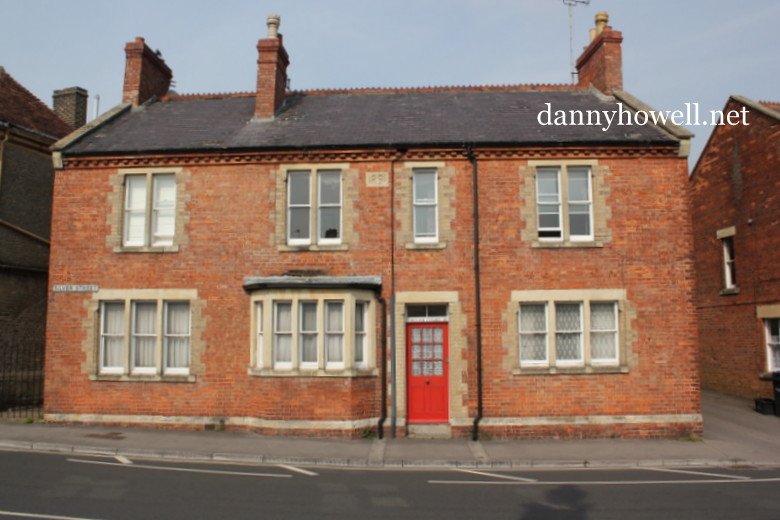
Obelisk Court, at 18 Silver Street, Warminster, photographed by Danny Howell on Wednesday 28th August 2013. This was, up until the early 1984, the Ship And Punchbowl public house.
“A search of records online reveals that Francis Joseph Greed and Nancy M. Greed were married at Warminster in 1954. Their marriage was registered during the quarter April/May/June. Nancy gave two surnames for her maiden name: Awcock and Smith. This immediately suggested to me that she had been married before. I now know that she had indeed been married before to a William C. M. Awcock, who I believe (from internet references) had been a ship’s captain. So I presume that Nancy’s birth surname was Smith.”
“I note from the internet, Edra, that your maiden name was Awcock (Captain Awcock being your father) and that your mother’s maiden name was Kalpakis. So, obviously, Captain Awcock was at one time married to Nancy Smith and later to a lady with the surname Kalpakis. I see from online records that the marriage of William Awcock to Nancy Smith was registered during the quarter October, November, December 1942 in the registration district of Wharfedale, Yorkshire. And I see that the marriage of William Awcock to Edra Kalpakis was registered in the quarter October, November, December 1955 in the registration district of Tynemouth, Northumberland.
From online records too, I see that a Francis Joseph Greed married a Doris R. Combes, in 1934, the marriage being registered in the quarter January/February/March, and in the registration district for Frome Somerset. This may or may not be the same Francis Greed who later ran the Ship And Punchbowl in Warminster.
Then I see (from the internet) that Francis Joseph Greed married Nancy Awcock (Smith) in 1954 at Warminster (as referred to above). I have checked the Warminster Journal newspaper, and strange to say, although Frank Greed would have been a fairly prominent figure in Warminster as a pub landlord, I can see no details for his marriage to Nancy in the marriages column, nor no separate write-up elsewhere in the paper which was usual in those days.”
Online records tell us that the birth of Graeme Awcock was registed during the quarter July, August, September 1943 in the registration district of Wharfedale, Yorkshire.
Danny Howell goes on to say ~
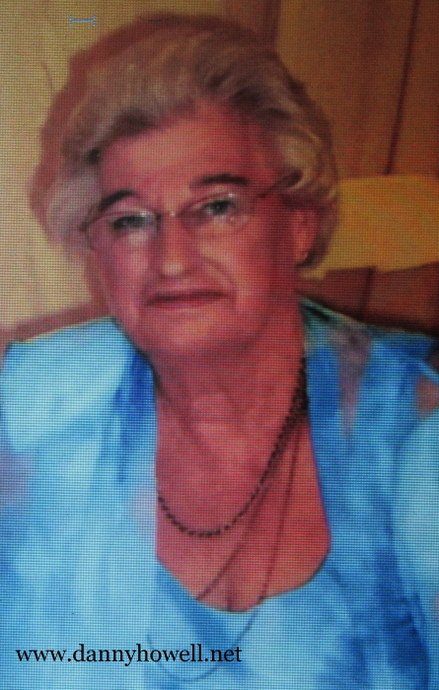
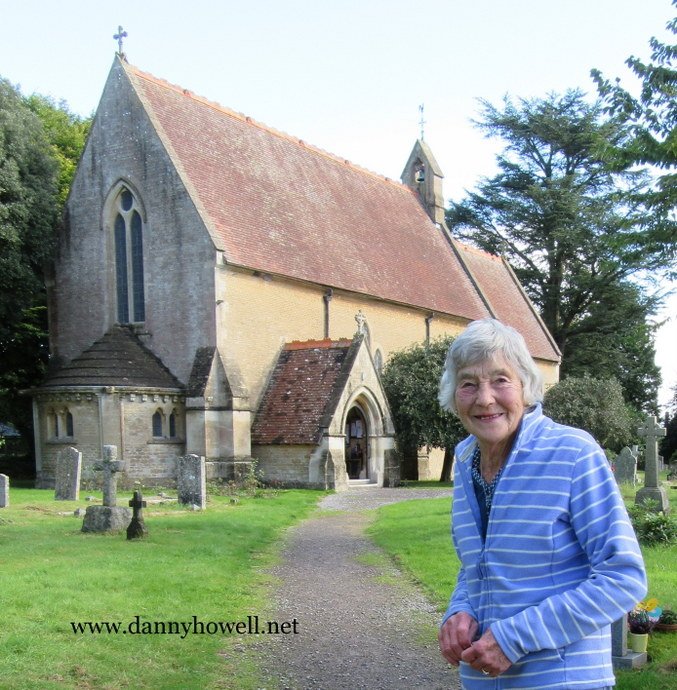
“I have spoken to a lady, born in 1941, who spent her childhood at Obelisk Terrace, the row of houses off the north side of Silver Street, Warminster, which are accessed by the narrow road adjacent the Ship and Punch Bowl. This lady lived at Obelisk Terrace until a few months ago and has now moved just a few hundred yards to her new residence in Silver Street. She remembers the Greeds and has told me the following things.”
This is what the lady had to say ~
“I do remember Frank and Nancy Greed being landlord and landlady at the Ship and Punch Bowl. They were certainly there when I was four or five years old (1945/1946) and were still there in my teenage years. I would say they were at the Ship and Punchbowl until the late 1950s. I never went in the pub so I can’t describe what it was like inside. I was sent down there once to get some cider but I didn’t go in. I went to the little doorway at the side, the jug and bottle. I would say the pub was a very busy place. It was well patronised by the working class. The church bell ringers used to regularly meet in there.”
“Frank Greed was well-built, big and tall. He had dark hair and he was always smartly dressed. Nancy Greed was quite small, short, and her hair was blondish. I can’t say I ever knew much about Mr. and Mrs. Greed. They were a different class, if that’s the word. I mean Mr. Greed, being the landlord of a public house, would have been a prominent figure. He would have been a figure of power. I never came into contact with him. He would have been in the pub, working.”
“Mr. and Mrs. Greed had a bulldog. There used to be a door in the wall, on the left hand side as you went up the lane to Obelisk Court, at the back of the pub. When the lorry used to deliver the beer to the pub, the barrels were rolled in through that doorway to the opening of the cellar. When we used to walk up the lane, we would see the bulldog’s nose pushed under the door, sniffing, as we went by. As children we were always a bit wary of things like that.”
The bricked-up doorway in the wall to the side of the former Ship and Punchbowl, where the beer barrels used to be rolled in; photographed by Danny Howell on Wednesday 28th August 2013.
“Nancy Greed had a son, called Graeme. I always remember the point being made that his name was spelt the Scottish way, Graeme, as opposed to Graham. He was two years younger than me. So he would have been born in 1943, during the war. His name was not Graeme Greed. He was Graeme Awcock.”
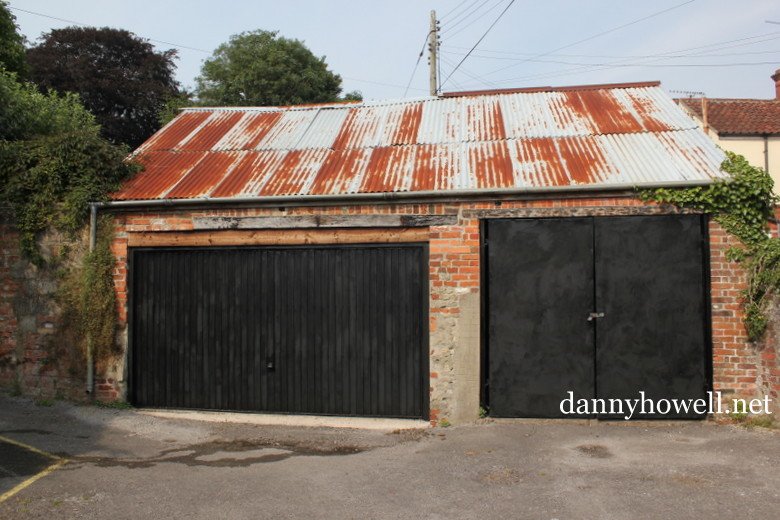
“I used to play with Graeme Awcock and another neighbour Mary Cruse. Mary died when she was 16. We used to play in what is now the little car park behind Obelisk Court (what was the Ship and Punchbowl). That car park now belongs to Adrian Phillips, of Teddington House. But when I was a child that little car park was a yard belonging to Mr. Butcher, the baker, at Silver Street. Frank Greed had a car and he used to park it in that yard of Mr. Butcher’s. Sometimes he parked his car in the tin garage at the top of the yard. He must have rented that garage from Mr. Butcher. Adrian Phillips parks his cars in that tin garage now.”
The garage adjacent Teddington House, photographed by Danny Howell on Wednesday 28th August 2013. It was in this garage, over 50 years ago, that Frank Greed used to park his car.
“I can remember the lorry which delivered the flour to Mr. Butcher’s bakery, would come up Obelisk Terrace and turn round in that yard. I do remember there was a tree near the corner of the yard and Graeme, Mary and me would climb it.”
“I remember too one day when Graeme, Mary and I were going swimming. We were walking down Silver Street with our swimming costumes rolled up in towels under our arms. As we were walking along the pavement, nearly opposite to where Mr. Dale’s shop was, Mr. and Mrs. Greed came along Silver Street in their car. They were going off out somewhere in it. I remember Graeme waving at them but they didn’t wave back. Graeme maybe got a bit upset, well, disappointed about them not waving back. It was quite sad really.”
“Mrs. Greed worked at Warminster School, just along Church Street. She was a matron there, presumably looking after some of the boarding pupils. One of our neighbours, Mrs. Foreman, also worked at Warminster School. Mrs. Foreman would tell my mother about the goings-on at the school and she would talk about Nancy Greed. Nancy’s son Graeme was a pupil at the school I think. I distinctly remember Mrs. Foreman telling my mother how Graeme had ‘miserably failed an exam.’ That was the words she used. I suppose that’s how my mother knew things about Mr. and Mrs. Greed, through Mrs. Foreman. Mrs. Greed and Mrs. Foreman would have chatted together at work, at the school.”
“The last I remember of the Greeds was when Graeme told me he had a book for me, like a comic book. When I went to get it, he said to me ‘I’ve got something to tell you,’ but that’s as far as it went. The next thing I knew, he and his stepfather and mother had left Warminster. I’ve got a feeling they went to Southampton. And for some reason I think Mr. and Mrs. Greed went there to run a Post Office. Or was it another pub? No, why should it be in my head they went to run a post office? I must have had their address in Southampton, because I wrote a letter to Graeme after he left Warminster. Unfortunately my letter was returned unopened, it came back, but I suppose that’s life. I’m sure I heard later on that Graeme had gone to sea, serving in the Navy or something like that.”
“Nancy Greed had nephews and nieces and they used to visit Warminster to see her.”
“Frank Greed’s brother Ron lived at Silver Street, just a couple of doors down from the Ship And Punchbowl. Ron worked up Warminster Camp, at the School of Infantry. Ron was married. His wife’s name was Elsie. She had an old-fashioned plaited hairstyle. Ron and Elsie didn’t have any children. Ron died first. Elsie died later.”
Ronald Greed died on 31st October 1989. He was aged 79. (He was born on 20th August 1910). His funeral service was held at the Parish Church of St. Denys, The Minster, Warminster, and was followed by burial at Pine Lawns Cemetery, Tascroft, Warminster, on Tuesday 7th November 1989.
Ronald’s wife, Elsie Clara Greed, died in December 1998. (She was born on 18th September 1910).
Online records show that Francis Joseph Greed was born on 23rd November 1907, and that he died in 1974, his death being registered in September that year, in the Weston-Super-Mare registration district. There is a brief announcement of his death in the deaths column of the Warminster Journal newspaper, issue dated Friday 13th September 1974. The announcement reads: “Greed. – On September 9th, 1974, Frank, beloved husband of Nancy, passed peacefully away at Weston-Super-Mare General Hospital.”
Danny Howell also writes ~
“I have also spoken to Doug Lakey, now aged 91, who ran the newsagents at Silver Street, Warminster, for many years; the premises of the newsagents being five doors/properties east of the Ship and Punchbowl. Doug well-remembers the Greeds, particularly Ronald, as he and Ronald were great friends it seems.”
This is what Doug Lakey has to say ~
“Frank Greed was the landlord of the Ship and Punchbowl. And his wife was Nancy. I recall that Frank was a tall man. I used to go in the Ship And Punchbowl sometimes. It was a spit-and-sawdust sort of a place. A lot of people used to drink in there. Nancy was ‘a bit posh’. Frank had a car and he let me borrow it once, so that myself and my wife Maureen could go to Ascot Races or the Chelsea Flower Show. I can’t remember which, but I know Frank let us borrow his car for that. I can’t remember what type of car it was. Frank was very popular and very talkative. The previous landlord at the Ship and Punchbowl, Tom Trollope, was prone to tempers and rages. Tom Trollope would get in fights or smash things up; like once he broke up his brass bed. Things like that.”
“Frank Greed had two brothers, Ronald and Norman. Frank was the oldest. The Greeds came from Chew Stoke, near Bristol. I knew Ronald and Norman much more than I did Frank.”
“Ronald lived at 32 Silver Street, between the pub and the newsagents. Previous to living at Silver Street, Ronald lived at Imber Road, and before that he lived at Portway, in one of the cottages on the left-hand side by the railway bridge. Ronald worked at the School of Infantry in Warminster. Ron served in the Glosters in the Second World War, in Burma. Among the things he brought back from Burma were two porcelain flasks. When he died he left one of the flasks to me, and he left the other flask to his next door neighbour, Mrs. Brenda Cruse (who lived at 31 Silver Street). Later on, Brenda decided she didn’t want her flask and she gave it to me so that I should have a pair. I’ve still got them.” (Doug showed Danny Howell the flasks).”
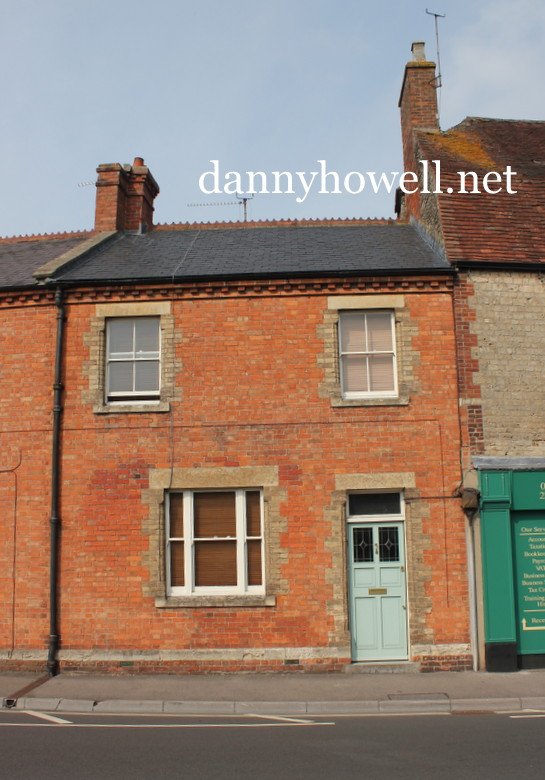
32 George Street, Warminster, photographed by Danny Howell on Wednesday 28th August 2013. This was the former home of Ronald and Elsie Greed.
“I can tell you how good a friend Ron was. Every morning, at 7 o’clock Ron would come out of his house, carrying a cup of tea, which he would bring down to the shop to me. He always did that.”
“Ronald and his wife Elsie often used to invite my wife and I to their place for a meal. The meal was always the same. Ron would say to Elsie ‘We’ll give them a good meal. We’ll do them proud.’ The meal was always ham, chips and peas. Else used to play piano, and she would have a go at teaching my children to play the piano. Ronald and Elsie had no children of their own.”
“Norman Greed lived at Chew Stoke, near Bristol. I would go to Chew Stoke to visit him. He was the boot repairer in Chew Stoke. When he left Chew Stoke, to go to live in Boston, he had an auction sale. I have a dinner service purchased at the sale. It cost £35.”
“The father of Frank, Ronald and Norman, had been a police constable at Porlock. He got some high award for arresting a murderer. Ronald had that medal in his possession in the finish.”
“Ronald Greed died of cancer. He had cancer of the penis. When I used to visit him in hospital, he used to joke about the cancer on his penis. Ron used to say ‘I always wanted a bit extra on the end!”
Ron died at Henford House Nursing Home, Warminster. Ronald’s death is recorded in the deaths’ column of the Warminster Journal, which also published a funeral report.
Danny Howell adds ~
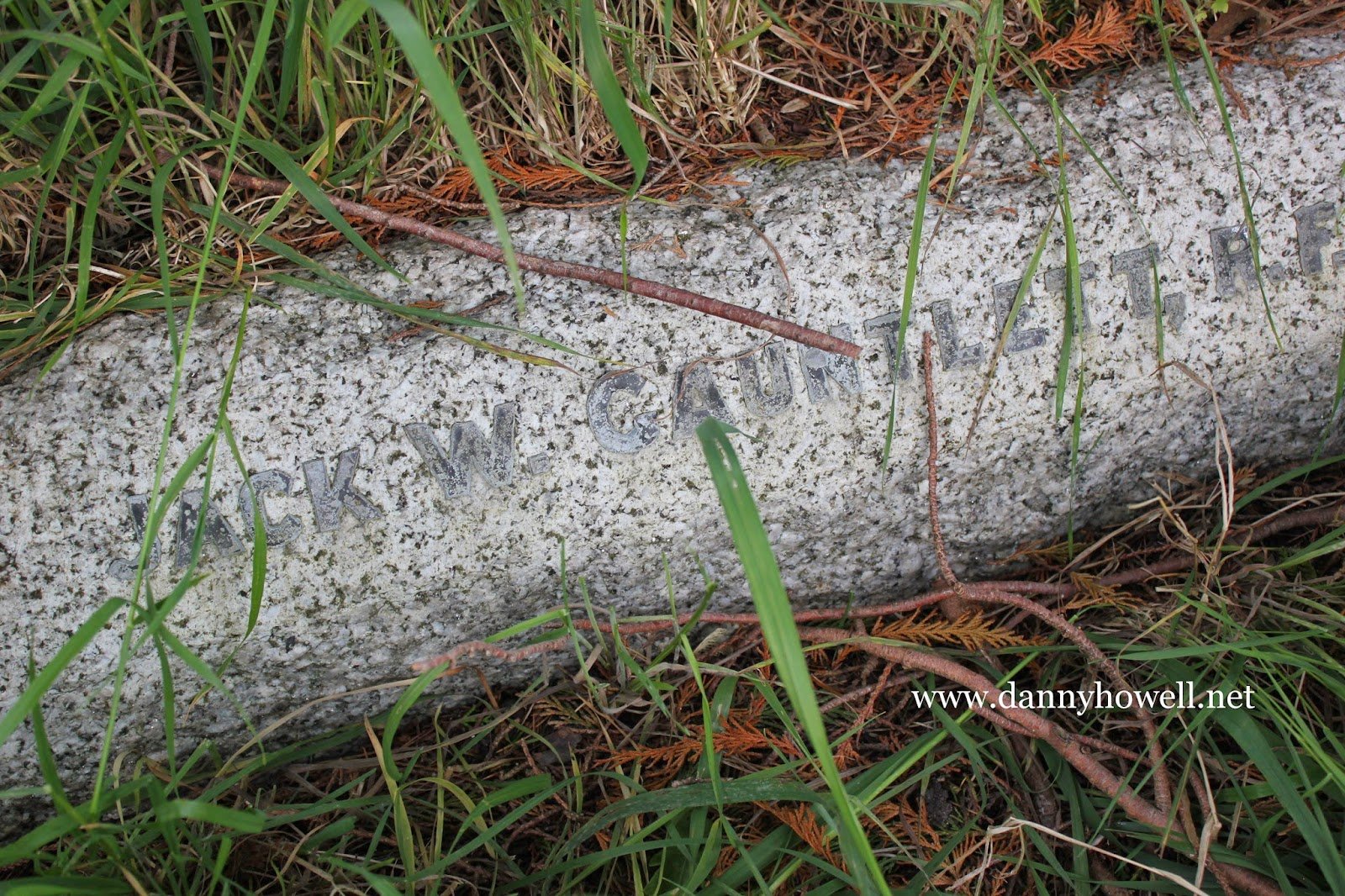
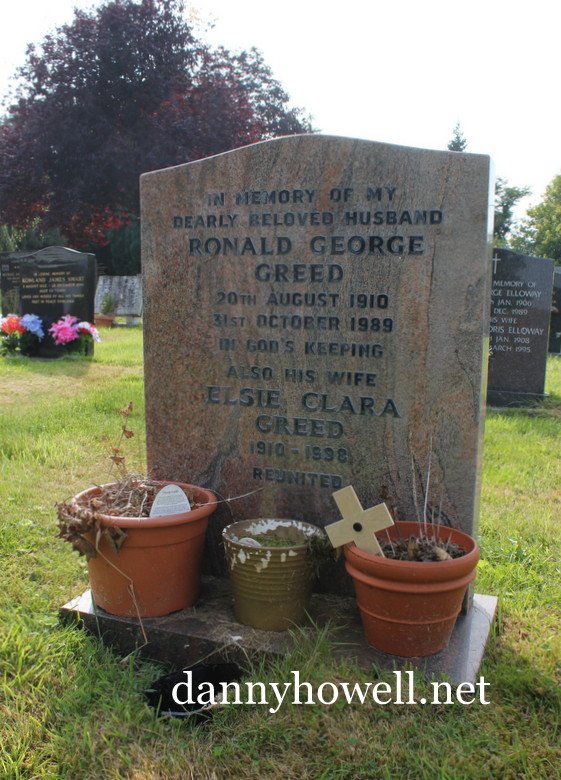
“Ronald and Elsie Greed are buried in the same grave at the Pine Lawns Cemetery, at Tascroft, Warminster. The grave is in Row E, Plot 36. The inscription on their grave stone reads: ‘In Memory of my Dearly Beloved Husband, Ronald George Greed, 20th August 1910, 31st October 1989. In God’s Keeping. Also of his wife Elsie Clara Greed, 1910 – 1998, Reunited.’
“When I visited the grave on Wednesday 28th August 2013, there were three flower pots at the base of the gravestone. One pot contained the dead remains of an abelia grandiflora, another pot contained a blue hyacinth orientalis, and the third pot had a little wooden cross with the word remembrance (the sort with a poppy that commemorates military personnel) but its paper poppy was missing. This cross was obviously put there on or about the time of a Remembrance Sunday, in memory of Ronald’s service with the Glosters.”
The gravestone for Ronald and Elsie Greed at the Pine Lawns Cemetery, Warminster, photographed by Danny Howell, on Wednesday 28th August 2013.
Danny Howell also shares the following information ~
The 1911 Census records the Greed family at Porlock, Somerset, but the census enumerator recorded their surname as Greedy. Living at Lurban, Doverhay, Porlock, are:
Joseph Greedy, head of the household, aged 31, married, police constable, born at East Quantockshead, Somerset.
Nellie May Greedy, wife, aged 29, married, married for six years, 3 children, 3 children living, born at Maldon, Essex.
Clifford Charles Greedy, son, aged 5, born Luccombe, Somerset.
Francis Joseph Greedy, son, aged 3, born Luccombe, Somerset.
Ronald George Greedy, son, aged 7 months, born Luccombe, Somerset.
Joseph Greed married Nellie May Bowtell. Their marriage was registered during the quarter April, May, June 1905, in the registration district of Williton, Somerset.
Nellie May Bowtell’s birth was registered during the quarter January, February, March 1882, in the registration district of Maldon, Essex.
The 1891 Census records living at 110 Wantz Road, St. Peter, Maldon, Essex:
Thomas Bowtell, head of the household, married, aged 38, bootmaker, born at Maldon, Essex.
Eliza Bowtell, wife, married, aged 37, born at Nethersfield, Essex.
Nellie M. Bowtell, daughter, aged 9, born at Maldon, Essex.
It is interesting to note that Joseph Greed and his wife Nellie Greed (the parents of Frank, Ronald and Norman) had their deaths registered in the Warminster registration district. It seems they may have come to live in Warminster, to be nearer their sons Frank and Ronald. It seems they may have spent their final years living with their son Ronald at 32 Silver Street, Warminster. Joseph Greed’s death was registered at Warminster in 1961. He died on 4th September 1961. The death of his widow Nellie May Greed was registered at Warminster during the quarter October, November, December, 1965. She died on 20th November 1965. Probate for Nellie Greed of 32 Silver Street, Warminster, was proved at Winchester on 4th July 1965, to Ronald George Greed, civil servant, the sum of £655.
With regard the mention by Doug Lakey that the father of Frank, Ronald and Norman Greed, had been a police constable who won an award for arresting a murderer, the True Crime Library on the internet (click here to see it) includes the following article, which tells the story of the murder which happened in 1914:
Fatal End To A Feud
Wounded by a shotgun blast, 18-year-old Alice Middleton lay in the lane outside the home of Henry Quartly, a 55-year-old builder living in Porlock, Somerset. When Police Constable Joseph Greedy was told of the shooting, he went to the scene and saw that the girl did not seem to be seriously injured. Then he heard a shot which seemed to come from Quartly’s cottage.
Entering it, he saw nobody about and went quietly up the stairs. On reaching the landing he saw Quartly’s sister pacing a bedroom. “Look out, Mr. Greedy,” she cried, “else he will shoot you too!”
Stepping into the bedroom, Greedy found Quartly hiding in a curtained-off recess and clutching a double-barrelled shotgun. The constable promptly knocked the gun from Quartly’s hand, threw him to the floor and shouted for assistance. Neighbours rushed up the stairs and held Quartly while Greedy handcuffed him.
There was a fresh scar on Quartly’s lip and cheek, his moustache was singed and there was a hole in the ceiling above where he had been standing. Moments earlier he had tried to shoot himself but had missed.
“What have I done?” he asked as he was taken to Dunster police station. “You have shot Alice Middleton,” Greedy told him.
“Oh, no! I didn’t intend it for her. I intended it for “Tacker.'”
This was Henry Pugsley, a 59-year-old fishmonger and Quartly’s neighbour, and Greedy knew there was a long-standing feud between them. What he didn’t know until he returned to Porlock was that the builder’s dispute with the fishmonger had ended.
In the excitement and confusion of Quartly’s arrest, everyone had assumed that the constable knew that the girl lying in the road was not Quartly’s only victim. As Quartly was being handcuffed, Pugsley lay dying a few yards away on a sofa in his home. He had been shot in the shoulder, and two witnesses had seen him stagger into his home, blood pouring from his back, while Quartly stood nearby with a smoking shotgun.
The previous October Pugsley had made a complaint to the police. He said he had been at home when Quartly came in, swearing at Mrs. Pugsley and shouting that he would have sex with her.
Taken before magistrates, Quartly had denied swearing. He said the trouble arose from his friendship with Thomas Heard, the Pugsleys’ young lodger who had told him that 51-year-old Fanny Pugsley had been touching him and making sexual advances. Quartly said he had therefore decided “to speak to Mrs. Pugsley.”
She had told the court that Quartly had said she should leave young boys alone and try to get a proper man.
The case against Quartly had been dismissed, but on June 3rd, 1914, he had received a second summons because Pugsley had made another complaint against him. So that evening Quartly had fired his shotgun at the fishmonger, killing him and also injuring Alice Middleton.
At the inquest Pugsley was stated to have died from shock due to haemorrhage after his right lung collapsed, riddled with shot, and more shot penetrated his liver. Henry Quartly was sent for trial and admitted committing the murder when he appeared at Somerset Assizes.
He was duly convicted, and when asked if he had anything to say he said, “It has all been through his wife. She has been the cause of all this trouble. It was she that began it and left her husband to bear the burden of it.”
Sentencing him to death, Mr. Justice Atkin told him: “You got your gun, went to your garden, and shot him in the high road in front of his house and almost in the presence of his wife.”
“I wish I had shot her. She deserved it,” Quartly interrupted.
He kept his own appointment with death on November 10th, 1914, at Shepton Mallet Prison where Thomas Pierrepoint hanged him.