Simon Fox, Proprietor Of Fox Auto Repairs, Warminster, Has Passed Away

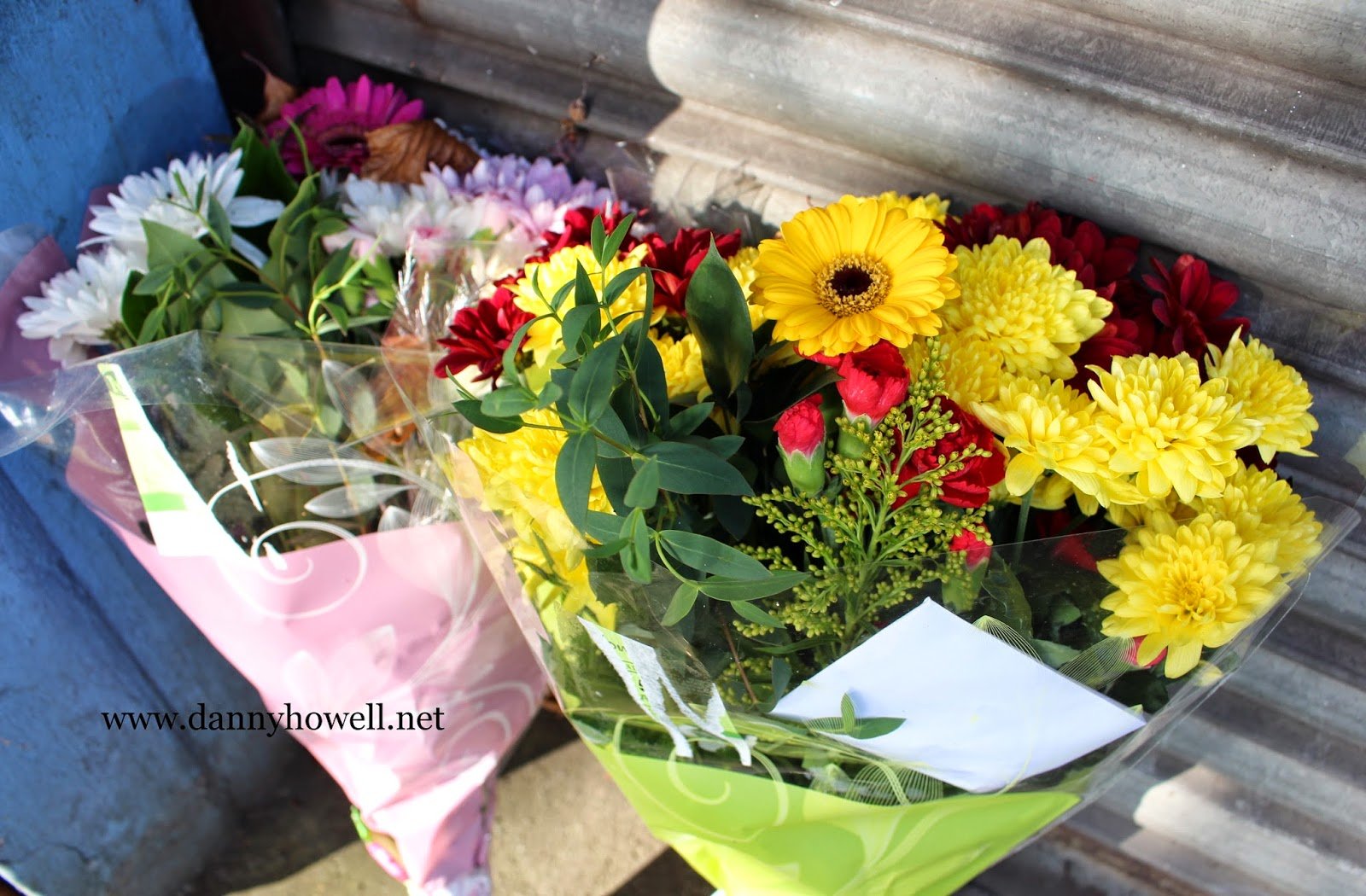
Floral tributes for Simon Fox,
 left outside the Fox Auto Repairs
garage at Woodcock Road, Warminster.

Simon Fox, the proprietor of Fox Auto Repairs
at Woodcock Road, Warminster, passed
away on Sunday 9th November 2014.

The funeral service for Simon, who was 49,
will be held at West Wiltshire Crematorium,
Semington, on Wednesday 26th November 2014
at 11.30 a.m. 
“Wear something red.”
Family flowers only. Donations, if desired, to
Claverton Down Cats & Dogs Home,
c/o F. Curtis & Son, Funeral Directors,
11 Portway, Warminster, BA12 8QG.

Stuart Wants Bryn Edwards To Get In Touch ~ Bryn May Live Or At One Time Lived In Bourne End, Buckinghamshire

Friday 31st October 2014

Two days ago, we featured Stuart Foley’s enquiry about Emanuel Dowdall, and by way of a reply we mentioned a reference by Bryn Edwards on Roots Web, with an email address for Bryn.

Stuart now writes ~ “Bryn and I have got to be related. I have sent him an email but it failed to connect. If Bryn should read this, or someone who knows Bryn reads this, please can they contact me. My email address is stuartfoley@tiscali.co.uk “

We think that Bryn lives or at one time lived in Bourne End, Buckinghamshire.

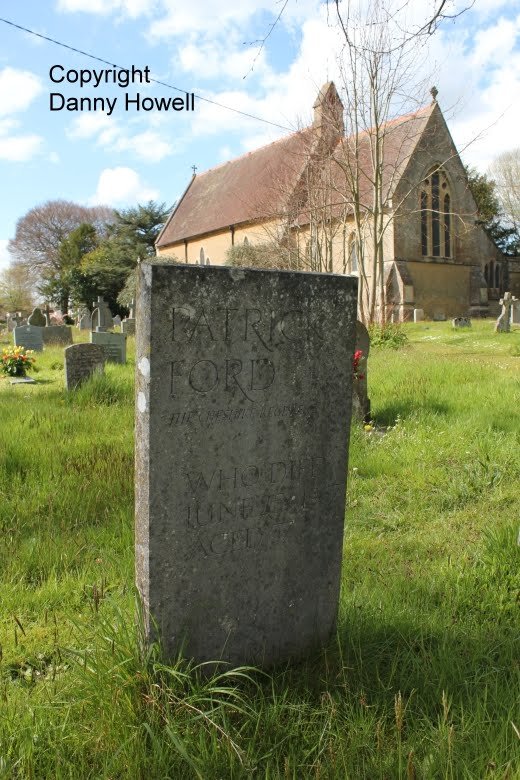
Has Anyone Any Information On The Ford Family Of Chapmanslade?

Saturday 20th September 2014

Brian Jones writes ~

“I’m related to the Fords of Southcot Farm, Chapmanslade – John Ford (1824-1864), son John (1864-1954) and grandson Percival John (1886-1960).  Percival’s wife Ethel died in Sonoma, California, in 1980 – a mystery! I know a little about them and their wonder horse “Rocket” but the trail has gone cold.  Does anyone know anything about this family?”

*John Ford (born 1864) was famous at equestrian events such as those at the Frome Cheese Show during the 1920s, as was his wonder horse “Rocket”.

Contact: dannyhowellnet@gmail.com

Death Of A Heytesbury Fundraiser

Friday 26th April 2013

Margaret Fitch, a resident of St. John’s Hospital, at Heytesbury, has died, aged 74. She passed peacefully away on Wednesday 17th April 2013, at Sutton Veny Nursing Home, after a long illness borne with great courage.

She will be remembered by many in Warminster, from her time as an employee behind the counter at Wilson and Kennard’s, the high-class grocers, whose premises were in the Market Place, Warminster (where the British Heart Foundation Charity Shop and Capelli’s the hairdressers now are). Margaret worked there for Peter Mead.

Following Peter’s death and the closure of Wilson and Kennard, Margaret started up her own shop, a delicatessen called Margaret’s Pantry, near the corner of Market Place and Carson’s Yard, circa 1988. This proved a great success, particularly with the former customers of Wilson and Kennard.

Following her retirement, Margaret devoted much of her time to charity fundraising. For the last few years she co-organised (with Anne Hawkins) the regular Wednesday Coffee Mornings and Raffles, in the Residents’ Hall at St. John’s Hospital, Heytesbury, raising thousands of pounds for local charities and good causes.

Margaret’s funeral service will be held at the Church of St. Peter and St. Paul, Heytesbury, on 9th May 2013, at 11.00 a.m. The service will be followed by a private cremation at the West Wilts Crematorium, Semington. Flowers may be sent to Arthur W. Mays, funeral directors, 52 Warminster Road, Westbury.

Death And Funeral Of Elizabeth Farnfield

Elizabeth Farnfield passed away peacefully on Sunday 27th May 2012 at Henford House Care Home, Warminster, aged 106 (almost 107!). Sadly missed by her family and friends. Cremation will be on Tuesday 12th June 2012, 1.00pm, at Salisbury Crematorium. Family flowers only. Donations if desired for Henford House C/H and others to L.C. Hill & Sons, Funeral Directors, Water Street, Mere, Wilts. BA12 6DZ. Tel: 01747 860361.

Are The Ponton Family Of Longbridge Deverill Related By Marriage To The Artist Harry Fidler?

Friday 25th May 2012

Eric Ponton, who lives in North Yorkshire, is researching his family tree and trying to find out if his family is connected by marriage with the family of the artist, Harry Fidler.

Harry Fidler was born at Teffont Magna in 1851, the ninth of ten children of yeoman farmer William Fidler and his wife Jane Fidler. Harry Fidler spent his early years working on the farm, which no doubt accounts for his later career, painting country scenes, many of which portrayed heavy horses at work on the farm.

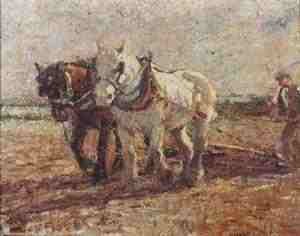
Tilling The Land painted by Harry Fidler

Fidler studied at Herkomer’s School at Bushey (later known as the School of Animal painting), under the famous equestrian artist, Lucy Kemp Welch. Fidler exhibited at the Royal Academy, London from 1891 onwards. He also exhibited at the the Royal Society of British Artists, the New English Art Club, the Goupil Gallery in London, and the Paris Salon.

In 1919 Harry Fidler married a fellow artist, Laura Clunas, and they made their home at the White House, Stoke, Andover, Hampshire, where they lived until Harry’s death in 1935.

Eric Ponton writes ~ My main interest is the Ponton family who were very prevalent in Warminster from about 1680 until the early 20th century. On your site, dannyhowell.net, you have grave locations for some Pontons in Warminster. All of these are my relatives.

In particular I am concerned with Thomas Ponton, born 1787 in Longbridge Deverill. He married Mary Ann Fidler, 11th April 1811, at Longbridge Deverill.

I have traced Mary Ann Fidler’s ancestors back to John Fidler, born 1735 at Great Bedwyn; and I am now trying to ascertain whether or not there is a connection with Harry Fidler the artist. I have had great difficulty in tracing his ancestors and wonder if you have any information which might assist.

If any readers of dannyhowell.net can shed any light as to whether Mary Ann Fidler (who married Thomas Ponton) was related to the family of Harry Fidler, please let us know, by emailing dannyhowellnet@gmail.com

The Life Of Bert Fox

Tuesday 28th February 1984

Herbert Sidney William Fox, who was always known as Bert to his family and friends, was born at Chippenham in 1899. He was the son of Charles Henry Fox, a Chippenham billposter. During the First World War Bert served in France with the Somerset Light Infantry, before transferring to the Royal Army Ordnance Corps. He completed his Army service as Chief Clerk on the Calais train ferry. He met his wife-to-be, Miss Constance Georgina Selfe, at a dance in his home town. She was a labourer’s daughter and was a native of Lacock. After leaving school she worked first as a probationer nurse at Fiddington House, a mental asylum at Market Lavington, and later as a part-time hairdresser at Chippenham.

Bert and Connie were married at the Parish Church of St Andrew, Chippenham, eight months after they had first met, on 19th June 1920. Bert followed in his father’s footsteps and secured a job as a billposter at Warminster. He and Connie, newly-married, set up their first home together at East Street in the former White Swan inn (closed 1907). They lived there and then at 4 Prospect Cottages, also at East Street, until 1940 when they moved to 34 West Parade. They had four children: Alan Herbert, born 9th December 1925; Gordon Eric, born 17th June 1927; Barry; and Joan Constance (Mrs Welsh), baptized 7th April 1921. Alan died of diphtheria, on l3th June1945, while serving with the Royal Navy at Madras, India. He had gained the rank of stoker in charge.

Bert Fox worked as a full time billposter until 1930. He then became an auxiliary postman for 15 years, although he continued to do some billposting on apart-time basis. He was finally employed at the School of Infantry, first as a bar steward and later as head batman. He retired in 1966. Between 1920 and 1934 he was also a retained fireman at Warminster.

Bert was a footballer of some renown and played in most positions for Warminster Town FC from 1920 until the mid-1930s. He was a member of the Wiltshire League Championship side of 1925/26 and was Captain for a year. He also played five times for Wiltshire. After his long soccer connection with Warminster, Bert played briefly for Westbury United before becoming a referee, serving as third man on most of the county’s pitches. He ended his footballing career as a first-class referee.

Bert’s other sporting passion was darts. He and his son, Gordon, were members of the Three Horseshoes team that won the Wiltshire Darts League Championship three years running. Later, Bert, Gordon and Bert’s other son, Barry, were members of the team from the Fox And Hounds that won the same championship. In 1940 Bert won the Spitfire Darts Individual Championship Cup, and also played for the White Hart and the Bunch Of Grapes.

Bert Fox died, aged 73, at his West Parade home on Friday 15th September 1972. Connie Fox died, aged 86, at Sambourne Hospital on 14th February 1984. Both were cremated at Salisbury.

Samuel William Farmer, From Market Lavington

A School’s Adventure by Geo. W. Olive, first published in 1951, relates the story of Dauntsey’s School. The book begins with a photograph of Samuel William Farmer and ends with two appendices about him.

The first is an ‘Extract from Mr Farmer’s Statement,’ and reads:.

“I was born at Market Lavington on November 29th, 1847, attended a village Dames School, kept by my Aunt (my Father’s Sister), till 8 years old. I consider the education I received from her and at Mr Evans, Devizes, was more intrinsically valuable than that received at any other period in my life.”.

“From 1855 to 1863 I was at School at Devizes (Mr Evans) and at the Spa, Melksham (Dr Gilchrist’s).”.

“In January 1863 when I was 15 years old I went to Aberdeen where I attended the Grammar School, King’s College (arts), and Marischall College (Medicine) till 1866. In that year I suffered from severe haemoptysis which continued till 1868 and to a much less degree for several years.”.

“I attained my twenty-first birthday in 1868. My Father was taken seriously ill in November 1868 and died May 1869 in his forty-third year leaving his Executors with two butchering businesses, one at Trowbridge, and another at Market Lavington, also a farming business of about 1,500 acres at Market Lavington, Easterton and Eastcott.”.

“The Executors disposed of the Trowbridge business, and I took over the Lavington butchering business and the farming business at Michaelmas 1869. I had been with my Father during the summer of 1868. I had no knowledge of either business except what I picked up at that time and during his illness.”.

“The years 1869 to 1874 were, considering the size of the business, probably as prosperous as, if not more prosperous than, any I have since experienced.”.

“In 1874 I sold the Lavington butchering business and gave up all the land I had hitherto occupied except the Eastcott Farm. In that year 1874 I married Emily Redman, daughter of William Redman of Coulston. I took the Little Bedwyn Farm and we made Little Bedwyn our home.”.

The second reference to Samuel William Farmer is an ‘Extract from Mr Gauntlett’s Paper.’ It reads:.

“Mr Farmer, I suppose, was the most successful farmer in England; it is a curious fact that his name should be Farmer. Another curious fact is that his main education was taken in Aberdeen at Marischall College, where he studied for a doctor, but his health broke down and he could not take his examinations. At the same time his father was taken ill and died when Mr Farmer was about 20 years old, and left him with two butchering businesses and 1,500 acres of land at Market Lavington near Devizes which he farmed in partnership with my father. He came to Little Bedwyn in 1874 and died here in 1926 and left a fortune of £400,000. He also gave away probably £100,000 besides that. In 1879 seventy-five per cent of the farmers in the country went bankrupt, and Mr Farmer took over farm after farm till he got together about 25,000 acres, 5,000 acres farmed by himself, 5,000 with my father as partner, and 15,000 with Mr Frank Stratton as partner. All this land was arable and taken when everyone else was going bankrupt. He was the pioneer of selling milk to London from Wiltshire, largely produced from arable land till the labour question and prices became more difficult. He milked over 1,000 cows in old barns converted to cow sheds paved with blue bricks which are good today.”.

“He fatted many cattle besides rearing nearly all the cow calves. He also had some 5,000 H.D. [Hampshire Down] ewes which meant 5,000 lambs to be fatted through the summer. This system was carried on until the War when the H.D. sheep gradually went to be replaced by grass sheep. After the War changes came swift and fast. Landlords began to sell and Mr Farmer foresaw great depreciation coming, and instead of buying farms took the opportunity of getting out while prices were high.”.

“His success largely was having two wonderful partners, Mr Stratton and my father, whose delight was good farming. My father had several hard working sons who gave their best. And last but not least he was clever in selecting key men. He worked hard and expected everyone to do likewise.”