
Thomas Davis, Steward Of The Longleat Estate

Some notes handwritten* by Percy Trollope during the early 1980s:

Thomas Davis, whose decease is recorded by a monumental inscription at Horningsham, was born at Penton, near Weyhill, Co. Hants., on the 11th July 1749. His father was for many years an officer in the Excise. He lived at Hindon, and Devizes, in Wilts., and died as supervisor at Wellington in Somerset.

Mr Thomas had a good classical education at Devizes and was taken into the office at Longleat in December 1763 by Mr Simon Jude Cole, who was then steward to Lord Viscount Weymouth. In 1777 Mr Cole returned to Horningsham superanuated, leaving Mr Davis in possession of his apartments and office at Longleat. On the death of the 3rd Viscount, who was created the first Marquis of Bath, in 1789, and died in March 1796, Mr Davis removed the office with his family to Horningsham Manor House, opposite the old Vicarage. [The Manor House was, at one time, occupied by the 2nd Viscount Weymouth, after leaving Longleat. His altar tomb can be seen in the churchyard.] Mr Davis resided at the Manor House, retaining the stewardship of the Longleat Estate, under the 2nd Marquis, until the time of his decease in 1816.

During the last ten years of his life, his abilities as a land agent were called into more general action, as a commissioner under Acts of Parliament for enclosures, and as a surveyor in letting and selling estates throughout the western counties.

He departed this life 10th November 1807, aged 58, surviving only one day after an attack of paralysis, with which he was awfully visited as Court Baron of his noble patron in the Manor of Frome, East Woodlands. His faculties were, up to this time, in their full vigour, and most actively employed for the good of his family and his country. He was buried in Horningsham Church, where a plain mural monument was erected to his memory, bearing an inscription found in his will in his own handwriting.

Mr Davis had issue three sons and three daughters; all of whom, with their mother, survived him. He bestowed liberal education on his children, at the sacrifice of many domestic and personal comforts. With a heart open and kind in all his social duties, he was happy with all ranks of society, even deeper and instructive with his family, beloved and esteemed by all who knew him. His greatest ambition was to be useful, and in his heart made an attempt, both in public and private character, he was eminently successful. To him we owe the statistical account of Wiltshire, which he very deservedly esteemed, one of the best that has been published.

*These words survive in Percy Trollope’s handwriting. Not sure if Percy Trollope wrote these notes himself from information he gathered or whether he copied them from some unknown source. Probably the latter is correct, as it does appear to be very much like the wording of a newspaper obituary.
“The Bishop” Of Warminster Common

In Christ Church, Warminster, The First 150 Years, a booklet published in October 1980, to celebrate the 150th birthday of Christ Church, the Rev. John C. Day (Vicar) wrote:

“The Bishop” Of Warminster Common

In the meantime others had begun to take an interest in the moral and spiritual life of the locals [at Warminster Common]. Notable among these was Mr. William Daniell who devoted forty years of his life to the welfare of the Common residents. He lived in Portway [Warminster], having been born in 1784. As a young man he began to interest himself in the Common and its problems.

A pious gentleman and obviously of some substance, William Daniell, and a Mr. James Ludlow joined forces in 1827 to build the small chapel in Chapel Street (now, alas, in a stare of decay) which was to become a hub of religious and social work in the district until Daniell’s death in 1860.

William Daniell was an interesting character. He was the self-styled minister of his chapel, he fought long and hard for the welfare of the Common residents, but he could be harsh in his treatment of beggars. He wrote a long and strange book about his work called ‘The History of Warminster Common’ in which he is critical of the Anglican Clergy of the town and very critical about the building of Christ Church, which he reckoned had been done out of spite following so soon after the opening of his own chapel. Daniell was called the Bishop or Apostle of Warminster Common. In his early years this was a derisory title but later one acknowledging the great work he had done in the field of social reform among the less fortunate, as Assistant Overseer for the Poor, as leader of his chapel and later as Registrar of Births and Deaths for the district.

But not only William Daniell had his conscience aroused. Others like William Dalby who came to the town as Vicar of St. Denys in 1826, were also led to consider the plight of the poor on the Common. Thus did the influence of religion become in its turn the influence for social reform.

Before we leave the Common we should perhaps say a little more about its chapel. According to the records a poor woman, Sarah Foreman, gave a piece of land and the owner of the adjoining plot offered it for sale, providing the site for the Common’s first place of worship. On April 3rd, 1827, the foundation stones were laid, the first by a James Bond, the second by a Stephen Payne, and a third by William Daniell, and a fourth by a John Hawkins. The Chapel opened in January 1828 under the supervision of nine trustees. In August 1885, a cottage on the west side of the chapel was pulled down and work began on the building of a schoolroom for the chapel.

With attention being focussed on the Common following William Daniell’s work and the influence of William Dalby, life began to change for the better there. In March 1833 (following a cholera epidemic) a drainage scheme for the Common was started.

In October 1834 the streets and lanes of the Common were given names and lit by gas, and in June 1849 a new piped water supply was installed. Before-times the stream flowing from Cannimore had been the all=provider of water for the residents and also the receptacle for much of their sewage waste, and it is no wonder that disease was rife in the area.

This programme of change in those early years of the last century sets the scene for the thought and planning which led up to the building of Christ Church.

Ignorance And Snobbery – Common Close

December 1949

Local historian Harold Nelson Dewey, J.P., (born 1888, died 1971), who served on Warminster Urban District Council for 49 years (from 1919 to 1968) and was its Chairman on three occasions, as well as being the Headmaster of the Avenue School from 1931 (when the school was built) until 1953 (when he retired), in an address given to the Warminster Chamber Of Trade in December 1949, said that the ignorance and snobbery of some people had been responsible for the word “common’ being removed from the street name Common Close – in similar vein to Warminster Common being re-named Newtown. He said people didn’t understand that the word “common’ was not necessarily to do with things which were vulgar. He noted that the word “Close’ had been retained in the new name for Common Close, even though the road had been opened up by the demolition of the Ship Inn and was no longer a close. He thought this sort of thing was very regrettable.

Residents In Warminster, Surnames Beginning With D, 1922

1922
Private residents in Warminster,
Surnames beginning with D.

Albert James Dale, 12 Silver Street.

Francis William Dale, 33 High Street.

Caleb John Daniell, Hampton House, Deverill Road.

Miss Mary Daniell, Fernside, Portway.

William John Daniell, The Laurels, Bread Street.

Frank Edgar Davis, 31 George Street.

Joseph Spencer Davis, Newtown Lodge, Upper Bread Street.

Miss Catherine Davis, 12 Deverill Road.

Miss Davis, Somerville, 62 Boreham Road.

Robert Davis, 10A High Street.

Charles Harold Day, 89 Pound Street.

George Day, 59 Pound Street.

H. Day, The Bungalow, Imber Road.

Henry George Day, Inverilot, Portway.

John Giles Day, 3 High Street.

Sidney Day, 11 Ash Walk.

Eustace Edward Dent, 22 Portway.

William Denton, 4 Park Cottages, Boreham.

Albert Charles Dewey, Flora Cottage, Emwell Street.

Charles Dewey, Providence House, Imber Road.

Charles Dewey, 27 Victoria Road.

Harold Nelson Dewey, 18 Imber Road (apartment).

Richard Dewey, 28 Vicarage Street.

Arthur William Dicks, 24 Deverill Road.

Charles Dicks, 37 Boreham Road.

Rev. Henry Lancelot Dixon, M.A., Prestbury, Boreham Road.

Ernest Thomas Dodge, 1 and 2 Fore Street.

Walter Henry Dodge, 6 George Street.

John Doel, 5A East Street.

Mrs. Doel, 82 Portway.

Francis Henry Dolman, 13 Boreham.

Mrs. Edith Douglas, Ivy Lodge, East Street.

Albert John Dowding, Smallbrook Farm.

Miss Dowding, 46 Church Street.

Alfred Edwin Down, 12 Boreham.

Mrs. Frances Down, 43 Market Place.

Augustus Hugh Draper, 89 Portway.

John Dredge, Teddington House, Church Street.

Harry Dunford, 21 North Row.

Miss Mary Dutch, 23 Church Street.

Harold Nelson Dewey Elected To Warminster Urban District Council

From a list of items in Harold Nelson Dewey’s diaries 1919-1947 (list made by Percy Trollope):

Saturday 5th April 1919

Mr. Dewey elected for the first time as a member of Warminster Urban District Council. Second place in poll results. 265 votes.

Boot And Shoe Dealer’s Daybook, Possibly Hubert Dodge Of 6 George Street, Warminster, 1897-1908

The Wiltshire And Swindon History Centre, at Cocklebury Road, Chippenham, Wiltshire, SN15 3QN, holds the following document:

Boot and shoe dealer’s daybook. Possibly Hubert Dodge of 6 George Street, Warminster. 1897-1908. Reference 2102/1.

The Death Of The Rev. John Jeremiah Daniell, Curate Of Warminster (1871) And Author Of ‘The History Of Warminster’

Saturday 3rd December 1898

The Rev. John Jeremiah Daniell (born 1819), who wrote several books including The History Of Warminster (published in 1879), was Curate of Warminster (1871), Curate of Wilton (1872 – 1877), Vicar of Winterbourne Stoke and Berwick St. James (1877 – 1879), and Rector of Langley Burrell from 1879 to his death in 1898. He died at Langley Burrell, Wiltshire, on 27th November 1898.

His obituary reads ~

The Death Of The Rev. J. J. Daniell
The Warminster Historian

The inhabitants of Warminster will learn with deep regret the death of the Rev. J. J. Daniell, the respected rector of Langley Burrell, which took place at his residence on Sunday morning last. The deceased, who had reached the advanced age of seventy-nine years last month, suffered from no disease, and as recently as a fortnight ago he conducted the services in his church. His strength, owing to advancing years, has of late gradually become less and less, and last week he was confined to his room. He was attended by Dr. Briscoe, but medical skill could not give increased strength to a rapidly failing constitution. On Saturday night he became unconscious, and at half-past ten o’clock on Sunday morning (Advent Sunday), as the bells of the Parish Church were calling worshippers together to God’s house, his Master called him to that “house not made with hands eternal in the heavens.” There was no man more beloved by his parishioners than the Rev. J. J. Daniell, whose kindness of heart and truly Christian spirit were examples to those amongst whom he lived.

The rev. gentleman, who belongs to an old Warminster family, being the son of the late Mr. Jeremiah Daniell, was in 1871 curate at Warminster Parish Church, during which time he won the respect of all who knew him, and he visited the town as recently as the laying of the foundation stone of the new St. Boniface College. During his curacy of the parish he did much good work for which his memory will be ever green, and he resigned to become tutor to H.R.H. Prince Higashi, the heir presumptive of the Japanese throne, who, with his suite, resided for some years at Boreham Villas, and we feel sure the instruction imparted to the Prince by the rev. gentleman during his stay in Warminster has not been without its effect in the rapid developments of Japan which has taken place in recent years. During the time Mr. Daniell was in the town he collected many valuable and interesting particulars about Warminster, which he afterwards published as The History of Warminster, while vicar of Winterbourne Stoke, a book which is highly praised by  the inhabitants.

Mr. Daniell entered the Church upwards of fifty years ago, and during that time, in addition to his residence in Warminster, he did duty at Winterbourne Stoke, Berwick St. James, Wilton, and Langley Fitzurse. For the last nineteen years of his life he has been rector of Langley Burrell, in the Parish Church of which he has left a monument which will record his veneration and attachment to that sacred edifice. The deceased was a well-known historian and antiquarian, and amongst the numerous works he published were histories of Chippenham, Warminster, and Cornwall, and also the geography of the last named. But his most important work was the life of George Herbert, published by the Christian Knowledge Society, and only within the last few weeks he published some illustrations in a new edition of the same work. He has just issued, through Messrs. Houlston and Son, of Chippenham, a book of verses, which he composed during his lifetime, and which show considerable merit. Mr. Daniell arranged that the profits from these verses were to be devoted to the church restoration fund. The funeral took place on Thursday afternoon at Langley Burrell, the remains being laid in the same vault where his wife was buried a few years ago. The deceased’s brother has been living with him for the past few weeks, and there is much sympathy with him in his bereavement. 

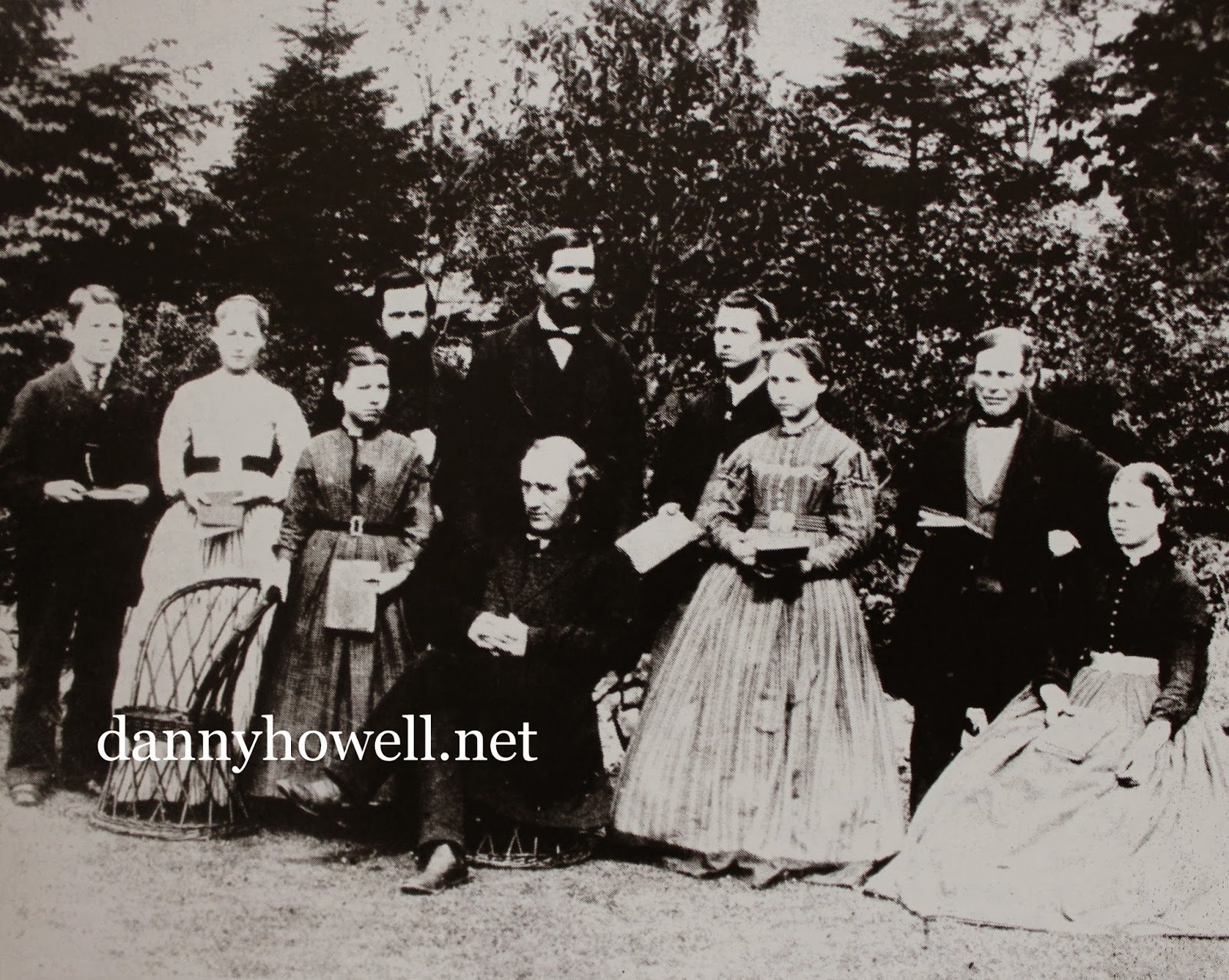
The Reverend John Jeremiah Daniell
(seated at the front).